
Rhode Island PBS Weekly 8/27/2023
Season 4 Episode 35 | 26m 45sVideo has Closed Captions
Brilliant photography of lighthouses and glittering vintage costume jewelry.
Weekly takes another look at local photographer David Zapatka as he captures lighthouses in a way that’s never been done before. Then, Pamela Watts explores Providence’s history of costume jewelry. Finally, we take another look at Newport International Polo Grounds and capture announcer William Crisp, who is on a mission, through passion and sarcasm – to elevate the equestrian competition.
Problems playing video? | Closed Captioning Feedback
Problems playing video? | Closed Captioning Feedback
Rhode Island PBS Weekly is a local public television program presented by Ocean State Media
Rhode Island PBS Weekly 8/27/2023
Season 4 Episode 35 | 26m 45sVideo has Closed Captions
Weekly takes another look at local photographer David Zapatka as he captures lighthouses in a way that’s never been done before. Then, Pamela Watts explores Providence’s history of costume jewelry. Finally, we take another look at Newport International Polo Grounds and capture announcer William Crisp, who is on a mission, through passion and sarcasm – to elevate the equestrian competition.
Problems playing video? | Closed Captioning Feedback
How to Watch Rhode Island PBS Weekly
Rhode Island PBS Weekly is available to stream on pbs.org and the free PBS App, available on iPhone, Apple TV, Android TV, Android smartphones, Amazon Fire TV, Amazon Fire Tablet, Roku, Samsung Smart TV, and Vizio.
Providing Support for PBS.org
Learn Moreabout PBS online sponsorship(uplifting music) - [Announcer] Tonight on "Rhode Island PBS Weekly."
- [Michelle] Your eyes are not deceiving you.
Still, don't expect this starry sky to look quite like this in person.
- The camera sees more than our eyes can see.
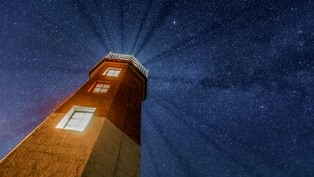
So when you're standing here looking at Beavertail Lighthouse in the middle of the night, the Milky Way is there, and you can barely see it with your eyes, but the camera can see it better than you can because it's seeing in this long exposure.
- This is the holy grail for us where we have the original sketch, we have the original bronze molds that this piece of costume jewelry was made in.
And then we find a piece on the market that came from it.
We have all three, and for us, this can't speak any louder for what went on in the city of Providence.
- Stuart trying to run past him.
He's got past him.
He's got control of this ball as he run it through the goal.
Wow, talk about control.
I'm William Crisp, and I'm the announcer for the Newport International Polo Series.
(horse snorts) It's not that funny.
(uplifting music continues) (uplifting music continues) - Good evening.
Welcome to "Rhode Island PBS Weekly."
I'm Michelle San Miguel.
- And I'm Pamela Watts.
Tonight we begin with a story about some of the country's most iconic beacons, lighthouses.
- For centuries, lighthouses have guided ships in and out of harbors, warning of shallow waters and rocky coasts.
For several years now, a photographer in North Kingstown has turned his camera on lighthouses up and down the East Coast as we first reported in September of 2021.
While countless photos have been taken of these majestic, often life-saving pillars of light during the day, David Zapatka takes the images long after the sun has gone down.
- If you think of a lighthouse, it does its work at night primarily.
To not have that recorded in history is a shame.
- [Michelle] David Zapatka has been recording history for more than three decades.
He's an award-winning videographer, but his biggest project yet has him picking up his still camera.
- And I didn't realize that this was a project 'til I was 15 or 20 lighthouses in, and that's when I was doing more research on more lighthouses, realizing, wow, there's no pictures of this lighthouse.
- [Michelle] Zapatka is the president of the Friends of Plum Beach Lighthouse in North Kingstown.
He's long been mesmerized by lighthouses, not just by how they look, but by their history.
- But there are so many others with these great stories behind them.
- [Michelle] Since 2013, he's photographed more than 175 lighthouses in the United States including many on the eastern seaboard.
- Oh, we got stars.
That's a good thing.
- [Michelle] His goal, to capture every working lighthouse around the country at night.
The idea came to him while he was out boating with his wife on Narragansett Bay.
- So we're anchored off Dutch Island, and I said to my wife, "Wouldn't it be cool to see if I can get shots "of the Dutch Island Lighthouse at night under the stars?"
- [Michelle] Zapatka says it's a photography project that hasn't been done before.
- What the digital camera has allowed us to do was to open up to photographers this whole new field of shooting when the sun goes down.
So these are the slick ones.
They're not too bad 'cause the tide is on the way in, so they're a little bit dry.
- What you can't see in Zapatka's photos are the great lengths he goes to in order to capture these images.
It's not a stretch to say you're putting your life at risk on some of these shoots.
- Early on, I realized that it's dangerous at night.
Almost there.
A little bit further out, then we get the reflection.
That's always the bonus.
- [Michelle] Zapatka often wades knee deep into water to take a photo.
On the night we went with him, it was this one, the Ned's Point Lighthouse in Massachusetts.
Other lighthouses are only accessible by boat.
To get an image like this, Zapatka put his 20 foot tripod in the water.
- So I can launch it off a boat, stick it down in the water, and get a shot of the lighthouse from the water that you couldn't normally get 'cause your camera has to be completely steady for 20 seconds during new moon phase.
- [Michelle] Arriving at night to these lighthouses is not for the faint of heart.
Zapatka and his friend Sean found that out on a trip to Thacher Island to capture twin lighthouses.
- We're like right by the lighthouses.
They're like right there.
It's like, there they are.
Let's keep going.
Let's shoot it.
So we tie the boat off at a mooring, and now we're facing into the wind, and now waves are coming over the bow of my 15 foot Boston Whaler, and it's all hell's breaking loose.
The water's coming over.
It's filling the back of the boat.
We're getting hit by wind.
I'm at the bow of the boat like getting slammed, and I'm like, "You know what, Sean?
"We gotta go."
And he was like, "Dave, you know, I'm with you man."
- [Michelle] Never one to give up, he came back another night and captured the twins in all their glory.
Behind every photo are a host of safety measures from a helmet with a headlamp to a personal radio beacon in the event of an emergency.
- Oop, that's slick.
(chuckles) Just when you think you're done.
- [Michelle] Even though he puts himself in some precarious situations, Zapatka says he is not a reckless risk taker.
- But the thrill is I'm creating this history right in front of my eyes that no one's ever done before, and it's all going to be available through the United States Lighthouse Society.
- [Michelle] Whether it's the Borden Flats Lighthouse in Massachusetts or Sanctity Head Lighthouse in Nantucket, photographing a lighthouse at night requires more than a skilled photographer and a good camera.
Zapatka times his photo shoots around the lunar calendar.
- So now, here's what you need, New moon or close to it, low tide, slack tide, which means the tide is stopped, and no clouds.
So- - Anything else?
- So why do you think it's taken me eight years to do only 175 lighthouses roughly?
Because some of those conditions are so specific that you have to be patient to get that shot.
- [Michelle] And when it comes to patience, Zapatka has plenty of it.
- When I first started, I was self-teaching myself night photography, and I knew there was a thing called light painting.
We just use a flashlight.
So if you show up at Beavertail Lighthouse and it's dark and it's night, you can light the lighthouse just with using a flashlight by waving it back and forth.
And I did that originally at Beavertail.
- [Michelle] He had already shot about a dozen lighthouses when he realized he could also use his battery powered television lights.
- I use those dimmed down to almost nothing.
You could barely read by these lights, but over the sensitivity and the long exposure that I've created within the camera sensor, that light goes a long way.
- [Michelle] Your eyes are not deceiving you.
Still, don't expect this starry sky to look quite like this in person.
- The camera sees more than our eyes can see.
So when you're standing here looking at Beavertail Lighthouse in the middle of the night, the Milky Way is there, and you can barely see it with your eyes, but the camera can see it better than you can because it's seeing in this long exposure.
- Zapatka's photography collection was published in his first book in 2017, "Stars and Lights: Darkest of Dark Nights."
Last year, he released the sequel, "Portraits from the Dark."
The project has been adopted by the United States Lighthouse Society and will live in their archives.
But you're hoping to take this RV to Michigan, to Florida, Ohio, all over the country?
- Yeah, farther and farther away.
- Zapatka has driven up and down the East Coast in this RV photographing lighthouses, but he says the effects of climate change with rising tides present a real and present danger.
The work you're doing is really a race against time.
- Totally, and on many different levels.
And talk about levels, the levels of the Great Lakes last year were higher than they've ever been.
They're down again this year, but if it gets higher again, there are several lighthouse that are threatened because the foundations will just start crumbling, and potentially those lighthouses could just fall into the lake.
- [Michelle] It's with that sense of urgency that Zapatka approaches his work.
- [David] To me, it has called out and said this needs to be done.
And so I guess I'm the person to do it.
- Up next, it was Shakespeare who coined the phrase, "All the glitters is not gold."
Here in Providence, it was gold plating that helped crown the city the Jewelry Capital of the World, but as we first reported back in April, it goes much further along than the fancy broaches and necklaces turned out by hundreds of factories here during the mid-century.
We recently met one local man who is determined to preserve the city's glittering past for people of all ages who are discovering what's old is new again.
In an old industrial building in Cranston, non-descript outside, the charm of bangles and baubles gleams inside.
- Well, if you look at this, this really amazing pin from the 30s- - [Pamela] Peter DiCristofaro has a master collection spanning two centuries.
It captures the innovation, creativity, and culture of craftsmanship that molded the Capital City.
- This is the holy grail for us where we have the original sketch, we have the original bronze molds that this piece of costume jewelry was made in, and then we find a piece on the market that came from it.
We have all three, and for us, this can't speak any louder for what went on in the city of Providence.
- [Pamela] Providence, the gem of the jewelry industry and kings of costume jewelry.
- The processes were brilliant, the pieces were beautiful.
Who cared that they made 1,000 of them?
- [Pamela] And the locally engineered machinery that cranked out affordable fashion accessories.
- And they came up with these magnificent American-built machines.
Whereas now instead of making an inch a minute of chain, they were making 12 inches a minute.
I'm the archeologist.
I dug the hole and found it.
I didn't go to archeology school.
- In fact, DiCristofaro went to pharmacy school, but turns out, he had real chemistry with another element, gold.
How did you become bedazzled by the jewelry industry?
- My summer jobs were in a family jewelry factory.
Every summer, I'd go to pharmacy school, learn chemistry.
I'd go to work in the summer and learn how to make jewelry.
And by the time I was done with pharmacy school, I was interested in the jewelry.
I wasn't interested in pharmacy.
Then we cookie cut out the excess silver.. - [Pamela] DiCristofaro spent many hours in his uncle's factory like so many Rhode Islanders.
- And what you're left with is the stamping all trimmed out.
When you think of 30 or 40,000 people making their living in one little industry, in one little city - In one little state.
- In one little state, it's pretty profound.
- [Pamela] It was DiCristofaro's uncle who urged him to salvage the remains of the industry as jewelry manufacturing migrated overseas in the late 1970s.
So he founded the Providence Jewelry Museum.
- I personally bought over 150 jewelry companies, and then I attended the liquidation of the end to another 100.
It's when they were closing the factories, we would buy them, and then we would always take something for the jewelry museum.
- [Pamela] His museum chronicles the origins of the industry starting in the 1700s with silver spoons made by Seril Dodge who worked and lived in the brick building that is now the Providence Art Club.
Dodge's company then designed something that radically transformed jewelry making.
- In Providence, we took a piece of gold, we put it on a piece of metal of lower value, made a sandwich, and made that cladding of gold.
It all happened here.
It was the first merchandising of gold in American history.
(machine clacks) And with the cladding of metals, they could take orders from around the world.
- [Pamela] That cladding or gold covering of non-precious metal, rolled gold, gold-filled, and ultimately electroplating and stamping brass made Providence shine.
In the late 1800s, many immigrants brought old world artistry to the factories.
Companies tinkered with technology, developing cutting edge tool and die equipment.
A real boom started in the 1930s and peaked in the 70s.
- My grandmother came from Italy.
She didn't have the money to have a brooch like Queen Elizabeth, which was worth $10 million, but she had $10 to go to Woolworth's and buy an imitation of it.
- [Pamela] DiCristofaro is an encyclopedia of jewelry stories.
He says one Providence company, Ostby and Barton produced the molds, known as hubs, for Tiffany's iconic diamond Solitaire engagement ring.
- It became the rage and the volume.
And where did they come to have this ring made?
They came to Providence, Rhode Island, and there's the original hubs that made the ring.
- [Pamela] In 1912, Tiffany's relationship with 64 year old Engelhardt Cornelius Ostby, the company's co-owner, came to a tragic end.
- [Peter] Mr. Ostby put his daughter on the lifeboat, and he went down with the Titanic.
- [Pamela] Decades later, Ostby and Barton's connection with Tiffany's came full circle when DiCristofaro enticed Tiffany & Company to establish a manufacturing plant in Cumberland.
- In 2001, those two hubs went back to Tiffany, their new factory in Rhode Island, and they copied them.
And today they make that engagement ring in the Tiffany Rhode Island factory from those two originals.
- Today, they also make their popular heart tags here along with coveted items like the Vince Lombardi Super Bowl trophy.
What can you tell me about this bracelet?
- Oh my God.
- [Pamela] I asked him about my grandmother's bracelet.
- You have two colors of gold or gold clad.
You have rose, and you have green.
It was made like a fine piece of jewelry even though it's clad metal.
And I guarantee you it was made in Providence.
- [Pamela] Now DiCristofaro wants to return to Providence its golden legacy, moving his museum to Chestnut Street downtown, the heart of the once flourishing Jewelry District.
He's renting and renovating the 1826 Palmer House where at one time gold rings were made.
- A jewelry factory on every corner and every inch, names that the whole world recognizes like Coro, Trifari, Monet, and Hedison.
- These little fine necklaces are very hot with young people.
These happen to be made by Hedy, which is Hedison, made in Rhode Island.
- [Pamela] Christine Francis owns Carmen & Ginger.
a retro jewelry store.
Originally located in Providence's Arcade, she's setting up a new larger shop in Warren.
Francis says vintage is en vogue, especially among millennials and Gen Xers.
Is it because the sustainability?
- I think that's part of it, yeah.
They're very mindful of not being wasteful and using things, you know, for years.
I think it's the uniqueness, you know.
I think we have a generation that doesn't really wanna look like everybody else.
The nice thing about costume jewelry is, you know, you walk into a store and generally it's one of a kind, you know, you're gonna see one thing.
They can come into a secondhand store, a thrift store, a vintage store, an antique store, and find something that's much better made than what's at the mall, and way more interesting that's than what's at the mall.
- What's most popular among the things that you have?
- This organic sort of trend of birds and flowers and butterflies.
In the 70s, they were popular, and they're popular again now.
- Well this Johnson & Wales building, most people don't know it was the largest jewelry factory in the world in the 1800s.
They made rings and pins.
They even made thimbles for women to sew with.
- [Pamela] College students have now transformed the old Jewelry District into the Knowledge District with Johnson & Wales and Brown Medical School, among others, taking up residency.
Back at the Palmer House.
- And it's in that piece of steel that we press the silver or gold to make the piece of jewelry.
- [Pamela] DiCristofaro is planning education workshops at the Providence Jewelry Museum to offer a chance for the next generation to touch the richness of Providence's gilded past.
- They don't have to know everything I know.
They don't have to learn to be jewelers, but if they come and experience what we do in our workshops at the museum, they're gonna take a bite of what I call the tactile qualities of man.
You're looking at something, it gets bent, it gets turned, and before you know it, it's on your finger as a ring.
It's brilliant.
Most people think this stuff came down from heaven.
(Pamela laughs) They've never seen it made.
- Finally, tonight, we take you to Aquidneck Island where we hear that one Englishman is flying the flag for a relatively obscure sport.
Back in June of 2022, senior producer Justin Kenny spent several weekends in the commentator's booth at the Newport International Polo grounds to capture one man's mission through passion and sarcasm to elevate the equestrian competition to new heights.
- Just tapping it around.
Dan Keating waiting to try and get to him.
Stuart trying to run past him.
He's got past him.
He's got control of this ball as he run it through the goal.
Wow, talk about control.
I'm William Crisp, and I'm the announcer for the Newport International Polo Series.
(horse snorts) It's not that funny.
Now Backhand Oskie.
Oh, he's a miss.
A rare miss from Oskie.
Chris couldn't get it.
Rory Torrey picks it up.
Stuart on the gray pony goes to cover him.
Polo's just most amazing sport that requires horses.
You can play indoors, so an arena polo, which is three a side, or outdoors, which is four a side.
And each person rides a horse, and you try and hit a little white ball with a bamboo stick that's like 50 inches long with a wooden head, and the ball is made of a hard plastic.
It's about three and a half inches in diameter.
So not the biggest thing to hit when you're galloping along on a horse.
And then the opposition are allowed to bump into you on their horses, and they're allowed to hook your stick too.
So it's quite active, and you've gotta get your horse to the ball.
And once you get there, you've gotta hit it.
Chris tries to overcut it, runs over the top of the ball.
Minnie trying to get to it.
She's pushing hard.
Put your stick down, Minnie, there we go.
Unfortunately, comes off Bullus.
Stop the appealing.
Get the hitting going on.
Roger Soto misses the backhand.
Chris Fragomeni, are you kidding me?
He's got a tough pony he's on.
Ah, Lucio gets in the way.
It's there.
Marguerite, ooh, she was looking at the goal, not at the ball and missed the ball.
I was lucky enough to be playing in England, and somebody said to me, "Hey, William, you wanna go to Newport?
"They've asked for a team from England."
Well, yeah, sure.
So I ended up captaining or bringing the team from England in the very first year.
So that was 1991, 1992.
And I fell in love with Newport, as you can imagine.
I'm still in love with Newport.
I still call it my hometown.
I fell in love with one of the local ladies and basically never left.
Sends a lovely shot towards the goal.
It's left there for someone.
Dan Keating gonna try and clear it.
He doesn't.
Rory Torrey does.
I think it's got a bad rap, the name polo.
I think a lot of people, polo is like this, you know, the kings play it or something.
It's got a posh rap.
But you come to Newport, it's not posh at all.
It's really down to earth.
The people who are playing, I mean one of our players is a waiter.
You know, we've got all sorts.
One, you know, is a general contractor.
Your stick down, hook it.
There we go, pressure.
Chris Fragomeni, nice backhand.
Anybody onto that?
Stuart Campbell.
Minnie's got the right.
Minnie's got it.
And Minnie's gonna unload this ball if she can.
So we have a lot of women play polo, a lot of ladies.
Two weeks ago, three weeks ago, we had the ladies versus the men, and the the ladies won.
You're on a half ton horse.
And so the difference in weight between a male and a female when they're on a half ton horse is negligible 'cause it's the half ton horse.
Then if you can ride a horse, you've got the game down.
Sure, there's a little bit of strength issue in hitting the ball, but as long as you've got timing and you can, you know...
They play just as hard as the men.
And there's some really good women players out there in the world.
I mean, it's really good.
I mean, they're better than a lot of the men.
Runs over the top.
(bell rings) There goes the seven-thirty bell ending the first chucker.
The teams will go off and change their ponies.
If you can imagine that each pony runs probably one to two miles every chucker.
They're very fit.
They're very well looked after.
So they'll go off for a break, and then a pony is well capable of doing a second chucker.
Each player has a minimum of three horses, and many of them will have six.
I'm really conscious of trying to bring the spectators into the game.
It's hard because it's polo, so a lot of people dunno the rules, and, you know, like in polo, they change ends after every goal, not after each quarter or half time.
So, you know, people will be watching go, "Whoa, thought we're going that way, "and what's going on here?"
So, I try really hard to make polo as simple as possible for people to understand the game and really be able to get into it.
And so they get into the supporting of a team.
And so that's my real aim is to get enjoyment to the through the fans that come.
Not even a grass stain to wash off.
We'll hope for better falls later on.
They're always interesting.
Yeah, Rory, you had to go across the line about four times there.
I know you don't think you did, but you did.
And guess what?
The whistle goes, the clock will stop, and we'll hang around for another 10 minutes while they make up their mind what they're gonna do.
We're gonna need headlights on the cars if we don't get this game over with soon.
I was really looking forward to this last chucker.
I thought it was gonna go absolutely flat out.
Just shows that I know absolutely nothing.
(both laugh) Did somebody mention a certain examination?
Really, another whistle.
I have no idea what this time.
I think people enjoy my type of commentating.
I think I'm quite dry, probably Monty Python-esque sort of weird humor, which amazingly, thank you to Monty Python, people get.
And so yeah, I enjoy my weirdness.
My mother called me Thumper when I was younger after the rabbit in "Bambi" where she says, "Thumper, if you can't say anything nice, "don't say anything at all."
And I still probably should be called Thumper 'cause I still say what I think.
He's impeded.
Rory Torrey's trying to turn it.
Leo does well to stop him.
Can Campbell get on this ball?
It's under there.
Unlucky for him, it gets popped out.
Minnie tries to turn it the other way.
And in comes Sam Clements, and the whistle goes.
This is when the f-bomb goes.
(person laughs) Oh, it's terrible.
He's lost control of it again.
- [Interviewer] You're commentating is a bit biting towards some of the players.
Do you ever get any reactions to that?
- What do you mean a bit biting?
I only say what I see.
It might needle the players a little bit or even the umpire a little bit, but the spectators see what I'm saying, and they enjoy the little giggle laugh maybe.
Cole's turning it, runs over the top.
(bell rings) There goes the seven-thirty bell ending the first chucker.
You know, polo came to Newport in 1876, so it's almost three years to its 150th anniversary.
I think my goal is to stay alive that long before maybe somebody will take me out.
I'm not gonna be rude to Putin or anything 'cause I don't want no assassins coming.
So as long as nobody takes me out before then, I'm gonna go on for another three years at least.
I mean, I enjoy it.
So, while I can still see, I'll carry on doing it.
Right, sweaty hand slappy time, gentlemen, ladies and gentlemen.
You want to get sweated on by a smelly polo player, now's your opportunity.
And I can't believe how many of you line up for this torture, but here comes Dan Keating to show his appreciation for your support.
And thank you so much everybody for coming.
Sorry it was a slow game.
- And that's our broadcast this evening.
Thank you for joining us.
I'm Pamela Watts.
- And I'm Michelle San Miguel.
We'll be back next week with another edition of "Rhode Island PBS Weekly."
Until then, please follow us on Twitter and Facebook and visit us online to see all of our stories and past episodes at ripbs.org/weekly, or listen to our podcast on your favorite streaming platform.
Goodnight.
(uplifting music) (uplifting music continues) (uplifting music continues)

Video has Closed Captions
Clip: S4 Ep35 | 8m 37s | Providence was crowned THE costume jewelry capital—now those vintage pieces are in vogue. (8m 37s)

Video has Closed Captions
Clip: S4 Ep35 | 8m 35s | Englishman flying the flag for polo in Newport. (8m 35s)
Video has Closed Captions
Clip: S4 Ep35 | 8m 29s | A local photographer captures lighthouses in a way that’s never been done before. (8m 29s)
Providing Support for PBS.org
Learn Moreabout PBS online sponsorship
- News and Public Affairs

Top journalists deliver compelling original analysis of the hour's headlines.

- News and Public Affairs

FRONTLINE is investigative journalism that questions, explains and changes our world.












Support for PBS provided by:
Rhode Island PBS Weekly is a local public television program presented by Ocean State Media