
Rhode Island PBS Weekly 8/4/2024
Season 5 Episode 31 | 24m 14sVideo has Closed Captions
Rhode Island’s new poet laureate and art, love and dementia.
Rhode Island’s Poet Laureate, Colin Channer. Then, we take a look at how artist, Sara Holbrook’s work took a dramatic turn when her husband began to lose his way. Finally, on this episode of Weekly Insight, Michelle San Miguel and WPRI 12’s politics editor Ted Nesi discuss why a Democratic Rhode Island politician publicly raised concerns about President Biden.
Problems playing video? | Closed Captioning Feedback
Problems playing video? | Closed Captioning Feedback
Rhode Island PBS Weekly is a local public television program presented by Ocean State Media
Rhode Island PBS Weekly 8/4/2024
Season 5 Episode 31 | 24m 14sVideo has Closed Captions
Rhode Island’s Poet Laureate, Colin Channer. Then, we take a look at how artist, Sara Holbrook’s work took a dramatic turn when her husband began to lose his way. Finally, on this episode of Weekly Insight, Michelle San Miguel and WPRI 12’s politics editor Ted Nesi discuss why a Democratic Rhode Island politician publicly raised concerns about President Biden.
Problems playing video? | Closed Captioning Feedback
How to Watch Rhode Island PBS Weekly
Rhode Island PBS Weekly is available to stream on pbs.org and the free PBS App, available on iPhone, Apple TV, Android TV, Android smartphones, Amazon Fire TV, Amazon Fire Tablet, Roku, Samsung Smart TV, and Vizio.
Providing Support for PBS.org
Learn Moreabout PBS online sponsorship- [Pamela] Tonight, meet the state's new poet laureate.
- My first poetry book came out when I was in my 50s.
- And that's surprising.
- Right, it is surprising, and it's completely not recommended.
(laughs) - [Michelle] Then a story about one woman whose art helped her through the painful struggle with her husband's Alzheimer's disease.
(upbeat music) (upbeat music continues) - Welcome to "Rhode Island PBS Weekly."
I'm Pamela Watts.
- And I'm Michelle San Miguel.
We begin tonight with a man born in Jamaica, educated in New York, and who is now a major voice in Rhode Island.
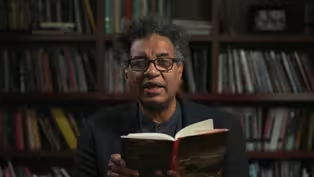
- Colin Channer is our state poet laureate and Brown University professor.
We first introduced you to him back in May and found out what the job entails and why he says poetry is "beyond words."
- As a poet, I try to always remember the roots of poetry are in song, are in ritual, are in prayer, are in magic.
- [Pamela] Rhode Island's new poet laureate Colin Channer believes there is a mystical connection to such words.
- When we say we're enchanted by something, there's the idea of the incantation.
How is it that we can listen to a song in a language that we cannot speak, yet be moved by that song?
- [Pamela] The author of two collections of poetry, Channer says verse gives power to the micro-moments of life.
- We have mirrors and we have windows, right?
The mirrors are the elements of a piece of writing that make you see yourself, and the windows are the aspects that give you a view into different worlds.
And so as a public poet in the role of the poet laureate, I'm in a position to present poetry that will do both.
- [Pamela] Channer is bringing both worlds to his role in Rhode Island.
He was born and raised in Jamaica where his mother declared he was lucky.
- I think that's part of my good fortune.
I describe myself as a weird kid with a strong mother who was influenced so much by the music of Jamaica, he didn't realize he was learning the art of poetry through the lyrics of people like Bob Marley.
- [Pamela] His father, a police officer, died when he was just 12 years old.
His mother, a pharmacist, was his major influence and a storyteller.
- I would listen to her and her friends on the veranda in Kingston, Jamaica, laughing and telling stories.
She spoke her mind.
She never hesitated.
You know, she would use quite colorful language, and she would often declare, "I'm no lady."
(laughing) She would say, "I am no lady.
A lot of the ladies come to me for Valium because they can't speak their minds."
(chuckles) - [Pamela] Channer eventually moved to New York and became an associate professor of literary arts at Brown University in 2016, where he continues composing poetry today.
- There's some times where I feel a poem is on me, and it feels like kind of haunting where I know that I am rising a little bit out of the every day.
It's a calling, and it's a practice.
It's kind of funny when you look through and see drafts of poems because some of them are just scraps that didn't make it.
I have very different processes.
Sometimes an idea comes, sometimes a line comes, sometimes I overhear things.
- [Pamela] He is following in the footsteps of late Brown professors Michael Harper and CD Wright.
Channer is the state's seventh poet laureate, a position generated by the general assembly in 1987.
The appointment is for five years with $1000 stipend for each.
The poet laureate has free reign as a literary arts advocate in the Ocean State.
Channer reveals he wants to create something special.
- I would love to see a literary festival in the state on the scale of the Newport Jazz Festival, right?
We have some of the greatest institutions of learning in the country here in Rhode Island.
And we also have a beautiful landscape.
You know, when I go to the state beaches, I just keep thinking every boardwalk is a stage.
And imagine if there were these events down in the state beaches, right, where you could bring your blanket, right, and you could hear the world's greatest authors and the region's greatest authors and the greatest local authors right there as the sun is going down behind you, right?
It would be so marvelous.
- [Pamela] That marvelous experience is one Channer has already co-created, the Calabash Literary Festival in his native Jamaica.
- The way in which the ocean is never far in Rhode Island, you know, that reminds me a lot of the Caribbean, but also, too, the way in which people here are vocal.
Rhode Islanders are not quiet people.
(laughs) - So you felt like you fit right in?
- I fit right in.
Rhode Island people are expressive, and they like food, the cultural admixture as well.
You know, Portuguese, Italian, Irish, African American, right, Cambodian.
It has that kind of complex mixture, which is a presumption in the Caribbean.
So it's that twin-ness of belonging and exploration that I think are part of who I am as a poet and as a person.
- And yet you didn't start writing until you were in your 30s.
- Yeah.
- [Pamela] Which people might find unusual.
- Yeah, my first book came out, I was 35.
My first poetry book came out when I was in my 50s.
- And that's surprising.
- It is surprising.
It is surprising, and it's completely not recommended.
(laughs) But also, too, I think a kind of openness and a kind of curiosity about what's possible is something that has always driven me.
And so I was curious about what it would mean to write poetry seriously.
And I kind of did it on a lark.
- [Pamela] That spur of the moment decision has taken flight in his most recent collection of poems, Channer was inspired to write about Rhode Island's stormy past after viewing photos of the destruction wrought by Hurricane Carol in '54 and the hurricane of '38.
It's titled "Eye."
- "Mist and drizzles turn to buffets, then all normal snaps from roots havoc sent to ravage wave to wave.
So it was for Wampanoag, Nipmuc, Niantic, Pequot, Narragansett deluge-colonizing, gust insults, bodies shook like canoes in crosscuts, pneumonic fear and the drowned boys last view, the eye, what stillness.
One new God's promise.
Peace."
We often think of a hurricane as a destructive force, and it is, right, but so was colonization.
And so I imagine in this poem, the hurricane as this force that comes from offshore onto land the way in which colonizers came from the ocean and came on the land, right?
And what it might have felt like for, you know, Native Americans.
- When people read your poetry, what do you want them to come away with?
What feeling?
- It's not so much a word, but a sound.
I want them to come away with some version of, hmm.
Beyond words.
- The post of poet laureate has one specific requirement, write a poem for the governor's inauguration, which will be in 2026.
We now turn to a story about art and love.
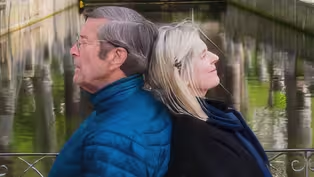
Last September, contributing producer Dorothy Dickie introduced us to a Massachusetts artist whose work took a dramatic turn when her husband began to lose his way.
- [] Art is essential to my life.
You know, I'm visual, and everything sort of matters to me visually more than anything, even jokes.
If a joke is a visual joke, I get it more than I get a spoken joke.
It's important for me to express myself through art.
My name is Sara Holbrook, and I'm an artist.
My husband, Foster Aborn, he was kind, he was generous, he was warm and caring, and helped so many people with their careers.
He was the love of my life.
Probably about 12 years ago, he drove home in a snowstorm, and he forgot where he was going.
By the time he got home, he was flustered, and he called his doctor the next day and said that this was not usual.
He was worried about his memory.
And at that time he had mild cognitive impairment.
They said not to worry, and he was still fine for a long time after that.
I specialized in watercolor, but I took a photography course with a friend out of curiosity in Boston, and I fell in love with photography.
And then it was crucial when my husband was ill because I didn't have time to paint.
You know, that takes a lot of time and concentration.
If he took a nap or something, I could do the my art in stages, which is important.
I started out with dreams.
I would dream up these ideas, and then I would take a background photo.
I would take a photograph of myself.
I had to be dressed as I needed to be for the photograph, and I had to be in the right position.
And that was always a little difficult to figure out how to do that.
But that worked.
And then I put it on the computer and scaled it down, and then printed it out and I cut it out, and I pasted it onto the background photo, and then I rephotographed it.
That was my process.
(gentle music) Later, I entitled my work "99 Problems," because that also reflects what I was dealing with as a caregiver for somebody with Alzheimer's.
I found the photograph when I was in Paris, and I just was drawn to it for the visual image of it.
It was orange and it was a perfume bottle.
And I snapped the photo and didn't think much of it until I started dealing with this Dream series.
And I put myself in it as a scuba diver.
Somebody was trapped and couldn't get out.
And that's the situation as a spouse, there you are, then you're dealing with this and that's what you do, but you're stuck.
"99 Problems" was a perfect metaphor because you never knew what problem was going to present itself.
There were myriad things that would happen to you during the course of a day, just unexpected.
And I had to feel like Wonder Woman, because I was dealing with so much, you know?
He liked to work more than anything.
So he'd go to his office.
So that worked out until Covid hit.
And then he couldn't go in anymore.
And that was very frustrating for him, because he didn't understand at that point anything about Covid.
He couldn't understand that all of Boston was really shut down.
He couldn't go into his office building, and he'd wander from the house trying to go to Boston.
He'd walk, you know?
And I'd have to run after him at all hours of the day and night.
I tried to keep him in, but it was sort of a full-time job just keeping the reins on him.
Well, the hardest part for me was not getting any sleep.
I was always, always on alert, on call, because he would wake up in the middle of the night and leave the house.
So I had to be ready to try to persuade him to come back.
Or I'd have to follow him outside and walk around in the middle of winter or in a rainstorm, anything.
And call the police sometimes.
If I couldn't persuade him to come back, I had to.
The police knew him pretty well.
How I dealt with it on the worst days was by loving him, knowing that I loved him, and that he was a worthy human being even if I was frustrated.
I tried to use humor as a way to diffuse the frustration.
So I think you look at it and you see both.
You don't know whether to laugh or cry when you look at my work, but you get it.
This is called "Rinse Cycle."
It was a very, very bad day.
It just shows intense frustration.
He saw the work, but it didn't register with him.
He even went to an art opening that I had, and he was just happy to be there with the people, but he had no idea of the concept of it.
So we both love Paris, and that was my place for shooting with my camera, because I just felt so alive there.
In October, 2019, I was walking around Paris with Foster.
I had been taking photographs, and we were heading back to the hotel.
And I saw some people gathering.
They were carrying these life-sized cutouts of people, and I was just fascinated.
I wanted to take a photograph and it wasn't long at all, but I turned around and Foster was gone.
And after an hour of looking, I came back to the hotel and Foster was there with this lovely young man.
And the man said that he, in fact, was a researcher in Alzheimer's.
And Foster found him in the whole city of Paris and went up to him and asked for help.
Amazing.
Absolutely amazing.
I didn't know I could cope with this.
And looking back, I don't know how I did.
I kept him far longer than anybody said that I should have, you know, at home because I loved him.
And putting him somewhere just didn't seem right, but eventually I had to do it.
We were really close to one another, you know?
And even when he was in memory care, we had fun.
I miss that.
You know, you sort of settle at whatever level they are at, and he still reacted.
I danced with him when I'd go in, you know.
It's still very intimate.
My understanding of Alzheimer's is, it's really a different process for everybody.
But it is usually very frustrating for the caregiver.
It's just your favorite person has become somebody else, basically.
And that's very hard to digest.
If you're an artist, you are driven to do something artistic.
It gave me an outlet.
It gave me a way to express how frustrated I was.
And somehow that relieved the frustration, and art's terrific that way.
And what amazes me is that my art has helped other people in this same situation, even though they didn't do the art.
For me, It was a joy to do the art.
but people looking at it, I think feel that it gives them license to feel their frustration, to own that frustration as well.
I think it just shows that it's okay to be frustrated and express yourself that way, because I hope my art shows the love that I have for my husband, but also shows that it's a very frustrating thing to take care of someone with Alzheimer's.
It's the hardest thing I've ever had to deal with in my life.
It was a long journey to be with somebody with Alzheimer's, because this is really a strange one.
You know, when people's minds go, it's difficult.
I've just been coping, you know, I don't know how I'm doing, it's just gonna take time.
I'm not sure how I'm gonna deal with it.
I will deal with it at some point, and be on another project.
(uplifting music) - Finally tonight, on this episode of "Weekly Insight," Michelle and WPRI 12's politics editor Ted Nesi discuss why efforts to rebuild the Washington Bridge are falling short.
And the role a US senator played in getting President Biden to drop out of the race.
- Ted, welcome back.
It's good to see you.
It's been about a month since you and I last talked about politics, and yet it feels like we've packed about a year's worth of news in that time.
- Yeah, what a month it's been.
I mean, I've never seen the series of news cycles we had from late June into July.
It's just been an extraordinary period.
- Yeah, many major news events to talk about.
Of course, there was the attempted assassination attempt against the former President Donald Trump.
And also what many have described as really a disastrous debate performance by President Biden, and, ultimately, his decision to step down from the presidential race and endorse vice President Kamala Harris.
You had a chance to talk with Rhode Island US Senator Sheldon Whitehouse in the days following that debate about what his reaction was to his performance.
What did he say to you?
- Well, Michelle, you know, every senior figure around here is a Democrat because it's such a blue area in Rhode Island and Massachusetts.
And I felt it was important to get all of them on the record, what did they think should happen as the party was facing this kind of existential crisis about Biden?
And so White House agreed to meet up with me in Providence.
And the second we started talking, I was struck by the fact that he was clearly ready to go further than most other Democrats were at the time in expressing concern about Biden.
And I had a feeling it would get a lot of attention.
- We have a clip from that interview.
I want to point out, this is four days after that debate.
Let's take a listen.
- Your honest reaction to the debate.
- I think, like a lot of people, I was pretty horrified.
Well, I think people want to make sure that this is a campaign that's ready to go and win.
That the president and his team are being candid with us about his condition.
That this was a real anomaly, and not just the way he is these days.
- And, Ted, those comments by Senator White House really ricocheted.
"The New York Times" ran a story about it, several networks picked it up.
And it's noteworthy because Senator Whitehouse was really one of the first prominent Democrats early on to publicly voice concerns about the President's debate performance.
- Exactly.
I think that's why it made national news, Michelle, because I think Senator Whitehouse was saying publicly what many Democrats were only saying privately.
And it was clear to me he felt that he needed to kind of force a tough conversation.
I asked him at a virtual news conference he held after Biden dropped out.
You know, "Why did you take that step?
Why were we willing to go further?"
And he said, "Facts matter."
He said he felt that Democrats and all voters had been so taken aback by the President's condition in the debate that it couldn't be just kind of swept under the rug, pretend it was just a bad day.
And that Democrats really needed to reckon with that and have a difficult conversation about what they needed to do ahead of the election.
- Right, which is now three months away from that election.
- [Ted] Hard to believe.
- Yeah, let's turn now to local politics here in Rhode Island.
We are nowhere closer to knowing when the westbound Washington Bridge will be reconstructed.
Of course, we know that the state put out bids, and the state received no bids to construct this Washington westbound Bridge.
Here's how Governor McKee explained what went wrong on the day that this news broke.
- I think it is was very aggressive timeframe that we put in place, right, as well as incentives to meet that timeframe and penalties if you didn't meet that timeframe.
So we gotta get out with a more realistic type of a time schedule to make sure that bidders do bid on it.
- And, Ted, the fact that the state received no bids really did shock a lot of people.
- Yeah, there was a huge reaction to this headline, Michelle.
And, I mean, we have to keep in mind this bridge has now been closed since December.
And at this point, the state has no estimate for when the new bridge will be built.
No estimate for how much it will cost.
Right now they're starting over by surveying construction companies to get feedback on why nobody bid on the initial proposal and kind of what they need to do to put together a more successful one.
It's not where people expected to be by midsummer.
- Were you surprised that there were no bids?
- I was shocked.
I was in the newsroom, a colleague, Alexandra Leslie, was waiting for the bids to come in and she said to me, "I think it says there are no bids."
And I said, "Oh, that can't be right.
Let's take another look."
And I was stunned.
That's how surprising it was to reporters who were tracking this.
- And the governor's administration is looking at this at the same time that a new poll shows that the governor's approval rating is low.
Let's talk about that.
- Well, you know, so this new UNH survey of Rhode Island voters, which came out in July, showed his approval rating all the way down to 29%.
A little worse than some other recent polling, but all the polls have shown him taking a hit.
And, yeah, it's hard, Michelle, not to think this is partly related to public concern about whether the governor and his administration has their arms around the bridge problem.
Of course, the bidding issue being the chief reason for that.
And it does come as, you know, McKee is looking ahead.
He wants to run for reelection in 2026.
He's clearly gonna have another strong challenge from Helena Foulkes.
New campaign fundraising numbers out this week showed he raised a bit more money than her in the last quarter, but she's actually already sitting on more cash than him looking at that campaign.
So it's something his advisors have to start to think about.
- And you're thinking about 2026, and 2024 is not even over yet.
- Oh yeah.
- Thanks so much, Ted.
- I'm thinking many elections ahead.
- [Michelle] No surprise.
Always good to be with you.
- Good to be here.
- That's our broadcast this evening.
Thank you for joining us.
I'm Pamela Watts.
- And I'm Michelle San Miguel.
We'll be back next week with another edition of "Rhode Island PBS Weekly."
Until then, please follow us on Facebook and X and visit us online to see all of our stories and past episodes at ripbs.org/weekly.
Or listen to our podcast on your favorite streaming platform.
Goodnight.
(upbeat music) (upbeat music continues) (upbeat music continues) (upbeat music continues) (upbeat music continues)
Video has Closed Captions
Clip: S5 Ep31 | 9m 56s | The power of Art and Love when caring for someone with Alzheimer’s. (9m 56s)
Video has Closed Captions
Clip: S5 Ep31 | 8m 55s | Colin Channer finds a connection between his homeland and the Ocean State. (8m 55s)
Video has Closed Captions
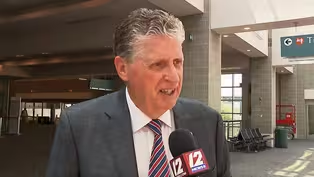
Clip: S5 Ep31 | 4m 51s | Why a Democratic Rhode Island politician publicly raised concerns about President Biden. (4m 51s)
Providing Support for PBS.org
Learn Moreabout PBS online sponsorship
- News and Public Affairs

Top journalists deliver compelling original analysis of the hour's headlines.

- News and Public Affairs

FRONTLINE is investigative journalism that questions, explains and changes our world.












Support for PBS provided by:
Rhode Island PBS Weekly is a local public television program presented by Ocean State Media