
Rhode Island PBS Weekly 8/6/2023
Season 4 Episode 32 | 24m 9sVideo has Closed Captions
An in-depth look at disappearing dairies and food waste here in Rhode Island.
Rhode Island PBS Weekly takes a second look at Rhode Island’s disappearing dairy farms. Michelle San Miguel talks to farmers about the state of the industry and how they’re keeping farms running. Then, another look at producer Isabella Jibilian’s in-depth report on food waste. Both segments are part of our Green Seeker continuing series.
Problems playing video? | Closed Captioning Feedback
Problems playing video? | Closed Captioning Feedback
Rhode Island PBS Weekly is a local public television program presented by Ocean State Media
Rhode Island PBS Weekly 8/6/2023
Season 4 Episode 32 | 24m 9sVideo has Closed Captions
Rhode Island PBS Weekly takes a second look at Rhode Island’s disappearing dairy farms. Michelle San Miguel talks to farmers about the state of the industry and how they’re keeping farms running. Then, another look at producer Isabella Jibilian’s in-depth report on food waste. Both segments are part of our Green Seeker continuing series.
Problems playing video? | Closed Captioning Feedback
How to Watch Rhode Island PBS Weekly
Rhode Island PBS Weekly is available to stream on pbs.org and the free PBS App, available on iPhone, Apple TV, Android TV, Android smartphones, Amazon Fire TV, Amazon Fire Tablet, Roku, Samsung Smart TV, and Vizio.
Providing Support for PBS.org
Learn Moreabout PBS online sponsorship(gentle upbeat music) - [Announcer] Tonight on "Rhode Island PBS Weekly."
- To sell the land to a developer would be like a parent selling one of their children.
That's how close I feel to this farmland.
- In the state of Rhode Island, it's 20% of our total landfill waste is food waste.
We think about the food waste that's on top of a heap in a landfill that's smelly with gaseous smell.
And so I really try to reframe it and say it's wasted food because once we change those words around, we realize we're not talking about trash.
We're talking about something that is food that we are wasting.
(sweeping upbeat music) (upbeat music decrescendos) - Good evening.
Welcome to "Rhode Island PBS Weekly."
I'm Michelle San Miguel.
- And I'm Pamela Watts.
We begin tonight with a story about one of the toughest jobs in the country, dairy farming.
Farmers are up before the sun rises and often work until sunset.
- Many milk their cows twice a day.
In between, there are fences to be fixed, hay to be baled, and field work that needs to get done.
As we first reported last October, many farmers put in the hard work despite not reaping a profit.
But a love for their cows and the land is not enough to stem the tide of disappearing dairies.
- I like what we do.
I don't particularly like doing the same thing every day.
which was kind of silly for me to marry a dairy farmer because that's what you do every day twice a day, is milk.
But I love this man.
- [Michelle] A self-described city girl, Jane Escobar says she long dreamed of working on a farm.
- [Jane] Come on, don't you know you're on camera?
- [Michelle] A life in the country became a reality when she met her husband, Louis Escobar.
The two married in 1986 and have been working on Louis' family farm in Portsmouth ever since.
- I was born on a dairy farm, one of six children, and I had a love for the cattle and what dairy farming was all about.
And I have lived my life's dream to have my own and to be able to keep the family farm in existence in my lifetime.
- [Michelle] In 2015, he was involved in a tractor accident on the farm that left him seriously injured.
Still, he remains active.
Jane Escobar says her husband calls the shots from his wheelchair.
- He's in charge of everything, and I do what I'm told for the most part.
(laughs) - Louis Escobar's father bought the farm during the Great Depression.
Over the years, Escobar Farm has grown to 98 acres.
Was it harder than you thought it would be to keep the farm running?
- It has become more difficult every year, and it's gonna get worse before it gets better.
- What do you mean by that?
- More challenges where people drink less milk.
- [Michelle] Fluid milk consumption in the United States has been on the decline for more than 70 years according to the United States Department of Agriculture.
It's made it increasingly difficult for the Escobars to make ends meet.
They're one of 10 remaining dairy farms in Rhode Island.
- And I can remember one year where were losing about $7,000 a month, and we were getting to come out here and work 12 and 13 and 14 hours a day and losing $7,000 a month.
- Are you still losing money?
- We're still losing money, yes.
- The dairy farmer does not generally control the end price of his or her milk.
It's controlled by the federal government.
That's far different than almost every other crop that is grown, and that's a big part of the equation.
- [Michelle] Ken Ayers is the chief of the division of Agriculture and Forestry at the Rhode Island Department of Environmental Management, or DEM.
- Rhode Island as well over the past, you know, 40 to 50 years show a sharp decline in the number of farms in the state driven by a bunch of other reasons.
Development pressure in the state is credibly intense.
The average cost of farmland in Rhode Island is the highest in the country, and typically that's the case year after year as measured by USDA.
(birds chirping) - [Michelle] On average, an acre of farmland in Rhode Island is worth $17,500, and not only is the land expensive, but it's also hard to find.
- Land access is probably one of the biggest barriers to farming here in Rhode Island.
- [Michelle] Andrew Morley and his wife Laura Haverland run a small dairy in Little Compton.
They say their biggest stroke of luck as farmers came when they spent time with the family that owns the land, which was once a dairy farm.
- And it took maybe a year and a half of driving up to Rhode Island and meeting with them to talk about our visions for the future and what we were gonna do with our lives as dairy farmers for them to get comfortable with the idea of them leasing their family's dairy farm to us.
And we are so grateful to them for that.
- It's a life they dreamt of while living in New York City.
Laura Haverland worked in marketing, Andrew Morley in finance.
In 2011, they decided to move to Rhode Island and pursue a life of greener pastures.
You both are living in New York City, working, have, I can say, comfortable jobs in New York City.
- Yeah.
- Why leave that behind to go become dairy farmers?
- That's a good question.
(all laughing) - Well, we both of us knew we didn't wanna sit behind a desk for our whole lives.
I think we were just drawn to doing something more active, and we were both especially interested in food, like from an eating perspective, mostly.
Prima.
(clicks tongue) - [Michelle] At Sweet and Salty Farm, the husband and wife team is raising a herd of grass-fed jersey cows.
They have a creamery on site where they process their milk into yogurt and cheese.
- We saw that there was this different wave happening of people's interest in like handmade and artisan foods and that the American cheesemaking scene was kind of starting to explode but that there really wasn't much going on in Rhode Island yet.
There were a lot of new, like, great farms in New England, but Rhode Island in particular didn't really have anybody doing what we are doing now.
- [Michelle] Laura Haverland oversees the yogurt production.
She works with a small team that makes the farm's plain whole-milk yogurt.
And Andrew Morley is the cheesemaker.
He creates a variety of artisan cheeses that are sold at farmers' markets and to restaurants in the region.
- I think both of us really love having the connection to our customers and seeing them really enjoy our cheese and yogurt and hearing about that.
- Yeah, I mean, it's all a lot of hard work, but it's all really satisfying when it goes well.
And when customers appreciate your hard work and your products, it makes all the hard work seem like it was pretty easy.
- [Michelle] They say one reason for their success is avoiding commodity pricing by not selling milk.
- We would stand no chance at having a viable business if we were farming the way we farm and selling our fluid milk to the commodity market.
We didn't grow up on farms.
Were not multi-generation knowledge recipients.
Yeah, the folks that are still dairy farming in Rhode Island have like a ton of our respect because what they do is really difficult, and we would be huge failures at that.
- [Michelle] Ken Ayers of Rhode Island DEM says the future of dairy farming in the state looks similar to what Sweet and Salty Farm is doing.
Nationwide, cheese and yogurt consumption are on the rise.
- I don't see fluid milk being the basis of the survival of dairy farming in the state.
It would be part of it, but I don't think it's strong enough to just keep dairy farms in itself without a lot of diversification of product.
- The Escobars say diversification is the reason their farm is still in business.
A corn maze every fall brings in much needed revenue.
Why do you think your farm has managed to survive when hundreds of others have not?
- I was so determined that even in the most difficult times that we could survive, and many other farmers chose to give it up and tremendous pressure by developers.
To sell the land to a developer would be like a parent selling one of their children.
That's how close I feel to this farmland.
- But certainly you've had those offers?
- Many times.
- [Michelle] Before much of their property became protected farmland, They say they were offered more than $10 million.
- And so I now have the development rights that have preserved it for perpetuity.
So you can do, it doesn't have to be dairy, but any other form of agriculture or anything, it's open space, and I'm happy I've done that.
- [Michelle] Louis Escobar is 83 years old.
He doesn't dwell on his age but acknowledges the mental and physical drains of life on the farm.
Have you guys talked about how much longer you plan to work the farm?
(Jane snickers) Why do you laugh?
- Till we both give our last breaths.
- That's probably it.
- Farmer Louis Escobar died last October.
He was 84 years old.
We turn now to a story we aired last fall.
More than 1/3 of all food grown for human consumption in the United States is never eaten.
Where all this food ends up and the effect this has on the climate is the subject of our continuing "Green Seeker" series.
From moldy strawberries to uneaten leftovers, food waste plagues our daily lives.
Producer Isabella Jibilian reports on the fight against food waste here in the Ocean State.
- [Isabella] At Four Town Farm in Seekonk, it's harvest season.
- Definitely getting a rhythm.
That's kind of fun when that happens.
- [Isabella] But Eva Agudelo knows not all this produce is gonna end up at the farm stand.
- The farm that we're on grows a lot of corn, and they have multiple acres of corn.
And they'll start growing the corn at different times so that it becomes ready at different times.
But if we have a super hot summer, sometimes all of the corn will be ready all at the same time, and then the farmer doesn't have sufficient customers or grocery stores or whatever that can actually move that much corn that quickly.
So they'll just have more corn than they literally know what to do with.
- [Isabella] And that's not the only problem.
- Sometimes the food that gets left in the field is a little too big or a little too small.
If it's too big, it might not fit in a box.
For example, a cauliflower will grow to the size of your torso if you let it.
For processing, like if you're selling potatoes to a french fry factory, they need those potatoes to be a certain size and shape and weight to be able to work within the machinery.
- [Isabella] So after months of tilling land, sowing seeds, and tending to crops, this extra produce will ultimately die on the vine.
- Food waste is a very big problem in the US, and everybody eats, and so it goes well beyond what we're putting into our landfills because 30% of food is wasted or lost before it even gets to the retail or distributor.
But they're both talking about economics, right?
- [Isabella] The problem is a subject of fascination for Dawn King, a senior lecturer and director of undergraduate studies at Brown University's Environmental Sciences and Studies Department.
- They also say pollution is a sign of waste.
- Why are we seeing waste happen on farms?
- We're very mechanized.
And so machines are actually specifically designed, many of them, to only harvest the top 2/3 of a plant.
- [Isabella] That's because farmers don't want machines getting tangled in the dirt.
Plus farmers leave behind produce that's less attractive, what's known as grade B.
- Once that becomes grade B, it loses almost all of its value.
It's not even like it drops 10%.
It loses almost all that value.
So farmers are facing this in this really bad predicament.
They want the food to go to others, but they have to pay people to pick it.
They have to pay people to package it.
They have to get it on a truck and get it to that donation site.
All of this costs the farmer money.
- [Isabella] And King says the problem goes far beyond the farm.
There's also waste from manufacturing, restaurants, grocery stores, and at home.
1/3 of all food produced in the US is never eaten.
- In the state of Rhode Island, it's 20% of our total landfill waste is food waste.
And so I really try to reframe it and say it's wasted food because once we change those words around, we realize we're not talking about trash.
We're talking about something that is food that we are wasting.
- [Isabella] When food breaks down when exposed to air, it becomes compost.
But when it breaks down in a landfill, something else happens.
- It rots when it's not exposed to oxygen like in a landfill state.
And when it rots, it creates- - Because it's so piled up.
- It's so piled up, exactly.
You pile it on top of each other, so none of it is exposed to air, and so it does the exact opposite of compost.
It turns into methane, right?
You're having a festering methane pile that is 25 times more potent than CO2.
- And that's what we're seeing when we see those pipes that are sticking out of a landfill.
Those are to let out the methane?
- Yes.
- [Isabella] So much food is thrown away, King says, because agribusiness and farm subsidies make food less expensive in America than in other countries.
- I always tell people think of the last time you went to maybe your local butcher and got like a really nice steak, like a t-bone, like a really expensive steak.
Whoever wastes that steak, right?
- [Isabella] Another culprit, those use-by dates that we all live by.
- A lot of people don't realize that expiration dates are not set by the US government, except for baby formula.
Baby formula is the only food product that actually has a mandated best-by date.
Sometimes it says sell by.
Sometimes it says best by.
Sometimes it just has a date.
- [Isabella] When food hits that date, it doesn't necessarily mean it has expired.
King says they describe how long manufacturers guarantee the quality of food, and she says they often put dates earlier to encourage more purchasing.
- There's actually a labeling problem in the United States as well that people throw away things that they think are bad, and it's really not that way.
- The average store throws out anywhere from five to $10,000 worth of food every day, and that food's anywhere from three days to sometimes weeks before the sell-by date.
- [Isabella] Josh Domingues is the founder and CEO of the company Flashfood.
- It's not just a story of the big bad retailer.
It's also consumers.
If we go buy a watermelon, and there's one on the shelf, as consumers, we assume it's the worst one.
So the grocer has to overstock the shelf so that we get selection.
- [Isabella] Domingues came up with an idea, take the perfectly edible food that is culled from supermarkets, like a nicked pepper or meat that is within three days of its use-by date, and create an app-based market for it.
The result, Flashfood, where customers can buy today's deals and pick them up from special purple fridges.
- Then in terms of the the volume, we've diverted over 50 million pounds of food that would've likely ended up in landfills.
- [Branden] A big rule is no seeds on your board.
- [Isabella] Just as Flashfood's customers get creative with their baskets of produce and cuts of meat, so does Chef Branden Lewis.
- We teach snout-to-tail cookery, so we're using every part of the animal.
- [Isabella] At Johnson & Wales University, Lewis teaches future restaurateurs about how to avoid wasting food.
It's a reaction to the waste that normally happens at restaurants.
He says catering requires full platters that are routinely refreshed.
Large portion sizes mean that lots of food gets left on the plate.
And then there are all those choices.
- We've all been to restaurants where the menu just goes on and on.
You're like, "Wow, so many items."
Well, if they don't have heavy foot traffic, a lot of that food could be going to waste.
- [Isabella] On this day at Johnson & Wales, Lewis is teaching his students to cook sustainably by improvising with what's available and seasonal.
Each student must draw a slip of paper with mystery ingredients.
Their assignment, create a delicious dish in an hour while minimizing food waste.
- [Branden] All right, you have 15 minutes.
- [Isabella] One student is assigned beets.
The tops and stalks become pesto and pickles.
Another, normally a pastry student, worries over what to do with beef neck.
- You could be helping your farmer by using off cuts of meat.
So for instance, offal, which is like organ meat, or even beef tongue, those things are delicious.
If everyone's always eating from the middle of the animal, then no one's buying the end pieces.
You're wasting money and- - Liver's back on the menu- - Yes, it is.
- Is what you're saying?
- And so, of course, to make liver taste good, you gotta have some pretty good kitchen skills.
(laughs) - And so that's what you're trying to teach.
- Yes, absolutely.
- Is this waste?
- [Isabella] Emma Albertini, a junior, is given leftover beans and sweet potatoes.
- Definitely stressful when you don't get to pick what you're gonna be making.
Okay.
- She purees the beans and sweet potatoes into a stew, adding in parsnips, maple syrup, and juniper berries.
Then she crisps the parsnip skins into a garnish.
- I got another 10 minutes, so I think I got it.
- [Isabella] To top it off, she makes Native American fry bread from scratch.
- I'm excited to see how this turns out.
I really have no idea.
Chef?
- Yep.
- I have a dish for you.
- Oh yeah?
- Yeah, the soup's seasoned with just maple syrup and juniper berries.
- Well, the salt's good.
It's crispy, and it's pillowy.
I mean, it's a really good fry bread for your first time.
- Thank you.
- [Isabella] For Chef Lewis, his class is a microcosm of a larger change happening in restaurants across the country.
- Back in like the '90s, a chef wanted zucchini blossoms in February, so they would ship 'em in from Israel in a clamshell for $100 a pop.
That's a little, you know, a little extreme, a little ridiculous.
This idea that a chef was this sort of top-down leader of the food system, someone who demanded ingredients brought to them, that age is gone.
- [Isabella] Instead, fine dining has embraced farm to table.
It's all part of an effort to decrease the emissions of what we eat and avoid the destructive impact of filling our landfills with food.
- Rhode Island is a state more than any other state, we have one landfill, and it's gonna fill by 2033, 2034.
And that's a very big problem for us because we don't have anywhere else to put it.
One solution, right, is to get that 20% of the food scraps out of the landfill.
- [Isabella] One way to do that, start municipal composting programs.
At present, those are few and far between.
- At least 90% of total food scraps in the United States go straight to landfills.
- [Isabella] Another way, turn food into fuel.
This plant in Freetown, Massachusetts takes everything from apples to the coffee in K-Cups from over 200 Stop & Shops across New England.
The tons of food are decomposed without air, producing methane gas, but rather than polluting, it's captured to generate electricity.
It's an emerging industry in the US but is more common throughout Europe and in China.
Though technology for dealing with wasted food is expanding, back at Four Town Farm, Eva Agudelo employs an Old-World solution to this problem.
- The first mention of gleaning is actually in the Old Testament in the Book of Ruth.
So it goes back, you know, thousands of years.
- It's not new tech.
- It sure is not.
No, people are like, "How did you come up with this idea?"
And I'm like, "Oh, I really did not."
(laughs) - Gleaning is the act of harvesting the extra produce left in the fields.
Through her program, Hope's Harvest, Agudelo and her team mobilized volunteers to pick these leftovers.
How much have you guys harvested so far, and how much are you planning on harvesting?
- So we're already past probably about 400 pounds of corn, and we will probably get over 1,000 pounds.
- [Isabella] The fruits of their labor are donated to food banks and hunger-relief organizations.
And across the country, there are over 250 gleaning and food recovery groups doing this work.
At Hope's Harvest, Agudelo has seen her project take root.
- We have grown so much in the last few years since we started in 2018.
That first year we harvested 36,000 pounds of fruits and vegetables, and last year it was up to 250,000 pounds.
- What motivates you to work on this issue?
- When I was a kid, so my mom was a single parent, and she worked full-time, and there were a lot of times where she was skipping meals so that I had enough money on my lunch card to eat.
And you don't forget that, and you don't forget what that feels like.
It's not okay for people to be having that experience if there's enough food to go around.
No one should have to feel that way.
People, until they come out and actually see in the field and see what it looks like, don't realize how much abundance there actually is and how prolific the Earth really is in giving us this abundance.
- And that's our broadcast this evening.
Thank you for joining us.
I'm Pamela Watts.
- And I'm Michelle San Miguel.
We'll be back next week with another edition of "Rhode Island PBS Weekly."
Until then, you can visit us online to see all of our stories and past episodes at ripbs.org/weekly.
Or listen to our podcast available on all your favorite audio streaming platforms.
Thank you and goodnight.
(gentle upbeat music) (sweeping upbeat music) (sweeping upbeat music continues)
Video has Closed Captions
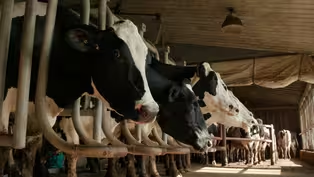
Clip: S4 Ep32 | 10m 1s | Dairy farmers discuss their struggles to stay in business. (10m 1s)
Video has Closed Captions
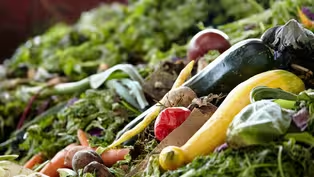
Clip: S4 Ep32 | 12m 53s | One-third of all food in the U.S. goes uneaten. Weekly explores why. (12m 53s)
Providing Support for PBS.org
Learn Moreabout PBS online sponsorship
- News and Public Affairs

Top journalists deliver compelling original analysis of the hour's headlines.

- News and Public Affairs

FRONTLINE is investigative journalism that questions, explains and changes our world.












Support for PBS provided by:
Rhode Island PBS Weekly is a local public television program presented by Ocean State Media