
Rhode Island PBS Weekly 9/1/2021
Season 2 Episode 35 | 28m 59sVideo has Closed Captions
A look at the Fox Point Hurricane Barrier and interviews with genocide survivors.
Rhode Island PBS Weekly takes a look at the future viability of the aging Fox Point Hurricane Barrier, as part of the continuing Green Seeker series. Then, Michelle San Miguel speaks with genocide survivors and educators about the importance of learning from the darkest chapters of history. Finally, guest commentator Scott MacKay reflects on the waning days of a summer marred by COVID-19.
Problems playing video? | Closed Captioning Feedback
Problems playing video? | Closed Captioning Feedback
Rhode Island PBS Weekly is a local public television program presented by Ocean State Media
Rhode Island PBS Weekly 9/1/2021
Season 2 Episode 35 | 28m 59sVideo has Closed Captions
Rhode Island PBS Weekly takes a look at the future viability of the aging Fox Point Hurricane Barrier, as part of the continuing Green Seeker series. Then, Michelle San Miguel speaks with genocide survivors and educators about the importance of learning from the darkest chapters of history. Finally, guest commentator Scott MacKay reflects on the waning days of a summer marred by COVID-19.
Problems playing video? | Closed Captioning Feedback
How to Watch Rhode Island PBS Weekly
Rhode Island PBS Weekly is available to stream on pbs.org and the free PBS App, available on iPhone, Apple TV, Android TV, Android smartphones, Amazon Fire TV, Amazon Fire Tablet, Roku, Samsung Smart TV, and Vizio.
Providing Support for PBS.org
Learn Moreabout PBS online sponsorship(gentle music) - [Announcer] Tonight on Rhode Island PBS Weekly.
- [Narrator] Although still a technological marvel, sea level rise now poses a serious threat to the aging Fox Point Hurricane Barrier.
- Inherent in the original design was the assumption that these things are separate.
So you get this maximum surge and the maximum freshwater input may occur at the same time.
Then you've got the worst possible problem.
- When they invaded Bulgaria, I had to leave the school.
They didn't want any to lose anymore death.
- [Narrator 2] Painful parts of history reveal man's inhumanity to man.
- You lucky if one day you get three grain of rice in a bowl of soup, which is just boil water, just to make enough for you to survive to the next day.
(gentle music) - Good evening, welcome to Rhode Island PBS Weekly, I'm Pamela Watts.
- I'm Michelle San Miguel.
We begin tonight with our continuing series "Green Seeker".
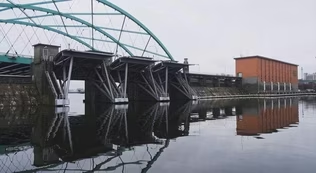
In the wake of tropical storm Henri last month, we take a closer look at the Fox Point Hurricane Barrier in Providence.
- While Henri wasn't a direct hit.
The hurricane barrier gates were closed as a precaution to protect Providence from potential surges.
The capital city is vulnerable to both coastal and inland flooding.
As John Smith first reported in March, more than 50 years after the Fox Point Hurricane Barrier was completed, there's now an impending threat of sea level rise brought on by climate change.
That's something the Sentinel of the city is being asked to deal with, but was never designed to do.
- [Narrator] In September of 1938, Rhode Island was pummeled by a category three hurricane, sustained wind speeds at 100 miles per hour and gusts reaching 125 miles per hour, battered the capitol city.
However, the true destruction did not come from the wind, it came from the storm surge of more than 13 feet.
It crippled an unsuspecting downtown.
It would be another 16 years and another hurricane before Congress finally ordered the US Army Corps of Engineers to create a plan that would help Providence avoid another climate catastrophe.
The result was the $15 million Fox Point Hurricane Barrier.
Completed in 1966, it was the first hurricane protection structure in the US, and the designers of the day were naturally very proud of it.
- The level of the structure, plus the impactments, both on the east and the west are sufficient to protect Providence against a recurrence of the '38 and 1954 hurricanes.
- It is impossible to adequately estimate the great benefit that this facility will be to the city of Providence and the state of Rhode Island.
The hundreds of lives, the millions of dollars and the achievements of our people that will be saved in the future are beyond anyone's ability to calculate.
- [Narrator] But no matter how satisfactory the original builders believed it to be, nearly six decades later, rising sea level threatens to create new challenges in the future.
- The question was, what is its ability to withstand or to continue to provide the service that has provided for all of the years since it's been built.
- When was sea level rise something that the scientific community began to understand?
- Oh, I would say maybe three decades ago, people started taking a look at it in particular areas, small levels of sea level change are really not so exciting, but you start to see the rates change.
A few millimeters of sea level rise every year, not so exciting.
You start to see that increase fairly dramatically.
And then you start linking that with what's going on in the atmosphere.
And suddenly a concern starts to rise pretty quickly.
- [Narrator] At the University of Rhode Island several years ago, students researched the Fox Point Hurricane Barrier for their work on this real world problem.
They received credit.
Their professor at the time was Malcolm Spaulding.
- We put together projections of sea level rise and all of them start off and say, here's what sea level has been.
Here's how it's changed recently, and then based on the climate models, they project what the different values would be.
- [Narrator] These frequently adjusted projections have a low, an intermediate low, a high and an extreme high.
Spaulding and his students chose to use the extreme projection as the benchmark, which at the time projected that by the year 2100 levels will have risen to seven feet.
This was the most conservative measurement and is the standard adopted by the Rhode Island Coastal Resources Management Council.
- The barrier was designed in the fifties, and then the barrier got built over the next five or six years.
Sea rise, not on the list.
However, it turned out that they, as they often do, they designed it for the once in 500-year event.
- [Narrator] Which means the percent chance of that event happening in 500 every year, over that period of time.
A common design metric for important public infrastructure.
- If you suddenly have five feet of sea level rise, the thing that you designed for once in 500 years looks like once in a hundred year.
And then the question is, where does it fail?
I said, well, to the students, take a look, how did they design this?
Well, they essentially did the once in 500 year event for the surge, and then they did it once in 75 years for rainfall.
So it's much lower rainfall.
So they essentially inherent in the original design was the assumption that these things are separated.
So you get this maximum surge and the maximum freshwater input and they occur at the same time.
Then you've got the worst possible problem.
- [Narrator] This is known as a compound flooding event.
According to the study, if a large enough compound event were to occur with seven feet of sea level rise, the barrier would fail.
However, the study also states that with proper mitigation strategies in place, the barrier is still able to protect Providence from rising sea levels until the end of the century.
But getting to this level of smooth operation and maintenance was not easy.
Neglect by the city of Providence for a couple of decades began to catch up.
And in 1996, a group of barrier stakeholders sent a letter to then Mayor Cianci detailing the issues.
Most notable, was the fact that four out of the five pumps were inoperable.
Other issues ranged from cracks in the concrete, a deteriorating roof and corrosion.
In 2006, with it becoming apparent that the city could not properly maintain the barrier, plans were set in motion to hand over control to the Army Corps of Engineers.
And in 2010, the transition was complete.
So when you inherited or when you took over the barrier, would you say that it was in the condition that it needed to be in to protect the city from a storm or did it need more work?
- Definitely needed more work.
There was a lot of deferred maintenance.
So there was quite a bit of catching up to do.
You know, this is the type of structure where you can't do maintenance on a fixed it when it fails policy.
- [Narrator] On a recent tour of the barrier with Army Corps Canal Manager John MacPherson and engineer Drew Cattano, we got to see firsthand how those mitigation strategies were implemented, through consistent maintenance.
- When this was constructed in the sixties, they use mechanical electrical systems to control that stuff, instead of a computer doing it.
So there's relays, fuses, circuit breakers, sensors everywhere that our operators can adjust all that to balance the flow of electricity, to operate these pumps.
- [Narrator] And MacPherson says, because many of the systems do not use modern computers operating the barrier is as much an art as it is a science.
- They're not just an on/off button.
You have to align the plant electrical mechanically.
They use alternating current and DC, direct current for excitation of the pumps.
So there's a, you know, there's a lot to it.
Our electricians are balancing the load on that three phase power that the pumps use to keep everything smooth.
- [Narrator] One of the most impressive features of the structure, are the five powerful pumps.
- 4,500 Horsepower motors.
They spin a shaft.
The shaft is about 50 feet long.
The impeller is seven and a half tons.
So it's a 15,000 pound impeller, 10 foot diameter that spins at 150 RPM.
So that configuration gives us that 630,000 gallons per minute capacity.
- [Narrator] A single pump could empty an Olympic-sized swimming pool in just over a minute.
Outside, the most distinctive feature of the facility are the three Tainter-style gates.
- The gates are 40 feet by 40 feet in size, 53 tons each, we close them, we rotate them down as needed for storm flood control.
It's really a five horsepower motor that operates each gate.
So each gate has a torque shaft that you can see rotating here that connects one side of the gate to the other, so that the gate goes down very evenly.
This was the state-of-the-art operating gear in the fifties and sixties.
- [Narrator] And because of their massive size and weight, it does take a bit of time for them to move.
- So, total closure time is right around 30 minutes, and then to raise it, it's about, almost two hours to reopen.
- [Narrator] For both Cattano and MacPherson, much of the credit goes to the original designers.
- They really thought through the different scenarios of storm events and gave us a lot of really good tools to be able to operate and maintain.
- We have a very good working relationship with the Army Corps of Engineers.
- [Narrator] Clara Decerbo is the director of the Providence Emergency Management Agency.
She says, the city's working relationship with the Corps of engineers is going a long way to avoid the negligence issues of the past.
- Just earlier in the spring, as part of the annual preparedness for hurricane season, we had a meeting with Army Corps of Engineers, the director of Public Works, myself, and we go over all of the different, either current issues, potential issues.
And we just do a quick update, what the status of the pumps are, what the status of the vehicle gates are.
If there's any small repairs needed, if there's any anticipated longer term issues that might be on the horizon.
- You know, this is a very expensive piece of infrastructure.
There could potentially be investments made to add protection on the top, but at some point there might be a scenario where the city or the state, or even with Federal Resources would wanna consider constructing a new barrier.
- [Narrator] Leah Bamberger is the director of sustainability for the city of Providence.
She says a holistic approach for any future planning will be key.
- When that decision point comes, there'll be lots of things to consider.
One of which is where should the barrier be located, right?
Right now it's protecting downtown, but it's not protecting a large portion of South Providence.
- [Narrator] In 2017, an independent analysis was conducted by the Center for Climate and Energy Solutions and Johns Hopkins University.
Although it came to similar conclusions of the URI study, this analysis suggests that the barrier can only provide protection until the end of its design life in 2070.
At that point, it should be decommissioned.
It also suggests that in less than 30 years, a decision needs to be made about its replacement.
- Having this on the forefront of people's minds now, I think is really important to make sure that when the time comes, that the government is ready to make such an investment.
- [Narrator] And for the Army Corps of Engineers, John MacPherson says keeping that high standard of operation will ensure the barrier will serve until the end of its design life, and perhaps further.
- If down the road, you know, others decide that there is some modifications that need to be done, you know, we'll be here and ready.
(gentle music) - Up next, Theodore Roosevelt once said, "The more you know about the past, "the better prepared you are for the future."
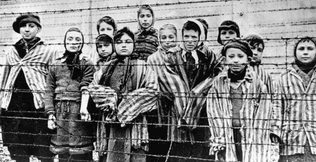
World history is full of dark chapters, including genocides.
Around the world, men, women, and children have faced unfathomable atrocities in their home countries.
Teaching those dark parts of history is on the minds of many in Rhode Island.
A new law in the state will create a permanent commission to promote and improve genocide and Holocaust education in schools.
As we first reported in April, before the law was passed, community leaders want to make sure the past is never forgotten.
- I grew up in Bulgaria, we did not know what was going on in the west.
When the German troops marched into Bulgaria, in 1941, the March of 1941, that's when we realized what was going on.
- [Narrator 2] 93 year-old Holocaust survivor, Alice Eichenbaum, was attending a German school when Bulgaria allied itself with Nazi Germany.
Immediately, she noticed her classmates began treating her differently.
- I was with these kids since kindergarten together, and then when that all happened, with the swastika and everything, they wouldn't play with me anymore.
In recess I was standing by myself and they didn't invite me anymore to their birthday parties.
It's no big deal, but it meant a lot to me, to an 11 year old.
- [Narrator 2] Eichenbaum then went to a French Catholic school in Bulgaria that accepted Jewish students.
A few years later, she and her parents were forced to live near the Turkish and Bulgarian border, in a ghetto, where Jews were segregated from the rest of the population.
- Let me tell you, I went to bed many times hungry.
Many times, and not knowing what tomorrow will bring.
My mother came down with malaria, so for weeks and weeks, she was sick, and very sick, you know.
And I came down with whooping cough, very severe.
No doctors were allowed in Jewish homes, you know, no medication.
So maybe few months we were sick.
And the place where we went, there was no plumbing, no running water.
I had to go to the well and bring buckets of water so we have something to drink and food.
- [Narrator 2] Her late husband, Raymond, was also a Holocaust survivor.
He was sent to Auschwitz, the Nazis largest concentration camp.
- He always said that he could never forget the scream and the smell of burning flesh in Auschwitz.
It was hell, hell on earth.
- [Narrator 2] In 2016, in an effort to make sure stories like Eichenbaum's and other victims of atrocities do not fade from history, then governor Gina Raimondo signed into law a requirement that public middle school and high school students be taught about the Holocaust and other genocides.
But today supporters of the legislation are concerned that many educators in the state aren't aware of the requirement.
Right now you don't know what's being taught in what schools.
- Exactly.
- State representative Katherine Kazarian was the lead sponsor on the 2016 legislation.
Now she's co-sponsoring a bill that would create a commission to oversee Holocaust and genocide education in the state and make sure it's being taught in schools.
Why is having that commission important for that education?
- We wanna make sure that these teachers are teaching about these materials.
We wanna make sure they're teaching about them properly.
And we wanna make sure that we have this commission there to enable that.
- [Narrator 2] Barbara Wahlberg was instrumental in creating and gathering Holocaust and genocide curriculum for the Rhode Island Department of Education.
She's a teacher at Cranston High School East.
She wants educators to know, there are free resources available and believes the commission will help teachers spread the word.
- I think the commission gives us a little bit more clout and influence, and it helps us to be, you know, it's almost like legitimizing us as educators to go in and say, well, we really can help you.
And we can provide professional development to your teachers.
- [Narrator 2] Wahlberg has been recognized by her peers for her work on genocide education.
She's made it her mission to ensure students know their history.
- I think they have a new sense of how valuable life is, how valuable their family is, their home, their bed, the food on their table.
They really do write journal entries that mention those things, that mention how fortunate they really are and that nothing like this could happen to them.
But they do realize that it has happened to others.
- Education is the most powerful form to erase systemic racism.
- [Narrator 2] Channavy Chhay is the Executive Director of the Center for Southeast Asians located in Providence.
She's also a survivor of the Cambodian genocide.
- My mom, my aunt and I survived this war.
And this war is tremendous impact because we were starved, we were attempted to be murdered.
- Chhay was seven years old when the murderous regime known as the Khmer Rouge took over Cambodia.
At least 1.7 million Cambodians died from torture, forced to labor and starvation.
For years, Chhay lived in a concentration camp desperately trying to survive.
- Picture 125 degree outside, and you have to carry loads of rocks or water, whatever it is or dig and then dump it somewhere, because they told you and you don't do it the right place, and you will get beaten and you're not getting fed.
You lucky if one day you get three grain of rice and a bowl of soup, which is just boil water, just to make enough for you to survive to the next day.
- How did you survive living in a concentration camp?
- It takes a lot of stamina.
Stamina is a key and maintaining your composure.
For me, was in my psyche is that I will not give in and I will not give up.
It's not my time yet.
That's for me, not anyone else, but for me, it's not my time.
- [Narrator 2] When the Vietnamese military invaded Cambodia in 1978, Chhay says the chaos that ensued, allowed her to later leave her camp and find her mom and aunt in nearby camps.
- And then from there, we plan to stay to see if my father were alive, because the promise to my mom was, you stay here for three months, if I don't show up, that mean I'm no longer here.
So that promise we waited for three months, and then we decided that we have to escape out of Cambodia.
So all my family were vanish.
I have two brothers, two sisters, I'm the second oldest of five children, and they all were murdered and killed.
Whether it's through the actual hand or whether through famine and starvation.
- [Narrator 2] Educators like Len Newman, hope Chhay story, and those of other survivors empower young people to work for social justice.
- And when we teach Anne Frank or Elie Wiesel's life, the critical question is always, what does this book, what does this story have to do with me?
And that's what we want to get to the root of.
- [Narrator 2] Newman's father and his mother survived the Holocaust.
He says teaching about those who suffered and perished at the hands of the Nazis is critical.
- With that, that students realize that this is not something that happened to somebody else a really long time ago, but we are part of a world community.
And what happens to one of us happens to all of us.
- [Narrator 2] For Representative Kazarian, making sure students learn about the Holocaust and other genocides is also about acknowledging her roots and the victims of the Armenian genocide.
- I have eight great-grandparents that escaped the Armenian genocide of 1915.
Their stories are horrific and incredible.
And I think in the Armenian community, something that is always a concern of ours is that our history will be forgotten.
- [Narrator 2] Inside of the North Burial Grounds in Providence, stands a monument for the victims of the Armenian genocide.
It's estimated that 1.5 million Armenians were killed by the Ottoman empire.
To this day, the Turkish government has not acknowledged the deaths as a genocide.
Kazarian believes that educators must recognize and teach, that in the midst of all the brutality, there were also heroes.
- That's why it's so important to teach about the Armenian genocide and all these genocides in the right way, because it's more about their government that, you know, perpetrated this most heinous crime.
Many Turkish people actually helped their Armenian neighbors hide and escape from the genocide.
- [Narrator 2] Alice Eichenbaum remembers when she was liberated in 1944 by the Russian army.
Months later, she says the Americans rescued her husband.
Despite what she's lived through, Eichenbaum says she's never lost her faith, and doesn't dwell on the hardship.
- I roll with the punches.
I don't fight, I just roll with the punches.
I accept things and move on.
Good or bad, I move on.
- [Narrator 2] Eichenbaum believes it is her mission to get the truth out.
An eyewitness account of the unspeakable made all the more important by those who continue to deny the reality of what happened.
- Some people don't believe that there was a Holocaust.
That it was just a myth.
So I want to tell 'em that it was true, I went through it, you know.
I was one of the lucky ones because I was in Bulgaria.
And the other thing it should never happen again, because if you don't tell and educate the people, it could very easily happen again.
- [Narrator 2] Scenes from the Cambodian genocide will always be with Channavy Chhay.
So too will the story of her resilience.
- I want my grandchildren and great grandchildren to understand what it take and the strength to look at a murder in the eye and say, it's not tonight.
Tonight is my night.
Tomorrow morning I will walk out alone and I did.
And I'm here today.
(gentle music) - Finally, tonight, as the summer comes to a close, Scott MacKay looks back and ahead as the pandemic continues to disrupt our lives.
- The waning days of summer are always bittersweet.
Nostalgia mixes with anticipation as school opens and sweater weather sneaks in.
The sun was on vacation on too many weekends this summer.
We even had a visit from tropical storm Henri that turned out to be more annoyance than disaster.
Except for trees, there was no loss of life or limb.
It was as if Henri flew in, discovered our fin restaurants shuttered and blew out.
Seasons change, but this year conditions don't.
18 months of virus misery continues.
Some days it appears all the news is bad.
Wildfires rage, floods drown innocents, doctors and nurses are fried, from the new flood of unvaccinated as ICU's fill.
Again, our country learns brutally the folly of using the military to bend to our will of people thousands of miles from our shores.
Even baseball disappoints, the Pawtucket Red Sox have fled to Worcester and the Boston Red Sox are mired in losses.
So we'll return to school.
The symbols will be familiar.
The yellow buses flashing their lights, students and teachers flocking to class.
Yet as the Delta variant surges, we won't be back to the familiar normal.
Our political ruptures haven't receded.
The FDA has approved vaccines.
Perhaps this will nudge some to get their jabs.
We'll find out if the previous lack of formal approval was a barrier or just an excuse.
"Unhappy is the land that needs heroes" said the playwright Brecht.
Speaking of Germany in the 1930s, politicians aren't going to deliver us from this evil, it's up to us.
We can forge a future where the virus is little more than an inconvenience, or we can slide back to lockdowns that threaten our freedoms and livelihoods.
It's time to follow the evidence.
Vaccines and masks are our best defense.
- Our thanks to Scott MacKay.
I'm Pamela Watts, - I'm Michelle San Miguel.
It's been 20 years since the terrorist attacks in the United States changed life as we knew it in this country and around the world.
Please join us next week for a special 9/11 edition of Rhode Island PBS Weekly.
(gentle music)
Video has Closed Captions
Clip: S2 Ep35 | 11m 8s | Genocide survivors and educators talk about the importance of learning from the past. (11m 8s)
Video has Closed Captions
Clip: S2 Ep35 | 11m 19s | Rising sea levels now pose a new threat to the aging Fox Point Hurricane Barrier. (11m 19s)
Scott MacKay Commentary on Labor Day
Video has Closed Captions
Clip: S2 Ep35 | 2m 11s | Scott MacKay reflects on the waning days of a summer marred by COVID-19. (2m 11s)
Providing Support for PBS.org
Learn Moreabout PBS online sponsorship
- News and Public Affairs

Top journalists deliver compelling original analysis of the hour's headlines.

- News and Public Affairs

FRONTLINE is investigative journalism that questions, explains and changes our world.












Support for PBS provided by:
Rhode Island PBS Weekly is a local public television program presented by Ocean State Media