
Rhode Island PBS Weekly 9/15/2024
Season 5 Episode 37 | 25m 25sVideo has Closed Captions
The race is on to sequence human RNA and Ken Hopkins wins the Republican primary.
Scientists explain how they’re working to establish Rhode Island as a hub for RNA research nationwide. Then, a former business executive-turned-pastor creates a program where instead of people going to a food pantry, pounds of free, fresh groceries are delivered to the community. Plus, a new Weekly Insight breaks down the primary results.
Problems playing video? | Closed Captioning Feedback
Problems playing video? | Closed Captioning Feedback
Rhode Island PBS Weekly is a local public television program presented by Ocean State Media
Rhode Island PBS Weekly 9/15/2024
Season 5 Episode 37 | 25m 25sVideo has Closed Captions
Scientists explain how they’re working to establish Rhode Island as a hub for RNA research nationwide. Then, a former business executive-turned-pastor creates a program where instead of people going to a food pantry, pounds of free, fresh groceries are delivered to the community. Plus, a new Weekly Insight breaks down the primary results.
Problems playing video? | Closed Captioning Feedback
How to Watch Rhode Island PBS Weekly
Rhode Island PBS Weekly is available to stream on pbs.org and the free PBS App, available on iPhone, Apple TV, Android TV, Android smartphones, Amazon Fire TV, Amazon Fire Tablet, Roku, Samsung Smart TV, and Vizio.
Providing Support for PBS.org
Learn Moreabout PBS online sponsorship(light music) - [Michelle] Tonight, a revolutionary science mission in our own backyard.
- Humans are very good at trying to hit a target if the target is provided.
(light music) (upbeat music) (George speaking Spanish) - [Pamela] Then we introduce you to one local nonprofit serving the community in new ways.
- When you do this, and you help somebody, and somebody at least say, "Thank you, God bless you," that's feeling good in your heart.
- And we look at primary results and the upcoming elections with Ted Nesi.
(lively music) (lively music continues) Good evening and welcome to "Rhode Island PBS Weekly."
I'm Michelle San Miguel.
- And I'm Pamela Watts.
We begin tonight with a project that could change human health for the better.
- In 2003, the Human Genome Project revolutionized our understanding of the body by sequencing human DNA for the first time.
Now, the race is on to sequence human RNA, another building block of our bodies.
RNA research has arguably already saved millions of lives, and researchers believe it holds the keys to saving many more, and scientists right here in Rhode Island are playing a key role in laying the groundwork.
(bottles clinking) It's been nearly four years since a pivotal moment in the fight against the COVID-19 pandemic.
- For the first time today, Americans are getting a COVID-19 vaccine.
- [Michelle] Vaccines made from ribonucleic acid, also known as RNA, have been credited with saving countless lives.
- So anybody knows what DNA is, and RNA was sort of like the distant cousin that nobody wanted to talk about.
- [Michelle] Brown University Professor Juan Alfonzo says the pandemic got more people talking about RNA, molecules that take genetic information found in DNA and turn it into processes like making proteins.
Take the current COVID-19 vaccines, for example.
It was RNA that taught cells how to quickly trigger an immune response to the coronavirus.
Alfonzo says the vaccines just scratch the surface of what's possible with RNA.
- We're all thinking, "Okay, if that one RNA did it, "what about the other millions of RNA molecules "that we can even manipulate in a lab "and make them do something new, right?"
- That's just the tip of the iceberg.
- Tip of the iceberg, yeah.
- [Michelle] Alfonzo is the executive director of Brown University's RNA Center in Providence.
He wants Brown University and Rhode Island as a whole to become a major hub for RNA research nationwide, and he says there's a lot of interest from students who want to pursue this field.
- It's like computer science in the 1980s, remember?
Everybody wanted to be a computer scientist, and with RNA right now, it's like that.
It's like everyone, "Oh, RNA, I'm interested."
- Much remains unknown about these molecules.
Alfonzo says scientists don't know the function of most RNA, and adding to the mystery, there are more than 180 known RNA modifications.
Would you say this is really because of a shortcoming in technology that we don't know the function of most of the RNA that exists?
- Partly, yes.
It's not just technology.
I mean, technology guides discovery, but ideas drive technology.
- [Michelle] Alfonzo is part of a nationwide network of researchers with an ambitious idea known as the Human RNome Project to sequence all of the RNA in human cells and map all the modifications.
It's the RNA equivalent of the Human Genome Project, which sequenced human DNA.
- Think of RNA as the future in better healthcare, cheaper healthcare.
- [Michelle] Dr. Vivian Cheung, a professor at the University of Michigan, has been studying RNA for decades.
She's joining the faculty at Brown University in the fall.
She's eager to learn the order of the building blocks that make up all RNA molecules.
Cheung says current technology to sequence RNA does not go far enough.
She likens it to reading a book where many of the letters are missing.
- That's exactly how we're reading RNA today.
We're missing many of the modifications, or missing most of the letters.
So we don't know.
We cannot read it completely, and it's very hard to copy it to make medicine.
We need to be able to make and sequence RNA quickly, cheaply.
- [Michelle] Cheung and other researchers briefed congressional staff earlier this year on the potential uses of RNA, including as medicine for many diseases currently without treatments.
But they say they need the federal government's help to make it happen.
- It's not so astronomical that it's not within reach, but we really need leadership, and kind of national infrastructure to make this possible.
- [Michelle] Researchers say RNA vaccines are being developed for malaria, tuberculosis, various cancers, and allergies.
RNA is already being used as a defense against plant pathogens and to help crops increase their yields.
- It seems that we should and must be able to read the RNA that is in every single one of our cells, and we have already seen the future of what it can be.
- [Michelle] Rhode Island US Senator Jack Reed is pushing for the United States to take the lead on RNA research.
- As a nation, it is essential we maintain our global leadership to harness this tool for good.
- [Michelle] He says with every breakthrough, there's the potential for misuse.
Scientists say that could include creating viruses that harm our food supply, and even humans.
- There's a first-person advantage, because once you have the technology, and you can use it for good, we hope, but also for ill. We've seen this throughout history.
You know, we were able to develop nuclear weapons before everyone else.
I think if another country had gotten it first, it would not have ended up the way it did.
(light mysterious music) - A report from the National Academies of Sciences, Engineering, and Medicine published earlier this year offers a roadmap to sequence RNA.
They're calling on federal entities to get involved to advance the research, the technology.
Where do things stand right now with Congress?
- Congress has not yet, I think, carved out a specific role and designated a specific agency.
I must say one of the things that we've been really spending a lot of time in is artificial intelligence.
I think RNA is waiting to be elevated to this level.
- [Michelle] Rhode Island is working to bring that research to the forefront.
The state is growing its life science industry, which includes RNA.
- Many years ago, earlier in my career, we had two primary industries in Rhode Island, jewelry and textiles.
And for a variety of reasons, they left, and we haven't really replaced those.
- [Michelle] Neil Steinberg wants to change that.
He's the chair of the Rhode Island Life Science Hub, a quasi-state agency tasked with strengthening the sector.
That includes building new lab space in Providence.
- We have no commercial lab space here.
The universities have it.
The hospitals have it.
So if you and I started a company today, and we needed lab space, it does not exist in Rhode Island.
We'd have to go to Cambridge.
- [Michelle] Philanthropic organizations, like the Warren Alpert Foundation, are also throwing their support behind RNA initiatives.
Gus Schiesser is the organization's executive director.
- The foundation likes to take big swings at high reward projects, like this study, that have the potential for countless medical breakthroughs.
- [Michelle] In 2022, the foundation awarded the National Academy of Sciences $1 million to develop a roadmap to sequence all of the RNA in human cells.
- We're hoping that the RNome Project is like the Genome Project, you know, and the sequencing of RNA, you know is gonna lead to so many cures and treatments of diseases.
- Researchers say the pandemic sparked a renewed interest in science and they want to seize on that momentum.
When I think about US leaders galvanizing the American people around science, right, I think about JFK, and, you know, getting people energized to get a man on the Moon.
- We choose to go to the Moon in this decade and do the other things, not because they are easy, but because they are hard.
- You're talking about something on that same scale.
- Yes, yes.
- [Michelle] Cheung says RNA technology can improve the world if leaders can get future scientists excited about the work.
- In order for RNA to become the bio-future for agriculture, for health, for data storage, or biodefense, we need people to work in these different sectors.
- [Michelle] Senator Jack Reed says the United States does not need to go at this alone.
He supports working with countries that are already funding RNA research, including Canada, Germany, and Australia.
- We can collaborate closely with them, and we can coordinate with them, and they are, you know, trusted allies in so many different ways.
- [Michelle] At Brown University, Professor Juan Alfonzo says it's important to seize on the momentum brought on by the pandemic.
- It is a moment in time with the RNA where not only the scientists are engaged, but the public is engaged, and that is unique, I think.
- Researchers estimate it will take about 15 years to develop the technology needed to sequence more RNA molecules with all its modifications.
Up next, combating hunger in the Ocean State.
According to the Rhode Island Life Index, nearly one in three local households cannot afford adequate food, and communities of color and families with children are at greatest risk.
Tonight, we introduce you to one local organization on a mission to change that by taking community sharing to a whole new level.
(upbeat music) (person speaking Spanish) - I really wanted to build a nonprofit that worked and acted differently.
How do you create one of these, and help people, but also at the same time, can we not offer something that helps us be self-sustainable?
Can we offer some kind of service, some kind of help?
And that was how I thought the Elisha Project would be.
(upbeat music) (George speaking Spanish) - [Pamela] George Ortiz is the driving force behind the Elisha Project, a community assistance program.
On this day in South Providence, cars came in droves to receive fresh produce, meat, and healthcare products.
- [George] That's 25 pounds of vegetables.
We have five pounds of fresh chicken.
(George speaking Spanish) - [Pamela] This drive-through distribution is what Ortiz has branded a share market.
Instead of those in need going to a food bank, or church pantry, the Elisha Project goes out into the community.
Families can receive all sorts of essential items, no questions asked.
Ortiz says his own difficult childhood was the genesis of the Elisha Project.
- Yes, we did have a rough childhood in the sense that it wasn't your traditional mom and dad, and a lot of things happened during those years, including one of my youngest of siblings passed away, which really had an effect on us.
- What happened?
- My seven-year-old brother passed away due to malnutrition that was going on in the house.
It was neglect, and lack of community, and all those things that contribute to that kind of outcome.
(George speaking Spanish) (George laughing) - Reversing that outcome for others is what Ortiz believes he was born to do.
But the road to this was a long one.
His mother was charged with manslaughter in his brother's death and sent to prison.
His father had died years before.
Do you think that that informed what direction your life would take later?
- At the time, my only quest was how do I make sure that this never happens again via money?
If I could just be successful in life, and start a family of my own, and never find myself in that situation where I was in want, or need, then that would never happen to me again.
Ironically, it did happen to me.
- [Pamela] At first, Ortiz came to live with his grandmother in Rhode Island.
He later joined the Marines, serving in Operation Desert Storm.
Afterwards, Ortiz began his own marketing business, but that success didn't last, and he says failure was swift and painful.
- It went under in such a dramatic way that we lost everything little by little.
So if you can imagine, you take a kid that grew up on food stamps and welfare with a mother in jail.
You take that kid, you put him in the Marine Corps.
The kid does well, and now he's living on a golf course in Newport Beach, California.
Comes to Rhode Island, and in three years he's back at square one, loses the house, loses the car, loses the business.
- [Pamela] Depleted and desperate, Ortiz, his wife, and children moved into his brother-in-law's basement.
He became active in their church's soup kitchen.
(George speaking Spanish) - [Group] Amen.
- [Pamela] Eventually, Ortiz was inspired to enroll in divinity school, becoming a minister.
Some 15 years ago, he created the Elisha Project, named for the Biblical prophet who performed many miracles.
- Let's do what we can with what we have, and let God do the miracles.
So we went to Price Rite with $48.50.
We made 24 lunches.
We went to the corner of Classical and where crossroads meet, and we started giving out meals.
- That humble beginning with bag lunches is now the logo of the Elisha Project.
In 2023, the nonprofit distributed more than 6 1/2 million pounds of food, and 2,000 pallets of furniture and household items.
How are you different?
- We're always hustling to bring in fresh protein, and yes, of course we need shelf stable, but they can get those at the food banks and the pantries.
What they can't get, because they lack refrigeration, is what I give.
The food banks have to work under something called Feeding America, and because of that, they are limited to what they can take.
The food bank's like the Army.
We're like the Marine Corps.
We're specialized.
We can receive a call from fishermen down in Wakefield that say, "Hey, we're a group of spear fishermen, "and we collect X amount, and we usually have like 40 extra.
"Do you know families that can take that?"
Yes.
- [Pamela] Using the same military precision, the Elisha Project acts as a distributor, creating partnerships with community and charitable groups.
Ortiz serves as a quartermaster of surplus.
He calls the roundup food rescue.
- Food rescue is whatever you think that you're gonna throw out, we show up and we get day's end.
I just took it a step further, and started knocking on LongHorn Steakhouse, Olive Garden, pizzerias, anything you could think of.
We had Seven Stars Bakery.
We had Providence Bagel.
We had Stop & Shop.
We were collecting from 26 restaurants.
- Perishables from bread to bananas, fresh produce, and toiletries are all given away at monthly share markets, or more frequent neighborhood pop-ups.
This is amazing.
- Yes.
- I mean, furniture.
- That's all Christmas stuff, right?
So this is all holiday stuff, stuff that's going out- - [Pamela] Today, the outreach program is headquartered in what looks like a warehouse, but is actually the old Apex department store in Pawtucket.
Excess new furniture donated by Costco is stored here and provided to low-income families.
Volunteers are busy each day bundling up bags and boxes of toiletries and personal care items, surplus from CVS and other stores.
Even new towels are donated by local hotels.
Volunteers work with a determined passion.
- Sometimes, you know, you have to work with your heart.
- [Pamela] Marvin Mayorga is a Spanish language radio DJ by profession, but he says his purpose is his daily donation of time to helping others, people like the woman who asked about a box being loaded on the truck that was about to be thrown out.
- And somebody said, "Can I take that box?"
And I said, "No, that box is no good.
"It's garbage," and the lady said, "Whatever's garbage for you is food for me."
When you hear that, your heart is moving.
It's broken in pieces, because sometimes you don't know what you have when you don't have nothing.
- [Pamela] Ortiz says he's also motivated by what he witnessed growing up, and he tries to instill in his son who works with him the example set by his grandmother.
- Even when we were in the housing project, she would always say, "All we need is "a little bit more water to make some more rice.
"Invite your friends over to eat."
So we always had an open apartment where anybody could come through and eat, and that kind of was instilled in me that you always have enough to share.
- [Pamela] And Ortiz says just because you have fallen on hard times doesn't mean you're any less human.
The share market and his work hunting down fresh food and resources is a mission he undertakes full force.
- If I wanna do something, I'm either gonna die, or get it done.
There's no other way for me, because I've never had a plan B for anything in life.
If I said, "I'm going forward," forward I'm going.
- The next share market in the Greater Providence area is scheduled for Saturday, September 21st.
You can find more details on the Elisha Project website, elishaproject.org.
And finally, tonight on this episode of "Weekly Insight," Michelle and WPRI 12's Politics Editor Ted Nesi discuss Rhode Island's primary results, and preview the fall election.
- Ted, welcome back, it's good to see you.
It has been an intense month in the world of politics, to say the least.
Of course, we had the big presidential debate, and then here in Rhode Island, we had the statewide primary, where voter enthusiasm has been pretty low.
- Yeah, these state level primaries in presidential years, Michelle, are never big turnout drivers, at least, or rarely, maybe I should say, because there aren't any big state offices on the ballot, unless there's a big US Senate primary, or something like that.
This year was no exception.
Turnout was a little over 10%, so not many voters showed up, and again, I can't really blame them, because there wasn't much in most places to draw them out to the polls.
- Well, one place where voter turnout was relatively strong was in Cranston.
There were eight contested races, including that bitter Republican primary for mayor between incumbent Ken Hopkins and challenger State Representative Barbara Ann Fenton-Fung, who, of course, we saw campaign alongside her husband, former Mayor Allan Fung.
There was a lot of talk about this race, a lot of publicity, but in the end, the election was not that close.
- No, it was not, you're right.
There was lots of talk about the enduring power of the Fung name after Allan Fung's success in the mayor's office, but Hopkins won pretty easily, and then he got nearly 60% of the vote in the Republican primary, and that was, despite, Michelle, there was this bizarre late-breaking story about a car that he took possession of, but hasn't paid for three years later, and there's a lawsuit filed.
It was messy.
Clearly, that didn't make a big impression on the voters in the Republican primary.
- Reporters caught up with both candidates after the results were counted.
Let's hear what they had to say.
- I obviously have real concerns what's happened with the car, and that entire, what I would call fiasco at the moment.
So before I throw my support behind anybody, I really wanna see how that plays out over the next days and weeks.
I really, I mean, look, I took out the speaker in 2020, and again, I thought this whole race would be a little bit more about the corruption of what's gone on at city hall.
- Isn't that a shame that you have to do that on a night like this?
There's no corruption.
There's none whatsoever, and that's exactly who she is, and that's why she lost, because that resonated with the people of Cranston who know that I'm an honest guy, and I'm a hardworking, genuine guy that loves this city.
- Ted, so clearly, there are some hard feelings in Cranston.
- For sure, and so, the question now is can the Democratic nominee for mayor, Robert Ferri, who's on the City Council in Cranston, can he make this a real race?
You know, Republicans have been very successful in Cranston over the last half century.
A statistic I like to cite is that since 1963, when JFK was president, Republicans have held the mayor's office in Cranston for all but six years- - Wow.
- That gives you a sense of how dominant they've been.
But Ferri's allies think that he can capitalize on that car story we were talking about before.
He thinks that could have some legs.
He's raising a lot of money.
He has a big fundraiser with other prominent Rhode Island Democrats coming up.
And they also do wonder if these bitter feelings out of the Republican Primary could give him an opening with some of those Republican voters.
We'll see.
- Yeah.
We're also watching the race for mayor in Woonsocket, where City Council President John Ward and incumbent Christopher Beauchamp have both advanced to the November election.
Okay, let's turn now to another race for US Senate.
No surprise here, Sheldon Whitehouse won the Democratic Primary.
He'll be facing Republican State Representative Patricia Morgan.
We heard from both of them that night on what voters can expect if they are elected come November.
Let's take a listen.
- I know it's broken.
- No, not yet, but- - And I'm not gonna paper it over.
Sheldon likes to pretend that everything he's done is good for Rhode Island, and it's just the opposite.
It's just the opposite.
It's hurt us.
- I have a lot of work left to do.
I think that particularly sitting on the finance committee, where we can make the tax code honest and serve working families again instead of billionaires.
- Ted, the big question is how competitive of a race can Morgan make this?
- Yeah, look, I never wanna rule out a surprise in politics, of course, but, you know, like when we were talking about Cranston, I do like to look to history, and Republicans haven't won a US Senate seat in Rhode Island since 2000 when Lincoln Chafee succeeded his father John Chafee, and the last time a Republican who wasn't named Chafee won a Senate seat in Rhode Island was 1930.
So it gives you a sense of just how hard it is for a Republican to win one of these Senate seats in the state.
And then, of course, you know, Whitehouse, while he can be a polarizing figure, his poll numbers have always been solid, he's raised millions of dollars, and this is a presidential election year, which means there's gonna be that higher turnout we usually see on the Democratic side.
So, you know, Morgan is gonna try to make it a race.
She's been putting out a lot of press releases.
We know she's an aggressive campaigner, but she's very much the underdog.
- And we should stress here the fact that she will not be returning to the General Assembly, a Republican, and also Fenton-Fung, who's currently in the State House.
That's two fewer Republicans who are in the General Assembly on the House side.
- And they only have nine seats.
So that's two seats they're giving up, at least incumbents, where the Democrats have a shot at picking them up.
So yeah, there is a loss for the Republicans with these two going for higher office.
- [Michelle] A lot to watch over the next few months.
Thanks so much, Ted.
- Good to be here.
- And that's our broadcast this evening.
Thank you for joining us.
I'm Pamela Watts.
- And I'm Michelle San Miguel.
We'll be back next week with another edition of "Rhode Island PBS Weekly."
Until then, please follow us on Facebook and X, and visit us online to see all of our stories and past episodes at ripbs.org/weekly, or listen to our podcast on your favorite streaming platform.
Good night.
(lively music) (lively music continues) (lively music continues) (lively music continues) (lively music fades)
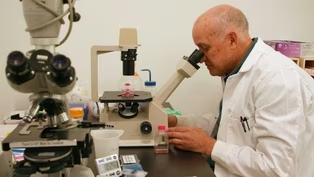
Video has Closed Captions
Clip: S5 Ep37 | 10m 23s | The race is on to sequence human RNA. (10m 23s)
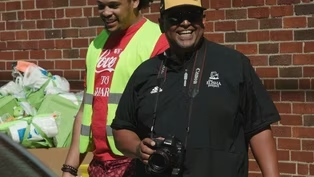
Video has Closed Captions
Clip: S5 Ep37 | 8m 56s | Unlike a food bank, the Elisha Project delivers fresh groceries and more to the community. (8m 56s)
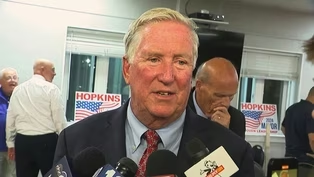
Video has Closed Captions
Clip: S5 Ep37 | 5m | Cranston’s mayor defeats Republican challenger in a hard-fought primary. (5m)
Providing Support for PBS.org
Learn Moreabout PBS online sponsorship
- News and Public Affairs

Top journalists deliver compelling original analysis of the hour's headlines.

- News and Public Affairs

FRONTLINE is investigative journalism that questions, explains and changes our world.












Support for PBS provided by:
Rhode Island PBS Weekly is a local public television program presented by Ocean State Media