
Rhode Island PBS Weekly 9/22/2024
Season 5 Episode 38 | 26m 24sVideo has Closed Captions
The on-going battle over who has the right to be on Narragansett’s Town Beach.
An in-depth report on the battle over who has the right to be on Narragansett’s Town Beach. Then, to celebrate Hispanic Heritage Month, we revisit a story about one Rhode Islander’s commitment to preserving the state’s Latino history. Finally, Michelle San Miguel and WPRI 12’s politics editor Ted Nesi discuss why Hasbro may leave the state.
Problems playing video? | Closed Captioning Feedback
Problems playing video? | Closed Captioning Feedback
Rhode Island PBS Weekly is a local public television program presented by Ocean State Media
Rhode Island PBS Weekly 9/22/2024
Season 5 Episode 38 | 26m 24sVideo has Closed Captions
An in-depth report on the battle over who has the right to be on Narragansett’s Town Beach. Then, to celebrate Hispanic Heritage Month, we revisit a story about one Rhode Islander’s commitment to preserving the state’s Latino history. Finally, Michelle San Miguel and WPRI 12’s politics editor Ted Nesi discuss why Hasbro may leave the state.
Problems playing video? | Closed Captioning Feedback
How to Watch Rhode Island PBS Weekly
Rhode Island PBS Weekly is available to stream on pbs.org and the free PBS App, available on iPhone, Apple TV, Android TV, Android smartphones, Amazon Fire TV, Amazon Fire Tablet, Roku, Samsung Smart TV, and Vizio.
Providing Support for PBS.org
Learn Moreabout PBS online sponsorship(gentle music) - [Michelle] Tonight, a battle for Narragansett Town Beach .
- They try to exclude the public and they use those measures to keep people out.
- [Pamela] Then preserving Rhode Island's Latino history.
- My first entry to the Rhode Island Latino community was here, and it was like my senses exploded.
It's like, "I'm home".
- [Michelle] And the future of Hasbro's headquarters with Ted Nesi.
(bright music) (bright music continues) - Good evening, welcome to "Rhode Island PBS Weekly".
I'm Pamela Watts.
- And I'm Michelle San Miguel.
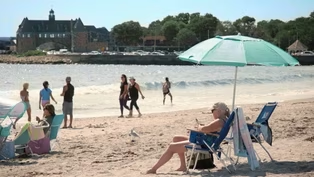
We begin tonight with a battle over who has the right to be on one of Rhode Island's most popular town beaches.
- Families regularly spend days enjoying sun, surf, and sand, but as the coastal access debate heats up across the state, the town beach has become a focus for activists who say the public is being shut out.
As part of a collaboration with the public's radio, reporters Alex Nunes and Isabella Jibilian take an in-depth look at the controversy.
(waves gently crashing) - [Isabella] Narragansett Town Beach, buffeted by warm southwest winds and gentle waves, it's known as the best place in the state to learn how to surf.
- That sea wall blocks all that disruption and filters a nice little wave for kids to learn on.
- [Isabella] Conrad Ferla taught surf lessons at this beach for more than 20 years, and it's where he got his start.
- And I would take my boat down to the river mouth and would surf all day.
- [Isabella] But in the last 20 years, that's become more and more difficult.
- And I've just seen in my lifetime it become more restrictive, harder to get to, and downright kind of strange and exclusionary.
- The character of Narragansett that most Rhode Islanders or people from New England would think of when they think of Narragansett and Narragansett Town Beach is, this is a middle class vacation area.
- [Isabella] Alex Nunes has reported on the debate over coastal access for The Public's Radio.
- Now there's this perception that Narragansett is becoming something different.
People have bought these small cottages on these lots, tore them down and put up, you know, what people refer to as like a McMansion vacation home.
So there's this feeling that this middle class vacation town has been lost in recent decades, or is at least under threat.
- What are some of the developments that we've seen in recent years when it comes to access at Narragansett Town Beach?
- So in recent years, the price of admissions onto the beach has gone up.
- [Isabella] In 2011, it cost $5 per person for a day pass.
Today it costs $12 per person.
- People from out of town used to be able to get seasonal beach passes, they can't anymore.
- [Isabella] And beach parking has become more difficult for out-of-towners.
In 2011, all day parking along Narragansett Avenue became time restricted to two hours.
Then a trolley service from overflow lots to the beach was discontinued.
In the beach parking area, the Cabana, North, and South lots, which total to about 800 spaces are for residents only.
The West lot with about 180 spaces, is open to everyone else.
On weekdays, after 1:00 PM the town can open up an additional 45 spots in the South lot to the general public.
But activists say they rarely do.
- And there are some people in Narragansett who think these changes haven't gone far enough.
- [Isabella] After a fight broke out on the beach in 2021, one resident circulated an email suggesting that the town limit buses stopping in Narragansett that non-residents enter the beach through a separate entrance.
And that non-residents should have their bags checked for weapons.
(waves crashing) - It's not by design to limit access.
It's a result of the situation that we see on the beach.
- [Isabella] Tom Warren, resident and former chairman of the Narragansett Recreational Advisory Board says, "Changes like the fee increase are for practical reasons."
- So we put two lifeguards in every chair, the diesel fuel to run the tractor that goes up and down the beach and rakes the beach every single morning.
And you know these things, you know, they cost money.
The entry fee, the parking fees are funding all the activities at the beach.
There's no town tax dollars, no residential tax dollars that go into running the beach.
- [Isabella] The revenue also feeds into a fund for maintenance and repairs in case of natural disasters.
As of 2023, it has a $5.1 million balance.
And with respect to the overflow parking and trolley to the beach, Town Council President Ewa Dzwierzynski says it's a matter of fiscal responsibility.
- It's just became more of a liability issue.
And I was not about to take that risk and bankrupt our our town.
- [Michelle] As for limiting public parking to the West lot, resident Gail Scowcroft supported the move.
- As a resident living two blocks from the beach, I'd have to get to the beach at 8:30 in the morning to get a parking spot.
It's not a state beach.
Narraganset Town Beach is a town-owned beach.
And so rightly, the town prioritizes parking for town residents, which most town beaches do.
The mindblower, right, a mile down the road, there's a gorgeous state beach with plenty of parking.
- [Isabella] There may be plenty of parking, but state beaches have other issues.
- Restricting access and making it harder for kids to go learn is actually problematic for surfing, because that's where people go and you can't surf at state beaches, unfortunately.
- The dispute in recent years has really been about kind of how people view Narragansett Town Beach.
Is this a place that's for the residents primarily?
The taxpayers in the town?
Is it like their private beach for their use and their enjoyment?
Or is it more of a place that it is to be enjoyed by the larger public?
- The beach is owned by the town.
They're operating within the legal parameters that have been established through a lot of litigation over the years.
- [Isabella] Some residents point to a 1997 Superior Court ruling that said Narragansett was not infringing on public access by charging entrance fees.
- We have dedicated parking for non-residents, and yet there are towns that do not allow non-residents to park in anywhere in their beach.
And yet those towns don't get any heat at all.
And we're a target.
- If you're on the town council and you're making these decisions, you have to be accountable and responsible to your constituents.
Your responsibility isn't to make opportunities for people who don't live in town.
Your responsibility is directly to your constituents.
So that's why those decisions come out that way, that the residents get a little bit more of a priority.
I think you could expect nothing less.
- Towns have the right to regulate certain things, but leaving towns to be in charge of shoreline access can be problematic because the incentive to reduce access is always there.
- [Isabella] Coastal access advocates point to the fact that the beach is funded by entrance fees, not municipal taxes.
And the fact that it received federal funds after Hurricane Sandy, they also point to a 1985 land swap involving this strip of beach.
The deal required the beach to be committed to public access and prohibited restricting non-residents.
- If you have a public beach and you want to privatize it, but you can't, what you will do is systematically remove public parking, and then raise rates to the point where it's so expensive that working class families can no longer go.
Frankly, it hurts the entire state.
- [Isabella] It's a debate that continues to play out.
The latest clash has centered on an iconic stretch called Ocean Road that leads to the town beach.
What changes are you looking to make regarding Ocean Road in Narragansett?
- So the changes would be a three hour time limit on Ocean Road to help with the traffic congestion during the summer months and the peak season in Narragansett.
- [Isabella] The town council put up the signs in July, but quickly saw backlash.
- State stepped in and said, "This is a state road, you can't do that."
- [Isabella] The state traffic commission held hearings.
Some residents say the policy would create much needed turnover.
- People like to get out of their cars and walk along the sidewalk there.
Clearly, I think people should have the opportunity to come and go during the day so that people that are parked to be at the beach, you know, from early in the morning through late afternoon, aren't hogging all the parking spaces.
- [Isabella] While others have advocated against the measure.
On the day we went to Narragansett, it proved unpopular among some beach goers.
- I disagree with it.
There's no need for it.
It's only four weeks where it's busy here.
So no, let them park.
- Even just to walk, like when I wanna take my family for a walk along the sea wall.
I think the access, I think the three hour parking is really ridiculous.
- Why is Ocean Road parking important?
- The West lot is tiny.
That's where they put the public, that's where they put the employees, and the general public.
That lot fills up right away, usually by like 10:30 in the morning.
Growing up, you could park in the South lot, you could park in the West lot, you could park on Narragansett Avenue.
So as Narragansett's removed all that public parking, the only place left to go is the seawall.
So if you restrict all the public parking and take it away and say, "Hey, we have a parking problem," whose fault is it?
You created the problem yourself!
- [Isabella] Earlier this month the Commission made its decision.
- The people on the Commission eventually decided "We don't think it's in the public interest to restrict parking," and they turned it down.
- [Isabella] It was a victory for the shoreline activists.
But as summer turns to fall, each side continues to advocate for their position.
All eyes are on the upcoming town council election, which has the power to shape Narragansett's future beach access.
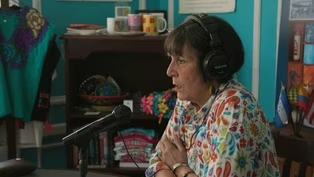
- Up next, Latinos are the largest minority group in Rhode Island, making up 17% of the state's population.
Whether it was Guatemalans who arrived as refugees or Puerto Ricans in search of agricultural work, the stories of Latinos are wide and varied.
In celebration of Hispanic Heritage Month, we're revisiting a story that aired last year about a Rhode Islander committed to preserving the state's Latino history.
(bright music) It's one of Rhode Island's most well-known neighborhoods.
- Have a good one!
- [Michelle] Broad Street in Providence, also known as La Broa, is packed with Dominican restaurants.
- So this is Mi Sueno, the owner is Dominican and he likes to welcome everybody, which is why you see all the flags.
- [Michelle] And all kinds of Dominican-owned businesses.
- This is a bodega.
This is one of the many bodegas.
- [Michelle] Marta Martinez loves to give people tours of La Broa.
- My first entry to the Rhode Island Latino community was here and it was like my senses exploded.
It's like "I'm home".
- [Michelle] She's been studying the history of Latinos in Rhode Island for more than 30 years.
- This is Juan Pablo Duarte and he is one of the founders of the Dominican Republic.
- [Michelle] To understand why communities like La Broa are shaped the way they are, Martina says, "You have to study the past and learn about a woman named Josefina Rosario, better known as Dona Fefa.
Who was Dona Fefa?
- Dona Fefa was, if I can just define her in one sentence, she's the mother of the Latino community.
She and her husband, Tony, moved to Rhode Island.
They opened the first bodega.
She was looking for her food, and she wanted platanos and yuca, and she couldn't find it.
So she says, "Well, I'm gonna open a bodega."
And she did.
- [Michelle] Fefa's Market opened on Broad Street in the early 1960s.
It went on to become a welcome site for Dominicans who left an impoverished country.
Martinez says, "Dona Fefa offered new immigrants more than a taste of their homeland".
- She would first help them find apartments or housing or jobs or schools for the kids, driver's license.
She was like an informal social worker.
And the bodega became the place where you went to find Fefa, you know, and, "I need a job.
My kids need a place to live."
We're going to hear from Dona Fefa.
It's my very first interview.
- [Michelle] Martinez sat down with Fefa in 1991 to document her story.
(Dona Fefa speaking Spanish) - [Michelle] Listening back to the crackled audio.
Martinez recalls asking Fefa about her early memories of life in Rhode Island.
- That's, she's describing the house that they, their first house where they kept all the Dominicans.
- [Michelle] Fefa later died in 2018.
She's one of about 110 Latinos in Rhode Island, whom Martinez has interviewed for the Latino Oral History Project of Rhode Island.
What sparked your interest in collecting the history of Latinos in Rhode Island?
- Yeah, so I didn't set out to do that, just that.
I had, I went to school here and I left, and then I came back.
I was hired to work for a Latino organization, a Hispanic organization at the time.
And I thought, "Well, if I'm gonna be working representing this group, I wanna know who they are."
And so I went out to look for them, if I may put it that way.
- [Michelle] Martinez found a welcoming community of Latinos on Broad Street and was eager to see what else she could learn.
- Outside of walking Broad Street, I went to the library and looked in newspapers and tried to find information and there was nothing.
The only thing I could find were newspaper articles that were negative.
Latinos arrested, Latinos in poverty.
And it just didn't seem right to me.
And I just felt that it was important that people got to see a positive side of the Latino community.
- [Michelle] That positive side includes telling people about what Martinez describes as the state's Latino pioneers.
- This is Roberto Gonzalez.
He did a lot.
- It was a time when the Latino community was just starting to come to Rhode Island.
- [Michelle] In 2004, Gonzalez, who's from Puerto Rico, was sworn into the Providence Housing Court, making him the first Latino judge in the state.
Martinez asked him about it during an interview she recorded back in 2015.
- I was used to going in the courtroom and being asked if I was the interpreter.
So here's an opportunity now, you know, to be addressed as "your honor".
- [Michelle] Martinez says, another Latino pioneer in the Ocean State is Miriam Salabert Gorriaran.
- There were all kinds of rumors that children were going to be taken from their homes, and they would be put out in the fields to cut cane.
- [Michelle] She left Cuba with her siblings in 1961 as part of Operation Peter Pan, a program that helped 14,000 children come to the United States to escape Fidel Castro's Communist regime.
In the three decades you've been doing this, what has most surprised you about what you've learned from these interviews?
- How similar their stories are and the hidden stories behind the individuals.
They, you know, most people think, "Well, I just did what I did.
I'm not, I'm nobody special."
But I remind them, you know, "What you did was huge."
I'm gonna do the interview in two languages.
- [Michelle] On this day, Martinez sat down with Soko Racano and her daughter Sessie.
They came to Rhode Island from Columbia in 1969.
Sessie's father had moved there the year before for work.
(Sessie speaking Spanish) - [Michelle] Sessie became emotional remembering what those early years were like as immigrants.
(Sessie speaking Spanish) - [Michelle] "Like Racano family," Martinez says, "there are countless stories of sacrifices."
These are the stories she wants students to learn about.
"Too often," she says, "Latino history is only briefly mentioned in history books."
- I just felt that that wasn't right.
That people needed to know more about the Latino children and the young people needed to know about the Latino history here, and who were the important people.
So she does it until it becomes transparent.
- [Michelle] Martinez wants to not only make sure that these stories are recorded in history... - So we're waiting for it to just melt, and it's nice and hot, so it will.
It's just like butter.
- [Michelle] But also the traditions continue to get passed down to the next generation.
- Okay, everybody, if you can all come up to her.
- [Michelle] She recently hosted what's known as a tamalada.
- [Marta] It's like, yeah, like wrapping a gift.
- [Michelle] People were invited to the Rhode Island Latino Arts Office in Central Falls to learn how to make a type of Peruvian tamale.
- [Marta] Everybody have two so far?
- [Michelle] Martinez is committed to preserving cultural identity through food.
(Marta speaking Spanish) - And you're passionate about not only collecting the history of Latinos in Rhode Island, but also the costumbre, the customs, making sure that that does not get lost.
- Some people told me that I should call myself a cultural preservationist because that's basically what it is.
When you retain your language, when you retain the dance of a bomba and plena.
When you play flamenco guitar.
All of those things, it's a way of preserving your culture.
So the bodega was this whole area here.
There were buildings- - Martinez showed me the site where Fefa's market once stood.
The building was demolished decades ago.
- So we're heading towards this temporary piece of art.
- [Michelle] Martinez hopes that a art piece can be erected at the site of the former bodega.
- And this is a image of Dona Fefa that was taken more recently.
- [Michelle] For now, a mural of Dona Fefa was painted over this utility box honoring a woman who Martinez says, "paved the way for future Latinos".
If not for the work that you've been doing for so many decades, how would people know about the influence that Latinos have had in Rhode Island?
- I don't know.
That's exactly, I do sit back and think about that.
And I'm very conscious because aside from the oral histories, I'm trying to create the narrative and I spend a lot of time in archives and libraries 'cause I think there's gotta be stuff here.
And I do locate it, but it's always buried.
And that my job, I feel, is to bring it to the surface and to share it.
- And finally, tonight on this episode of "Weekly Insight", Michelle and WPRI 12's politics editor Ted Nesi, discuss why the demolition of the Washington Bridge is on hold and why one of Rhode Island's most iconic businesses may leave the state.
- Ted, welcome back to the show.
Let's start with some major business news in Rhode Island.
"The Boston Business Journal" was the first to report that Hasbro is scouting new headquarter locations in greater Boston.
Hasbro executives acknowledged, "Yes, we are considering this."
But this was something that took a lot of Rhode Island leaders by surprise.
- And I'm not quite sure why it did, Michelle, because Hasbro's been seen as, I would say, a flight risk for the better part of the last decade.
If people remember back to when Gina Raimondo was governor, she was very close to Hasbro's CEO at the time, Brian Goldner, there was a lot of conversation about whether Hasbro would build a new headquarters in Pawtucket.
Would they potentially move to Providence?
It was very much in the discussion.
And Raimondo said over and over, you know, she kept very close to them for this reason and to say, "You know, let's figure this out together".
But by the end of 2021, Raimondo was gone to Washington and Goldner sadly had died.
He got cancer.
And since then you've had a lot of changes at Hasbro.
A new CEO, Chris Cox, they've struggled a bit in the post pandemic environment as people are buying fewer toys, they're trying to do digital gaming, a ton of changes.
And it's not clear to me now, after everything that came out this week that state officials really prioritized a consistent dialogue with them.
- After the news broke, the Hasbro CEO told employees, "Look, we are considering this.
Nothing is final."
How likely do you think a move to Massachusetts would be at this point?
- It's hard to say.
I wouldn't want to get over my skis about how confident I'm in either direction.
I do know some people think this is some sort of play for state tax incentives by Hasbro to get a deal.
That's possible, but I do also think people should be clear-eyed about the reasons they might wanna go to Greater Boston.
It's obviously a bigger city than Pawtucket.
It's got that kind of tech edge that you don't really have in an industrial place like Pawtucket, which again, kind of reflects how the company sees itself changing into something with more of a digital presence.
And then also, you know, Hasbro stands for Hassenfeld Brothers.
The Hassenfeld's founded it in Rhode Island a century ago.
Well, Alan Hassenfeld, who was the last member of his family to serve on the Hasbro board, left the board earlier this year.
So I think that's another tie to Rhode Island of Hasbro's that's gone now.
- And Cox has said, "If we do relocate, it would be at least 18 months from now."
So we'll be following this story.
But I feel for the people of Pawtucket who lost the PawSox a few years ago and now stand to lose Hasbro.
- Yes, well, you know, we don't wanna get ahead of ourselves that it's certain.
If it were to happen, Michelle, it would be another big blow to that city.
- Okay, another story we've been following all year is the crisis surrounding the Washington Bridge.
The state unexpectedly paused demolition of the bridge on September 17th, citing the lawsuit that was filed last month against contractors who were working on the bridge.
The big question for me is why didn't the state think of this sooner?
- Yes, and I think a lot of people asking the same question, Michelle.
There has been a tension, or at least a lot of us have thought, there's been a tension all through this year between the McKee administration's desire to build a new bridge, build it fast, get it up there, and end the disruption.
But also to pursue this litigation against a lot of construction companies.
You see here that the demolition had to pause because they needed evidence.
They said from the, from the old bridge, they couldn't keep taking it down.
But you also saw it.
No bids came in when they tried to, when they put out the bidding process for a new bridge.
Many people think that was partly 'cause of the message sent to the construction industry by filing this litigation.
You've certainly heard that.
So I think that tension is real, even if state officials don't wanna admit it.
- And they are being very tightlipped about this issue.
What are the big questions that you still have for them?
- Well, I watched all week, as reporters might say, every news outlet in Rhode Island tried to get answers and struggled, frankly.
They're claiming this demolition pause won't last long.
Maybe it'll be over by the time people are watching us here, but we don't know that.
We still don't know when they're gonna start a new bidding process, when they're gonna have the revised bid documents out for the new bridge.
And we have no idea how much it's going to cost.
I mean, they were talking about maybe close to half a billion dollars, but it could be much more than that.
We just don't know.
There's so many things we don't know, even after all these months.
- The through line of this conversation is the unknowns with Hasbro relocating, the unknowns of the demolition, when that's gonna start.
A lot of- - A lot of "I don't know."
- Of I don't know.
Yeah, yeah.
No, fair enough!
Thanks so much Ted, always good to see you.
- Great to be here.
- And that's our broadcast this evening.
Thank you for joining us.
I'm Pamela Watts.
- And I'm Michelle San Miguel.
We'll be back next week with another edition of "Rhode Island PBS Weekly".
Until then, please follow us on Facebook and X, and visit us online to see all of our stories and past episodes at ripbs.org/weekly or listen to our podcasts on your favorite streaming platform.
Goodnight.
(bright music) (bright music continues) (bright music continues) (bright music continues) (bright music continues) (bright music fades)
Video has Closed Captions
Clip: S5 Ep38 | 9m 50s | One Rhode Islander’s commitment to preserve the state’s Latino history. (9m 50s)
Video has Closed Captions
Clip: S5 Ep38 | 11m 48s | Has the public been unfairly shut out of Narragansett Town Beach? (11m 48s)

Video has Closed Captions
Clip: S5 Ep38 | 4m 4s | Toy giant Hasbro is considering moving its headquarters from Rhode Island to Massachusetts. (4m 4s)
Providing Support for PBS.org
Learn Moreabout PBS online sponsorship
- News and Public Affairs

Top journalists deliver compelling original analysis of the hour's headlines.

- News and Public Affairs

FRONTLINE is investigative journalism that questions, explains and changes our world.












Support for PBS provided by:
Rhode Island PBS Weekly is a local public television program presented by Ocean State Media