
Rhode Island PBS Weekly 9/24/2023
Season 4 Episode 39 | 26m 26sVideo has Closed Captions
Early Intervention for infants and toddlers and the ongoing fight for swim safety.
Uncover the RI crisis of why infants and toddlers with developmental delays are waiting months for critical, federally-mandated Early Intervention services. Then, an in-depth report on the number of American children who can't swim and how racism has barred generations of swimmers from pools. Finally, see behind the scenes at Whooplah Studio—home of the new children’s show, Pollywog Pond.
Problems playing video? | Closed Captioning Feedback
Problems playing video? | Closed Captioning Feedback
Rhode Island PBS Weekly is a local public television program presented by Ocean State Media
Rhode Island PBS Weekly 9/24/2023
Season 4 Episode 39 | 26m 26sVideo has Closed Captions
Uncover the RI crisis of why infants and toddlers with developmental delays are waiting months for critical, federally-mandated Early Intervention services. Then, an in-depth report on the number of American children who can't swim and how racism has barred generations of swimmers from pools. Finally, see behind the scenes at Whooplah Studio—home of the new children’s show, Pollywog Pond.
Problems playing video? | Closed Captioning Feedback
How to Watch Rhode Island PBS Weekly
Rhode Island PBS Weekly is available to stream on pbs.org and the free PBS App, available on iPhone, Apple TV, Android TV, Android smartphones, Amazon Fire TV, Amazon Fire Tablet, Roku, Samsung Smart TV, and Vizio.
Providing Support for PBS.org
Learn Moreabout PBS online sponsorship(soft upbeat music) - [Pamela] Tonight, why is Rhode Island failing to provide early intervention programs for hundreds of children?
- They're waiting a really long time.
I mean, it's criminal.
- [Michelle] Then swim safety and race.
- She watched her son drought, she could not swim.
- [Pamela] And a look inside the mind behind the new Rhode Island PBS children's show "Pollywog Pond".
- I always thought I had to work and this is not work.
(bright upbeat music) (bright upbeat music) - Welcome to "Rhode Island PBS Weekly", I'm Pamela Watts.
- And I'm Michelle San Miguel.
Tonight we welcome Boston Globe reporter Steph Machado.
She recently joined Rhode Island PBS and will be a regular contributor here and on our political talk show, "A Lively Experiment".
- And Steph recently has been looking into a problem affecting some of Rhode Island's youngest children.
Many face a long wait to get into early intervention, a program for infants and toddlers with developmental delays.
The current wait times in Rhode Island actually violate federal law, but advocates say only children are being punished.
- [Steph] Two and a half year old Levi loves to play and run around.
- More?
- I want more.
- You want more, good job.
- [Steph] He also has some delays that have concerned his mom, Olivia Ippolito, since he was a baby.
Developmentally, she says, he's about 18 months old.
He was late to walk and struggles with speaking.
- He can say a lot of things but they don't make sense together.
- [Steph] From birth until age three, children in Rhode Island with developmental disabilities, just like Levi, are entitled at no cost to services known as early intervention.
Roughly 4,000 children are in the program each year.
But getting Levi in proved difficult.
- I didn't realize it would take that long and then I would have to hound people for so long.
- What were they telling you?
- Sorry, we have a wait list.
- [Steph] Levi's pediatrician referred him last year.
Ippolito says all she got at first were pamphlets.
- I was pretty mad about it.
What am I gonna do?
Report them to the government, they're the government.
- [Steph] Federal law requires children wait less than 45 days for an initial visit, but for Levi, it took a full nine months.
His occupational therapist now comes to his home to work with him.
- Ba, ba, bye.
- But after waiting all this time, at two and a half, Levi is just months away from turning three which will make him ineligible for the program.
What are you most worried about when it comes to how long it has taken for him to get these services.
- That he is gonna get stuck?
It's a very tight window.
- They're waiting a really long time.
I mean, it's criminal.
It is just awful.
- [Steph] John Kelly is the president of Meeting Street, the largest provider of early intervention in Rhode Island.
There are nine private agencies total overseen by the state.
Meeting Street alone has a wait list of more than 400 children.
The backlog started during the pandemic.
- We have a service requirement you have to provide, you have to do that initial visit within 45 days, the 45-day rule, we weren't meeting it.
No provider was meeting it.
- [Steph] Initially, the state took over the wait list in 2021.
It grew to more than 1,000 infants and toddlers.
Ultimately, the providers asked for control back.
So now there are nine separate waiting lists.
As of August, Rhode Island had more than 900 children waiting for early intervention services.
Many of them, like Levi, far beyond the 45-day timeframe in federal law.
- The child gets on the wait list and by the time you're able to get them, they're within a year of aging out.
And we know how critical it is to get through them those early years and that's painful.
- [Steph] Kelly says he is clear about what's causing the long wait.
- We're short staffed.
Everybody's short staffed.
And unfortunately, people don't wanna hear it but that comes down to money.
- [Steph] Private providers like Meeting Street are paid for early intervention through a family's health insurance, either Medicaid or private insurers, but it doesn't fully cover the cost, Kelly says, the nonprofit has to ask for donations to support its special education programs including early intervention.
- So the federal government and the state have said, "No, this is a mandated entitlement.
"We're just not gonna pay for it all."
- And what do you think of that?
- I think it's outrageous.
If you think it's that important, pay for it.
- [Steph] Speech, physical and occupational therapists are in high demand in other settings such as hospitals and schools where they can make more money than in an early intervention program.
- We're getting interviews and they're turning us down because of pay.
- [Steph] For the first time in two decades, Rhode Island lawmakers raised the Medicaid reimbursement rates by 45% last year but Kelly says it wasn't enough.
- Speaker Shekarchi was very helpful, we were grateful for that.
And you're nervous about, you know what I mean?
Thank you but we need the rest.
So that's kinda where we are.
- Early intervention is run out of the State's Health and Human Services Agency where a spokesperson declined to make anyone available to talk about the crisis or how Governor McKee's administration plans to fix it.
In an email, the spokesperson pointed to COVID relief money McKee has directed to early intervention providers and said the state has led an effort to recruit more staff.
The U.S. Department of Education tracks state's compliance with the 45-day timeframe to get an initial meeting.
Here's how Rhode Island stacks up against the rest of New England.
Connecticut and New Hampshire are meeting the requirements of the law according to the federal agency.
Massachusetts and Maine are categorized under needs assistance for one year.
And Rhode Island and Vermont are under needs assistance for two or more consecutive years.
- Having 900 Or more kids waiting for early intervention services is really not something that we should be doing.
- Leanne Barrett is the senior policy analyst at Rhode Island Kids Count which tracks data and advocates for children's wellbeing.
- Every single day, every week, every month that a kid does not get the services they need for healthy development and learning including an infancy, that the further they fall behind their peers who are getting the services they need.
- What would be an acceptable wait list number?
- Well, I don't think that we should have any wait list.
There should be no children who are waiting more than 45 days.
The numbers should be zero.
- [Steph] Kids Count is part of a larger group called the Right From The Start campaign that's asking for another Medicaid rate increase in next year's state budget.
A rate increase would also apply to private insurers.
- We're also looking at trying to get a cost of living adjustment into state law.
We're looking at what else can we do to help recruit people to work in early intervention.
What can we do to raise those wages to be competitive with the community?
- Early childhood and particularly early intervention is not valued the way it should be valued.
- [Steph] And John Kelly says, failing to provide timely early intervention has an enormous ripple effect.
- Not having a robust early childhood system has long-term implications on society and on our functioning of everything.
The impact that has on a child's employability, on a child's happiness, on a child's sociability, on the tax revenues of a state or municipality is profound.
And it's really, it starts at that age.
- [Steph] For Olivia Ippolito, the effects have already been staggering.
While waiting for early intervention, she says Levi was forced to leave his daycare.
The childcare center told her he needs one-on-one attention which they couldn't offer.
- They're like, "Well, he needs a smaller ratio," but there are no smaller ratios anywhere.
- [Steph] As a single mom without childcare, this past summer, Ippolito says she couldn't go to her job as a licensed practical nurse where she works with children with medical needs.
- There's a whole family that's gonna suffer because I don't have anywhere to send him to daycare.
- Because you can't work.
- Because I can't work.
So it's at least one to two other families that are affected.
- If you had a chance to meet with the governor, meet with state leaders and tell them your story, what would you say to them?
- Why do you think that my kids aren't worth it?
Why are you putting money into other things but my kids who can't fend for themselves are not worth it?
That's sad.
- Governor McKee has not yet weighed in on whether he will propose a Medicaid rate increase in his upcoming budget in January.
And just weeks after our interview in August with Olivia Ippolito, she was able to get her son, Levi, into private daycare allowing her to go back to work.
You can read more about this story in the Boston Globe at globe.com/ri.
- Up next, many Rhode Islanders spent their summers splashing in the ocean but studies show that a surprising number of American children cannot swim.
In our next story, producer Isabel Jibilian reports on the often tragic issue of swim safety and how some Americans are at greater risk than others.
- One night, phone call, woman sobbing on the phone telling me that her child had drowned at five o'clock at Lincoln Woods.
- [Isabel] It was the early 90s and Ray Rickman was a Rhode Island state representative.
- And the coroner had his body and would not release it.
She was Islamic.
And I know enough about religion to know you're supposed to be buried within 24 hours.
I called the coroner and he wouldn't release the body.
In fact, he hung up on me and I walked over to the Capitol, two blocks, saw the governor without appointment and said, "Governor Sundlun, I need you to get this done."
- [Isabel] Rickman was able to get the teenage boy's body released but he couldn't forget this mother's pain.
- She watched her son drown.
She could not swim.
Can you imagine?
You can't imagine.
- In the United States, an average of 11 people are drowning every day.
So we're losing 4,000 people a year to drowning.
It's the leading cause of death for children from one to four.
- [Isabel] Mara Gay was an avid swimmer growing up.
Today she's on The New York Times editorial board.
- Drowning is something that affects Americans of all backgrounds.
However, it does disproportionately affect minorities and in particular, Black and native communities.
- [Isabel] According to the Centers for Disease Control and Prevention, Black children are 1.5 times more likely and Native American children are two times more likely than white children to die of drowning.
Gay says, for African Americans, the gap is rooted in history.
- It goes really deep.
So Black Americans, many people know were not allowed to learn how to read during slavery.
Many times they also weren't allowed to learn how to swim.
And that's because it would've made it easier to escape to freedom.
Dogs couldn't track your scent in water which was known among enslaved Americans.
During segregation, you had public pools that were not open to Black Americans.
- [Isabel] And after segregation, many Black Americans were still unwelcome.
Storyteller of V. Raffini grew up in Rhode Island.
- We were like around nine, 10.
This was '68, '69.
Pools weren't segregated but they were racist.
And when we got there, we dealt with the racism.
We've had our lunches stolen, we've had them smashed, spin on our food and leave it so you could see this.
I can remember them calling us names like the walking Tootsie Roll or there's a Hershey bar in the in the pool.
And all straight out coming out with the N word.
It was shocking to us and it hurt our feelings but also made us angry.
So we end up getting into fights at the pool and getting kicked out of the pool and not able to come back for that summer.
- [Isabel] Intimidation wasn't the only way African Americans were driven out of pools.
- Many communities across the south, but also elsewhere unfortunately, chose to fill in, destroy or close their public pools rather than allow Black Americans to swim in them.
So white wealthier Americans who were able to started forming their own clubs, their own neighborhood associations that were of course, segregated and the rest of America was shut out.
You would never take similarly your child and put them in a car without a car seat.
And yet, we find it completely acceptable in American society to allow generations and millions of children to grow up without learning how to swim or be safe around the water.
- [Isabel] In Rhode Island, multiple generations of the Willis family are working to reverse that trend through their business Orca Aquatics.
Wayne Willis- - Do 1:25, just focus in.
- [Isabel] And his son Dylan.
- One, two, three, four.
- [Isabel] Coach the swim team.
Wayne's daughter Sydney and wife Joanna teach lessons and his sister Leslie manages arriving families.
Some of their students are able to learn for free, thanks to Ray Rickman.
- Our number one goal is to teach now low-income children to swim and to avoid drowning.
- [Isabel] He started a program called Swim Empowerment to sponsor swim lessons for Black and low-income youth.
It was a promise to a heartbroken mother.
- This is my commitment to her.
- [Isabel] He raises money for the effort at his bookstore and museum Stages of Freedom.
- Here's first edition, "A Story of Race and Inheritance".
It is autographed by Barack Obama and the last one sold for 4,200.
When you get 5,000 bucks, that's 50 kids learning how to swim from one book.
You go, are you kidding me?
- [Isabel] 2,600 children have learned to swim through his program so far.
Some go to Orca Aquatics, others to the YMCA, but lessons are only the beginning.
- I have these five year old Black kids say to me, "Okay, Mr. Rickman, will you pay for me to join the Y now?
"Those five people I was swimming with, "they're all joining the Y next week, can you pay for me?"
I say, "No, I don't have the money."
- I've spent a lot of time calling for more free swim lessons.
I believe firmly that that's a part of the solution.
But what I've found is actually that the reason so many Americans can't swim is because they don't have safe places to learn to do so.
Public pools are the critical piece of this puzzle.
So it would be the equivalent of calling for education for all Americans without having any schools.
- [Isabel] Orca Aquatics has felt that squeeze.
In August, a chlorine explosion occurred at the North Providence Pool closing the facilities where they usually ran programs.
For weeks, they called countless pools across the state and were repeatedly turned away.
Until the problem is fixed, they're practicing at Rhode Island College's pool but have had to cut back swim lessons from seven days a week to three.
The shortage of pools has inspired Ray Rickman to pursue a new dream.
- And we're doing the first draft of a proposal to build a $20 million Olympic plus swimming pool for the people of Providence to come free to swim.
And again, I told you it's for everybody, the richest people on the east side and the lowest income folks from Silver Lake.
And we're gonna get it done.
- [Isabel] The next steps, Ray Rickman needs to get Rhode Island Senate President and Speaker of the House on board so that the pool can eventually be added to the state budget.
- Swimming is one of the most exciting things you can do.
You don't know that until you do it.
That's what I hope for this whole community.
(soft upbeat music) - There are some new faces in the Rhode Island PBS neighborhood.
They are the critters from our locally produced children's program "Polywog Pond".
The stars of the show are made by an artist who is both puppeteer and video game creator.
And he does it all from his Rhode Island home.
Tonight we take a plunge behind the scenes of "Polywog Pond".
♪ Hello there and welcome ♪ ♪ It's great to see you drop by ♪ - We were just talking about how lucky we all are to be such good friends.
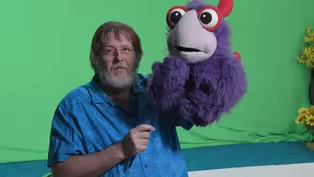
- [Pamela] This cast of characters from the new Rhode Island PBS children's show "Polywog Pond" spring from the imagination of Bill Culbertson.
- Just like a river going downhill.
(roars) - [Pamela] Who says he sees himself as just a big kid.
- I like to think I'm an eight year old, so that was a good time.
A lot of things happening and you're kinda on the border to understanding adult things but you still want a foot back there.
- [Pamela] Culbertson path to programming for children started as a fine art student, earning a graduate degree in sculpture from Rhode Island School of Design.
- Just as I graduated, Hasbro was reintroducing G.I.
Joe, the three and three quarter inch one, and they were just starting to work on those sculptures and they needed a sculptor.
I applied for the job, got hired before the end of the interview and that's how it all started from there.
It was basically dumb luck.
- [Pamela] Not only did he begin sculpting the action figures for Rhode Island based toy company Hasbro, he actually became one.
His department was designing so many dolls, a new soldier in the series had to be farmed out to a freelance artist.
- It was supposed to be looking like Robert Redford, didn't look like him at all.
So they said, "Well, we've gotta redo it "and it's money to do that."
And then somebody said, this looks like Culbertson.
So they all came around and sat behind my desk and was like, What?
"Oh God, it is, it looks like him.
"What a waste of money."
So instead of redoing it, they just named him Wild Bill and I became the character.
- [Pamela] Wild Bill, as the doll was named, kept Culbertson busy as well as sculpting popular Hasbro toys like My Little Pony.
- We did ponies, Charmkins, boys Toys, girls Toys, pre-school.
I actually benefited because I couldn't sculpt any category.
- [Pamela] And that led to other make-believe worlds.
Culbertson decided to become a freelance artist, modeling toys for Disney and Nickelodeon.
- And I slowly built up a clientele.
I worked a lot with "Sesame Street", Jim Henson.
I learned how to do the puppet stuff, mainly with working with people at "Sesame Street".
Jim Henson would tell you how to work a puppet, it's not like this, it's you go forward.
When we talk, our top of our head doesn't go up and down, our jaw goes up and down.
So little things like that.
- What is it about being a puppeteer that intrigues you?
- I guess just that it's, you can make that thing come alive and it has a personality but you know how it's gonna react to somebody.
You know the, as soon as you put the puppet on, he's automatically doing something.
And I may not even be paying attention but he's still doing something.
- Did you ever think you'd be doing this as a career?
- No, 'cause I always thought I had to work and this is not work.
- [Pamela] But it does take creativity.
Culbertson began crafting his own puppets at home.
First sketching them out and then sculpting the animals of "Polywog Pond".
- This one's Berb, he's the big one with all the personality.
This is Derb, so they're in scale with each other.
Here's Waddle, the pink female.
- [Pamela] Culbertson transformed a spare room into his Hoopla Production Studio and had to learn a new skill to bring his crew to life.
- I started sewing and I didn't know how to sew, so I got my mom's old Singer sewing machine.
It only goes forward and backwards and through trial and error, ended up learning how to sew in the seams and all that stuff.
And sort of like in the movie "Alien" where there's all those mutations and stuff, I've got lots of mutations of these until we got to the ones that were just right.
So this is the third project and I told you it's the humanoid figure.
- [Pamela] As Culbertson was making creatures and developing his children's program, he started teaching computer generated 3D drawing at New England Tech for students learning to design video games.
- It's the human figure, you're gonna be accentuating the muscles, exaggerating them, kinda like a Marvel superhero type of thing.
Student came up and said, "Do you wanna make a game with your characters?"
Why didn't I think of that?
So we did, and in three months, we built the basic framework of Polywog Pond, the video game.
As soon as the puppet starts to move, we gotta move the tree with it.
- [Pamela] Polywog Pond immerses the puppets in a video game environment.
- So now the puppets, live puppets are in the game and it's a unique look, different than the other shows we've seen out there.
It's where it's supposed to be.
It's the world I wanted and it's all there.
- [Pamela] As an example of how his world works, I took a dip into Pollywog Pond.
- Hi, miss Pamela.
- Hi, Derb, it's good to see you.
Interacting with Culbertson's puppet, we said our lines in front of a green screen.
Everyone here at the park to pick up trash.
I see you have a trash bag too.
And after Bill edits our session, here's what the finished product looks like when the computer generated video game background is added.
Are you picking up litter today?
- Yes, I am.
I'm here with Berb, Wallow and Weep.
- We're a soft curriculum.
We're not doing A, B, C, one, two, three, we're doing social emotional skills which is critical in schools right now, especially after coming outta COVID.
A lot of kids didn't get, they've missed stuff, so they need to be caught up.
- [Pamela] Culbertson hopes "Pollywog Pond" will make a big splash with preschoolers and their parents by underscoring the message with original songs such as this one with the voice finalist, Michelle Brooks Thompson.
♪ I'm having a perfectly awful bad day.
♪ ♪ A terrible lousy sad day ♪ ♪ What's your name?
♪ - Derb.
♪ I'd like to get to know you ♪ - Greg Cooney is musical director for "Pollywog Pond".
♪ Say it again ♪ - Derb.
Our themes are just like, what's happening in your daily life?
It doesn't have to be a big complicated thing, just a simple little thing that happens.
- Never know, never know.
- [Pamela] Culbertson performs two of the puppets; Derb and Weep.
- Well, hello to you too.
- [Pamela] And two other puppeteers handle Berb and Waddle.
But since Culbertson writes the scripts, he says there's a bit of him in all the characters.
- Those are all me, it's different parts of my personality.
So when I watch the show, it's like, "Okay, what am I saying now?"
Oh, and how am I gonna react like that?
But they're all different, so it's like you take your personality and chop it up.
And I know I'm gonna be this way and I'm gonna be this way with this character.
And the puppeteers we have are fantastic.
They have been able to just absorb the personalities of them.
And now I watch and I go, "My God, it's real.
"It's over there.
"It's actually me.
"I know, wow."
It just blows my mind to see 'em.
- At the heart of your show, what do you want it to be for children?
- A safe place to go to, place they trust.
I can go watch this and be interested in what they're doing.
It's just like having friends.
They're there and maybe subliminally or somehow I'm learning from them.
- We knew you would make a great friend.
You had the right stuff.
You were kind, consider considerate and cared about others.
- But I think that's part of what we're after, is how do you be a nice person?
You know, just be a normal, nice person in society.
- If you know Pamela, it should come as no surprise, she is a natural around puppets.
And for the record, she is genuinely kind.
And on that note, that's our broadcast this evening.
Thank you for joining us, I'm Michelle San Miguel.
- And I'm Pamela Watts, we'll be back next week with another edition of "Rhode Island PBS Weekly".
Until then, please follow us on Facebook and X and visit us online to see all of our stories and past episodes at ripbs.org/weekly.
Or you can listen to our podcast on your favorite streaming platform.
Goodnight.
(bright upbeat music) (bright upbeat music) (bright upbeat music) (bright upbeat music) (bright upbeat music)

Video has Closed Captions
Clip: S4 Ep39 | 8m 26s | Infants and toddlers with developmental disabilities forced to wait for critical services. (8m 26s)
Video has Closed Captions
Clip: S4 Ep39 | 9m 14s | Meet a local puppeteer, video game developer and creator of RIPBS kid’s show Pollywog Pond (9m 14s)

Video has Closed Captions
Clip: S4 Ep39 | 8m 43s | The fight for swim safety in Rhode Island. (8m 43s)
Providing Support for PBS.org
Learn Moreabout PBS online sponsorship
- News and Public Affairs

Top journalists deliver compelling original analysis of the hour's headlines.

- News and Public Affairs

FRONTLINE is investigative journalism that questions, explains and changes our world.












Support for PBS provided by:
Rhode Island PBS Weekly is a local public television program presented by Ocean State Media