
Rhode Island PBS Weekly 9/29/2024
Season 5 Episode 39 | 24m 59sVideo has Closed Captions
The history of stone walls and the iconic state bird, the Rhode Island Red.
Michelle San Miguel explores the stone walls that surround New England and interviews experts who say the historic walls function as more than a barrier. Then, Pamela Watts gives us a history lesson on our state bird, the Rhode Island Red. And photojournalist Michael Frank introduces us to a master cobbler from West Warwick. Plus, a new Weekly Insight.
Problems playing video? | Closed Captioning Feedback
Problems playing video? | Closed Captioning Feedback
Rhode Island PBS Weekly is a local public television program presented by Ocean State Media
Rhode Island PBS Weekly 9/29/2024
Season 5 Episode 39 | 24m 59sVideo has Closed Captions
Michelle San Miguel explores the stone walls that surround New England and interviews experts who say the historic walls function as more than a barrier. Then, Pamela Watts gives us a history lesson on our state bird, the Rhode Island Red. And photojournalist Michael Frank introduces us to a master cobbler from West Warwick. Plus, a new Weekly Insight.
Problems playing video? | Closed Captioning Feedback
How to Watch Rhode Island PBS Weekly
Rhode Island PBS Weekly is available to stream on pbs.org and the free PBS App, available on iPhone, Apple TV, Android TV, Android smartphones, Amazon Fire TV, Amazon Fire Tablet, Roku, Samsung Smart TV, and Vizio.
Providing Support for PBS.org
Learn Moreabout PBS online sponsorship- [Michelle] Tonight, the enduring legacy of Southern New England's stone walls.
- When you're here fixing a wall, it's like you're transported back in time.
- [Pamela] And the 100-year-old professor who has taken the Rhode Island Red under his wing.
- [Michelle] Then, the art of cobbling in West Warwick.
- People come in and say, "It's my favorite, "favorite shoes," that's the bottom line.
- [Pamela] And unpacking the Lifespan executive shakeup with Ted Nesi.
(upbeat music) - Good evening and welcome to Rhode Island PBS Weekly.
I'm Michelle San Miguel.
- And I'm Pamela Watts.
We begin tonight in the fields of New England.
- Take a walk through the woods and you're bound to come across long stretches of stone walls.
Many were built more than two centuries ago.
These historic walls function as more than a barrier.
A local geologist says they unite the region in a way that nothing else does.
- [Mike] I've always had a deep interest in history, especially local history in Rhode Island history.
And when you're working on these walls, there's something really magical about it because you know that other people have put each of these stones into place.
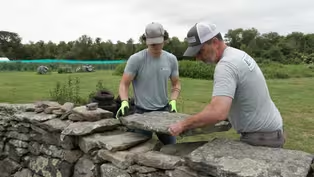
- Mike Minto has been building and repairing stone walls for about 20 years, a skill he's passed down to his son.
When Minto was in high school, he spent his summers working on a farm, fixing collapsed stone walls was part of the job.
Minto went on to become an English teacher and then a farmer, but his love of masonry kept tugging at him.
Did you wonder, can I build a career out of this?
- Yeah.
I had a moment where I was really thinking about what do I want to really do with my life?
How do I wanna spend my days?
I didn't want to have a 9 to 5 job.
I wanted to blend my career with a lifestyle.
- A lifestyle that revolves around history and the outdoors.
Minto is the owner of Rhode Island Stone Walls.
Most of his work centers around restoring them, including at Casey Farm in Saunders Town.
The property which is owned by Historic New England features more than 10 miles of stone walls.
- Well, a lot of times walls will start to sag.
And if it's a repair as opposed to a full restoration of a wall, you basically take out a section of the wall and you do it with two diagonals so that you can tie into the existing wall.
And you're generally trying to make it match what's on either side of it so that it doesn't look like you just fixed a spot in the wall.
- It's really, really well built.
- [Michelle] Robert Thorson is also mesmerized by stone walls, a fascination that began when he moved from Alaska to Connecticut in the mid '80s.
- I could not believe how many stone walls were there in the forests of Eastern Connecticut.
And I just said, "What is that thing?
Why are they different?
Why do they look the way they do?
Stones are selected for the purposes of lying flat on the top.
- [Michelle] Thorson has been studying them for decades.
He's a professor of Earth sciences at the University of Connecticut.
He describes stone walls as a signature landform in New England, the region has hard crystalline rocks that were spread out by retreating glaciers.
As forests were cleared to create farmland, glacial stones were then used to separate fields and pastures.
- When you change the land by removing the trees, you change the physics of the soil and that causes the concentration of stone after you've settled.
And when you have enough stone along a border, you can begin to do something with it, especially if you're running outta wood.
What we have here is a wall that was probably blasted out for this trail so the stone was moved a little bit.
- [Michelle] For Thorson these walls represent hard work and tenacity.
- These stone walls are fantastic symbols of the new republic, the early Americans, the prideful development of a country before the the troubles of the Civil War.
- [Michelle] But Thorson says these walls also reveal a darker part of America's history.
- There's no doubt that some slaves built stone walls, and there's no doubt that prisoners built stone walls.
There's no doubt that there's some nastiness associated with the construction, but the vast majority are built by people who live on the farm with stones from the farm with money from on the farm.
- How does Rhode Island stack up against the other New England states in terms of the amount of stone walls that we have here?
- Well, Rhode Island wins the prize for having the most concentrated stone walls.
And part of that has to do with the fact that it's a small state just by measurement.
But most of it is it settled early on very hard rocks by very enterprising people, okay?
And they just stayed and stayed and stayed.
And so, the longer you stay in one place, the more the stone walls become built up and well organized.
- [Michelle] Including in Southern Rhode Island where farming was big business and high walls were needed to keep in livestock.
Farm records at Casey Farm indicate there was a farmer in the 1780s who built more than 900 feet of five foot walls around the barnyard and pastures in exchange for 650 pounds of Narraganset cheese.
Minto says, the rich history here captures the essence of what he loves about the work.
- When you're here fixing a wall, it's like you're transported back in time.
These walls are old, most of them.
Some of these were built in the late 1700s.
Most of the wall building in this area was more late 1700s, early 1800s, but some of these walls are older than that 'cause this land was cleared very early.
- [Michelle] Minto's 19-year-old son, Ben, enjoys working alongside his dad and he feels the responsibility of the job.
- I think all over New England stone walls are so important and historical and tell such a story that as someone who's repairing or building them, I think you have a duty to do the absolute best you can and take your time with the work.
- [Michelle] It's work that provides a home and hiding spot for various animals, including chipmunks and snakes.
Thorson says it's important that all New England communities have a plan in place to protect these historic walls.
- In some places, you can go into a rural property and you need a permit to take down an old barn, and you need a permit to dig a little peat or to take out a little bit of sand and gravel out of it.
But you can do whatever you want with the stone walls over that there's no regulations 'cause we just simply haven't developed them yet.
- [Michelle] Thorson encourages people to wander through the woods and go wall watching.
He appreciates the detail that went into cobbling together all of these stones.
- It's not just a wall, somebody made it, some living, breathing person who cares about his breakfast and the fate of his children built that wall.
And the cool thing about that, who somebody like me who comes from Alaska and arrives in New England, they unify this place in a way that nothing else does.
- Up next, preserving another iconic Rhode Island symbol.
Tonight, we introduce you to a local centenarian who is on a mission to ensure the Ocean State's favorite bird is not forgotten.
- Yeah, here we go, chicks.
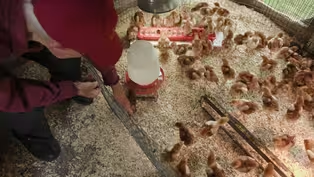
- [Pamela] 100-year-old Wayne Durfee likes spending time with a lot of young chicks, Rhode Island Reds to be exact.
Some of these little peeps will grow into roosters with striking plumage.
This is the Ocean State's official bird.
- That color of the Rhode Island Red, kind of a deep mahogany red of the body and the black tail feathers is very distinctive.
Beauty is in the eye of the beholder.
I think they're beautiful, but not everybody does.
- [Pamela] Yeah, Durfee has always had an expert eye for poultry, beginning as a little boy on his family's farm in North Situate where he was born and raised.
- I can remember very clearly going up and getting scratch feed, you know, it's a combination of corn and oats, wheat, scratch grains, and putting them in my pocket.
And then I'd go down to the house and I can remember sitting on the back step in the sunshine and reaching in and getting some corn.
And, "Here, chick, chick, chick, chick, chick, chick, chick."
My goodness, they'd come from everywhere.
- [Pamela] Durfee left that bucolic setting right after high school to join the Navy during World War II.
He served as a torpedo man, launching depth charges at sea.
Durfee later went to school on the GI Bill, eventually, earning his doctorate.
He taught for decades at the University of Rhode Island, where he's now Professor Emeritus of Animal Science.
Durfee, also volunteers here, at the South County Museum.
- My only goal, my only real purpose here, I guess, is to be sure that the hatching schedule is developed.
- [Pamela] Durfee watches over the chicks like a mother hen supervising their arrival for an annual community event.
- Those eggs have to go in the incubator on a day in June in order to hatch three days before the 4th of July.
That's so that on the 4th of July, little kids can come in and they got chicks to handle.
And they were hatched right here.
They're a single comb Rhode Island Red.
- [Pamela] Durfee says he admires the Rhode Island Red because it's a hearty breed that can withstand harsh New England winters.
And he says it's also gentle, social, and a chicken that's productive as well as attractive, known for both meat and big brown eggs.
- They were competing with other breeds from all over the world up at the Rhode Island egg laying test.
And the Rhode Island Reds always came out very well.
The original Rhode Island Red, the male was purchased from a whaling vessel.
(gentle folk music) - [Pamela] That rooster came to our shores in 1854 according to Marjory O'Toole, executive director of the Little Compton Historical Society.
- Very customary in the 1800s for our farms to take market wagons to the docks in New Bedford, bring produce to the whaling ships.
And, in return, sometimes those farmers would return with items that had been brought in from all over the world.
- [Pamela] Little Compton poultry farmer, William Tripp fancied the exotic rooster that had voyaged from the far east.
- And William bred it with his barnyard chickens.
And he noticed that their offspring were bigger and better than anything that we had seen in Little Compton before.
- [Pamela] The all-purpose poultry became popularly known as Tripp's fowls.
Yet another little Compton farmer, Isaac Wilbur, took it a step further.
He crossed, bred the Rouge Rooster with hens at his barnyard here.
And the Rhode Island Red revolutionized the industry.
- At one time, he had as many as 5,000 birds.
The eggs and the birds are starting to be shipped all over the country, Canada and some sources even say Europe.
- So was this the biggest poultry business in the world?
- We like to say that Rhode Island was the poultry capital of the world at the end of the 1800s, - [Pamela] Wayne Durfee says it was Isaac Wilbur who gave Tripp's fowls their new name and claim to fame.
An expert from URI, the agricultural school at the time, came to view the celebrated chickens.
- And he said, "Mr. Wilbur, you've got a new breed here.
"Have you thought of a name for it?"
And Mrs. Wilbur came back and said, "Wouldn't Rhode Island Red do," so that stuck.
- And that became the official symbol of Rhode Island.
- Yes, it did, but not until 1954.
- [Pamela] Durfee says The Rhode Island Red was not only vital to the local economy... - It had a major role and recognition right after World War II, when so much of Europe had been decimated by the war and the agriculture was in chaos over there, they had no big poultry industry and food was needed everywhere.
- [Pamela] The eggs were shippable in these metal crates.
Also, Rhode Island Red chicks could withstand an overseas flight.
The chicken with the colorful name became part of pop culture by mid-century, honored with this monument in the Little Compton Village of Adamsville and mentioned in this episode of the classic TV comedy, I Love Lucy.
- Why don't you tell 'em you were born in Providence, then they can call you Rhode Island Red.
(audience laughing) - And at one time, Rooster Booster lapel pins were a popular plug for Rhode Island pride.
Durfee is so proud of the heritage breed he wanted to ensure it would continue existing in Rhode Island at the South County Museum for future generations to enjoy.
More and more farms began disappearing.
And a decade ago, Durfee went on a mission to collect a nest egg.
Why was it so important for you to raise $10,000 so that there would always be a perpetual flock here in Rhode Island?
- It just seemed to me that since the Rhode Island Red was developed here in Rhode Island, that Rhode Island Reds should have a home here.
- As a symbol of Rhode Island, what do you think it represents?
Or what does it say about us?
- Well, it's sort of a symbol of productivity, long life.
- [Pamela] And as for the secret to his own longevity, Durfee says it's protein, especially the kind that you break out of a shell.
- I eat an egg and a half a day.
I have two eggs one day and one egg the next and the time I have one egg, then I have a half a sausage.
So anyway, you know... - That's your secret?
- I don't know.
- We now turn to a man in West Warwick who's bringing shoes back to life.
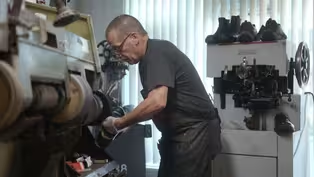
Photojournalist Michael Frank has been spending time with cobbler, Bob Fontaine to find out some secrets of the trade.
This segment is part of our continuing My Take series.
- A lot of people don't know what a cobbler is.
People don't know that we still exist.
Hi, my name's Bob Fontaine, this is my take on cobbling.
People come in and say, "It's my favorite, "favorite shoes," that's the bottom line.
It's like, "My dog chewed it, it was my father's, "I want it fixed and get it back to normal."
Everybody's, "Oh, I'll throw it away.
"I'll buy another pair," you're paying good money for your shoes, bring it in, we'll look at it.
We're honest with you, we'll let you know right there and then if we can do it and how much it's gonna cost.
They're not making the shoes as well as they used to.
My industry, we have to figure out, okay, different types of glue for different types of rubber now.
Some are glued, some are stitched, it's a new game.
I always like working with my hands and I always made things You're creative, you gotta think outside the box.
I probably started 25 years ago.
Before I was a cobbler, I was in the Teamsters.
I hurt my back and I couldn't do heavy lifting anymore.
My brother-in-law, he had a store and I learnt to trade from him.
I finally found something I liked to do and my body could stay up with it.
When I took the shop over, I come down, talked to the previous owner, Marcel Cayouette, very nice people, him and Janice.
And they were here 45, 50 years.
I left the name, I said, "Why would I change the name?
"Everybody knows Cayouette's Shoe Repair."
I like moving, I can't sit still.
If I don't have three, four jobs going at once I'm not happy 'cause I bounce from here to there.
Cowboy boots, work boots, ballroom dance shoes, car salesman, I do their shoes 'cause they wear out quick.
Anytime you turn around, you never know what's gonna walk in the door.
I have a gentleman who comes in from Connecticut.
He works for, I think, the Shriners and he's a clown.
And he brought his clown shoes in and they're like huge and nobody would work on 'em.
So I rebuilt the whole shoe for him, and everything and he loved it.
A lot of the jobs are challenging, which I like.
The ladies high end shoes, the Louis Vuittons, the Christians with the red soles, I do the sole guards on 'em.
And a lot of guys don't wanna work on 'em because they're very expensive and you gotta take your time.
I have the state police contract, I do their boots.
They're high-end boots, and they're very tall.
A lot of times we have to do full soles, heels, patches, and they're always wearing 'em out 'cause they're in 'em 10, 12 hours a day sometimes.
And you have to make sure that they're up to snuff.
We've got a customer coming in, I believe.
My thing is, when somebody comes, picks up their shoes, I take everything out of the bag and show 'em what I did.
Because a lot of people just say, "Oh, I'll take it."
I say, "Wait a minute, I spent a lot of time fixing this "for you like at least look at it "and appreciate it a little bit before you wear it."
People say, "Oh my God, I couldn't believe "it could get done," I make one person happy a day, I'm happy, okay, I can go home.
There's nobody opening stores.
The older guys are passing away.
The families are just closing the stores up.
There's, I think, only maybe six left in Rhode Island.
It's tough to say who's gonna run the shops.
I hate to say nobody and I feel bad for the people because it's getting tougher and tougher to get somebody to fix your shoes.
We wanna make sure it thrives.
(gentle music) It's a nice thing because it's a family business.
Everybody says, "Bob, you got the gift of gab."
Want to know what's going on in your life when you come in here.
Whatever they wanna talk about, it's good.
A lot of times they come in and say, "Oh, oh, I forgot my mother's in the car."
Or, "My wife's in the car, I gotta go back out."
If somebody comes in and they're a couple dollars short, I say, "Don't worry about it.
"Next time you come in, pay me."
And I bust them up 'cause I say, "I'll put you on the Wall of Shame over here."
I put you on the Wall of Shame here.
The next time you come by, pay me.
You trust your customers, they trust you.
This is how local businesses should run.
People say, "Oh, how can you survive?"
Guess what, get up, go to work every day and be happy what you're doing.
I'm doing something I love to do, I work with my hands.
I like challenges and I like people.
Yes, my name's Bob Fontaine, and that was my take on cobbling.
- Finally, tonight on this episode of Weekly Insight, Michelle and WPRI 12's politics editor Ted Nesi, unpack why a cable company is suing the state.
But first, what's ahead for Rhode Island's largest hospital group following a round of executive layoffs.
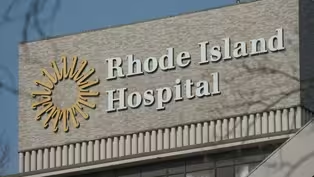
- Ted, welcome back, let's start with some big news from Lifespan, of course, the owners of Rhode Island Hospital and Hasbro Children's Hospital, among others.
Lifespan recently announced major layoffs at the senior level.
- Yeah, a big set of layoffs, Michelle, 20% of executives at Lifespan were let go here in September.
It was a dramatic shakeup by John Fernandez, who's the CEO.
He's been the CEO for about two years now since they brought him down to Lifespan from Mass Eye and Ear in Boston.
He says it was driven by concerns about too much overhead at Lifespan, as well as the financial challenges that we've talked about on this segment before, Michelle.
Lifespan has been barely breaking even for a number of years, and they're about to close their current fiscal year.
And as of June 30th, they were running... Their base hospital operations were earning about $70 million in the red.
So they're looking for ways to save money, and these executive layoffs are supposed to save them about $6 million next year.
- And Ted, the timing is interesting because a few months ago you and I were talking about how Lifespan is rebranding itself as Brown University Health and deepening its relationship with the university.
So clearly there are a lot of changes happening at Lifespan.
- Yeah, it feels like a big transition period for Lifespan, I would say Michelle.
They're expanding into Southeastern Massachusetts.
They're close to closing on a transaction where they're gonna buy Saint Anne's Hospital in Fall River and Morton Hospital in Taunton.
They don't currently own any hospitals outside Rhode Island.
That's set to close in October and the executives hope it'll help strengthen their finances overall.
And then they're also in the final stages, as you said, of planning this transformation into Brown University Health.
And actually just learned shortly before this taping that they're planning to launch that rebrand on October 15th so people will start to see the hospital signage change and all that over to Brown Health.
- Yeah, let's switch gears now to one of the state's largest broadband providers, Cox Communications, which is suing Governor McKee's administration over a major federal grant, what are they claiming here?
- So this involves $108 million of federal money.
It was money from the bipartisan infrastructure law, but it wasn't for roads and bridges, it was actually for broadband expansion.
And Cox is arguing, basically, that the McKee administration is planning to duplicate infrastructure that already exists, broadband infrastructure in places that don't need it, and that that's not what Congress intended when they appropriated this money.
They're also arguing that the maps that the administration is basing their sort of survey of how broadband access is across Rhode Island are faulty and that the data isn't right.
So they have a number of questions about this, but overall they just say, this plan is wrong.
- And the McKee administration is basically saying that Cox just wants more of this money.
- Yeah, exactly, they say, well, of course, Cox wants more of the $108 million to go to them by subsidizing customers' bills.
The administration says their plans are... they argue it's perfectly in line with what Congress said you could do with this money and that they have a plan.
Also, bigger picture, Governor Dan McKee, he was on Channel 12 this week and sort of suggested this is a bit of the normal course of business where big companies looking for a slice of state money, try to push back at how it's gonna be handed out.
He pointed out that Blue Cross Blue Shield is currently protesting the next Medicaid contract, which is a huge $15 billion contract.
So not necessarily saying he's happy about the lawsuit by any means, but also arguing this is something that happens in the normal course of business.
- Yeah, a lot of money at stake in this dispute.
Good to see you, Ted.
- For sure.
Good to see you.
- And that's our broadcast this evening.
Thank you for joining us, I'm Pamela Watts.
- And I'm Michelle San Miguel.
We'll be back next week with another edition of Rhode Island PBS Weekly until then, please follow us on Facebook and X and visit us online to see all of our stories and past episodes at ripbs.org/weekly or listen to our podcast on your favorite streaming platform, goodnight.
(gentle music) (gentle music continues) (gentle music continues)
Video has Closed Captions
Clip: S5 Ep39 | 7m 56s | Stone walls are a signature landform in New England. A geologist explains why. (7m 56s)
Video has Closed Captions
Clip: S5 Ep39 | 5m 38s | West Warwick cobbler Bob Fontaine on the art of repairing shoes. (5m 38s)
Video has Closed Captions
Clip: S5 Ep39 | 8m 36s | The role the iconic Rhode Island Red played locally, culturally and in post-WWII history. (8m 36s)
Video has Closed Captions
Clip: S5 Ep39 | 3m 18s | Lifespan’s decision to lay off 20 percent of its executives comes amid a sea of changes. (3m 18s)
Providing Support for PBS.org
Learn Moreabout PBS online sponsorship
- News and Public Affairs

Top journalists deliver compelling original analysis of the hour's headlines.

- News and Public Affairs

FRONTLINE is investigative journalism that questions, explains and changes our world.












Support for PBS provided by:
Rhode Island PBS Weekly is a local public television program presented by Ocean State Media