
Rhode Island PBS Weekly 9/3/2023
Season 4 Episode 36 | 27m 24sVideo has Closed Captions
NA
Michelle San Miguel reports on the ever-growing tick population in Rhode Island and the devastating diseases they bring. Then, contributing producer Dorothy Dickie has an in-depth story on how the power of art and love helped one Massachusetts artist as her husband’s Alzheimer’s disease got progressively worse. Finally, Pamela Watts explores the stories behind a 150-year-old carousel.
Problems playing video? | Closed Captioning Feedback
Problems playing video? | Closed Captioning Feedback
Rhode Island PBS Weekly is a local public television program presented by Ocean State Media
Rhode Island PBS Weekly 9/3/2023
Season 4 Episode 36 | 27m 24sVideo has Closed Captions
Michelle San Miguel reports on the ever-growing tick population in Rhode Island and the devastating diseases they bring. Then, contributing producer Dorothy Dickie has an in-depth story on how the power of art and love helped one Massachusetts artist as her husband’s Alzheimer’s disease got progressively worse. Finally, Pamela Watts explores the stories behind a 150-year-old carousel.
Problems playing video? | Closed Captioning Feedback
How to Watch Rhode Island PBS Weekly
Rhode Island PBS Weekly is available to stream on pbs.org and the free PBS App, available on iPhone, Apple TV, Android TV, Android smartphones, Amazon Fire TV, Amazon Fire Tablet, Roku, Samsung Smart TV, and Vizio.
Providing Support for PBS.org
Learn Moreabout PBS online sponsorship- [Michelle] Tonight, as more ticks spread out of the woods and into neighborhoods, they're infecting thousands of Rhode Islanders.
- One time my wife came in and I said, "I think we need to be talking about funeral plans."
- [Michelle] Then we meet one woman whose art helped her through the painful struggle with her husband's Alzheimer's disease.
- It gave me an outlet.
It gave me a way to express how frustrated I was.
And somehow, that relieved the frustration.
- [Pamela] Finally, we learn the challenges of keeping one of Rhode Island's cherished national landmarks alive.
- I saw that there were deep reds around the eyes and there was black around them and the nostrils were flaming and there were these wild, angry horses, and I painted 'em just the way they'd been in the very beginning, and everybody hated it.
(upbeat music) (upbeat music continues) - Welcome to "Rhode Island PBS Weekly".
I'm Michelle San Miguel.
- And I'm Pamela Watts.
They are some of Rhode Island's most dangerous creatures.
- And although they are sometimes as small as a poppy seed, ticks are a big problem.
Last year, there were more than 2,400 cases of tick-borne illnesses reported in our state, but health experts believe the actual number is much higher.
- I was in a fetal position for days.
I was having blinding headaches.
I was just in desperate condition and getting worse.
- [Michelle] Harvey Perry's love of nature nearly cost him his life.
18 years ago, he found a bullseye rash similar to this one on his arm, which is a classic symptom of Lyme disease.
- And I felt like, well, I've got Lyme disease.
It's about time I did.
Other people have been getting it and I'm out in the woods all the time.
So I went and got treated for that with doxycycline and cleared it right up.
- [Michelle] But a few weeks later, he collapsed at his home in Westerly.
- I woke up on the kitchen floor.
I fainted without realizing I was faint.
I thought that was weird.
And it happened to me again the next morning.
And I went to the emergency room and they said, "Oh, you must have babesiosis too."
- It turns out one tick bite had infected Perry with three diseases, including anaplasmosis, which kills your white blood cells.
It took two trips to the emergency room before his medical team realized the full extent of what was wrong.
Take me back to when you were in the hospital.
Did you have a moment amidst the hallucinations when you thought, "I could die"?
- Oh, absolutely.
I started, in fact, one time my wife came in and I said, "I think we need to be talking about funeral plans, 'cause I don't know where this thing is going."
I mean, my liver's already shut down.
Well, I don't know what else is gonna shut down.
And she cried and we talked about it.
- [Michelle] Fortunately, a combination of antibiotics has set Perry on a path to recovery.
He no longer deals with symptoms, but he's never forgotten how close he came to losing his life all because of a tick bite.
- We're seeing the tick population increase here in Rhode Island because of the weather changes that we're experiencing.
- [Michelle] Dr. Philip Chan is an infectious diseases specialist at the Rhode Island Department of Health.
(phone ringing) - This is Dr. Chan.
- [Michelle] He says warmer, wetter weather creates an environment more hospitable for ticks.
- In general, a tick has to be attached usually for longer than 48 hours in order to transmit a lot of these diseases, including Lyme disease.
So if you can find it soon and remove it, you are gonna really minimize your risk.
- [Michelle] While most people try to avoid ticks, Thomas Mather makes it his business to find them.
- That's a nymphal blacklegged tick.
- [Michelle] He's the director of the University of Rhode Island Center for Vector-borne Disease and its TickEncounter resource center.
- [Thomas] Lovely.
- [Michelle] Mather's seen how the tick population in Rhode Island has evolved throughout his three decades at URI.
- What's really changed here in Rhode Island, and probably New England, is that white-tailed deer have just become more of a backyard entity.
- [Michelle] Deer are the primary reproductive host for ticks.
So as deer move to more suburban areas, ticks go with them.
- They take a blood meal, they grow 100 times in size, they'd fall off, they lay thousands of eggs, those eggs hatch, and that's where the problem really starts.
- [Michelle] That problem includes a relatively new type of tick to Rhode Island called the lone star tick.
The adult female has a white dot or lone star on her back.
- This is a nymph lone star tick.
In the last few years, we've seen large increases along most of the coastal areas of the state.
- [Michelle] A bite from this blood sucking lone star tick can cause people to develop an allergy to red meat called alpha-gal syndrome.
And these ticks are spreading across the country.
- Today, the Centers for Disease Control is warning about a potentially life-threatening red meat allergy caused by tick bites.
- [Michelle] Mather says nearly all lone star ticks are carrying the sugar molecule, alpha-gal.
Meanwhile, he says about one in four of the blacklegged ticks or deer ticks in Rhode Island is carrying the bacteria for Lyme disease during the nymphal stage.
Even more carry it as adults.
I followed along as Mather looked for ticks along the edge of a backyard in North Kingstown.
- When we show people what nymphal stage ticks look like, they don't have any idea.
- I was not expecting it to be that small.
- Most people would just completely dismiss that as a speck, right?
Well, that speck is a tick, and if you don't find it and it's attached for a day or a day and a half, it has a high likelihood of making you sick.
- [Michelle] Emily Levy knows that all too well.
She says her life was altered by a tick bite she never saw, a rash that never came, and a doctor who did not diagnose her properly.
- So some days I would have a migraine.
Other days it'd be pain in my legs.
Some days it would be neuropathy, GI tract issues.
Chronic fatigue was pretty much throughout.
- [Michelle] She started to feel sick when she was in middle school.
She made numerous trips to the hospital throughout her senior year of high school and college.
It took seven years for her to get an accurate diagnosis.
She had Lyme disease and a number of other tick-borne illnesses.
- That was really challenging as a young adult because I knew something was wrong with me, but I also felt like my concerns weren't being taken seriously by the authority figures or medical professionals in my life.
- [Michelle] She says her symptoms are in remission, but she lived with a PICC line, a peripherally inserted central catheter, on and off for a few years to deliver medication into her bloodstream.
A nurse recommended she use a cut off sock to cover it.
Levy later went on to have a port in her chest.
It inspired her and two of her friends to launch Mighty Well, a company that sells PICC covers and other medical products.
- The whole idea is a patient's external medical tubing can be kept secured, safe, sanitary.
- [Michelle] Levy's grateful for everything she's learned from her tick-borne illnesses, but she says her health outcomes could have been different had she been tested for those diseases sooner.
- I think it could have been treated very quickly if the doctor just knew.
I mean, we lived on a lake.
We had so many deer in our backyard.
None of that about the environment we lived in was ever questioned or taken into consideration.
- [Michelle] Entomologist Thomas Mather hopes he can spare many others from the devastating effects of ticks.
Using funding from the Centers for Disease Control & Prevention, he's involved in a New England study that's analyzing the best ways for people to protect themselves against ticks.
- If you have a residential yard where you see deer on a regular basis, you have chipmunks and mice running around, then you're probably a good candidate for doing tick management in your own backyard as well.
- [Michelle] Mather also recommends that people spray their shoes with an insecticide called permethrin to repel ticks.
- The nymphal ticks are down in the leaf litter.
They get on your shoes and then crawl up your legs.
So there's a good, easy to do, once a month, spray your shoes with permethrin spray.
- Back in Westerly, Harvey Perry says he's opposed to spraying his property because of the effect it has on the environment.
Instead, he wears clothes treated with permethrin when he's doing work outside.
At any point, did you think maybe it's worth moving and not living in a wooded area?
- That's my life.
That's what I enjoy the most, is getting out in nature and managing nature for native plants and wildlife.
- [Michelle] Perry says this isn't a view he's willing to give up.
- I'm determined that I'm not gonna let them change my life that way.
I just protect myself so that I can do what I want to do.
(gentle music) - We now turn to a story about art and love.
Contributing Producer Dorothy Dickey introduces us to a Massachusetts artist whose work took a dramatic turn when her husband began to lose his way.
- Art is essential to my life.
You know, I'm visual, and everything sort of matters to me visually more than anything.
Even jokes.
If a joke is a visual joke, I get it more than I get the spoken joke.
It's important for me to express myself through art.
My name is Sara Holbrook and I'm an artist.
My husband, Foster Aborn, he was kind, he was generous, he was warm and caring and helped so many people with their careers.
He was the love of my life.
Probably about 12 years ago, he drove home in a snowstorm and he forgot where he was going.
By the time he got home, he was flustered, and he called his doctor the next day and said that this was not usual.
He was worried about his memory.
And at that time, he had mild cognitive impairment.
They said not to worry.
And he was still fine for a long time after that.
I specialized in watercolor, but I took a photography course with a friend out of curiosity in Boston and I fell in love with photography.
And then it was crucial when my husband was ill because I didn't have time to paint.
You know, that takes a lot of time and concentration.
If he took a nap or something, I could do my art in stages, which is important.
I started out with dreams.
I would dream up these ideas.
And then I would take a background photo.
I would take a photograph of myself.
I had to be dressed as I needed to be for the photograph, and I had to be in the right position.
And that was always a little difficult to figure out how to do that, but that worked.
And then I put it on the computer and scaled it down and then printed it out, and I cut it out and I pasted it onto the background photo, and then I rephotographed it.
That was my process.
(gentle music) Later, I entitled my work "99 Problems", because that also reflects what I was dealing with as a caregiver for somebody with Alzheimer's.
I found the photograph when I was in Paris, and I just was drawn to it for the visual image of it.
It was orange and it was a perfume bottle.
And I snapped the photo and didn't think much of it until I started dealing with this dreams series.
And I put myself in it as a scuba diver, that somebody was trapped and couldn't get out.
And that's the situation.
As a spouse, there you are, then you're dealing with this, and that's what you do, but you're stuck.
"99 Problems" was a perfect metaphor because you never knew what problem was going to present itself.
There were myriad things that would happen to you during the course of a day, just unexpected.
And I had to feel like Wonder Woman 'cause I was dealing with so much, you know?
He liked to work more than anything.
So he'd go to his office.
So that worked out until COVID hit, and then he couldn't go in anymore.
And that was very frustrating for him 'cause he didn't understand at that point anything about COVID.
He couldn't understand that all of Boston was really shut down.
He couldn't go into his office building.
And he'd wander from the house, trying to go to Boston.
He'd walk, you know?
And I'd have to run after him at all hours of the day and night.
I tried to keep him in, but it was sort of a full-time job just keeping the reins on him.
Well, the hardest part for me was not getting any sleep.
I was always, always on alert, on call, because he would wake up in the middle of the night and leave the house.
So I had to be ready to try to persuade him to come back, or I'd have to follow him outside and walk around in the middle of winter or in a rainstorm, anything, and call the police sometimes.
If I couldn't persuade him to come back, I had to.
Police knew him pretty well.
How I dealt with it on the worst days was by loving him, knowing that I loved him and that he was a worthy human being, even if I was frustrated.
I tried to use humor as a way to diffuse the frustration.
So I think you look at it and you see both.
You don't know whether to laugh or cry when you look at my work, but you get it.
(gentle music) This is called "Rinse Cycle".
It was a very, very bad day.
It just shows intense frustration.
He saw the work, but it didn't register with him.
He even went to an art opening that I had, and he was just happy to be there with the people, but he had no idea of the concept of it.
So we both loved Paris, and that was my place for shooting with my camera, 'cause I just felt so alive there.
In October, 2019, I was walking around Paris with Foster.
I had been taking photographs, we were heading back to the hotel, and I saw some people gathering, they were carrying these life-sized cutouts of people.
And I was just fascinated, I wanted to take a photograph.
And it wasn't long at all, but I turned around and Foster was gone.
And after an hour of looking, I came back to the hotel and Foster was there with this lovely young man.
And the man said that he in fact was a researcher in Alzheimer's.
And Foster found him in the whole city of Paris and went up to him and asked for help.
Amazing.
Absolutely amazing.
I didn't know I could cope with this, and looking back, I don't know how I did.
I kept him far longer than anybody said that I should have, you know, at home, because I loved him, you know?
And putting him somewhere just didn't seem right.
But eventually, I had to do it.
We were really close to one another, you know?
And even when he was in memory care, we had fun.
I miss that, you know?
You sort of settle at whatever level they are at, and he still reacted.
I danced with him when I go in, you know?
It's still very intimate.
(gentle music) My understanding of Alzheimer's is it's really a different process for everybody.
But it is usually very frustrating for the caregiver.
It's just your favorite person has become somebody else, basically.
And that's very hard to digest.
If you're an artist, you're driven to do something artistic.
It gave me an outlet.
It gave me a way to express how frustrated I was.
And somehow, that relieved the frustration.
And art's terrific that way.
And what amazes me is that my art has helped other people in this same situation even though they didn't do the art.
For me, it was a joy to do the art, but people looking at it, I think, feel that it gives them license to feel their frustration, to own that frustration as well.
I think it just shows that it's okay to be frustrated and express yourself that way.
'Cause I hope my art shows the love that I have for my husband, but also shows that it's a very frustrating thing to take care of someone with Alzheimer's.
It's the hardest thing I've ever had to deal with in my life.
It was a long journey to be with somebody with Alzheimer's, 'cause this is really a strange one.
You know, when people's minds go, it's difficult.
I've just been coping, you know?
I don't know how I'm doing.
It's just gonna take time.
I'm not sure how I'm gonna deal with it.
I will deal with it at some point and be on another project.
(gentle music) - Finally tonight, it's September, which for many means back to school and a time when everyone asks, "What did you do on your summer vacation?"
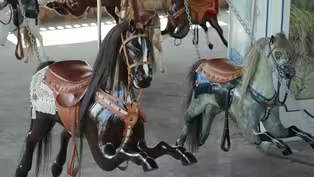
For some young people, the answer is riding off on a flying horse, something children have been doing in Rhode Island for nearly 150 years.
(upbeat organ music) - These horses are from the 1800s, if you can believe it.
- Oh my God.
- Oh my God.
- [Pamela] The iconic Watch Hill Flying Horse Carousel rounds up a stampede of memories for Lindsay Murphy of Westerly.
- You really go fast and you feel like you're flying.
They angle out when it gets full speed.
It's almost like you feel like a daredevil when you're on it.
You know, you're leaning out and you're holding on and you're spinning around and around and you have the sun and the salt and you're, you know, you're right on a beach.
- [Pamela] Murphy grew up riding the carousel along with her identical twin sister, Holly.
It's an unusual merry-go-round because instead of going up and down, the ponies fan out like Pegasus, sailing by centrifugal force.
The cherished carousel has been a landmark in the summer colony since 1881.
What is it about the Watch Hill Flying Horse Carousel that captivates everyone?
- I think the biggest thing people can't believe when they see it for the first time is how beautiful it is.
It really is a working antique.
The horses are so old and they're, you know, wooden and everything is real.
It's pretty amazing that anyone is allowed to ride it year after year after year.
- [Pamela] These days, the rides are propelled by a simple motor, but initially, the amusement rodeo was hand cranked, and at one time, a real horse would pull it around.
The exact origin of the carousel is still a bit of a mystery.
- Well, the myth is it was left here by a traveling carnival.
That's a lovely, lovely story.
And I don't think it can be fully disputed at this time.
- All right, reach out, everyone!
- [Pamela] Extensive research is ongoing as to who lassoed the seaside attraction.
What is certain, generations wouldn't be able to mount these folk art horses and grab for the hand forged brass ring if not for Murphy's grandmother, Harriet Moore.
It was Moore who took up the charge to champion the carousel's preservation in the 1940s.
- You can see how much information she gathered.
- [Pamela] In Moore's scrapbooks kept at the Westerly Library, you can see photos of the horses in disrepair after providing thousands of rides and surviving several batterings by hurricanes.
- Back then, instead of using newspaper, they decided to dry out some seaweed and to stuff the saddles.
- [Pamela] Moore used her prominence in the community to raise funds for repairs and corral stories.
- I love reading all of them, but this one in particular is quite sweet.
- [Pamela] These are letters from people recollecting their childhood long ago.
- "I was born in 1890 in North Stonington.
As a little girl, I went with my parents by horse and surrey to Watch Hill.
I rode the old merry-go-round."
- [Pamela] Murphy says her grandmother guarded the herd like a cowboy, sourcing leather for the saddles and real horse hair for the manes and tails.
She also had strict rules.
- No wet bathing suits.
There was no sandy feet.
There was no feet allowed to touch the legs of the horses.
There was no pulling on reins.
There was no twisting of ears.
She was tough as nails.
I mean, in many ways, I laugh, I call her the Margaret Thatcher of the merry-go-round world.
- [Pamela] Moore's legacy has now come full circle, as Murphy leads the town's carousel committee.
She estimates the merry-go-round gallops through some 12,000 rides every summer.
Despite expert repairs, though, the original vintage horses only fly a few weeks a year.
(wood scraping) That's when artist and sculptor, Gary Anderson, takes the reins.
(chisel knocking) He's almost completed carving a full fleet of exact replicas that are swapped out for the bulk of the season.
His stable gives the real deal a rest, because Anderson says they were a mess when he first started working on them years ago.
- They were just so full of nails and spikes and so cracked that I couldn't just put another nail or a screw or anything, or glue it.
- What did you do?
- We did what everybody else had done, 'cause everybody else was sanding.
So we sanded and cleaned and took off all the paint, and in some spots, there was 50 layers of paint.
- [Pamela] And beneath the paint, a revelation.
- I saw that there were deep reds around the eyes and there was black around them and the nostrils were flaming and there were these wild, angry horses, and I painted 'em just the way they'd been in the very beginning, and everybody hated it (laughs) because they'd gotten used to these very friendly, little, docile, happy faced horses.
- [Pamela] Not only did the community prefer what the war horses had morphed into, Anderson also confirmed something townspeople long suspected about these rare equine treasures.
- I worked around maritime carvings, and I started looking it up and I couldn't find anything that remotely looked like a carousel horse.
And then I went to a couple museums and looked at rocking horses and I said, "Oh, yeah, that's what these are, they're rocking horses."
- [Pamela] Just like this one Anderson later purchased for his workshop.
This hobby horse was created by the same New York toy maker its believed crafted the Watch Hill Carousel.
When merry-go-rounds became all the rage, the entrepreneur started churning out models using the same parts.
- They were meant to be a rocking horse that was inside.
You know, a little kid was gonna use it, and they were never gonna be used outside.
- Which is why the horses deteriorated so fast.
The unusual stance is because the front legs are just the back ones in reverse to save the toy maker time, and the eyes are made of vintage German marbles.
If you look closely, you can see animals inside, creating the iris.
What has it been like for you to be the quartermaster of the carousel?
- 30 years of time has been spent on these little horses.
I feel like they're part of our family.
I know Beth feels that way.
She grew up with 'em, they're like brothers and sisters.
- Okay, go.
- [Pamela] And now that his daughter, Beth Anderson, is grown, she's apprenticing with her father, restoring the old steeds and grooming the new ones to ensure authenticity for the next generation.
- It's a little daunting, to be honest.
It's hard to teach what we do.
These are works of art that are getting use.
- [Pamela] She is learning the ropes of tacking, as well as taking on some unexpected assignments.
- I brush their hair, I condition their hair.
(laughs) - [Pamela] You really condition the hair?
- Oh, yeah.
It helps keep the raw hide of the manes still soft and supple.
- [Pamela] While the father-daughter team keep pace with the ponies, Murphy is also hoping her children, twins Si and Abigail, will someday continue her family's mission to preserve the flying horses.
Because... - How special is it you can spend a day at the beach, get an ice cream cone, and go ride a piece of American history?
It's something that makes Watch Hill, Watch Hill.
It's something that even with the changing of the years and all the things that are going on in the world, it's a constant.
- And what a constant that is.
- So true.
- That's our broadcast this evening.
Thank you for joining us.
I'm Michelle San Miguel.
- And I'm Pamela Watts.
We'll be back next week with another edition of "Rhode Island PBS Weekly".
Until then, follow us on Facebook and X, and visit us online to see all of our stories and past episodes at ripbs.org/weekly.
Or please listen to our podcast on your favorite streaming platform.
Good night.
(upbeat music) (upbeat music continues) (upbeat music continues) (upbeat music continues)

Video has Closed Captions
Clip: S4 Ep36 | 9m 54s | Artist Sara Holbrook’s work took a dramatic turn when her husband began to lose his way. (9m 54s)
Video has Closed Captions
Clip: S4 Ep36 | 8m 45s | Memories are made on the Watch Hill Flying Horse Carousel –as kids ride a working antique. (8m 45s)

Video has Closed Captions
Clip: S4 Ep36 | 9m 22s | Tick population increases and spreads throughout Rhode Island. (9m 22s)
Providing Support for PBS.org
Learn Moreabout PBS online sponsorship
- News and Public Affairs

Top journalists deliver compelling original analysis of the hour's headlines.

- News and Public Affairs

FRONTLINE is investigative journalism that questions, explains and changes our world.












Support for PBS provided by:
Rhode Island PBS Weekly is a local public television program presented by Ocean State Media