State of Affairs with Steve Adubato
Riccardo Dale, Carlos Lejnieks, Jennifer Nelson
Season 8 Episode 15 | 27m 8sVideo has Closed Captions
Riccardo Dale, Carlos Lejnieks, Jennifer Nelson
Riccardo Dale, Founder of Free All Minds Academy, highlights the ways his nonprofit is helping young men in South Jersey. Carlos Lejnieks, President & CEO of Big Brothers Big Sisters of Essex, Hudson, & Union Counties, discusses the initiative "Bigs in Blue," pairing law enforcement with youth. NJ State Librarian, Jennifer R. Nelson, discusses the Freedom to Read Act & literacy in the digital age.
Problems playing video? | Closed Captioning Feedback
Problems playing video? | Closed Captioning Feedback
State of Affairs with Steve Adubato is a local public television program presented by NJ PBS
State of Affairs with Steve Adubato
Riccardo Dale, Carlos Lejnieks, Jennifer Nelson
Season 8 Episode 15 | 27m 8sVideo has Closed Captions
Riccardo Dale, Founder of Free All Minds Academy, highlights the ways his nonprofit is helping young men in South Jersey. Carlos Lejnieks, President & CEO of Big Brothers Big Sisters of Essex, Hudson, & Union Counties, discusses the initiative "Bigs in Blue," pairing law enforcement with youth. NJ State Librarian, Jennifer R. Nelson, discusses the Freedom to Read Act & literacy in the digital age.
Problems playing video? | Closed Captioning Feedback
How to Watch State of Affairs with Steve Adubato
State of Affairs with Steve Adubato is available to stream on pbs.org and the free PBS App, available on iPhone, Apple TV, Android TV, Android smartphones, Amazon Fire TV, Amazon Fire Tablet, Roku, Samsung Smart TV, and Vizio.
Providing Support for PBS.org
Learn Moreabout PBS online sponsorship- [Narrator] Funding for this edition of State of Affairs with Steve Adubato has been provided by The Fidelco Group.
The Russell Berrie Foundation.
Making a difference.
Valley Bank.
Horizon Blue Cross Blue Shield of New Jersey.
Here when you need us most.
RWJBarnabas Health.
Let’s be healthy together.
The North Ward Center.
The Healthcare Foundation of New Jersey.
The New Jersey Education Association.
And by New Jersey Sharing Network.
Promotional support provided by Insider NJ.
And by NJBIZ.
Providing business news for New Jersey for more than 30 years, online, in print, and in person.
[INSPRATIONAL MUSIC] - Hi everyone.
Steve Adubato.
We kick off the program talking to a very significant, compelling leader, who's out there making a difference every day.
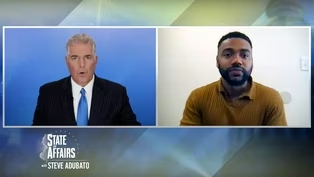
He's Riccardo Dale, founder of a terrific nonprofit down in South Jersey.
It is called Free All Minds Academy.
Riccardo, good to see you.
- Definitely.
Good to see you as well.
- And Riccardo is in fact, a 2024 Russ Berrie Making a Difference winner.
Congratulations on that, Riccardo.
Tell everyone when we put up the website right now, what the Free All Minds Academy is.
- Yeah, so Free All Minds is a full self-service program for at-risk and underprivileged youth, from eighth grade all the way into adulthood.
A group of mentors meet with these young men every single week to prepare them for life after high school.
So whether that's college, trade school, or a career, we're preparing them every step of the way to be able to go on and live productive lives.
But alongside our programming, we're there as a support system, as father figures and big brother figures to these young men.
Having family dinners with them every single week.
Being there for them when they just need to talk and have a conversation about things that are going on in their lives.
Providing them with toiletries and clothing when in need.
Outside of just programming and academic workshops, we really create a family environment for these young men.
- How'd you get into this and why?
- I got to this kind of work around 18, 19 years old.
I was on a full scholarship in college and I came back to my neighborhood.
- You went to Rowan University?
- Yes.
Where I went to Rowan University, and came back to my neighborhood and I saw a lot of my peers in the same space that I'd last seen them.
And that was in and outta jail, selling and using drugs.
And I thought about how I was just in the same position as them, and the biggest difference between me and them was the opportunities that I received.
I got the opportunity to go to a private school.
I had mentors that came into my life and were able to support me.
I got a lot of breaks in life that a lot of my peers did not receive.
And because of those opportunities, me being able to go to a private school for free, and me being able to go to college for free, me having mentors that constantly looked out for me, even though I came from a rough background without the family support that I needed, I had other people that stepped into my life, and it changed my life.
- So you started the nonprofit to help others?
- So I started the nonprofit to help other people, because I realized how much other people did for me.
And I'm like, if a mentor or two can come into my life and take a kid that was sleeping in a basement, that was failing classes and turn him into somebody who was excelling at this private school and then going off to college on a full scholarship, what could I do for other young men that are just like myself?
How many other Riccardos are there out there that just needed an opportunity, because in high school or middle school, I was going nowhere.
I was a problem child.
How many other kids are out there like that?
So I took advantage of an opportunity to kind of tap into, those group of kids.
- And actually, you shared with our producers that you went from a 0.8 grade point average, - Yes.
- To graduating at Rowan University.
So interesting.
You had the wherewithal, not just the wherewithal, you had the instincts, the passion, the compassion, the leadership skills.
I'm a student of leadership, so again, it strikes me when I see people taking the initiative like this.
So when you had to go out and start this non-profit, did you have any idea how the heck, I mean, we run a not-for-profit production company.
I'm not raising money more than half of my time.
Did you realize what it was going to take to not just create, but lead and run a not-for-profit?
- No, I had no idea.
I thought I was just gonna be helping the kids.
And it just turned into so much more.
I had no idea what it actually was.
I didn't know what a non-profit really was.
It's just like I had this idea and I'm just like, "I can do it."
I feel like I could do anything.
So I just jumped into it and learned it along the way.
- What's interesting to me is that the students, the young people who are part of the Free All Minds Academy, who are getting tutored, mentored, you have a 100% graduation rate?
- [Riccarodo] High school graduation, yes.
- [Steve] How?
- I would say it comes with the environment that we create.
The education system sometimes just kind of puts something in front of these kids and says, "Chase it."
Just like, "Chase this education because I told you to.
Go to college because it's what's best for you.
Get good grades because that's what you're supposed to do."
And that's not always effective because what if I just don't care?
I don't care about my grades because it's nothing, there's nothing appealing to me about my grades.
So if I'm a kid who's not passionate about school, you telling me that I need to get good grades and go to college is not gonna be inspiring to me.
For our program, we figure out what it is that every individual kid is actually interested in.
And then we use their interests to help inspire them and push them to do well academically.
- When we were at the Russ Berrie Making a Difference award ceremony at Ramapo, we were up on the college campus.
And you're with other leaders who are doing all kinds of important work, who received the Russ Berrie Making a Difference award.
And that was the first time I got a chance to meet you, because I was proud to host that event since the beginning, well over two decades ago.
What was it like for you that day?
- For me it was just a breath of fresh air, honestly.
You don't do the work for recognition, but it feels good to know that somebody's behind you, that somebody's supporting you, that a group like the Russ Berrie Foundation and Ramapo College is behind the work that I'm doing, because it gets hard.
When you're trying to build something and you have setbacks and things don't go as planned, and you're trying to make this impact and you struggle.
And it always is fulfilling to know that other people are here supporting you and you're not doing this by yourself.
- And by the way, to be clear, the Russ Berrie Award is a cash award.
Russ Berrie Foundation is a supporter of our programming that is in fact called Making a Difference.
We talk to not-for-profit leaders who are making a difference in their community.
And Riccardo Dale is definitely doing that as the founder, the leader at Free All Minds Academy.
Riccardo, wish you and your colleagues all the best, making a difference every day.
Thank you.
- Thank you.
I appreciate it.
- You got it.
Stay with us, we'll be right back.
(grand music) - [Announcer] To see more State of Affairs with Steve Adubato programs, find us online and follow us on social media.
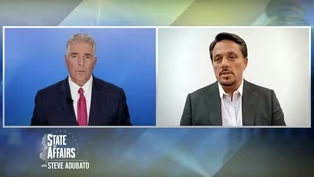
- We are now joined by our long time friend Carlos Lejnieks, who's CEO of Big Brothers Big Sisters of Essex, Hudson, Union Counties.
Carlos, good to see you buddy.
- Good to see you, Steve.
Thanks for having me.
- You got it.
Hey, listen, website's up.
Tell everyone what Big Brothers Big Sisters is, 'cause you need mentors, I know that.
- Absolutely Steve, Big Brothers Big Sisters is the oldest youth mentoring organization in the nation over a hundred years old, based on evidence-based practices, we pair up a volunteer mentor in a one-to-one relationship with a child.
And through a thoughtful intake process, we get to know both sides of the equation and play matchmaker, and then this relationship is so critical 'cause they meet on a regular basis for at least one year.
And on average, many kids in our program stayed matched up for at least three years.
So, so the average length of match tells us that we're doing something well on the front end, that we're matching people up thoughtfully based on common interests and commonalities.
So at the end of a year, it's no longer the end of a program.
It becomes part of a life long relationship.
- Carlos, what has been the impact that you can tell from COVID, and not just in your program, but most importantly to the young people you're attempting to help?
- So, so two things are pronounced coming out of the pandemic more than ever before.
We see the depressive elements of our young people extremely challenging.
And so what we do is with the specialized eyes of our bigs, they have, they're in tune with our littles.
- The bigs are the mentors.
Sorry, Carlos.
- That's right.
- The bigs are the mentors.
- That's right, with our adult mentors, they have specialized on the needs of our children.
So they see the things that are obvious, but more importantly, they see the things that are not as obvious, the subtle cues that our kids will offer.
And coming outta the pandemic, there've been a lot of depressive elements that trusted adults, that volunteer Big Brother, Big Sister is able to see.
Now, now there are bigs are not therapists, they're not behavioral health social workers.
We make sure that that's clear.
But when they see that, they signal it to us as an organization and then the village is galvanized.
We then bring in our staff who are trained in supporting our kids as well as other more professional services like Jersey City Medical Center, for example, and RWJ Barnabas have been extremely helpful in offering us consistent, caring professionals for their behavioral health strength that they offer our communities.
They're there for our families, our kids, and frankly, to support our bigs as well through that journey.
So that, that's a big takeaway coming outta the pandemic.
And then secondly, frankly, another big issue is a lack of focus on keeping down the path of attaining your degree, graduating from high school, as well as going off to college.
And evidence is piled on.
We know what, what, what the power towards social mobility is to have that degree, that the university degree, the higher education degree, and the skills, and the network that being a college graduate offers kids.
And we know that the whole world, a global, in a global economy, people are competing for these jobs.
Our kids will be so far left behind if they don't have that degree.
And so what we're doing is ensuring that they get the supports to ensure that they get to the right schools of their choice and that they have the support network around them to make it successful.
- And Carlos I happen to know that you, your higher ed experience, very significant in your life.
Tell folks where you went to school.
- I was born and raised in the public school system in Montclair and went off to College of Brown University.
I'm now on the board of Governors of Brown University and got a master's degree at London School of Economics.
I will, I'm the first to testify to the power of what wonderful education can do to transform one's life.
My mom cleaned houses, was born in a small room apartment in Ecuador.
She scrubbed toilets to put food on the table.
She worked really hard to keep us at a wonderful public school system that then offered the opportunity for me to go off to an Ivy League college, and then the real blessing was at every turn, the reason why I stayed in school and I graduated and went off to get a master's degree was 'cause I had mentors at every corner, at every turn in my life, had someone encouraging me to stay down the right path even when I thought maybe of going astray.
And that's why 16 years ago when I became CEO, was asked to become CEO of this local chapter based here in Newark, I took a reflection.
I was like, who would I not be to pay that forward and to have that be a job, a real profession, frankly, a mission that's been a lot longer than anyone predicted 16 years and loving it.
It's a marathon race, but one that requires regular action to be done person to person every single day.
To me, if I, if you don't mind, Steve, the, you know, it's been a long journey on this, but there are these moments that really fuel the fire to this work.
So of course we all have the testimony that we have mentors.
You've had mentors in your life, Steve, but I will tell you to have a young person as one of my former students who I met 20 years ago.
He was in middle school, he was, I was an administrator of a school in Newark.
He came to that school.
I knew him, I knew his family.
Fast forward, he graduated high school on time, went off to college, is now a union organizer here in Newark.
He's fully employed.
He's really giving back to his community.
And he just signed up a month ago.
This was a 20 year relationship that I have had.
- To be a big?
Yeah and now he's a big brother in Newark to a young man in Newark.
Talk about paying it forward, to me, my friend, that is the ROI, that's the return on investment.
- You've mentioned Newark a couple of times.
We've been focused on the fact that some of our mutual friends in Newark who are involved in development, economic development have picked up on the fact have informed us, and we've been focused on this, there's a certain location in the heart of Newark downtown at 550 Broad Street.
Someone says, what does that mean?
550 Broad Street?
What is going on at 550?
And why is it significant, particularly in the world of philanthropy and nonprofits?
- This is an exciting place to be.
This is an exciting time to be in downtown Newark.
I'm proud to say that one of my advisory board members and dear friends Kerry Burse Levine was visionary on what to do with a single building and creating an opportunity for kindred spirits, people who care about our community to be in this building.
We were one of the first Big Brothers, Big Sisters was one of the first tenants as she launched into this post pandemic.
And it's across the street from Harriet Tubman Square where there's so much going on, Juneteenth, there's so many great celebrations at Harriet Tubman Square with anchor institutions investing in this part of the downtown area.
But investments are one thing, but it's person to person.
So when you see in this building, frankly, so many wonderful organizations that are- - Foundations, there are nonprofits that are working in the community every day at this one location.
- That's right, and so it's a dream manifested in the lives of people in these halls now.
And it's exciting to be here.
- Stay on the Newark thing.
Got about a minute left.
Bigs in Blue is what?
And why does it matter?
- It's an opportunity for law enforcement to be paired up in a one-to-one relationship with our kids.
We launched it in Newark.
In fact, when then Mayor Booker had, had tension in our community and we try to build a bridge between law enforcement and children.
Fast forward to today, we're launching it, re relaunching it in our communities, specifically in Jersey City with the president of the Police Union signing up his rank and file as well as in Plainfield under the support of Congresswoman Bonnie Watson Coleman.
We've done increased programming in the greater Plainfield area and Bigs in Blue is robust there.
And it allows the relation to humanize each other.
And so the tensions that we see around the nation between law enforcement and our communities, they don't, they're not inevitable.
If we build conversation and opportunities to get to know each other, this is a way to be build better understanding and frankly build a better future between our law enforcement officers and our communities.
- And that's called Bigs in Blue.
And this is Carlos Lejnieks who's the CEO of Big Brothers, Big Sisters of Essex, Hudson, and Union Counties.
Carlos, all the best wish you and your team and the other folks down at 550, all the best doing important work in the community, in the city of Newark and the surrounding areas.
Thanks Carlos.
- Thanks Steve.
I appreciate it, thank you.
- You got it, stay with us.
We'll be right back.
(grand music) - [Announcer] To see more State of Affairs with Steve Adubato programs, find us online and follow us on social media.
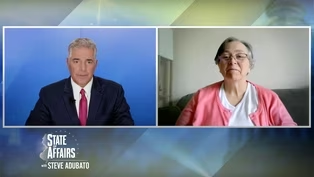
- We're now joined by Jennifer Nelson, New Jersey State Librarian.
Jen, good to have you with us.
- Thank you.
It's a pleasure to be here, Steve.
- By the way, you said I could call you Jen.
So, people are wondering, why is he being so informal?
Tell us, Jen, what exactly the state librarian's job is.
- The state librarian's job is to do a number of things, mostly to be a bureaucrat, to move and help libraries across the state to develop and to grow.
We administer state and federal funds that go to libraries in New Jersey, and we actually operate a research library and a library for the blind and print disabled, which serves people in New Jersey with disabilities at no charge.
And we are an affiliate of Thomas Edison State University.
So, we also serve the students at Thomas Edison.
- Why'd you call yourself a bureaucrat?
- Oh, I do it in the most sort of loving way possible.
- Okay.
Just checking.
Just checking.
- Yeah, yeah.
No.
My favorite thing is to be creative within rules and within regulations, and to really work within the context that's available to make good things happen for people.
- You are a public servant, just to clarify.
- Yes.
- Jen, help us on this.
The freedom to redact, which is a piece of legislation moving through the legislature, hopefully.
What is it and why is it so significant?
Please.
- It's a piece of legislation that provides certain protections for library staff, librarians in school and public libraries.
It asks school boards and public library boards to create policies that dictate how materials get taken out of a library.
We've had a lot of issues in the United States recently, and several in New Jersey, where people who live outside a community have come in and complained and asked for books to be removed from the library and created hostile situations.
And we're trying to avoid that, and to make sure that people who have concerns about the materials that are held in a library are people who are actually affected by the library.
So, parents, students, library card holders, and that sort of thing.
So, it's important, at this point, as a way for the state to make sure that there are good policies out there that boards are following, so that there is an opportunity for people to challenge the presence of a book in a library, but also a very clear procedure for reviewing and removing the materials.
- I'm curious about this.
First, to what degree do you believe, excuse me, Jen, that librarians are being targeted and at much greater risk than they've ever been before because of, not just how many people are concerned about certain books and express their views, but target librarians who approve those books?
Loaded question, I know.
Are librarians being targeted?
- I would say library collections are being targeted.
And through that, the librarian is often the focal point of the hostility, if you will, because they're the ones who are making the decisions ultimately.
The board of the library is giving the authority to the librarian to make the, to create the collection.
But the policy for what is purchased and maintained in the library is really a board policy decision.
- But how do we protect librarians and still protect parents, others who have concerns about a certain book?
How do we balance this, Jen?
- Oh, that's a great question, Steve.
And I think some humility maybe goes a long way in terms of respect.
In a library, a child or an adult is never required to take out a particular book.
Parents are welcome to visit libraries with their children to help them choose books.
Librarians make decisions about including books in the library that have quality and merit for their community.
And a good librarian, which most of ours in New Jersey are, knows their community, knows the kinds of materials that the people in the community are interested in.
- But that's not everybody, Jen.
I mean, the community is not a monolithic entity.
And there are people who say no to, no, that book is gonna indoctrinate my kid.
I don't want my kid exposed to such and such.
That's real.
- Oh, it is.
It certainly is.
And that's the issue that folks are running into.
I think, a library... And I should say I'm speaking primarily of public libraries.
School libraries are a different, different world in some ways.
The way to think about it is the library is really designed to have a little something for everybody.
So, you don't have to like the same books I like, but we should both have the opportunity to check out the books that are meaningful for us.
So, I wouldn't interfere with what you wanna check out, and I would hope you wouldn't interfere with me.
And we know that the librarian is making a decision based on, not just whim, but how is the book written.
Is it well reviewed?
Is it highly respected?
What's the nature of the author?
So, as I said, nobody's required to take out any particular book.
And there are things, I think, with our tax dollars, being a public servant, there are all sorts of things that I personally might prefer the government didn't spend their money.
But by the same token, I'm part of the larger community in New Jersey and United States, and I understand that I can't always dictate exactly how every penny gets spent 'cause the state has priorities that are not mine.
The same a library is gonna have priorities that are that of every individual.
- Question.
- Sure.
- How has the digital age in which we are living in impacted the world of a librarian?
- Oh, it's, you know, I've been a librarian for a long time.
Almost 40 years.
And in that- - Thank you for your service.
- Oh, thank you.
You're welcome.
And in that time, we went from not having the internet.
So, if you can imagine sitting and answering a reference question at a desk with a collection of materials behind you, and somebody says, "Well, I need to know what the stock price was on June 4th, 1950."
Well, you get up, you walk to the book, you pull it out, and you open it up.
Today, you sit at your computer, you call it up, and you look at it.
So, things have become much more efficient in some ways, but people in communities then, anyone really who has skill can find a lot of the information a librarian used to be able to find.
So, the role of librarians has really changed into being sort of the expert searcher.
So, you can probably go in and find news stories, you know, that's part of your, you know, your (indistinct) You're doing fine with- - People read less.
Jen, I got about a minute left.
I'm sorry.
Do people read less because of information being so accessible on one's phone?
- No.
And we consider reading to be on a phone, on a device as equal to reading a printed book.
- Do we?
We read differently.
- You know, there are studies that have been out that show that with younger children, it can make a difference whether they're reading a print book or an electronic book.
But for most of us, I think the convenience of an electronic book doesn't get in the way because it allows us to do things we couldn't do.
I don't have great eyesight and I can read an electronic book and increase the font size, so, which I can't do on a printed book.
So, there've been a lot of changes.
I would say they're all to the good.
But I think the primary difference between a library now and 40 years ago is the way literacy has changed and the way we define literacy, and including the use of technology as one of those fundamental literacies that librarians need to be prepared to demonstrate for people and help them learn how to use so they can participate in everyday life, whether it's making doctor's appointments or communicating with friends.
Any number of things.
- Jennifer Nelson, New Jersey State Librarian.
Jennifer, thank you so much for being with us.
And again, for your service.
Thank you, Jen.
- Thank you.
It was a pleasure to be here, Steve.
- You got it.
I'm Steve Adubato.
Thank you so much for watching.
We'll see you next time.
- [Narrator] State of Affairs with Steve Adubato is a production of the Caucus Educational Corporation.
Celebrating 30 years in public broadcasting.
Funding has been provided by The Fidelco Group.
The Russell Berrie Foundation.
Valley Bank.
Horizon Blue Cross Blue Shield of New Jersey.
RWJBarnabas Health.
Let’s be healthy together.
The North Ward Center.
The Healthcare Foundation of New Jersey.
The New Jersey Education Association.
And by New Jersey Sharing Network.
Promotional support provided by Insider NJ.
And by NJBIZ.
The North Ward Center continues to expand their services and outreach in Newark, from the childhood years to the golden years, Offering programs like preschool, youth leadership development, Casa Israel Adult Medical Day program our Family Success center, as well as a gymnasium.
And most recently Hope House, a permanent home for adults with autism, supporting and nurturing our autism community with Hope House 2 coming soon.
The North Ward Center.
We’re here when you need us.
Carlos Lejnieks Highlights Their New Mentorship Initiatives
Video has Closed Captions
Clip: S8 Ep15 | 9m 30s | Carlos Lejnieks Highlights Their New Mentorship Initiatives (9m 30s)
NJ State Librarian Addresses the Freedom to Read Act
Video has Closed Captions
Clip: S8 Ep15 | 10m 12s | NJ State Librarian Addresses the Freedom to Read Act (10m 12s)
This Nonprofit is Helping Young Men in South Jersey Succeed
Video has Closed Captions
Clip: S8 Ep15 | 8m 29s | This Nonprofit is Helping Young Men in South Jersey Succeed (8m 29s)
Providing Support for PBS.org
Learn Moreabout PBS online sponsorship
- News and Public Affairs

Top journalists deliver compelling original analysis of the hour's headlines.

- News and Public Affairs

FRONTLINE is investigative journalism that questions, explains and changes our world.











Support for PBS provided by:
State of Affairs with Steve Adubato is a local public television program presented by NJ PBS