State of Affairs with Steve Adubato
Richard Besser, MD; Michael Renna; Audrey Lane
Season 9 Episode 15 | 27m 23sVideo has Closed Captions
Richard Besser, MD; Michael Renna; Audrey Lane
Richard Besser, MD, President and CEO of Robert Wood Johnson Foundation, discusses the growing mistrust in public health and vaccines. Michael Renna, President & CEO of South Jersey Industries, addresses rising utility costs and meeting supply demands through renewable natural gas. Audrey Lane, President of Garden State Initiative, talks about New Jersey's fiscal health.
Problems playing video? | Closed Captioning Feedback
Problems playing video? | Closed Captioning Feedback
State of Affairs with Steve Adubato is a local public television program presented by NJ PBS
State of Affairs with Steve Adubato
Richard Besser, MD; Michael Renna; Audrey Lane
Season 9 Episode 15 | 27m 23sVideo has Closed Captions
Richard Besser, MD, President and CEO of Robert Wood Johnson Foundation, discusses the growing mistrust in public health and vaccines. Michael Renna, President & CEO of South Jersey Industries, addresses rising utility costs and meeting supply demands through renewable natural gas. Audrey Lane, President of Garden State Initiative, talks about New Jersey's fiscal health.
Problems playing video? | Closed Captioning Feedback
How to Watch State of Affairs with Steve Adubato
State of Affairs with Steve Adubato is available to stream on pbs.org and the free PBS App, available on iPhone, Apple TV, Android TV, Android smartphones, Amazon Fire TV, Amazon Fire Tablet, Roku, Samsung Smart TV, and Vizio.
Providing Support for PBS.org
Learn Moreabout PBS online sponsorship- [Narrator] Funding for this edition of State of Affairs with Steve Adubato has been provided by Hackensack Meridian Health.
Keep getting better.
New Brunswick Development Corporation.
New Jersey’s Clean Energy program.
Lighting the way to a clean energy future.
Congress Hall.
A Cape Resorts property.
Kean University.
Where Cougars climb higher.
Horizon Blue Cross Blue Shield of New Jersey.
The Turrell Fund, a foundation serving children.
New Jersey Sharing Network.
And by The Port Authority of New York and New Jersey.
Moving the region through air, land, rail, and sea.
Promotional support provided by Insider NJ.
And by BestofNJ.com.
All New Jersey in one place.
[INSPRATIONAL MUSIC] - Hi everyone, Steve Adubato.
We are honored once again to be joined by Dr. Richard Besser, President and Chief Executive Officer of the Robert Wood Johnson Foundation, also formerly served as the Acting Director of the CDC, the Centers for Disease Control.
Dr. Besser, as always, it's an honor, thank you.
- Thanks, Steve.
It's really great to be here.
- Yeah, let's get into this.
We'll put up the website for the Robert Wood Johnson Foundation, a longtime underwriter of our public health programming.
There are so many areas to cover, but I'm gonna ask you right now as we are in the summer of 2025, this will be seen later.
The most pressing public health issues in our state and nation right now are?
- You know, that's a tough one.
- I know it's too broad.
Let me ask you this.
Is it the misinformation coming from certain credible sources in government on the federal level as it relates to public health and information that's needed, is that one of the most pressing?
- I mean, it is.
That is clearly one of the most pressing.
This is an unprecedented time in that we have a Secretary of Health who has done more than just about anyone in our nation to instill a lack of trust in our vaccine system.
And when you have someone in such an important, critical health position in our government, they have the opportunity to do incredible amounts of harm.
And this secretary, in the short time that he has been in office, has done just that.
Dismantling our public health system, undermining trust in our vaccine system, that is something we've never faced before, and how we address that will be critically important for the lives of people across our nation.
- We're engaged in an initiative, a public health awareness initiative, simply called, Vaccines, What You Need to Know.
We're driving people to the New Jersey Department of Health website, which has a very specific and very useful section on vaccines.
- Dr. Besser, you serve at the highest levels in our federal government.
You head a major foundation right now.
You are a pediatrician, clinically, in your background.
Tell folks what you believe to be the most tangible, relevant concerns as it relates to misinformation on vaccines coming out of Washington right now, particularly as it relates to small children, babies, small children.
- Yeah, you know, we have had what has been considered the gold standard system for approving new vaccines, for considering the impacts of existing vaccines, for making recommendations to healthcare providers and through them to their patients.
It has been the best system in the world, that is no longer the case.
And so, you know, I practiced pediatrics for more than 30 years in community clinics around the country and I looked to the Centers for Disease Control to provide me with the best information to share with my patients so they could make the best decisions for the health of their children.
The CDC recommendations came to them from an advisory committee, an incredible advisory committee.
It's called the Advisory Committee on Immunization Practices.
But it's made up of people with deep expertise in vaccines, in children's health, in the health of the elderly, of adults, of pregnant women, there's community representative on there.
And so as a pediatrician, I could pay attention to the discussions and the debates that they would have around new vaccines.
And so when a recommendation came forward, I would feel comfortable in understanding what went into the decision and in providing information to my patients.
We've already seen with this secretary, a new way of doing business.
He issued, on a short video, new recommendations around COVID vaccination that said pregnant women should not get the COVID vaccine and children without medical conditions should not get the COVID vaccine.
No information provided in that video in terms of who provided the recommendation to him, given that he is not a health professional.
What went into that?
What were the concerns that were being lifted up?
How were those addressed to come up with that recommendation?
So you had this recommendation.
He was flanked by the head of the National Institutes of Health, the head of the Food and Drug Administration.
No one from CDC was even there.
And so as someone who really knows the process by which this should go through, to me it was no different than any other video on TikTok or YouTube.
It didn't provide me with what I would need.
- When the head of health on the federal government end says we need to do more, quote, "research" to determine whether vaccines, let's be more specific, the MMR vaccine, potentially causes autism.
You say what to that?
- I say that is a question that was raised, studied, and answered many times over.
And simply by raising that as an unanswered question again, it raises concerns to parents of children as to whether they should get their child vaccinated.
What I say to those parents is talk to your doctor.
Talk to your child's doctor.
It's so important to establish a relationship with a healthcare professional who you trust, your child's doctor, their nurse, their nurse practitioner, your pharmacist, someone who you feel comfortable asking questions to, who can wade through all of the information, misinformation and disinformation that's coming out to help you make those decisions.
I think it's great that you're steering people to the New Jersey Department of Health website.
- It's up.
I'm sorry.
It's up right now as you're speaking.
Go ahead.
- Yeah, you know, I used to steer people to the CDC website and you know, it absolutely breaks my heart that that's something I can't feel comfortable doing anymore.
As we see experts from CDC leaving, experts speaking out about how their data and studies that they've been involved in are being used and misused.
You know, hopefully you will be able to find through your healthcare provider, sites like the New Jersey website that are up to date that can give you the information you need.
And I think we're gonna see medical societies, the Academy of Pediatrics, of which I'm a member, providing the kind of information and guidance that had been coming from the federal government.
- And also, let me be clear, Dr. Besser was referring to this advisory council of pediatricians, experts on infectious disease, vaccines, they were all removed.
- Yeah, they were all removed without cause.
They were accused of bias.
And you know, something very hurtful and harmful to them.
You know, these are individuals who were serving their country.
This is not a job where you're paid a lot of money.
You're paid for the time that you spend at those meetings.
But it was viewed as a real honor because of the vetting process that you had to go through to get selected.
You were only selected if you had the kind of deep understanding and knowledge to be able to look at the data, look at the studies, and provide that kind of information.
And it was an incredibly transparent process.
All of the committee hearings were live streamed.
The information was up there.
You could hear the debate going on.
It was the definition of transparent.
And during COVID, when we were all hunkered down, I watched those hearings to see what was going on in the discussions around COVID vaccination, how they dealt with any signals for any safety concerns, how they assessed whether the vaccines were working and who should get them, and it gave me real confidence to go on the air and talk about who should get vaccines, to talk to my patients about who should get vaccines.
But now, to have a committee, the committee that the secretary put in has quite a number of people there who are voices against vaccines, who really question the safety and effectiveness of vaccines.
And there's no public health intervention in my lifetime or in the past a hundred years that has had more benefit than vaccines, and you know, making sure that children and adults are vaccinated fully and on time.
- That's Dr. Richard Besser, President and Chief Executive Officer of the Robert Wood Johnson Foundation, the former head of the CDC, and formerly, in a different life, on behalf of ABC News, Medical and Health Editor.
And we'll talk in a different segment with Dr. Besser about the role of the media, what we need to do to help people better understand what they need to understand, not with a point of view, but science-based.
Thank you Dr. Besser, we appreciate it.
- Thanks so much, Steve.
Real pleasure.
- You got it.
Stay with us, we'll be right back.
(grand music) - [Announcer] To see more State of Affairs with Steve Adubato programs, find us online and follow us on social media.
- We're joined once again by Michael Renna, president and CEO of South Jersey Industries.
Mike, good to see you again.
- Great to see you, Steve.
Thanks for having me.
- You got it.
We've got the website up of South Jersey Industries.
Tell everyone who you serve and how you serve them.
- Yeah, sure.
So South Jersey Industries is the parent company of two New Jersey utilities, South Jersey Gas Company, Elizabethtown Gas Company.
Serve roughly 750,000 customers, spread out in multiple geographic areas of the state, the western corridor, the suburbs of New York City, and the bottom third of the state.
- Mike, do us a favor, can you make sense of the energy situation in our state and just help us understand A, why are energy, utility prices going up so quickly right now as we speak, and then we'll talk about the future.
- Yeah, so actually, it's really not a utility issue, right?
I mean, we deliver the bills, but the issues that New Jersey are facing right now are on the commodity side, whether that is on the natural gas side or the electric side.
The prices for the commodities themselves are going up, and that is largely because of the fact that our demand in New Jersey and throughout the region and the grid are growing at multiples of what we had previously projected, and our supply is unable to keep up.
So when you have supply and demand in this kind of an imbalance, it drives up pricing, right?
And that pricing is meant to set a signal to the marketplace to spur the development of additional generation.
This is largely right now a problem that is in the electric area of utilities.
And again, I mean, it is purely supply and demand.
We have far more demand and more projected demand coming online, particularly with AI and data centers, than we do supply.
- So along those lines, there'll be a new governor.
We're doing extensive in-depth interviews with Jack Ciattarelli, the Republican candidate for governor, former state legislator, and Congresswoman Mikie Sherrill, the Democratic candidate for governor, policy oriented, in depth.
We're planning for one hour with each one of them, unedited.
It's what it is, and a big part of that conversation will be about energy policy.
Mike, if you were advising the next governor as to what his or her priority should be regarding energy policy, what are the top two items?
What would you tell 'em?
- I think the first is we have to address the supply and demand disconnect right now.
We have got to accelerate the development of generation, and I think that generation, this gets to number two, is that we have to have an all of the above strategy.
You know, there's a role and an important role for renewables.
There is also a role for gas fire generation, right?
There is an element of reliability and grid stability that comes uniquely from gas fire generation.
It's also gonna be one of the quickest to market, even though now.
But one of the other things I would very quickly advise either candidate, and I've met 'em both, and I think they're both, you know, really keen on these issues, is that we've got to fast track this development.
We've got to remove the impediments to development, and we've got to build nuclear, right?
That is the long-term solution.
We've got to create a bridge to nuclear, which is base load generation, and it's zero carbon.
- Along those lines, what is the Linden Renewable Energy Project and how does it relate to what we're talking about right now?
- So Linden Renewable is an RNG project.
So it's a renewable natural gas project, and it's going to take waste, organic food waste from New Jersey, as well as the five boroughs of New York.
And it's gonna convert that organic food waste into energy, in this case, natural gas.
It will be safely blended, shares the same BTU content and quality as-- - Go back again, Mike.
BTU content, help us understand - It is effectively the same as geologic natural gas, and so that it can be blended safely into the distribution system and displace geologic natural gas.
So what's gonna end up happening is Linden will, when it's at full operation, it'll produce the daily equivalent of what a refinery uses.
So a very large quantity of natural gas will be produced daily at Linden, safely injected, and then blended with geologic natural gas and ultimately, you know, heat the homes and heat the businesses of the Elizabethtown customers.
- What's the connection between hydrogen and natural gas?
- So hydrogen, it's another fuel, it's another gas.
Hydrogen can be made using various feed stocks.
What we are doing at South Jersey Industries and what some of our other utility peers are doing is creating green hydrogen.
So what green hydrogen is is we use green renewable power, whether it's from wind or from solar to power an electrolyzer, which then splits the atoms, you know, water, creates hydrogen and oxygen.
That hydrogen is then, similar to RNG, safely blended into the gas stream and delivered to our customers.
So it's another example of a low carbon, in this case, zero carbon fuel displacing geologic natural gas.
- Before I let you go, Mike, you're the CEO, the president at South Jersey Industries, you're a leader.
Do you have a background in science.
How do you know this stuff?
- I've learned it over 28 years of working in this industry.
But no, my background is actually in marketing.
(Steve laughing) - Well, P.S.
that's, marketing education, public awareness is a lot of what this is.
- Absolutely.
- But if the average person, how the heck they gonna understand this?
They know what they see in their bill, but understanding, I'm not saying they're supposed to...
Listen, we're all trying to...
While Mike's explaining this, half the time, I'm like, what's he saying makes sense.
It's a long way of getting to this.
We need to do a better job explaining this stuff.
- We do, we do.
And I think if we can sort of, you know, if we can tamp down some of the rhetoric and really focus on the key issues and educate folks, I think we can solution these issues.
- How dare we attempt to educate people and inform.
- And tamp down the rhetoric?
Go figure.
- Yeah, yeah, yeah.
We need more of that.
We've been listening to and watching Mike Renna, president and chief executive officer of South Jersey Industries.
Mike, as always, thank you so much for joining us.
We appreciate it.
Thank you, Steve.
- You got it.
Stay with us, we'll be right back.
(grand music) - [Announcer] To see more State of Affairs with Steve Adubato programs, find us online and follow us on social media.
- We're now joined by Audrey Lane, who's president of the Garden State Initiative.
Good to see you, Audrey.
- Good to see you.
Thanks for having me today.
- We've had your friend and colleague Regina Egea on many times talking about this initiative.
The website is up.
Tell everyone what the initiative is and why it's so significant in the state.
- So we're talking about njbudget.com, and this is significant because it really allows people in the press, people like you and residents, to take a look at how New Jersey's tax dollars are being allocated, specifically what's known as by some people the Christmas tree items.
These are the extra expenditures that happen a little bit outside of the normal budget process.
So we thought it was important to shed light on it.
There's been a lot of talk about this.
- So the Garden State Initiative, describe the organization and then connect it back to the website njbudget.com because it's part of your mission.
- Absolutely.
So we believe in strengthening New Jersey by providing policy initiatives that promote job growth and new investment and job creation, opportunity for all in New Jersey.
And we also believe hand in hand, in... in New Jersey, in transparency and good government, and that's what this was really about.
- If someone goes on njbudget.com- - Yes.
- All about transparency.
What will people see, and how can they trust that it's accurate?
- I'll start with trusting that it's accurate because that's incredibly important for all of us, and it was throughout the mission.
And we have all of our sources listed on the bottom.
So these are direct data and figures from government documents that are available to all.
All we did was combine them, collate them, and put them in an easy-to-use place for members of the press, like I said, or for the public to look at.
And what you'll see is the extra spending by years.
You can sort this by the entity that's receiving the funding, by the county that the money was allocated in, by the municipality, and also by legislative district.
- Audrey, along these lines, the organization Garden State Initiative, as Regina joined us in the past, so much of the conversation was about tax policy.
So there's gonna be a new governor in January of 2026.
What message do you and your organization want to send to who the next governor is as it relates to tax policy?
- So, listen, this year's budget's a monster, right?
It's $58 billion.
It's gone up 67% over the past eight years.
And the fact is we can't afford it.
As New Jerseyans, we can't afford to spend this much.
So we would urge the next administration to have a more fiscally responsible budget that does not include a structural deficit so that we're bringing in revenue that can cover our expenditures that really looks at the must-haves versus the nice-to-haves in our state because I think most of the people in the state are struggling with affordability right now.
And these are the kind of conversations that people are having in their home, and I think they're expecting the new administration to have these conversations as well.
- But Audrey, say someone comes in to be governor.
He or she comes in and say, "You know what?
Audrey Lane is right.
Garden State Initiative is right.
We need to be fiscally responsible.
So you know something?
We need to bring in more revenue.
I'm gonna raise taxes."
- So I'm glad you brought that up.
That does seem like- - Yeah, because... - That seems like an answer, but actually the converse is true.
As you raise taxes, often revenue goes down.
We put out a report two years ago, and it was written by Dr. Arthur Laffer, famous for the economic Laffer curve, exactly.
And it shows that as you raise taxes, actually revenue goes down.
- How?
Explain how that could happen.
Go ahead.
- Okay.
Because we lose growth.
So if you look at states like North Carolina, like Pennsylvania, that have lowered their corporate business tax rate, their revenues actually increase.
Listen, drive people to our website.
Look up our report on this- - Putting right now.
It put up right now- - By Dr. Arthur Laffer.
You will see the actual numbers where North Carolina intentionally stepped down their corporate tax rate, and their revenue went up.
North Carolina did this.
Pennsylvania's doing this.
Iowa did this.
Ohio did this.
There is a template for reducing the corporate business tax to increase revenue in our state, and I really hope the next governor does this.
- So wait a minute, I wanna be clear.
- Yes.
- You and your colleagues at the initiative are proposing that the next governor reduce the corporate business tax?
- 100% - Where is it, and where do you believe it needs to be?
- So we're actually an outlier.
We have the highest corporate business tax rate in the entire nation at 11.5%.
- Do we?
- This is true.
I'm so glad I'm on today.
- What's the percent?
- 11.5%.
- That's the highest in the nation?
- That's the highest in the nation.
At the highest rate, that is the highest in the nation.
I think it should be cut in half, but I think there's a really smart way to do it.
We look at what North Carolina did.
They stepped it down with guardrails to make sure that, you know, this doesn't send the state into a real problem.
We missed an opportunity with the influx of COVID federal funding that we received to do this with the surplus.
Now we've spent down our surplus a bit, but that doesn't mean it can't be done.
- Okay, let me ask you this in a time that we have.
Real quick, energy costs.
The Garden State Initiative's position on where we should be on energy policy, which has to do with affordability, go ahead.
- Yeah, this is something we've been talking about for a couple years, and we actually have a report coming out in the next month.
I wrote down the number here.
We did an analysis of the cost of energy for natural gas, solar, and offshore wind.
So at natural gas, and these are inputs specifically for New Jersey based on our energy system and the PJF, which is our- - Yep.
- Yes.
And so natural gas is $16 per megawatt hour.
Solar ranges from $70 to $180 per megawatt hour, depending on residential versus industrial.
Offshore wind is up to $260 per megawatt hour.
It's unaffordable.
It's not sustainable.
It's really not something that should be part of our portfolio.
- Audrey, we'll continue the conversation about affordability in the state, tax policy, energy policy, and also remind folks, njbudget.com.
Check it out.
It's information that the initiative says is important for people to know.
Audrey, thank you to you and your team.
We appreciate it.
- Thanks for your time.
- You got it.
I'm Steve Adubato.
Thanks for joining us.
We'll see you next time.
- [Narrator] State of Affairs with Steve Adubato is a production of the Caucus Educational Corporation.
Funding has been provided by Hackensack Meridian Health.
New Brunswick Development Corporation.
New Jersey’s Clean Energy program.
Congress Hall.
A Cape Resorts property.
Kean University.
Horizon Blue Cross Blue Shield of New Jersey.
The Turrell Fund, a foundation serving children.
New Jersey Sharing Network.
And by The Port Authority of New York and New Jersey.
Promotional support provided by Insider NJ.
And by BestofNJ.com.
Here at Kean University, everyone gets their chance to climb higher.
Michael came to Kean and found his passion for health care, and now he's a doctor.
After Tricia graduated, her graphic design work was featured in The New York Times.
Samantha is studying athletic training and finding her path to an internship with the New York Giants.
Real Students.
Real Stories.
Real Success.
Cougars Climb Higher.
Kean University.
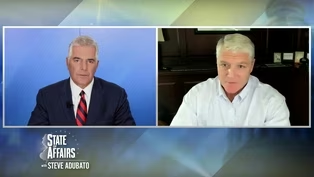
Addressing the rising cost of utilities & new energy policy
Video has Closed Captions
Clip: S9 Ep15 | 8m 35s | Addressing the rising cost of utilities & new energy policy (8m 35s)
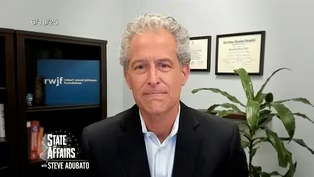
Discussing the growing mistrust in public health & vaccines
Video has Closed Captions
Clip: S9 Ep15 | 11m 10s | Discussing the growing mistrust in public health & vaccines (11m 10s)
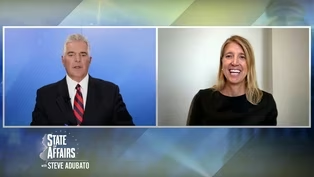
President of Garden State Initiative talks about New Jersey's fiscal health
Video has Closed Captions
Clip: S9 Ep15 | 8m 24s | President of Garden State Initiative talks about New Jersey's fiscal health (8m 24s)
Providing Support for PBS.org
Learn Moreabout PBS online sponsorship
- News and Public Affairs

Top journalists deliver compelling original analysis of the hour's headlines.

- News and Public Affairs

FRONTLINE is investigative journalism that questions, explains and changes our world.












Support for PBS provided by:
State of Affairs with Steve Adubato is a local public television program presented by NJ PBS