
The Art Scene
Richmond Ballet: 40 yrs of Stoner Winslett
Clip: Episode 7 | 7m 17sVideo has Closed Captions
Fewer than 1/3 of ballet artistic directors in the nation are women.
Fewer than 1/3 of ballet artistic directors in the nation are women, and Stoner Winslett of Richmond Ballet is one of them. Since she was 21 years old, Winslett's influence over the ballet's performances and operations is significant. We sit down with Winslett as she talks about her life and legacy in Richmond.
Problems playing video? | Closed Captioning Feedback
Problems playing video? | Closed Captioning Feedback
The Art Scene is a local public television program presented by VPM
The Art Scene
Richmond Ballet: 40 yrs of Stoner Winslett
Clip: Episode 7 | 7m 17sVideo has Closed Captions
Fewer than 1/3 of ballet artistic directors in the nation are women, and Stoner Winslett of Richmond Ballet is one of them. Since she was 21 years old, Winslett's influence over the ballet's performances and operations is significant. We sit down with Winslett as she talks about her life and legacy in Richmond.
Problems playing video? | Closed Captioning Feedback
Where to Watch The Art Scene
The Art Scene is available to stream on pbs.org and the PBS app.
Providing Support for PBS.org
Learn Moreabout PBS online sponsorshipFS: When I was a little girl my mother took me to ballet class.
She was tall and she thought I would be tall and she wanted me to learn to stand up straight.
And that was all.
She had no vision past that.
But I fell in love and am still in love after all of this time.
Five and six and seven and eight.
One and two and... I was very conflicted because I was a good student and it was expected that I would go to college, but then my heart was to dance.
(Kids dancing) FS: I love the music and I love moving through space with the music.
And I think I also really loved the camaraderie of it.
I've never been on an athletic team, but it must be how that feels to share a goal.
But ultimately my left knee took me out, so I had to give up performing.
MS: And we will have four counts.
FS: Well, when I realized I wasn't going to be able to dance anymore myself I had to have this talk with myself and I thought you can either just go in the corner and cry and stay there forever, or you can just bag ballet all together and do something else with your academic interest or perhaps if you're a person that does have some gifts you might be able to use those to make a place for other people to dance.
I was always interested in teaching, directing and choreography.
I started a dancing school in my neighbor's basement when I was 13 and was choreographing for those children and putting them on the local high school stage for recitals and then I directed the Columbia City Ballet apprentice company when I was 16 and 17.
And then after I stopped pursuing the professional ballet dream I did a lot of choreography and direction at Smith College where I was.
So I was no stranger to the tech table and directing and choreographing.
I was lucky enough to have the opportunity to come to Richmond Ballet when I was 21.
And then the Artistic Director that I came to work for resigned a couple of months later and it was right before Nutcracker.
So on October 1st of 1980 I found myself with no costumes and no choreography, a student company guest artist, what was then was known as the Mosque and is now the Altria Theater in the Richmond Symphony and something needed to be there for the audience in about six or eight weeks.
So that was a tall order.
When I first came in 1980 the School and the Company were two different organizations and the Company was the best students from the School.
It was a civic company.
The School had been founded as the first not for profit dance training facility in Central Virginia in 1975.
Then I came in 1980, five years into it.
And then in the early 80s those students that had come to the very fine training in 1975 were starting to graduate from high school and they were getting jobs all over the country, literally all over the world.
Some of them were going to Europe, Pittsburgh Ballet Theater, APB2, Houston Ballet.
And the Board and the community were saying why are all of our best dancers leaving Richmond?
And the answer to that was pretty simple, there was no place in the Commonwealth of Virginia to have a job as a ballet dancer.
So in 1984 the Board and I founded the Professional Company.
And that was a total game changer, because it gave a place for the good students from our school to maybe be able to stay at home and have a career that also opened us up to the whole worldwide market of dancers and auditions and we were able to attract people here from all over the country and now all over the world.
The dancers come from as close as our own Richmond neighborhoods and as far away right now as Japan, Brazil, Hungary, all kinds of different places and bring different perspectives , different backgrounds.
And I think really enrich our community living here.
FS: There have been so many performances over the last 40 years that I've loved.
I always love The Nutcracker.
It's an entry point for both artists and audience, and I've been here long enough to see, you know, some of those tiny mice come all the way up through party and, you know, battle and student company and some even in the professional company now.
And that's so rewarding.
One of the things that keeps Nutcracker fresh every year is the change in the children's casting.
The company members may be doing their sugar plum fairy, their butterfly, their snake charmer every year for many seasons, and that's actually good, because it gives them a chance to revisit and grow and be better, but every year there are new little mice, there are new mother ginger children, there are new party children.
And the sparkle and the enthusiasm and the freshness that they bring is just completely infectious I think in the audience.
Arabesque, good, perfect, and step through and turn and look at him.
Beautiful.
Look at that.
I also love driving to the theater and seeing three generations coming into the theater together.
I think there's so little entertainment today that grandparents, parents and children can all come to together and there's something there for everybody.
Our mission is to uplift and awaken the human spirit.
And I hope that that's our place in this community that everyone who lives here knows that we are their ballet.
I hope that they feel access to shows.
I hope that they feel access to training.
I hope that they're proud when we go to London or China or even Chicago or Kennedy Center in D.C.
that they feel proud of what we're doing.
Forty years is a long time.
I like to say I started when I was two, not quite that young.
Whether I have 40 more in me, I don't know.
But the beautiful thing about ballet is sort of like the candlelight service at church, you know, you receive the flame from your teachers and then you hold the flame and tend it and take care of it and you pass it to the next generation.
And I feel so proud and so humbled and so honored to be working with so many people here.
I was the first full-time employee and there are now 135 people here and many of them are former students in the school, former dancers somewhere else, former dancers here and I feel like so many people have received the flame now and will tend it whether I'm here or not.
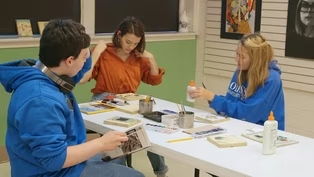
Artist Lora Beldon and Military Kid Art Project
Video has Closed Captions
Clip: Ep7 | 7m 17s | Beldon teaches an artistic workshop at the Appomattox Governor's School in Petersburg. (7m 17s)
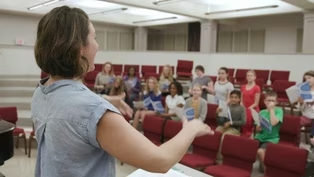
Video has Closed Captions
Clip: Ep7 | 7m 12s | Children sing different styles of music from around the world and build their confidence. (7m 12s)
Providing Support for PBS.org
Learn Moreabout PBS online sponsorship New Episode
- Arts and Music

Innovative musicians from every genre perform live in the longest-running music series.
 New Season







 New Episode
 New Episode

Support for PBS provided by:
The Art Scene is a local public television program presented by VPM