
Rick Atkinson Discusses His Book, "The British Are Coming"
Clip: 6/11/2019 | 19m 6sVideo has Closed Captions
Rick Atkinson joins the program to talk about his book, "The British Are Coming."
As America grapples with political discord, Pulitzer Prize-winning historian Rick Atkinson says the nation’s founding history holds the key to today’s challenges. He has dusted off King George III’s archives with “The British Are Coming”, the first book in his American Revolution trilogy, and sat down to discuss it with Walter in New York.
Problems playing video? | Closed Captioning Feedback
Problems playing video? | Closed Captioning Feedback
Rick Atkinson Discusses His Book, "The British Are Coming"
Clip: 6/11/2019 | 19m 6sVideo has Closed Captions
As America grapples with political discord, Pulitzer Prize-winning historian Rick Atkinson says the nation’s founding history holds the key to today’s challenges. He has dusted off King George III’s archives with “The British Are Coming”, the first book in his American Revolution trilogy, and sat down to discuss it with Walter in New York.
Problems playing video? | Closed Captioning Feedback
How to Watch Amanpour and Company
Amanpour and Company is available to stream on pbs.org and the free PBS App, available on iPhone, Apple TV, Android TV, Android smartphones, Amazon Fire TV, Amazon Fire Tablet, Roku, Samsung Smart TV, and Vizio.
Watch Amanpour and Company on PBS
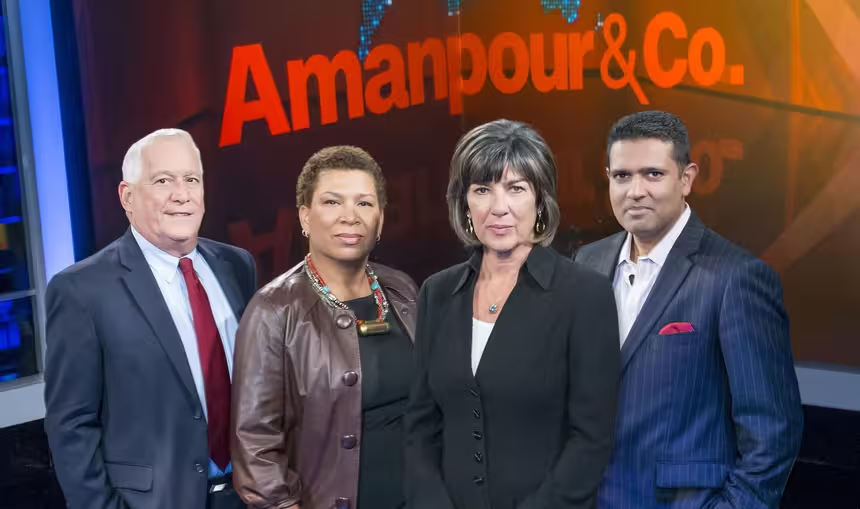
PBS and WNET, in collaboration with CNN, launched Amanpour and Company in September 2018. The series features wide-ranging, in-depth conversations with global thought leaders and cultural influencers on issues impacting the world each day, from politics, business, technology and arts, to science and sports.Providing Support for PBS.org
Learn Moreabout PBS online sponsorshipAs America grapples with political discord.
Our next guest says the nation's founding history holds the key to today's challenges.
Rick Atkinson is a punitive prize winning historian who delve deep into King George the Third's archives to write his new book.
The British Are Coming.
It's the first installment of his planned American Revolution trilogy.
He walked out Walter Isaacson, through the key players in America's War of Independence.
Rick, welcome to the show.
Thank you very much.
You know what really blew me away is the notion of you going through the archives of George the Third King George at Windsor and anybody ever tap those archives before?
You know, surprisingly, not really.
The there were 350,000 pages of George and documents and the queen Queen Elizabeth's second, who owns them.
And she decided in 2016 that she was going to open them up to scholars.
I was one of the first ones in and to have them digitized so that they'd be preserved in perpetuity.
And most of those Georgian papers are from George the third because he was king for 60 years.
So every day I would show my badge at the Henry the Eighth gate and show my badge at the Norman gate and climb 102 stone steps and then 21 wooden stairs and you'd be in the garret of the round tower built by William the Conqueror in the 11th century.
And that's where the papers are kept, and they're fantastic.
George was his own secretary until late in life when he began to go blind.
And so he not only wrote his correspondence himself, he wrote the copies.
And there's a real tactile sense of being in his presence.
And he's a great list maker.
He he would write lists.
He would he would write in formulas for insecticide, for example, and theater reviews.
And he would write lists of all of his regiments in North America.
And he would list the number of officers, the number of musicians, the number of rank and file.
You can see as arithmetic scratchings in the side as he as he does his sums.
So I spent a month there in April 2016 and really felt like I got to know him and felt like I, you know, he's not the bumbling nitwit we see in music across the stage.
And Hamilton is much more a man of parts and has a greater depth than we Americans particularly have generally assigned to him.
And he is running the train in the American Revolution.
And in your book, the British are coming you're able to do it from both vantage points, from the vantage point of the American colonists fighting as well as the British.
And one of the interesting things about George the third is that he was much more of a hard liner than we thought before.
This is so true.
And, you know, when the revolution began in April, 1775 and for some months thereafter, Americans wanted to believe that he was, if not an innocent bystander, that he was fundamentally on their side.
And that's not true at all.
He was, in fact, a hard liner.
He was the force behind the hard liners within the cabinet.
Lord North who was his first minister.
The prime minister really had no appetite to be a war minister and was not particularly interested in prosecuting a war for eight years across 3000 miles of open ocean in the age of sail.
And George is the one who's constantly bucking him up, and George is the one who's saying blows must decide.
And George is the one who is not necessarily drawing up the minutia of which battalions are going where.
But he's very involved in the nitty gritty of expedition three Warfare.
Why?
Why was George the Third so intent on pursuing a war against the colonies?
Who wanted thereand why?
Why why?
Why indeed?
I think the fundamental reason, Walter, is that he becomes king in 1760 in 1763.
The first British Empire is created with British victory in the Seven Years War, French and Indian Wars, we call it.
They gain enormous territorial benefits from that victory.
They get Canada, they get Sugar Islands in the West Indies, they get parts of India.
They get a billion fertile acres west of the Appalachians.
And George is determined that he's going to hang on to that empire.
And he also believes and this is an article of faith within the Cabinet, and certainly for him, that if the American colonies are permitted to breakaway, if the insurrection succeeds, then Ireland is next Canada, the Sugar Islands, India, and that the empire will dissolve.
It'll be the end of Britain as a great power, a newly created great power.
And it's a strategic misconception.
It's it's their badly informed this.
This is not true.
And yet it really is the underpinnings of their determination to to thwart American independence and to suppress bloodily the the revolution.
Could it have been avoided if they had found some more Commonwealth type structure Yeah.
You know, I Commonwealth I think is the the obvious answer, but it wasn't obvious.
In 1775 there were lots of negotiations.
Benjamin Franklin was in London, as you well know, four years before he left in the spring of 1775 trying to find a modus vivendi, trying to accommodate both the British point of view and the colonial points of view.
And I think positions are just hardened too much by that time And so it just kind of unravels and once the shooting starts then it's very difficult to put the base back together once it's smashed.
Mm hmm.
That was a Ben Franklin line and of course he had his own son end up on different sides of the revolution.
How common was that that Americans were divided on whether or not they wanted independence.
Yeah.
Yeah.
I mean, you know, well, it's one of the great tragedies of the war is beloved son William, who is the royal governor of New Jersey.
And he's you know, he's participated with his father in some of the experiments and the kite flying and all the rest of it.
And Ben Franklin talks about it's the happiest period of his life and he remains loyal.
He does not become radicalized the way his father has over time in London and refuses to accede to fatherly advice that you need to get on.
You need to get on the side of the angels here.
And, of course, he's ultimately arrested.
He's imprisoned in New England.
It's it's it's really a tragedy.
It's quite common this schism within families as a consequence of irreconcilable political differences.
It really anticipates the civil war in that sense.
This is a civil war.
The revolution is and it anticipates these civil war of the 19th century in the way that it fractures families.
You call it a civil war.
And one of the themes of your book is you treat it as a civil war as opposed to just a war for independence.
What do you mean by that?
Well, you know, you can guess.
And scholars have calculated that 18 to 20% of of the 2 million white Americans in the colonies at the time of the revolution are loyal.
And now loyalty is a shifting concept.
You may be loyal if the royal the British army is in your backyard.
And when they leave, you may be less loyal, particularly if your rebel neighbors are warning you that you're going to be punished.
But say 18% or loyal enough of them are loyal to form regiments to fight to to to support the the king's army and the Royal Navy and to do the bidding of the ministers in London.
And so it's a civil war in the sense that there actually is armed conflict between Americans.
If you're a loyalist, the treatment you're likely to receive from the rebels can be atrocious.
You can't have your lands confiscated.
You can be jailed, you can be sent into exile, you can be executed.
In some cases, it's very harsh treatment.
Some of the loyalists were put on scales in the Hudson River below Albany in dire conditions.
Some were lowered by windless 70 feet below ground in an old Connecticut copper mine to these rock walled cells known as hell.
It was really a harsh treatment and went back and forth.
The loyalists sometimes persecuted their their rebel neighbors So it's a civil war in the most fundamental sense.
Why was Washington such a great leader?
He's not a particularly good general.
I think it has to be said.
He's not a tactician.
He's like Dwight Eisenhower in some ways.
He doesn't see the battlefield spatially and temporarily the way a great captain does a Napoleon.
And he's got a steep learning curve when he takes over the Continental Army on July 2nd.
1775 in Cambridge outside of Boston.
He's been out of uniform for 17 years.
And in the five years that he was in uniform, you know, he's a colonel in the Virginia militia is always under British superior commanders.
There are a lot of things he does not know is he acknowledges he does not know how to run a Continental Army.
He doesn't know much about artillery.
He doesn't know much about cavalry.
So we start with the understanding that he makes a lot of mistakes on the battlefield.
He's got his moments, there's no doubt about that.
But he makes a lot of mistakes.
He's also got a lot to learn about the army that he's commanding.
He shows up in New England as a Virginian commanding mostly New Englanders in the Continental Army.
And he is very disparaging of the new English as he writes about the dirty New Englanders.
And he has nothing good to say about the officers serving under him from New England.
And it takes a while for him to understand, first of all, that he is someone who has scores of slaves and overseers back in Mount Vernon, taking care of business for him while he's away, has trouble understanding the sacrifice made by men who leave their farms, their shops, their families to come serve at his side in the cause.
He doesn't really get that at first.
The Army, the Continental Army, is the absolutely critical institution in this young republic morning.
It's the indispensable institution, and he is the indispensable man within it.
And for the two of them to figure out how they fit together, it's going to take some time Having said all that, he's a great man.
He's a great man who's worthy of our adulation and all the things that we think about him.
If we will acknowledge that there are some issues when he dies.
There are more than 300 slaves at Mount Vernon.
You cannot square that circle morally.
Nevertheless, he embodies traits that I think should be the North Star for all of us to this day.
A sense of probity, a sense of commitment to a cause larger than himself, dignity.
These are things we should demand in our leaders.
These are things we should demand of ourselves.
These are things that we should recognize in Washington and celebrate to this, this day.
He can seem alabaster.
He can seem remote.
And he's not really he's got a three dimensional quality that is really riveting.
And it's important for us to remember that he's not just this distant figure who has been embalmed in reverence.
He's a fantastic person to help launch us on our journey.
One of the other great generals in the book and actually far more colorful in a way, is Charles Lee.
Yeah.
Tell me about Charles Lee and what would have happened had there been no Washington.
How would Charles Lee have been the one in charge and how would it have been different?
Yeah, well, it would have been real different and probably not as good Charles Lee was a British Army officer.
He'd ascended to the rank of lieutenant colonel, which is a fairly high rank in the British Army.
He'd seen some combat.
He'd been in, you know, in America, in the French and Indian War.
He'd been shot in the chest and survived that.
He is a colorful guy, is a weird looking guy.
By all accounts, he's tall and spindly.
He's the people described as having no shoulders.
And he has an enormous nose.
He he accumulates many nicknames, one of which the cruelest of which is narzo.
He has a great affection for dogs.
He likes dogs, as he acknowledges much better than people.
He's always got a pack of dogs around him.
He decides he's going to emigrate.
He becomes disaffected with his life in the British Army.
He comes to America a couple of years before the revolution begins.
He's a radical at heart.
And he writes and speaks eloquently about the power of the ideas that are germinating in America about potential independence but distance from the crown.
And he writes powerfully about his assertion that this rather ragtag, badly armed, badly led, badly Fed army in the making can hold their own against the British Army, one of the finest armies in the country.
And this falls on welcome.
Here's the the political leadership and other military officers are pleased to hear this.
He's made a general, major general, and he soon becomes second in command to Washington.
He Washington listens to him carefully because he knows things that Washington does not as a practical things about how to organize a bivouac and how to organize artillery and and how to get men to do what you want them to do and in order to do other things that Washington is really pretty green and all this unfortunately he's also very ambitious.
So we see him successfully on command in command on the scene when the British sent the Royal Navy to try to take Charleston in June.
1775.
They're repulsed in a very bloody and surprising defeat for the Royal Navy.
Lee is the commander at the time and he's celebrated through the colonies for this this a clubbing of the Royal Navy.
And he begins to think that maybe in fact Washington is having his problems.
Washington's going through a succession of defeats that may be what the country needs is Charles Lee is a commander in chief.
He has a very disloyal correspondence with one of Washington's aides, Joseph Reed, who's a lawyer from Philadelphia.
Washington opens a letter by mistake from Lee to Reed and discovers that, in fact, these guys are conspiring behind his back.
He's deeply wounded by it when Washington retreats across New Jersey in December.
1775 76 after being badly slapped around in New York, Lee has a wing of the Army.
Washington is pleading with him to to join the Army.
Lee's taking his time he is corresponding with members of Congress is he's forming the beginnings of a cabal he makes a really serious mistake.
And on one night in mid-December 1776 he decides that he is not going to camp that night as he is moving to join Washington in Pennsylvania and he goes to a tavern spends the night there's a British cavalry patrol that gets wind that is there they attack this tavern early in the morning and they capture Washington who by this point is shrewd enough to recognize that Charles Lee is a big problem for him.
Writes this very deaf letter to Lee in jail in New York saying, Gee, I'm sorry about this.
I can only hope that someone in your circumstance can be as happy as you might be in this circumstance.
It's really Lee is later exchanged.
He comes back, he joins the army, disgraces himself in battle later.
It's he's really finished as a force, but he's got a role early on.
And he's a wonderful character to write about underlying this book, sort of the foundational truths that help create America.
What do you think those troops are and how are we wrestling with them today?
Well, first of all, I think the concept of truth is true.
We hold these truths to be self-evident, that all men are created equal, that they are endowed by their creator with certain unalienable rights.
Okay.
That's foundational.
And it's asserted that it is true.
And you know what?
It's not true because all men are not created equal in 1775.
Those fine words do not apply to 500,000 black slaves.
They don't apply to women, they don't apply to Native Americans.
They don't apply to indigence.
It's aspirational It is.
The great Yale historian Edmund Morgan wrote It doesn't guarantee men these basic rights it invites them to claim them.
And I think that that is the essence of what we see in those who are fighting for independence from Britain at the time.
It's aspirational.
They recognize that there are issues to be worked out, and it turns out there are issues to be worked out for.
243 years subsequently we're working them out still.
Archibald MacLeish the poet and Library of Congress, said, Democracy is not a thing that's done.
It's a thing a nation must be doing.
And I just think it's very important to remember that that we have we've inherited this extraordinary political legacy but it's a work in progress, and it's always going to be, I think, understanding what our forebearers thought they were fighting for.
What they thought they were creating is important for us to understand that what we're fighting for, what we are continuing to create I just think it's important to affirm it every day.
Right.
Thank you so very much for being with us.
Thank you for that.
Thanks.

- News and Public Affairs

Top journalists deliver compelling original analysis of the hour's headlines.

- News and Public Affairs

FRONTLINE is investigative journalism that questions, explains and changes our world.











Support for PBS provided by: