One-on-One
Rick Cotton & Kevin O’Toole; Regina Egea; Dr. Jennifer Chen
Season 2026 Episode 2873 | 27m 49sVideo has Closed Captions
Rick Cotton & Kevin O’Toole; Regina Egea; Dr. Jennifer Chen
Rick Cotton, Executive Director & Kevin O’Toole, Chairman of the Port Authority of NY and NJ, discuss the projects underway in the region. Regina Egea, Founder & Chair of Garden State Initiative, discusses the importance of budget transparency. Dr. Jennifer Chen, Professor of Early Childhood Education at Kean University, explores the link between early childhood education and brain development.
Problems playing video? | Closed Captioning Feedback
Problems playing video? | Closed Captioning Feedback
One-on-One is a local public television program presented by NJ PBS
One-on-One
Rick Cotton & Kevin O’Toole; Regina Egea; Dr. Jennifer Chen
Season 2026 Episode 2873 | 27m 49sVideo has Closed Captions
Rick Cotton, Executive Director & Kevin O’Toole, Chairman of the Port Authority of NY and NJ, discuss the projects underway in the region. Regina Egea, Founder & Chair of Garden State Initiative, discusses the importance of budget transparency. Dr. Jennifer Chen, Professor of Early Childhood Education at Kean University, explores the link between early childhood education and brain development.
Problems playing video? | Closed Captioning Feedback
How to Watch One-on-One
One-on-One is available to stream on pbs.org and the free PBS App, available on iPhone, Apple TV, Android TV, Android smartphones, Amazon Fire TV, Amazon Fire Tablet, Roku, Samsung Smart TV, LG TV, and Vizio.
Providing Support for PBS.org
Learn Moreabout PBS online sponsorship- [Narrator] Funding for this edition of One-On-One with Steve Adubato has been provided by United Airlines.
The Turrell Fund, a foundation serving children.
IBEW Local 102.
Lighting the path, leading the way.
PSEG Foundation.
Newark Board of Education.
The North Ward Center.
Operating Engineers, Local 825.
New Jersey Manufacturing Extension Program.
And by Congress Hall.
A Cape Resorts property.
Promotional support provided by NJBIA.
We put business at the center.
And by BestofNJ.com.
All New Jersey in one place.
- This is One-On-One.
- I'm an equal American just like you are.
- The way we change Presidents in this country is by voting.
- A quartet is already a jawn, it’s just The New Jawn.
- January 6th was not some sort of violent, crazy outlier.
- I don't care how good you are or how good you think you are, there is always something to learn.
- I mean what other country sends comedians over to embedded military to make them feel better.
- People call me 'cause they feel nobody's paying attention.
_ It’s not all about memorizing and getting information, it’s what you do with that information.
- (slowly) Start talking right now.
- That's a good question, high five.
(upbeat music) - Hi everyone, I'm Steve Adubato.
More importantly, I'm about to introduce a segment we did with two leaders who are making a huge difference in the region.
Port Authority of New York and New Jersey.
Never heard of them.
They matter.
George Washington Bridge, the airport, Newark Airport, PATH, all of it operated by the Port Authority of New York and New Jersey.
The chairman of the board, Kevin O'Toole and the executive director, Rick Cotton, who is leaving in early 2026.
But they've had a long time partnership as chairman of the Port Authority and the day-to-day executive director of the Port Authority, Kevin O'Toole and Rick Cotton, making a difference in our lives, whether we realize or not.
Talking about leadership, talking about economic development, transportation, a whole range of other issues.
Let's check it out.
Once again, we're joined by two important significant leaders in our region.
Kevin O'Toole is Chairman of the Port Authority of New York and New Jersey.
And Rick Cotton, the executive director of the Port Authority of New York and New Jersey.
And let me disclose Port Authority, a longtime underwriter of our programming around economic development, infrastructure, et cetera.
Good to see you gentlemen.
- Good to see you, Steve.
- You got it.
Hey Kevin, kick this off.
The two of you have been in these two roles, which by the way, it's rare.
It may be unprecedented.
Rick has been the executive director.
You've been the chairman since '17, 2017?
- Correct?
Eight years.
- Eight years.
And lots of governors.
- Yeah, a couple, a handful.
And you know, you know a few of them.
- Yeah.
How the heck have two strong leaders collaborated, worked together and somehow put egos to the side?
Kevin and then Rick?
- Well, listen, listen.
When I met Rick in June of '17, we said we had to just make this place work.
And we talked long and hard back in June of '17 that we had to work together working with the governors at the time, whether Republican or Democrat, we're gonna make this thing work.
And it's been eight years, and I will tell you, Rick and I have been totally hand in glove working with our commissioners, with senior staff and the 8,000 employees.
And we have done amazing things with the Port Authority because we've worked together as opposed to against each other, which has happened in the past.
- Yeah, just a little bit, and by the way, background, Kevin O'Toole, former state senator, and also one of the co-founders of O'Toole Scrivo, a significant law firm in the region.
Rick, let me ask you this.
When you met Kevin, I mean I've known Kevin for more than a few years, he says what he thinks, he's extremely candid and direct.
What was your first reaction to him and did you know, Hey, we're gonna have a great partnership?
- Well, I think we hit it off right from the very first time we met each other.
And the foundation is what Kevin just said.
We both came to the table, we almost used the same words with each other.
We wanna get things done.
And we also wanted to put behind us and the agency, the divisions and the dysfunction which sometimes appeared.
And so we set out to do exactly that.
And we took a regional focus.
We took the key ambitions of each state into account, and we've worked together to deliver.
And I think the last eight years have been very productive.
- Lemme make it clear for those folks who say, Hey, what the heck has the Port Authority created in a compact of 1921, two states coming together, New Jersey and New York.
Hey, wait a minute.
There are a whole bunch of things that affect both states.
We need to come together and do things together.
That was on paper.
The reality of that, as Rick and Kevin are talking about, very different, more challenging.
Kevin, you and I talked about this the other day, a couple of the most significant initiatives, whether it's the airport, at the airport, several airports, but also the bus terminal.
Then Rick jump in as well.
Go ahead, Kevin.
- Yeah, I mean, it's astonishing.
So you're seeing renovations going on at Newark and LaGuardia and JFK, $19 billion at JFK.
You're talking LaGuardia, which has gone from the worst to the best and Terminal A at Newark, which is amazing.
And now we're working on the planning stations for Terminal B. It's astonishing.
All three regional airports, which have record numbers, are going through this massive renovation and getting, you know, recognized across the world for being amazing in terms of state of the art.
We talk about the bus terminal, which is, as you know, is from 1950s, it should have been... had a wrecking ball to it probably 30 years ago.
So we just passed over $4 billion in its first stage.
Can't wait for that to come online.
You're seeing a $3.5 billion new AirTrain in Newark.
You're seeing new renovations at the port, you're seeing upgrades at the GW, $1.9 billion, $2 billion to rewire the the GW.
So there's a massive infrastructure being done right now and it's overseen by Rick.
And you know, Rick was very kind to talk about, you know, what his impression was of me.
I'll tell you my impression of his remains today.
He's the most hardworking, the most diligent, the most transparent, most hands-on leader I've ever worked with Steve, and Steve, I've worked, as you know, at federal, state, local, county.
He's the most distinguished and amazing public servant I've ever worked with, bar none.
- Well said.
Rick, lemme follow up on that.
Kevin mentions all these projects and there's the word, the B word is in there a lot, a lot of billions.
Here's the question.
From a leadership point of view, from a getting things done point of view, how the heck do you, have you gotten these approvals along with Kevin and the board and the executive team at the Port Authority when you're talking about so much money.
Those are critical investments that have been avoided forever, confronting and dealing with falling apart infrastructure.
People talk about all the time, very few people do anything.
How is that connected to leadership?
Rick, talk to us.
- Well it starts with a vision and it starts with a commitment and it starts with being clear with the organization and indeed the public where you want to go.
And it was very early on that Kevin and I committed not only to get things done, but that world class was our standard.
And we are gonna do that across every aspect of the operation.
The buildings we built, the capital structures that we brought online, how we are gonna operate the place and we did it together.
And you need to communicate clearly where you're going for the organization.
You can't have different visions and fighting is very destructive.
So the emphasis that we put on it, very straightforward, as I say, world-class quality, speed of execution, getting things done and working together to do that.
And I think the agency has pulled together across all of our priorities and Kevin and I have done it together.
- But the other part of this, Rick and Kevin, which again, Kevin, let's just say Kevin O'Toole knows politics better than most.
And he is had to navigate and negotiate a whole range of complex things on the Jersey side that I'm more familiar with, but obviously at the PA, Port Authority.
If I'm not mistaken, each governor, the governor of New Jersey and the governor of New York have the constant, they have the legal authority to quote, veto the minutes of any meeting of the Board of Commissioners to the Port Authority.
And if they veto those minutes, anything that's approved in those minutes doesn't happen.
Kevin, accurate?
- Absolutely accurate.
And it hasn't happened on our watch Steve.
And lemme tell you, because the governors on both sides understand if they do that they'll be killing jobs, killing initiatives, killing progress, and killing any of these big projects we're talking about.
And they have, and we're working on their agenda so they wouldn't really undermine their own agendas.
- However, let me get a little more complicated here.
New York has a governor in place right now.
Governor Hochul's there.
As we do this program, it's right before, this will be seen after the election.
We don't know.
It could be Mikie Sherrill, it could be Jack Ciattarelli.
How the heck does the Port Authority leadership with you as Chairman, Kevin, and Rick, how do you prepare for a new governor, because Governor Murphy will not be there in January of 2026.
How do you engage he or she on the Jersey side to what's important and how do you engage them in the process?
Kevin, then Rick.
- Listen, so once we have the winner, you know, 34 days from today, we will set up a transition team.
We'll have a briefing.
And frankly, whether it's Congressman Sherrill, whether it's Jack Ciattarelli, you know, those folks have reached out and want to have some input now and talk about what's going at the port.
We've had some discussions.
And once the election's over professionally and what we do, the same we did with Governor Murphy, by the way.
We will sit down and talk about Some of the exciting things that are happening.
And it's pretty seamless, believe it or not.
And for those who have been paying attention, they're not be shocked by some of the ambitious plans we have at the Port Authority.
- Rick, jump in here 'cause you've seen a few governors as well.
- The key in my judgment is that the priorities that the Port Authority is working on are really shared by the governor.
Where both state houses very clear in terms of what their priorities have been, that has enabled us to put together a regional agenda.
But if you think about it, world class airports is what we're building.
You look at LaGuardia, hopefully your viewers have been to Terminal A at Newark.
World-Class structures widely characterized that way.
And so we're going to the state houses, we're going to the public and saying, look, this is what we want to build and we wanna operate them in a way that they are rated in terms of their operations at the absolute top of the game.
And that's the agenda that we're bringing to the state houses.
That's the agenda we'll bring to new governors, different governors.
But we've had support because these are shared objectives.
No one wants the New York, New Jersey airports to be at the back of the line.
They wanted them to be at the front of the line.
People want the bus terminal built and we're committed to that.
So I think it's in delivery, it's in shared priorities that makes the relationship with governor's work.
- And Steve, to that point, you know, years ago when we started talking about the bus terminal, not everybody was on board.
The locals in New York and New Jersey, not everyone understood and appreciated it.
We had a groundbreaking, everybody unanimously was on board, the community boards, governors, local officials because we took their needs into into consideration, talked about what was really important to them.
And now literally everybody's on board the bus terminal, which would be one of the biggest projects in the country.
- It's so interesting.
It's easy.
And I'm not gonna get in my soapbox, but people in governmental and political positions and in the corporate world as well, it's easy to blame.
It's easy, why don't they do this?
It's so easy to be against things, to build something, to create something and then have to get other people on board, easier said than done.
To Kevin and Rick, I wanna thank you for joining us.
Thank you again for longtime collaboration with the Port Authority.
We call it infrastructure, it's economic development.
It's transportation, it's sustainable energy, it's the environment, it's all kinds of stuff, and quality of life.
To the chairman of the board and to the executive director of the Port Authority, thank you so much.
Thank you gentlemen.
- Thanks Steve.
Appreciate it.
- You got it.
Stay with us, we'll be right back.
- [Narrator] To watch more One on One with Steve Adubato find us online and follow us on Social media.
- We're now joined by Regina Egea.
She's been on with us before.
There's an important message today.
She's founder and chair of Garden State Initiative.
Good to see you, Regina.
- Nice to see you too, Steve.
- Tell everyone, as we put up the website, what Garden State Initiative is.
- It's a public policy organization that focuses on broad economic matters in the state, including energy, transportation, our performance on unemployment, et cetera.
So we try to really give a good temperature check on how the state is doing economically.
- Tell folks very quickly about your leadership journey.
You've had some key leadership positions in a variety of sectors.
Talk about that.
- Well, I began in the private sector at AT&T, and I was very fortunate.
I was in AT&T in the period when I was very much focused on leadership development.
And we were put through many, many both academic as well as career-enhancing experiences.
And it really put me in situations that you really learn to understand yourself and how you behave when you are put under stress, when you are put in, you know, a spotlight, et cetera.
So I was very fortunate, and I was in across the organization in both sales leadership, network operations, as well as product management and financial leadership.
So it was a interesting preparation for going into government after a career at AT&T.
I joined the Christie Administration as the Chief of Staff to the Treasurer.
and then on into the Governor's Office, overseeing the Authorities Unit, which includes a wide range of government functions.
And then ultimately the Chief of Staff for Governor Christie.
- Wow.
You know, it's interesting.
You worked with Governor Christie, and Governor Christie and I have talked about different leaders who he's had working on his team, and the Governor and I have had many discussions and sometimes debates about leadership style because there's no one way to get things done, but he clearly got things done.
But the other governor who got a lot of things done in a time when as a very, very young man serving in the state legislature for a very, very short time, was Tom Kean.
Governor Kean was an extraordinary leader, is an extraordinary leader.
The Tom H. Kean, Governor Thomas H. Kean Leadership Award, there was an event recently, September 18th, the inaugural event.
What was it?
Why do we have to honor and recognize the great leadership of Governor Kean?
Regina.
- Well, you know, we are coming to observe about our current environment of polarization and frankly, lack of productivity of our government in delivering on what really citizens need.
what we are learning to appreciate, and as you say, honor about Governor Kean's leadership and others, frankly, also in that era understood that you have to begin with listening and understanding how people come at problems and agree that you want to solve problems in a way that accommodates as many points of view as you possibly can.
And at the event you're referencing, Steve, again and again, individuals spoke to the notion that Governor Kean listened, absorbed, and frankly, when he spoke, he had a very purposeful goal in mind and delivered on what he understood needed to get delivered.
And also the other observation, 'cause you contrasted Governor Kean and Governor Christie, is, you know, Governor Kean, while he's extremely poised and never see him lose his temper in public, he was a very schooled politician, and he understood how to work the government, as well as the private sector, to get stuff done.
So different styles, but understanding, you know, how this system works and what needs to be accomplished was the hallmark of Governor Kean.
Governor Kean, while in the state legislature, as a Republican, when the Republicans were in the minority, which means they did not have the majority of votes, he became the Speaker of the House, the Speaker of the Assembly in the minority party, which means he had to not just get Republicans but Democrats to vote for him to be the leader of the House.
Just imagine that happening today.
That's not commentary.
It's just a question.
Hey, Regina, do this for us.
We're putting up the website, njbudget.com.
What is it?
Why is it so incredibly important for people who want to understand what the heck's going on with our money in the state?
- Well, you know, the New Jersey State budget, all most people hear is how big it is, right, 50 billion or whatever the, you know, current number is.
and it's very difficult for anyone in the public, and frankly, some legislators, honestly, to really start to try to understand what are the elements that matter that we understand about how that money gets spent.
And so njbudget.com, which, Steve, you've heard me say this before, I find it completely ironic that in 2025, the URL njbudget.com wasn't taken.
And so when we launched this product, it was really to help people understand the New Jersey budget.
And we began with what gets a lot of the press at the end of the budget cycle, is those elements that get added at the last minute.
And they are important because they are part of the negotiation process, not just the spending plan.
So our goal is to keep building on this product that shows, in a very user-friendly way, some of these elements of the budget, how the spending was last year, how it was this year, and then when the Governor's Budget gets presented in the following year, what is being proposed.
And as I said, user-friendly interface, and it breaks it down by municipality, by legislative district, and by entity.
So user can go in and really look and understand, and I hope that it helps to translate what's government, you know, speak into normal speak, and people can ask questions about how the money's getting spent.
Regina, thank you.
We will continue the conversation and I look forward to sitting down with Governor Kean.
Thank you, Regina.
- Thanks, Steve.
- You got it.
Stay with us, we'll be right back.
- [Narrator] To watch more One on One with Steve Adubato find us online and follow us on Social media.
- We are honored to be joined by Dr.
Jennifer Chen, who's Professor of Early Childhood Education at Kean University, one of our higher ed partners.
Dr.
Chen, great to have you with us.
- Hi, Steve.
I'm so delighted to be here.
Thanks for having me.
- Our pleasure.
Help us understand this.
What is the connection, I'm gonna talk about something called brain science.
And we've been part of a public awareness initiative around early childhood, and this term brain science comes up a lot.
We'll put up the website for Start Strong NJ.
- So I keep thinking about brain science, brain development, and then I think, wait a minute, wait a minute.
Artificial intelligence and childhood education and brain development of a child, meaning, what are some of the concerns in the research community, in the child education community around AI and early childhood education and brain development?
Please, Dr.
Chen?
- Sure, thanks.
It has something to do with experiences, the early childhood experiences.
For instance, in human developments, the brain adapts to and builds up on its previous experiences.
So when early experiences are positive, they can strengthen healthy brain developments as well as lay a strong foundation for other domains of development, such as cognitive, language, and socio or emotional.
So this is where early childhood education comes in.
High quality early childhood programs provides developmentally appropriate learning experiences, such as play, exploration, socio-emotional learning, and importantly, consistent responsive interactions with peers and teachers.
So in turn, these experiences help shape children's brain development in ways that support their overall wellbeing and development.
So if AI can help foster those early positive experiences, then yes, let's go for it.
So the key here is like to identify what AI tools parents, teachers, children can use to enhance their early positive experiences to contribute to their brain development.
- But, Dr.
Chen, on the other side, you talked about play, that early childhood education, early childhood experiences are critically important, particularly around playing, learning how to, as some people say, play in the sandbox.
I don't know whether there's a sandbox or not, but being able to interact with other people, other children, getting along, learning how to share, dealing with bullies, all kinds of stuff.
Does AI have the potential, if used incorrectly or abused, misused, to take our children away from that human interaction, Dr.
Chen?
- Oh, I totally agree with you.
Those are the questions that educators been trying to address.
So in one of my publications, I describe it, children's use of AI as a double-edged sword.
What this means is that AI has both benefits and drawbacks.
Specifically, AI can support like personalized learning to meet the children where they are, both educationally and developmentally.
However, and the social interactions, you know, like you said earlier, Steve, the interactions with peers, the playtime, that is hard to find.
Those are uniquely human qualities.
And AI, no matter how advanced AI may become, they still don't carry that kind of emotional interactions and connections with humans as we can, as humans.
- And what should we do?
What is your advice to parents right now, Dr.
Chen, as to, you know, who are saying, "Well, if artificial intelligence can help my child development and help my child grow and succeed."
And by the way, AI is gonna be more accessible in certain communities than others based on zip code, affluence and a whole range of other factors, socioeconomic and others, what advice do you have for parents right now?
And by the way, same thing goes for social media.
It's not the same, same.
But what advice do you have for parents who are concerned about their child's development and human interaction, or want to give them every technological opportunity possible?
Is it a balancing act, doctor?
- Absolutely.
There's a balance act.
And also, we need to ask our ourselves some fundamental questions.
What is AI?
What are AI tools out there that are developmentally appropriate for young children?
What good purposes do they serve, right?
Because AI can be used for harm.
So that is, why do children use AI?
How do children use AI?
Basically, we need to understand the what, the why, and the how of AI used by children to better enhance the learning and to navigate the complexity of the AI landscape, including the critical, ethical, and social, emotional implications of AI use.
- That's also true for social media, isn't it?
- I think so, yes.
With any kind of digital media, yes.
- Before I let you go, you're a parent.
- Yes.
- And so you experienced this not just as an academic, a scholar, and a researcher, but as a parent.
Advice for parents right now in terms of early childhood development and social media.
30 seconds, go ahead, give some advice.
- Okay, thanks.
So I think at this moment in time, I think we are approaching an inflection, critical inflection points in the use of AI by children for learning.
As AI becomes increasingly integrated into children's everyday experiences at home, at school, the balance between innovation in developmental appropriateness is shifting.
So at this juncture, all key stakeholders, not just parents, teachers, educators, education leaders, must understand how to use AI in the most effective ways, as well as in ethical and responsible matters, combining with the developmentally appropriate activities that are so critical in early childhood.
- But also, again, as we wrap up, you're talking about AI, but also related to social media, correct?
- Yes, and it's related to everything.
Now, as AI is their life in some ways, it's part of their daily experiences, as they are growing up in this AI-driven world, yes.
- Dr.
Jennifer Chen, Professor of Early Childhood Education at Kean University, one of our higher ed partners.
Dr.
Chen, thank you so much.
- Thank you so much, Steve.
- You got it.
I'm Steve Adubato.
We thank you for watching.
We'll see you next time.
- [Narrator] One-On-One with Steve Adubato is a production of the Caucus Educational Corporation.
Funding has been provided by United Airlines.
The Turrell Fund, a foundation serving children.
IBEW Local 102.
PSEG Foundation.
Newark Board of Education.
The North Ward Center.
Operating Engineers, Local 825.
New Jersey Manufacturing Extension Program.
And by Congress Hall.
Promotional support provided by NJBIA.
And by BestofNJ.com.
- (Narrator) For the last 125 years, the International Brotherhood of Electrical Workers Local 102 has powered progress and built a brighter future.
As we celebrate this incredible milestone, we honor the dedication of our past, the strength of our present, and the promise of our future.
Together, we're stronger.
Together, we're Local 102.
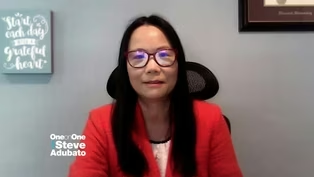
Early childhood professor examines AI on young minds
Video has Closed Captions
Clip: S2026 Ep2873 | 8m 18s | Early childhood professor examines AI on young minds (8m 18s)
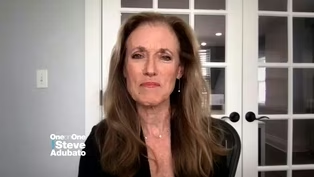
Garden State Initiative on budget transparency in NJ
Video has Closed Captions
Clip: S2026 Ep2873 | 7m 36s | Garden State Initiative on budget transparency in NJ (7m 36s)
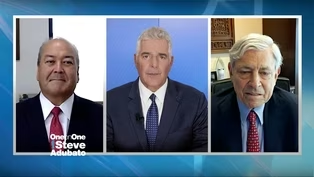
PANYNJ Rick Cotton & Kevin O'Toole discuss projects underway
Video has Closed Captions
Clip: S2026 Ep2873 | 12m 30s | PANYNJ Rick Cotton & Kevin O'Toole discuss projects underway (12m 30s)
Providing Support for PBS.org
Learn Moreabout PBS online sponsorship
- News and Public Affairs

Top journalists deliver compelling original analysis of the hour's headlines.

- News and Public Affairs

FRONTLINE is investigative journalism that questions, explains and changes our world.












Support for PBS provided by:
One-on-One is a local public television program presented by NJ PBS