One-on-One
Rick Diaz; Sara Cullinane; Marylou & Jerome Bongiorno
Season 2021 Episode 2424 | 27m 3sVideo has Closed Captions
Rick Diaz; Sara Cullinane; Marylou & Jerome Bongiorno
Rick Diaz shares the changes bus drivers made to ensure they safely transport students to and from school; Sara Cullinane discusses the nation’s broken immigration system, the impact of the Trump administration’s policies on immigration, and President Biden’s approach to keeping families together; Marylou & Jerome Bongiorno talk about their "RUST" documentary examining racial tension in Newark.
Problems playing video? | Closed Captioning Feedback
Problems playing video? | Closed Captioning Feedback
One-on-One is a local public television program presented by NJ PBS
One-on-One
Rick Diaz; Sara Cullinane; Marylou & Jerome Bongiorno
Season 2021 Episode 2424 | 27m 3sVideo has Closed Captions
Rick Diaz shares the changes bus drivers made to ensure they safely transport students to and from school; Sara Cullinane discusses the nation’s broken immigration system, the impact of the Trump administration’s policies on immigration, and President Biden’s approach to keeping families together; Marylou & Jerome Bongiorno talk about their "RUST" documentary examining racial tension in Newark.
Problems playing video? | Closed Captioning Feedback
How to Watch One-on-One
One-on-One is available to stream on pbs.org and the free PBS App, available on iPhone, Apple TV, Android TV, Android smartphones, Amazon Fire TV, Amazon Fire Tablet, Roku, Samsung Smart TV, and Vizio.
Providing Support for PBS.org
Learn Moreabout PBS online sponsorship- [Narrator] Funding for this edition of One-On-One with Steve Adubato has been provided by The New Jersey Education Association.
Horizon Blue Cross Blue Shield of New Jersey.
Here when you need us most, now and always.
Holy Name Medical Center.
This place is different.
The New Jersey Economic Development Authority.
The Healthcare Foundation of New Jersey.
New Jersey Sharing Network.
Choose New Jersey.
Our mission is attracting companies to the Garden State.
Prudential Financial.
And by Georgian Court University.
Promotional support provided by Northjersey.com and Local IQ.
Part of the USA Today Network.
And by The New Jersey Business & Industry Association.
- This is One-On-One.
- I'm an equal American just like you are.
- The jobs of tomorrow are not the jobs of yesterday.
- Look at this.
You get this?
- Life without dance is boring.
- I don't care how good you are or how good you think you are, there is always something to learn.
- Do you enjoy talking politics?
- No.
- People call me 'cause they feel nobody's paying attention.
- Our culture, I don't think has ever been tested in the way it's being tested right now.
- That's a good question, high five.
(upbeat music) - Hi, this is Steve Adubato.
Thank you so much for joining us.
And we kick off the program with Rick Diaz who is a bus driver in Toms River Regional School District, and the President of the Toms River Schools Transportation Association.
Good to see you, Rick.
- Thank you, Steve.
Thank you for the opportunity.
Good to see you as well.
- Well, you got our colleagues and friends and the folks at the New Jersey Education Association they don't only represent teachers.
They represent Education Support Professionals like yourself.
And we were talking about the role of bus drivers and others.
Give us a perspective as we tape this program on the 6th of April, it'll be seen later, what has this 13-14 months for you and your colleagues been like, given COVID?
- So because of the COVID, being a school bus driver is tumultuous.
It's added stress.
A lot of things have changed.
Before the COVID.
We transported approximately 13,000 students a day.
And with the COVID in August of 2020, we were given a Reduction of Force letter by the Board of Education.
Meaning that 60 of us, approximately 60 drivers were going to be removed from employment, because we didn't have the setup or the program to transport that many students.
So that is troubling in it's sense, that you don't have medical coverage.
You don't have means of making finances to pay your bills and keep your family going.
So that was 28th of August.
About two, three weeks later they decided to go into a hybrid program.
The A, B Program.
- Yeah.
- And that took us off of the Reduction of Force notification.
- But, let me ask you this 'cause the area that many parents and others that are watching right now are interested in has to do with bus safety, as it relates to COVID.
We have a daughter in the public schools in Montclair, New Jersey.
She takes the bus, but as we speak right now, she's remote, but she will be going to school.
Talk about bus safety.
Rick what are the most important areas where bus drivers and those connected to school buses are working to keep our children safe, and those who drive those buses safe.
- Yes, sir.
That's a great question and a great concern and topic that's at the forefront of the bus drivers every day.
So as a bus driver, we wear our mask.
We load our students and we sit them in from back to front at a distance.
We alternate seats.
We open our windows, so that there's fresh air continuously running throughout the bus - Right.
- We're driving the students to and from school safely each day.
We monitor the mirrors and make sure that their compliant with the mask.
And they're not too close to each other.
After we deliver the students home or to the school, we physically walk to the back of the school checking for students and book bags and computers, but we disinfect the bus as well.
- How do you do that, Rick?
Describe that.
- Yes, by all means.
As we're physically walking to the back of the bus, we are spraying each seat and the high touch areas to include the window sills and the front and the back of the seats.
We put a light mist of a disinfectant that we use, that was cleared through the Board of Education.
We spray the hand rails.
We spray everything that a student would come in contact with.
And we'd let that sit for approximately five to 10 minutes, just before we start to pick up the next tier of children.
We do the high-schoolers first, the intermediate second and then the elementary.
Go ahead.
- No, I'm sorry for interrupting, Rick.
But I'm so curious, because kids will be kids and COVID is exhausting for all of us but I can't imagine what it's like for kids.
How cooperative have most kids, and I know there are different ages and a whole range of variables, but how cooperative are kids overall, given this incredibly difficult situation.
14 months into this, as we tape, go ahead.
- In large, they're all cooperative.
And like you said, they are children.
So we do have to definitely remind them to keep their mask or keep their distance.
'Cause it's not at their forefront and they want to be social.
They want to engage and talk to each other, as if it was pre-COVID.
- Is the role of bus driver to remind them that it is not pre-COVID?
- No.
No, I wouldn't say that.
The role of the driver is primarily to get them to and from school safely and with the COVID to keep their distance to keep their mask on and to ensure that the bus is cleaned and well ventilated and disinfected.
When we finish our runs for the day, we deep clean our bus.
We spray with a different cleaning agent.
We wipe everything down.
So we're pretty meticulous with the health of the children.
- Final question, before I let you go.
This, it's so interesting to me because the Education Support Professionals, who play such an important role, and by the way who are the other folks, other than the bus drivers?
Are we talking cafeteria workers?
- Yes, I represent, as the President, the school bus drivers, the school bus aides and the mechanics.
So in the umbrella of support staff, yes, you do have the cafeteria workers, the security guards, grounds department but I'm only representing the drivers, aides- - I know but the Education Support Professionals play an incredibly important role in our schools.
Particularly as children are returning to school.
Before I let you go.
(sighs) What is the most important message you want to deliver to our audience, in 30 seconds, about frankly why this is so important that we continue to take this seriously as children go back to school?
- I would like to reiterate that safety, our health, the bus drivers, the workers, the support staff and the students as a whole, that we shouldn't let our guard down.
That we should continue to social distance, wear our masks, disinfect.
That's what I would continue to be an advocate for.
It's just staying the course that we're doing now.
- Hey, Rick Diaz, I want to thank you for joining us and thank you for what you and your colleagues do every day.
We appreciate it.
Thank you, Rick.
- Thank you, sir.
Thank you kindly.
- I'm Steve.
Adubato.
Stay with us.
We'll be right back.
- [Narrator] To watch more One on One with Steve Adubato find us online and follow us on Social media.
- We're now joined by Sara Cullinane, director of Make the Road New Jersey.
Good to see you, Sara.
- Great to see you Steve, Thanks so much for having me - Sara, let everyone know what your organization is and why you're so important.
- Make the Road New Jersey builds the power of immigrant and working class communities.
We do that through community organizing, through the provision of legal services, through policy innovation and transformative education, we're about winning respect and dignity for immigrant and working class communities.
- So, Sara, we're taping on the 6th of April, being seen later, as we speak, you say that the situation on the border is not a crisis.
Well, it's a certain kind of crisis, but not the crisis that many Republicans and some Democrats and others who just care.
When we see children, as we speak right now unaccompanied wrapped up in some sort of blanket but not the blanket we're familiar with.
Long story short is, that's not a crisis?
- These are children, thousands of children who are fleeing violence who are fleeing two hurricanes that happened in Central America since November, 2020.
They're fleeing a pandemic, and most importantly, most of them are trying to reunite with their families here.
So the crisis is about our broken immigration system and the fact that we don't have a legal safe process for young people to reunite with their parents in this country.
- We'll talk about President Biden's immigration policies in a second, but you have spoken out very clearly and publicly about the Trump administration's policies regarding administration and how they, and that has in fact contributed to this crisis of immigration.
Talk about it.
- Absolutely.
The Trump administration gutted our asylum system.
There are thousands of people sent away who were fleeing violence, seeking asylum.
Asylum is a bedrock principle of our country.
You should be welcomed here.
If you are fleeing violence, if you're unsafe and the Trump administration gutted that policy they also terrorized immigrants across the country not only on the border, but here in Elizabeth, New Jersey you know, families, parents were ripped apart from their from their children in predawn raids.
So what we're seeing now is the fallout from four years of horrific attacks on immigrants and really just violations of due process and of of our asylum system across the board.
- Okay.
Now let's talk about President Biden.
So for President Biden, who says, I am guilty of having being a quote, nice guy, being welcoming to those who want to come across the border seeking asylum.
Let's assume that that is the vast majority.
What do you say to those who argue it's important to be empathetic and sympathetic and caring, but is it also fair or is it not fair to say that the Biden administration did not have a plan for how to deal with how many have come across the border, particularly unaccompanied children, and that is not just a policy mistake, but a mistake from a human perspective.
- The Biden administration certainly needs to move faster to set up protocols in place for children who are crossing the border, seeking asylum, seeking to reunite with their families.
Detention is not the answer here.
We need to have quick policies in place that safely put kids back with their families.
And I think, you know, moreover, we've seen the Biden administration come out very strong right out of the gate, promising a pathway to citizenship for 11 million undocumented immigrants and steps to undo so many of the harms under the Trump administration.
That's a great message to send, and we need to see real policies put in place to make sure that the 11 million undocumented people who've called this country home for decades are able to have a pathway to citizenship.
- But Sara, in playing devil's advocate, to say we want you we want to welcome you, without having the plan in place.
Is that not the mistake in and of itself, even though the Biden administration is yes, we must do better.
But to send the message, please come without a plan is a real mistake and a real problem not a question of politics or semantics or partisanship, that had to be in place before you did that.
Am I wrong about that?
- I think it's a fallacy that these young people are watching CNN and listening to the president and making a decision to cross the border to risk their lives, to reunite with their families or to flee violence.
Just based on what the president said.
We've seen immigration under every president.
What we've seen now is a backlog and a sort of backup when the border was closed during the pandemic.
And now there are thousands of young people waiting to cross they're crossing to save their lives.
They're crossing to reunite with their families.
They're not crossing the border because the Biden administration seems more welcoming.
On the contrary, the Biden administration just did a whole junket to show that they are trying to discourage immigration, which is you know, I think not the right message to send, the real issue here is kids trying to reunite with their families, kids fleeing violence, kids fleeing the pandemic and environmental degradation in their home countries.
And that's, that's what we need to address.
- But it's interesting.
Sara, you talk about fleeing the pandemic but how do you flee the pandemic coming into our country when we are still struggling as we speak on the 6th of April, with the pandemic, and its variants of COVID-19, et cetera, please.
- Well, that's absolutely true.
and you know, I think that's more of a reason why we need to have a strong response to the pandemic certainly in Central America that, you know the pandemic has hit very hard, and in terms of the economy, in terms of increased gang violence, in terms of having a pandemic and two hurricanes at the same time, you know, they're seeing really difficult situations and that are pushing people to leave the country.
- Let me ask you this, in the current political environment that we're in in our nation in 2021, the degree of polarization, how divided we are, how xenophobic many are, to what degree do you believe most Americans have the degree of empathy, compassion, and sympathy for legitimate people who are legitimately trying to escape horrific conditions in their country and want to come here in a process that's legal and appropriate that doesn't exist right now.
To what degree do you, it's a long-winded question, but to what degree do you think most people care on a human level?
Forget about politics.
- I mean, I don't think anyone will ever forget images of children being separated from their parents at the border, children being detained.
We're the only country in the world that puts children in detention centers.
And so when we see the lengths that people are willing to go to to try to reunite their families, I can't imagine that, that doesn't impact anyone the same way it impacts me the same way it impacts you.
And so, you know, this system is really about creating pathways so that families can stay together, so that they can be reunited, and so that we can have a country that's really based on on justice and on dignity and on respect for everyone.
- Sara, I want to thank you, Sara Cullinane is the director of Make the Road, New Jersey.
The issues that we're talking about right now are obviously, you don't need me to tell you this, and I don't editorialize in our programs.
They're incredibly complex, but they're not going away, and calling people names and demonizing people, including children and others or trying to put everyone in one category, that's what they are like, these immigrants trying to come in, that's not the answer either.
But we'll stay on top of this issue, and Sara, sorry for editorializing like that, but I want to thank you for joining us.
- Thanks so much for having me, Steve.
Great to see you.
- You got it.
Stay with us, we'll be right back.
- [Narrator] To watch more One on One with Steve Adubato find us online and follow us on Social media.
- [Narrator] I'’m Marylou Bongiorno.
My husband Jerome and I have been documenting our home city of Newark New Jersey for many years.
Our "Three R'’s" trilogy began with "Revolution '’67".
Its sequel was "The Rule", and this film is "Rust" which tackles solutions to reduce poverty and racism.
- We need the President, we need Congress to create a national jobs program to put the unemployed back to work now!
- You just watched a clip from a compelling documentary called "Rust."
The documentary filmmakers are with us today.
Right now you've got Marylou and Jerome Bongiorno, filmmakers at Bongiorno Productions.
Good to see my friends.
- Great to see you Steve.
- By the way, I wanna make it clear.
There are two other documentaries that we've featured, "Revolution 67" about the riots, if you will.
The revolt in Newark, 1967.
And also "The Rule" from 2014 on St. Benedict's prep and the extraordinary story there.
So "Rust".
We saw the video.
The premise using Newark as a microcosm of what issue?
Marylou.
- [Marylou] Well, our log line for Rust is how to break the chains of poverty in US inner cities.
And obviously, as you said, we were focusing on our home city of Newark.
So we made the film for viewers to understand that poverty and racism in Rust Belt cities are major problems and to think differently about our home city of Newark.
- Jerome, how did you select, 'cause I saw Ryan Haygood and some of our other friends there, how did you select the people you spoke to for this documentary?
- We just try to get the best people who knew what they were talking about or as far as history of Newark was concerned, as far as history of United States is concerned, racism, slavery, activism you know, we just took the best of the best.
- And by the way, the documentary is premiering on PBS on May, 18th.
And Marylou has got some other premiers coming up as well.
- Yes.
So on May 18th, National PBS as you mentioned.
Check local listings because that'll be over a period of time.
We also have the virtual premiere hosted by Prudential Financial and that's on May 3rd.
And it's a powerhouse panel discussion that evening with Dr. Khalil Muhammad, Dr. Jordan Barrett and Larry Ham.
So come to our website bongiornoproductions.com and sign in and get to see the film early.
- By the way, we'll put up that website as we do the program.
What is the most significant message?
And I'm sure you know, with your documentary is so powerful, so compelling, so moving people take different things away from them.
But particularly at this very difficult time in our nation as polarized and divided as we are with the racial tension slash polarization, Marylou what would you say the most significant message you'd like people to take away?
- Well, our message in all these films is very simple.
It's to reduce poverty.
So once you reduce poverty the crime goes down, graduation rates go up.
And our takeaway, we want people to take away from this film is that it's not hard to reduce poverty.
This is a solutions based film.
So poverty reduction has been done and it can be done by government with political will and Jerome maybe you wanna give your take on that.
- Yeah we have- - Jerome as you're talking about this our team's gonna put up our graphic of our ongoing series called "Confronting Racism."
And we're gonna ask people to go on our website and look at previous interviews, including with Ryan Haygood, who was in your documentary, but pick up your point, Jerome.
- Yeah.
We have a high poverty rate in Newark, you know it's near 30% and you know, we live in Newark so we see, and we've been here a long time so we see this poverty, you know every day in our neighborhood.
And I think the big takeaway from "Rust" is that after people see the film they'll understand that our government has had major success with reducing poverty in the past.
And the other takeaway from the film is that, the four points that we give in the film is how to reduce poverty.
Number one, you know, jobs, you got people have to be employed.
The second thing is you gotta improve the educational system.
And actually we had featured St. Benedict's prep in our previous film called "The Rule."
And we actually took up an alumnus from that time who had a troubled past, you know he was gonna drop out but because he received counseling while he was at Benedict's 10 years later, we're following him today.
Now he's a college graduate and he's a social worker.
So he got his life back on track.
He's a success, all because the school gave him what he needed.
And that so that's the second point.
The third point to reduce poverty is we've gotta create programs to help families to stay intact and the fourth point to reduce poverty the final one, which actually maybe should be number one is to create programs to reduce racism.
- So reduce racism.
What do you say to those Marylou who are sitting there going, "Yeah this sounds interesting "But this whole structural racism thing "Institutional racism, "I'm not convinced it's as serious a problem "As most of us realize it is."
What would you say to those folks?
Because Marylou will all due respect you and I grew up in the same neighborhood.
Many of the people we grew up with and around who don't quote live in the neighborhood any longer don't buy the structural racism argument and you know exactly what I'm talking about.
- Absolutely I do.
And that's why we made this film.
So the first thing, Steve, in terms of confronting racism is we have to admit that it exists.
And that's why we set about systematically showing in this film, proof of that.
And not only that it exists, but how it severely impacts people's lives.
So when we say that it's not just some minor, you know anger or embarrassment or people get saddened because they experienced this, I mean, they have fear and this is every day of their lives to the point where it destroys their health, it destroys the cohesiveness of their families their living conditions, and even their freedom.
So if you don't have freedom and that's really what we're saying, right?
If you don't have freedom, then how are you supposed to function?
So "Rust" then details very specifically the rise of of racism in America.
From when we were English colonies the progress through US slavery and then the post-slavery black codes all the way up to mass incarceration today.
So a major goal for us was to increase the viewer's consciousness of racism.
And to understand what it means.
- Real quick in the time we have left Jerome to what degree do you deal with COVID and the disparity in terms of how COVID has impacted communities of color, in addition to the vaccine, 'cause you're doing this in real time, but you have a historical respect.
We've got a few seconds left but COVID is part of the discussion about racism, is it not?
- Oh, definitely.
Well, you know in communities that suffer racism, COVID you're gonna see COVID in higher concentrations.
And then when people see "Rust", they'll be more receptive to our message because it'll be easier to see how government can mobilize to redirect the industry, keep businesses running, provide relief for unemployment, prevent evictions, food insecurity, revamp healthcare and allocate more funds funding for gaps and education.
So we're seeing this happen because the government is taking action.
So if the government can take action for COVID why can't it take action for racism?
And the answer is, it can, if it wants to.
- It's a question of will and commitment and understanding that it's not going away.
And just because people would like it to.
And so to you Marylou and to Jerome Bongiorno, the filmmakers at Bongiorno productions this documentary May 18th on PBS.
You catch it later.
We'll also provide a link on our website at the appropriate time, after it airs on PBS.
To say that we are proud of you and what you've done, particularly being Newarkers and Marylou with us.
And I said this many times, growing up in the neighborhood on Tiffany Boulevard, sounds like a cliche but I know you'll appreciate this.
You make the neighborhood proud.
Thank you.
- Thank you and thanks for all you do, Steve.
And for having us, this is the third film.
Thank you for all the coverage.
We appreciate it.
- We're here.
We're not going anywhere.
Thanks so much.
This is Steve Adubato.
We thank you so much for watching.
We'll see you next time.
- [Narrator] One-On-One with Steve Adubato has been a production of the Caucus Educational Corporation.
Funding has been provided by The New Jersey Education Association.
Horizon Blue Cross Blue Shield of New Jersey.
Holy Name Medical Center.
The New Jersey Economic Development Authority.
The Healthcare Foundation of New Jersey.
New Jersey Sharing Network.
Choose New Jersey.
Prudential Financial.
And by Georgian Court University.
Promotional support provided by Northjersey.com and Local IQ.
Part of the USA Today Network.
And by The New Jersey Business & Industry Association.
(gentle upbeat music) - [Miles] I'm Miles and this is what I work for, to be my best for them and for me, in body and in mind.
I need a health insurer that helps me get the care I need for both, that has mental health professionals that I can talk to when I need to.
Because when I feel strong and secure, so do they.
This is my life.
And this is how Horizon Blue Cross Blue Shield of New Jersey works for me.
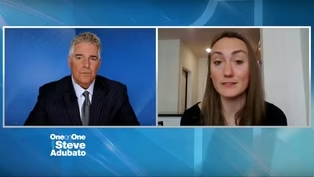
Examining the Nation's Broken Immigration System
Video has Closed Captions
Clip: S2021 Ep2424 | 9m 21s | Examining the Nation's Broken Immigration System (9m 21s)
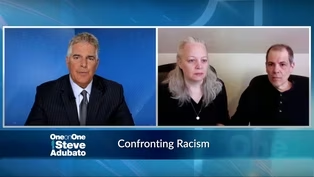
RUST Documentary Focuses on the Racial Tensions in Newark
Video has Closed Captions
Clip: S2021 Ep2424 | 9m 54s | RUST Documentary Focuses on the Racial Tensions in Newark (9m 54s)
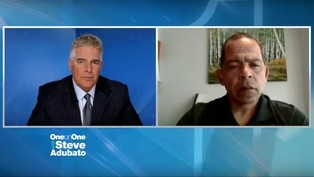
Safely Transporting Students to and From School During COVID
Video has Closed Captions
Clip: S2021 Ep2424 | 8m 37s | Safely Transporting Students to and From School During COVID (8m 37s)
Providing Support for PBS.org
Learn Moreabout PBS online sponsorship
- News and Public Affairs

Top journalists deliver compelling original analysis of the hour's headlines.

- News and Public Affairs

FRONTLINE is investigative journalism that questions, explains and changes our world.











Support for PBS provided by:
One-on-One is a local public television program presented by NJ PBS