Unspun
Rising Rent and Home Prices in Charlotte | Unspun
Season 2 Episode 221 | 26m 55sVideo has Closed Captions
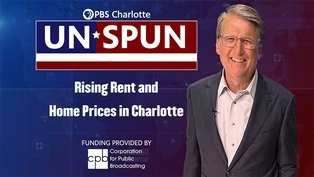
Charlotte’s housing crisis is pricing out workers, families, and young professionals.
Affordable housing has become one of the biggest challenges facing Charlotte. Rising home prices and rents that continue to outpace wages are making it harder for teachers, first responders, and young professionals to afford living in the city. As Charlotte struggles to close the housing gap, the debate is shifting from low-income housing to workforce housing and who will solve the crisis.
Problems playing video? | Closed Captioning Feedback
Problems playing video? | Closed Captioning Feedback
Unspun is a local public television program presented by PBS Charlotte
Unspun
Rising Rent and Home Prices in Charlotte | Unspun
Season 2 Episode 221 | 26m 55sVideo has Closed Captions
Affordable housing has become one of the biggest challenges facing Charlotte. Rising home prices and rents that continue to outpace wages are making it harder for teachers, first responders, and young professionals to afford living in the city. As Charlotte struggles to close the housing gap, the debate is shifting from low-income housing to workforce housing and who will solve the crisis.
Problems playing video? | Closed Captioning Feedback
How to Watch Unspun
Unspun is available to stream on pbs.org and the free PBS App, available on iPhone, Apple TV, Android TV, Android smartphones, Amazon Fire TV, Amazon Fire Tablet, Roku, Samsung Smart TV, LG TV, and Vizio.
Providing Support for PBS.org
Learn Moreabout PBS online sponsorship- [Announcer] This is a production of PBS Charlotte.
- Tonight on "Unspun", affordable housing isn't just a local issue anymore.
It's a defining challenge for cities like Charlotte, from rising home prices to rent that's outpacing wages.
The question is no longer whether there's a problem.
It's who's going to solve it.
We'll talk with someone who's spent years fighting the fight and learn how she became one of the most influential women in banking as we continue our pioneers in politics and business series.
In today's America, welcome to the spin game.
Believe me, I know, I'm Pat McCrory.
When I was governor and mayor, I played the spin game.
I was played by the spin game.
But aren't we all done being spun?
Let's take the spin out of the world we're in, here on "Unspun".
Good evening, I'm Pat McCrory.
Charlotte has spent years trying to close the gap on housing.
Increasingly, it's not just about low income housing, it's about workforce housing, teachers, first responders, and young professionals.
They're all being priced out.
Joining me now is someone who has been at the center of this issue from both the business and community side.
Cathy Bessant is a former top executive of Bank of America, where she helped oversee community development and housing revitalization.
Most recently, she served as CEO of the Foundation for the Carolinas.
Cathy, it's great to have my old friend and active community person right here in the studio here at WTVI, thank you so much.
- Thank you, governor, for having me.
- Well, first of all, how did you get to Charlotte?
- Well, I actually moved to Charlotte three times, all three at different points of my career with Bank of America.
One of those times, you know very well, because you did not disclose to me when I was in an airport moving to Charlotte that you were the mayor.
- It was about 1997.
- 1997, and I said, you know, you said, do you think you like Charlotte?
And I said, I don't really know.
- We just struck up a conversation.
- Exactly.
- You were lying, I was lying.
I didn't know you were a top executive of Bank of America - And I didn't know you were the mayor.
- Why tell each other that?
- Right, right.
- And I asked you a question.
- Yeah, you asked me what I thought I was gonna like or not like about Charlotte and what I was worried about.
And I told you in some pretty frank terms, several of the things I told you we will talk about today.
I am sure, but only at the end of that did I say, so what do you do?
- And I proceeded to go to another line and catch another flight.
- Left me in the dust.
- That's what I recall.
- It's the truth of it.
Not very many people can say.
- I beat you by 15 minutes.
- You did.
- I beat you by 15 minutes to Charlotte.
We've laughed about that for years, and have become friends.
Very close friends, now, when you came to Charlotte, not only did you have some incredible responsibilities in business, you were in charge of marketing.
You were later on, you were in charge of IT.
You, I mean, you were at the top, but you also got involved in the community.
Tell us your first major community involvement.
- Well, a couple of things, first of all, my parents, my father was a public school teacher.
My mother, an executive at a not-for-profit.
I grew up, lucky enough, I grew up with the DNA of public and community service.
Then I go to work for what became Bank of America.
And Hugh McColl doesn't just espouse community service.
He requires it.
I grew up in a company and with an attitude that says all of us as individuals and collectively have to matter in the communities where we live and work.
Otherwise, you know, really what's the point?
So probably my first public service or community service in Charlotte was around affordable housing.
You know, Fourth Ward, Third Ward, First Ward.
- Yeah, well, that's what we know of it as today.
Actually, it was that way when it was developed.
But then we converted First Ward into Earl Village, urban renewal, as we called it, during the, mainly the sixties during the Johnson administration.
And I guess they became projects, not neighborhoods, would you agree?
- I would agree, in fact, I grew up with my mother driving us by notwithstanding the fact that there were six of us in a 900 square foot house.
So, you know, we had our own challenges.
But growing up and saying, oh, we don't wanna live in the projects.
- That's what they were known as, the projects.
- Right.
Lo and behold, I had the opportunity to take Earl Village.
Think about it from a real estate perspective.
Think about it from a housing and neighborhood perspective, and between bank resources, public resources, and a lot of hard work by hundreds of people.
I think we began to think about things differently.
We began to think not about a project, but a neighborhood.
- And this is when I was mayor, we went out and got some Hope Six grants, I believe they were called, which was a huge deal.
Usually a city only gets one, we got four over my tenures.
14 years, and we needed that desperately 'cause it was the federal government that did this.
And we think the federal government needed to help bail us out of really, we put low income families and we destroyed what was known as Little Brooklyn.
- No question that it's a confluence of things.
And it took the public sector and the private sector to move things forward.
And it's not just housing, although importantly it's housing.
It is education, it's transportation, for Hope Six grants, I think those were the Jack Kemp days, if I'm.
- Well, the idea came during the Jack Kemp days.
I think we got the grants during the Bush administration.
- That's absolutely right.
- And maybe even one during the Clinton administration.
- So the important thing was to use those as the catalyst that they needed to be, not just to have conversations, but to create units, to create places where people could live, to create opportunities that come from having stable housing.
- And we knew in the city, in the mayor's office, we couldn't do this alone.
We didn't really have the qualifications.
And Bank of America stepped up and volunteered, volunteered your services on the side.
And I guess the first neighborhood was what was called Earl Village at the time.
We converted it back to First Ward with your leadership.
Literally, this was blocks from your headquarters and you didn't go there.
- Well, you didn't end the day.
- Or the night.
- But I remember, that's true.
But I remember Mr.
McColl saying to me, showing me, and he did this with others too, but looking down from the bank headquarters, looking at the neighborhood and saying, I don't care what you have to do, fix it.
And so it was a cobbling together of the programs that existed that your leadership made a really big difference around.
It was a cobbling together of great brains who could be innovative.
And importantly, it was working with residents.
I think the key to redevelopment is working with people, not for or to people.
And I think that's what made Earl Village subsequently First Ward really very different.
- One thing I worked with you on and others, is I worked with the Bush administration, went to the White House and got a waiver to try to encourage to get people to work because we had generation after generation stuck in a lot of the Piedmont Courts, thorough village, the Dalton Villages and so forth.
And we weren't helping them get out of these projects.
And that waiver also made a big difference.
But it was really the concept of neighborhood that you put together along with many others.
- Well, I think one of the great things about Charlotte, about your leadership, about things that our private institutions have done, is a real recognition of the intersection between education, transportation, housing, healthcare, and really saying, what does it take?
And simply understanding that intervention at any one of those points helps all the other points.
- We had a lot of people in rural village, actually, elderly, predominantly African American women, in fact, which didn't have a lot of independence.
They were living in fear because we had a lot of drug dealing back in that area.
I cannot remember the young lady's name with a housing authority.
They named something after, in Earl Village.
God, what a wonderful person she was.
But we also wanted to help the elderly regain some safety and independence.
- No question, and independence is important.
I also think connectivity of generations makes a real difference.
You and I have talked before about how we learned from our parents.
Your own journey in public service stems a lot from your father, as I recall.
But the importance of generational transference of values, ethics, discipline, spirit of optimism.
And you know, her name will come to me after I'm done taping.
- Yeah, I'm embarrassed.
- But that individual leadership across generations is what I believe has helped make, just as an example, First Ward remain First Ward.
- Now First Ward, it was a great model, not only for Charlotte, but the rest of the country, because what you did at First Ward, we replicated then in Piedmont Courts.
We had a area off of West Boulevard.
Boulevard Homes where we had two officers killed, Officers Nobles and Burnett brutally assassinated right off of West Boulevard on the way to the airport near Billy Graham Parkway during Richard Vinroot's last year in office.
Those things had a major impact.
So public safety was another important part that you and others emphasized that we needed in these new neighborhoods.
- And I think absolutely you're right.
But I also think it has to be a priority today.
You know, I think it's pretty simple.
Let's make a declaration that Charlotte and Mecklenburg County is the safest city and the safest county in the country, maybe in the world, but let's just go for it, in the country.
For 10 weeks earlier in the year, my husband and I lived uptown while our home was being renovated.
And I can tell you firsthand, the uncertainty and the occasionally the fear around, am I safe?
What am I walking over, what am I walking to?
How do I, you know, how do I feel confident going into my parking deck?
Those fears are real.
And they don't vary by income, by the way.
- When you came to shore, the police were afraid.
- Absolutely right.
Fortunately, we've got a great police chief.
- We do.
- We have a committed set of citizens working on a public safety task force where the city and the county also participate.
David Longo's been instrumental in leading that.
But you know, when I think, yeah, I'll nerd out on you for a second.
I mean, when I think about Maslow's needs hierarchy, safety, housing, food, those things are the basis of humanity.
And so, getting public safety right, having people feel comfortable going to Spectrum Center to watch our fantastic Hornets, just as one example, those things are fundamental to the vibrance we want for our city.
- Another area that you emphasize, because we're talking about trying to help people get out of certain circumstances, we need to get them a job, but they didn't have transportation, A good transportation system.
So another thing you emphasized to me when I was mayor is, Hey, McCrory, Mayor, whatever you called me at the time, you said, we gotta upgrade our transportation system if we're gonna get people to and from work.
- Yeah, transportation is fundamental.
Gene Woods will tell you that there are thousands of medical appointments missed every single year because people can't get to them because transportation isn't reliable.
My own brother who lives.
- Tell us who Gene Woods is.
- Oh, Gene Woods, the CEO of Atrium Advocate Health.
- Yes, absolutely.
- And the vision behind the Pearl, which is a pretty amazing development and really brings a lot of hope for the future, and a lot of hope for the recognition of Charlotte as an innovative community.
But my own brother, who as a crow flies lives, I don't know, maybe five miles from me.
If he takes public transportation, it takes him two hours to get to my home.
So, transportation as a path to healthcare and wellness, as a path to jobs, as a path to education.
Again, very much intersecting with those other things that we were talking about, education, housing, but really fundamental.
And, you know, I know we're not really talking about you here, but I do have to say that my first experience with courageous leadership around transportation was you and the topic.
And you know it, you know how hard it had to be fought to get light rail to even be a conversation.
You know how challenging it was to talk about the I-77 corridor.
And the difficulty in our system now is that the period of time that you get to serve as an elected official is a lot shorter than what it takes to make fundamental change in infrastructure.
And that takes real courage, I commend you.
- Most people forget that we had to upgrade the bus system.
That was the first 25% of the work we did.
When the light rail passed, we put the initial front funding into bus system because the bus system was so dilapidating that was to help people at Earl Village, at Dalton Village.
Now First Ward and Boulevard Homes and so forth.
- Well, and we built the transit center.
- That's true.
- There's a redevelopment challenge around the transit center, that has to be addressed today.
But 1990s, you know.
- It was at the square.
- It was at the square, and people were on the square in the rain, in the snow.
Occasionally in the snow.
And the importance of the transit center again, was safety and protection.
Now, things change over time.
Again, we have to rethink that.
That's what revitalization and a constant focus on revitalization is all about.
But building the transit center, it was the Bank of America Community Development Corporation, the first bank, CDC in the country.
But the Bank of America, CDC, that actually was the developer of.
- I remember the transit center, I cut the ribbon, but Richard Vinroot did all the work.
And I gotta give Richard and you and Hugh and others, that was really Hugh McColl's swan song when he was leaving the bank to get that done and get the bus stop or the transit center off the square in the rain and the cold and in horrible conditions.
- Yeah, and when you think about, again, the courageous leadership it took to pass the transit referendum.
Real, again, deeply appreciative of the great voter base that made that happen.
And the public and private leadership that came together to advocate for it.
But when you listened at the public hearing at the county, what people talked about is what feat what they talked about is freezing standing at the center.
What they talked about is how they couldn't get their kids where they needed to be.
This is real human stuff.
- Okay, I wanna get back on your leadership because you've joined a very elite group here at WTVI and "Unspun", you're a pioneer of business and politics right here.
And you've joined a rare group of people.
And the reason we're doing this is we want to talk not only about how Charlotte got to where it was in North Carolina, got to where it was, but about the future.
You have had the incredible honor to be invited to Switzerland four, five times now to talk about major issues to leaders throughout the world.
Your major expertise has kind of become AI.
How do you see AI impacting Charlotte and the world and jobs?
- I think, thank you by the way.
- And by the way, congratulations being invited to what's the conference called?
- Davos.
- Davos.
I mean, that's incredible.
- Well, I didn't wanna go in the beginning and my CEO at the time will tell you he had to make me go because I had some perception of what it was.
Little did I know the power of getting brilliant minds together to tackle society's real issues.
And I think about this in terms of any transformational change.
It has the opportunity to move us forward.
And it has the opportunity to leave people behind.
AI, the power is unreal, and you can't go anywhere.
You can't listen to CNBC, you can't listen to anything without people talking about AI.
And yet I think it's incredibly important that we focus on, yes, capturing the power, but also making sure that we handle the risks, the risks to, you know, infrastructure that has not caught up with technology.
And I don't mean chips, right?
I mean, if your automated car hits a person, who's in trouble?
The person who wasn't driving, the chip maker, who manufactured the chips that are in the car, the software engineer that designed how the car is supposed to respond?
- And there are lawsuits now going on against Facebook and others, or Meta about kids getting almost brainwashed or being accused of being brainwashed.
- You know, and yes.
And so it's how do our social and legal and environmental ways of working or ways of being people, how does it stay on top of the technology?
So the power incredible, but also the opportunity for leaving people behind or not advancing our social and infrastructure systems in a way that we can capture the beauty, but avoid the ugliness.
Those are incredibly important things.
And by the way, technology and jobs and housing and transportation, all of those things are created.
And I, you know, I believe this, I believe it's our job to make sure that those things move us forward, not create a broader divide.
- So let's talk about the future 'cause I know you care about the future of Charlotte and the Carolinas in our country.
What do you think are the greatest challenges based upon your experience, not only at the bank and in housing and transportation, the foundation of the Carolinas work, where you had some major challenges, and I wanna congratulate you on your outstanding work there.
- Thank you.
- Based upon all this experience worldwide and being in France for a while too, in Paris, what are are our greatest challenges and how does that apply to Charlotte and North Carolina and the Carolinas?
- I think a lot about that.
I would have to say, and I don't want this to sound too basic, but I have to say our greatest challenge is human connectivity.
- Define that.
- Well go back to Margaret Mead, never forget that a small group of thoughtful citizens can change the world.
So it's our connectivity with each other that allows us to tackle not only the problems that we can see today, but the problems that will come in the future that we can't see.
- So are we losing that?
- I think we're at risk, you know.
Who predicted a global pandemic and who predicted not only the pandemic and the health issues itself, but how entire countries would completely shut down, and how do we recover from that?
And how do we, the only thing that solves the problems that we have today are great minds and great minds working together.
And I'm committed as I know you are, which is partly why you have this show.
Great minds working together can in fact tackle these problems.
There's nothing here insurmountable.
I live in great hope and optimism every day.
- All right, you were talking about macro.
- I was super macro, let's get down to micro.
Charlotte and the Carolinas.
What do you think our greatest challenges are as we look at our competition throughout the United States and the world?
- We have 157 people on average that move to Charlotte every single day.
- It's incredible.
- It's incredible.
- It's almost a thousand a week.
- Do the math on that.
And that growth is wonderful, but it strains every single system we have.
It strains the educational system, the ones we've talked about, education, transportation, housing, affordability.
Not just of housing, but of everything really.
- And we've seen boom towns go bust, in the past history.
- And we know towns we don't want to be.
We know towns that have grown and adapted in ways we don't want Charlotte to adapt.
There's a secret sauce here.
Or a special sauce, not secret, really special.
And so I think that those are our issues.
How do we absorb growth?
How do we absorb and manifest new corporate headquarters, growth from the companies that live here today, but also how do we preserve what's great about Charlotte and address issues that growth actually magnifies?
I don't know if that sounds optimistic or not.
- No, my theory has always been in the remaining, we got 30 seconds.
We're either dealing with growing pains or dying pains.
And you look for that place in the middle where you're not overextending yourself, but if you overextend yourself, you can become what some of the cities in the northeast have become.
- And some in the south.
- And some in the south.
- So you're spot on on the issues and how to make growth work for us.
That's our opportunity and our challenge.
- So in the remaining 30 seconds, what's your future?
- What's my future?
(laughs) Do you know my husband reminded me, I have been full-time in the professional workforce for 44 years.
That means 44 years of weekends where even if I wasn't doing work, I thought about work.
So what I'm looking forward to most is curating my own future.
- Good for you, well, Cathy Bessant, you've made a difference in the Carolinas and in Charlotte.
You've become a friend to so many, including me.
And on behalf of "Unspun", I wanna thank you for being a pioneer in business, in politics, and making a difference where you're leaving this place a better place than when you arrived.
And thank you to you, Cathy Bessant.
- Thank you, governor.
(upbeat music) - Starting in the 1960s, during Lyndon B. Johnson's Great Society, the federal government working with cities across the country began what was called urban renewal.
The goal was noble, replace substandard housing and improve people's lives.
But in many cases, the result was just the opposite.
Whole swaths of predominantly black working class neighborhoods were torn down.
These were historic, close knit communities with churches, small businesses and generations of families who knew their neighbors.
In their place, government built high density public housing projects.
Over time, too many of these projects became isolated pockets of poverty and crime and hopelessness where children and families often felt trapped, not transitioned.
Here in Charlotte, Little Brooklyn became Earl Village.
Belmont became Piedmont Courts.
The Clinton Road community became Dalton Village and West Charlotte saw the development of Boulevard Homes.
By the time I was first elected mayor in 1995, conditions in some of these communities had deteriorated so badly that even police officers were reluctant to enter without proper backup.
Gangs, drugs, and violence, that's what they were afraid of.
And that was never intended to be the outcome.
The Urban Renewal Experiment may have failed, but we weren't going to.
With four major federal grants, we began the hard work of rebuilding these areas as true neighborhoods once again.
Mixed income communities, better designed, safer streets, and most importantly, a restoration of dignity and opportunity.
With the help of leaders like Cathy Bessant and many others, these communities become models for what can happen when housing policy gets it right.
The lesson is a simple one.
People don't just need a roof over their heads.
They need a neighborhood, because in the end, neighborhoods are the answer, not projects.
Well, that's the truth as I see it.
I'll see you next time on "Unspun".
(upbeat music) - [Announcer] A production of PBS Charlotte.
Rising Rent and Home Prices in Charlotte Preview | Unspun
Preview: S2 Ep221 | 30s | Charlotte’s housing crisis is pricing out workers, families, and young professionals. (30s)
Providing Support for PBS.org
Learn Moreabout PBS online sponsorship
- News and Public Affairs

Top journalists deliver compelling original analysis of the hour's headlines.

- News and Public Affairs

Today's top journalists discuss Washington's current political events and public affairs.










 New Season
Support for PBS provided by:
Unspun is a local public television program presented by PBS Charlotte