Across Indiana
Riverboats, Rivets, & Red Bricks
Season 2026 Episode 8 | 7m 47sVideo has Closed Captions
Did you know one of the oldest and largest shipyards in the country was in Indiana?
The Howard Steamboat Museum in Jeffersonville reports that during the shipyard’s heyday, roughly one out of every four steamboats in America was built right here in Indiana—making the Howard family very wealthy. Today, their former mansion is a museum on the banks of the Ohio River, the perfect spot to learn about shipbuilding history and watch the Great Steamboat Race before the Kentucky Derby.
Problems playing video? | Closed Captioning Feedback
Problems playing video? | Closed Captioning Feedback
Across Indiana is a local public television program presented by WFYI
Across Indiana
Riverboats, Rivets, & Red Bricks
Season 2026 Episode 8 | 7m 47sVideo has Closed Captions
The Howard Steamboat Museum in Jeffersonville reports that during the shipyard’s heyday, roughly one out of every four steamboats in America was built right here in Indiana—making the Howard family very wealthy. Today, their former mansion is a museum on the banks of the Ohio River, the perfect spot to learn about shipbuilding history and watch the Great Steamboat Race before the Kentucky Derby.
Problems playing video? | Closed Captioning Feedback
Where to Watch Across Indiana
Across Indiana is available to stream on pbs.org and the PBS app.
Providing Support for PBS.org
Learn Moreabout PBS online sponsorshipEvery year on the banks of the Ohio River.
Jeffersonville, Indiana has a front row seat to a race that's almost boiling over with history.
It's the Great Steamboat Race.
And since 1963, it has been held like clockwork.
On the Wednesday before the Kentucky Derby.
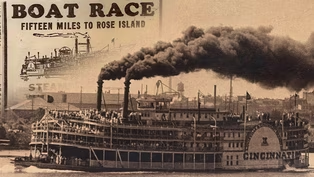
This year's race is a regional rivalry between the boats, the Belle of Louisville and the Belle of Cincinnati.
They'll steam chug and churn a few miles up the river and back, just to see who's quicker, all the while honoring a unique chapter of American history, a chapter Indiana helped write Just to the left of these boats on the Indiana shoreline is a 132 year old, 22 room, beautiful red brick mansion.
A mansion that houses the Howard Steamboat Museum, Now currently helmed by this expert of American River history.
Hi, My name is Travis Vasconcelo and I am the director here at the Howard Steamboat Museum.
We are the only museum that covers the story of the steamboat in its entirety, and we are located in the home of the premier steamboat builders on the inland waters.
The Howard family.
Now, when I say the Howard family made a lot of boats, trust me, they made a lot of boats.
We're talking over 1,100 of them.
Travis estimates that during their heyday, that roughly one out of every four steamboats you'd see out on the water was built right here in Indiana.
All of that started with the reputation of just one man, James Howard.
He built his first steamboat back in 1834 while he was still just a teenager.
Anybody that could cut lumber was building a boat when the steamboat first came out, because we were in a hurry to settle the Western lands.
They were built quick, slipshod.
Get them out, get the money.
The average life of a steamboat when James Howard started, if you were lucky, was 18 months to three years.
James Howard saw the problem with the plan and he made his boats more durable.
His boat on average lasted five years.
That reputation for durability allowed this young man's company to not just stand out, but to grow by leaps and bounds.
even after the Civil War, when railroads were becoming more and more popular, The Howards countered the speed and convenience of trains by making their boats much bigger, more luxurious and more expensive.
James Howard's son.
Edmonds took over when his father passed away, and helped usher in this new, elegant era.
Edmonds was one of the pioneers in making the boats more luxurious.
to get people there, they made them like luxury hotels with fancy European carpets.
on the outside, gingerbread starts to show up to make the boat look fancier.
The big fluted stacks show up With every boat the Howards built, more and more wealth was brought into the family, and all of that money helped Edmonds build his 15,000 square foot mansion in 1894, not only was it the first fully electrified home in Jeffersonville, it was built by the same skilled workers that crafted those luxury boats.
Everywhere you look in this house, you will see something hand carved out of either wood, stone or tile.
People come here for the architecture of this building because it's a very ornate richardsonian romanesque building built in the 1890s, which is the perfect era for it.
Built to be just as strong as it is beautiful.
All of the walls are made of solid brick.
To protect it against the flood prone river.
By the early 1900s, it really looked like the Howards were on top of it all.
They had a brand new mansion and their company was known as being the largest inland shipyard in America, as well as being the oldest operated one as well.
But by the 1920s, things started to change for the worse.
When Edmonds passed away, his two sons, Clyde, who was the older son, and Jim, who was the younger son, took over the operation.
Clyde was the businessman.
Jim was the visionary and the dreamer.
Being two different sides of the same coin.
Many thought the shipyard was in good hands as long as the brothers continued to get along.
But it didn't take long for things to go south between them, and Clyde started looking around for the exit.
what ended up happening was Clyde, left, forced Jim to buy him out and went into the banking business in Louisville.
Now the family business rested solely on the shoulders of a dreamer.
a dreamer that would build gasoline engines, race speedboats and take photos.
All those pictures of all those beautiful boats.
Most were taken by Jim, along with another 1,400 other photos he took He got into doing photography with glass plate negatives, which is very involved.
He actually turned one of the rooms of the house into a darkroom, By this point, though, progress had started creeping up on Jim's door.
His boats weren't just competing against trains.
They were competing against cars and trucks now to.
To bring a little savvy into the family business, he made his wife, Loretta, his new vice president.
Here we have Jim and his wife, Loretta, who had run a business before, so she knew how to handle the money, but a dreamer running a business.
Usually in the third generation, things didn't go so well.
they were slow to change.
They were slow to adopt steel construction on boats, which was becoming the thing that we did by then, and if that wasn't enough, the stock market crash and Great Depression struck just a few years later.
And Jim and Loretta were in trouble.
They didn't have a lot of cash to to operate with.
So what ended up happening was they had to find unique ways to make money.
They started renting out rooms in the mansion to people Jim and Loretta limped the company on for another decade, But the writing was on the wall.
When the federal government came knocking in 1941, needing new shipyards for the war effort, Jim and Loretta decided to sell.
one thing I will say about the Howards and this sounds negative, but it really is a positive.
They didn't throw things away.
They kept things.
when the government took over the shipyard, they literally took the Howard files and threw them over the fence into the yard.
Loretta kept everything boxed.
It took care of it.
Keeping, protecting, and sharing that story became Jim and Loretta's passion in their later years.
But Loretta, I think, was the real savior.
She was the steel magnolia of Jeffersonville.
She truly was When her husband died in 1956, it was his dream that this become a museum.
And in a day when women did not do business, she was actually conducting this business.
And she made this a museum and opened it in 1958 and kept it going by herself until 1968, Frankly, the only thing tougher than Loretta Howard is the Howard Mansion itself.
A devastating fire in 1971 couldn't even bring this place down.
it only closed the museum's doors for a year.
It's been open ever since.
Jim you can see he had a great passion for his family's history, and I think that was the impetus that made it a museum.
I think Loretta is who diversified it into it's not just the Howard story, it's what the Howards did to make the big picture story of the steamboat era.
An era that may have ended a long time ago but still hasn't been forgotten.
Thanks to the Howard's and to the Belle of Louisville.
The winner of this year's race.
Those stories of riverboats steaming up and down the river will continue to be told, one paddle wheel at a time.
To discover more stories, visit wfy.org/acrossindiana.
Video has Closed Captions
Clip: S2026 Ep8 | 1m 49s | Steamboat racing was dangerous, so why rig it? (1m 49s)
Providing Support for PBS.org
Learn Moreabout PBS online sponsorship













Support for PBS provided by:
Across Indiana is a local public television program presented by WFYI