
Riverfront Alliance, Newlab, Wright Museum, Weekend events
Season 8 Episode 43 | 26m 46sVideo has Closed Captions
Riverfront East Alliance, Newlab, The Charles H. Wright Museum and some weekend events.
Members of Detroit’s Riverfront East Alliance reflect on the 20-year transformation and beautification of the city’s riverfront. Newlab helps shift the technology and entrepreneurial landscape in Detroit. The Wright Museum continues to enhance its exhibits through technology and expands its performance stage. Plus, upcoming events on “One Detroit Weekend.”
Problems playing video? | Closed Captioning Feedback
Problems playing video? | Closed Captioning Feedback
One Detroit is a local public television program presented by Detroit PBS
Riverfront Alliance, Newlab, Wright Museum, Weekend events
Season 8 Episode 43 | 26m 46sVideo has Closed Captions
Members of Detroit’s Riverfront East Alliance reflect on the 20-year transformation and beautification of the city’s riverfront. Newlab helps shift the technology and entrepreneurial landscape in Detroit. The Wright Museum continues to enhance its exhibits through technology and expands its performance stage. Plus, upcoming events on “One Detroit Weekend.”
Problems playing video? | Closed Captioning Feedback
How to Watch One Detroit
One Detroit is available to stream on pbs.org and the free PBS App, available on iPhone, Apple TV, Android TV, Android smartphones, Amazon Fire TV, Amazon Fire Tablet, Roku, Samsung Smart TV, and Vizio.
Providing Support for PBS.org
Learn Moreabout PBS online sponsorship- [Narrator] Coming up on "One Detroit," we're shining a light on the many things that are truly Detroit.
We'll take a look back at the grassroots movement that shaped and developed the city's award-winning Riverfront.
Plus, we'll preview a documentary about the transformation of the waterfront.
Also ahead, the Newlab at Michigan Central is upping the technology innovation game in Detroit, and we'll hear what's new at the Charles H. Wright Museum of African American History.
Plus we'll have some ideas on how you can spend this last weekend in April.
It's all coming up next on "One Detroit."
- [Announcer] From Delta faucets to Behr paint, Masco Corporation is proud to deliver products that enhance the way consumers all over the world experience and enjoy their living spaces.
Masco, serving Michigan communities since 1929.
Support also provided by the Cynthia & Edsel Ford Fund for Journalism at Detroit PBS.
- [Announcer] DTE Foundation is a proud sponsor of Detroit PBS.
Among the state's largest foundations committed to Michigan focused giving, we support organizations that are doing exceptional work in our state.
Learn more at dtefoundation.com.
- [Announcer] Nissan Foundation and viewers like you.
(soft rhythmic music) - [Narrator] Just ahead on "One Detroit," as we welcome visitors to the city for the NFL draft, we're sharing stories about what makes Detroit great.
We'll preview a new documentary about the development of Detroit's waterfront, plus we'll take you to a state-of-the-art facility that's helping to grow the city's high-tech industry.
Also coming up, we'll get an update on the technology upgrades and new exhibits at the Charles H. Wright Museum of African American History, and Cecilia Sharpe and Peter Whorf of 90.9 WRCJ have a list of activities to enjoy in Metro Detroit this weekend and beyond.
But first up, the Detroit Riverfront has received national recognition, and it attracts millions of people each year.
However, the current Riverwalk and parks were not part of the original plan for the area.
A grassroots effort in the late 1990s prevented the Riverfront from being turned into a casino district.
"One Detroit" contributor Bryce Huffman has the story.
(soft rhythmic music) - [Bryce] Detroit's Riverwalk is one of the city's main attractions.
About 3.5 million people visit the Riverfront every year, according to the Detroit Riverfront Conservancy.
It was also voted the best Riverwalk in America three years in a row by "USA Today."
But back in the late 90s, there was a plan that would've completely changed the Riverfront we have now.
This is the story of that plan and the grassroots group that fought to make sure it didn't happen.
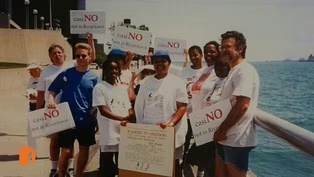
- The Riverfront East Alliance, or REAL, was first formed in 1998 as a community response to Mayor Dennis Archer's decision to move casinos to the East Riverfront, and our goal was to save the East Riverfront to make it into something more like a public park, something that was clean, green and accessible for everyone.
- [Bryce] Carol Weisfeld is a longtime resident of the Lafayette Park neighborhood.
We sat down with her at Robert Valade Park on the city's Riverfront east of downtown.
Like others in the area who heard of this plan, Weisfeld wasn't a fan.
- The idea that the Riverfront was going to be a casino district and that the highway to the casinos would go like right near where I lived, right underneath people's, you know, apartment windows was just infuriating.
- [Bryce] Weisfeld said a group of about 200 people met to discuss ways to stop the casino district plan.
- And two leaders emerged from that, Bob Jackman and Evelyn Johnston, both of who have passed away, and they got us organized and mobilized, and within two months, we were the Riverfront East Alliance, getting our 501(c)4 documentation so we could accept donations.
- [Bryce] About a dozen Detroit neighborhoods, mostly east of downtown, got involved in this fight.
Dan Wiest is another longtime Detroit resident and REAL member.
- The big fear back then was it was gonna be like another Atlantic City and the crime that might come with it.
- [Bryce] Steve Wasko also got involved in this grassroots movement early on.
- And the kinds of things that we somewhat take for granted today in terms of that there would be community involvement and there would be the opportunity for the community to literally come and devise what are the community benefits for the community benefits committees and that sort of stuff would've been so far off the radar at that point in time.
- [Bryce] REAL members shared information with each other at a time when tools like social media didn't exist.
- We would print 3,000 newsletters, and we had a list of people who volunteered, and they would just put 'em in people's doors or people's mailboxes, and so the community mobilized in a way that we never even imagined.
They wanted good information.
- [Steve] Just the monthly meeting kept us all to your next deadline and what you needed to do but also was like that focus if you needed to invite other people or a time to invite city representatives.
- We had a database of up to 400 people that we would have to communicate with email, but we had employees of the city, you know, on the down low who were giving us information, but we also within our area had architects and lawyers and planners who knew what to do.
- Eventually, REAL had enough residents pushing back to jeopardize the city's casino plans.
Ultimately, the residents who united won.
The casino district plan had failed, but that wasn't the end of the grassroots group.
A public-private partnership involving the city and General Motors took shape.
Tell me a little bit about how GM got involved and what it meant for REAL going forward.
- We would meet through these design sessions at Stroh River Place at the time, and in the early sessions, you know, there'd be some general conceptions about now that we are not gonna have casinos, what do we do with the river?
Because it's one thing to say we're gonna have public park land.
It's another thing to say how that's gonna take shape.
- Tell me about the Riverfront Conservancy and its role with REAL.
- They were interested in getting our input into things like what should the benches look like?
What should the railings look like?
It just felt like they respected us, you know, and they understood that the city is nothing without the people, you know?
It's the people that make the city.
- REAL dissolved in 2017.
What first led to REAL dissolving?
- One of our mandates was quality of life in the area, and there were the casinos and then the development with the Riverfront Conservancy, and as some issues would come up, we had the infrastructure to deal with that.
We were trying to get more shopping, grocery stores and such in the district, but we got those things and they were taken care of, and so there were fewer issues, I think, or, - Yeah.
- that came up that needed to be dealt with and- - And we just kind of got old and tired, I think, and some of our leaders like Evelyn Johnston and Bob Jackman passed away, and I think we just sort of felt like it was time to say, "Okay, we did her job."
- [Bryce] What does the Riverfront mean to you personally, and why is it important that we preserve spaces like this?
- [Steve] We've learned the Riverwalk and the Riverfront's ability to draw just a incredibly diverse set of individuals, and what we've been able to create here or one of the added benefits to that is something that has been a draw for folks of all ages and colors and backgrounds.
- [Carol] And I also love the fact that they can just go down to the water and sit and just be quiet and just immerse themselves in nature and their own thoughts, and that that is so healthy for the human spirit.
(water laps) - [Narrator] And you can see a documentary about the development of the waterfront here on Detroit PBS on Monday, April 29th at 9:00 PM.
It's called "Ignore the Noise: The Transformation of the Detroit Riverfront."
The film shows how the city's waterfront was changed from a blighted wasteland into a national award-winning Riverwalk.
The story is told through the voices of the people who played a major role in the transformation over the past two decades.
The documentary is a collaboration between Detroit PBS and Free Age Films.
Here's a preview.
(soft pulsating atmospheric music) - There are a million ways this project could've gotten killed.
It didn't have to happen this way, and it is uncommon for a community to be able to pull something like this off.
- The Riverfront was desolate.
It was abandoned.
It was in total disrepair.
- Tall piles of cement, burned out buildings, abandoned cars, eroding shoreline.
It was not a place where anyone would have any reason for visiting.
- I grew up in Detroit, and I didn't know we had a Riverfront.
Unless you went to Belle Isle, you never saw it.
♪ This is Detroit ♪ ♪ I like to live in this town ♪ ♪ My neighbors are people to care ♪ - [Woman With Short Hair] You had the cement silos there.
You had aggregate everywhere.
It was pretty bad.
♪ Detroit, Detroit, my home ♪ - It was just real industrial when I started working at the Riverfront.
At the time, it was kind of like, "Are we really gonna make this a beautiful Riverfront?"
I just couldn't see it.
It was just so much work that had to be done.
♪ Ooh ♪ - [Preview Narrator] Detroit.
It literally means straight or river.
So when we talk about our waterfront, the words are as important as the thing itself.
The water that flows past our city is our city, and it shapes so much of who we are.
(upbeat soulful music) Another sign of Detroit's revitalization can be found on the Ford Motor Company's soon to open Michigan Central Station campus.
A facility called Newlab uses cutting-edge technology to help bring ideas to life for the city's innovative startups.
The state-of-the-art operation is helping Detroit compete with coastal tech hubs.
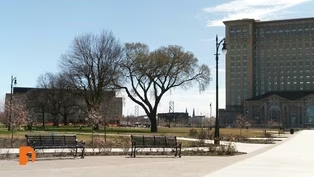
(soft rhythmic music) Next to the iconic Michigan Central Station in Detroit's oldest neighborhood, Court Town, a cutting edge facility called Newlab at Michigan Central has quickly become a hub for tech companies and entrepreneurs.
Since opening in 2023, 90 companies have joined.
CEO Cameron Lawrence is at the helm.
- It's becoming this amazing ecosystem.
You're seeing entrepreneurialism on a day-to-day basis.
You're seeing products come from vision to reality in real time, and it's actually a really special place that I think Detroiters can really be proud of.
- [Narrator] Newlab was built from the skeleton of a former book depository.
- This is an old decrepit building.
It had a long history in the city but was, you know, overlooked.
It was abandoned, but man, look around.
Bones are fantastic, right?
So we have this history of taking historic buildings and creating something new, and this kind of poetry between what it was in the past and what it can be as a center of excellence for a city in the future.
- [Narrator] Open to the public, the first floor is full of displays from the startup companies calling Newlab home, a cafe, and plenty of meeting and workspaces, all underneath a massive glass ceiling.
The new aesthetics pay homage to the past with exposed beams and pillars, but what makes Newlab more than a historic building turned coworking space is the hardware amenities available to startups.
- [Cameron] Because we have all the best in class equipment here, we're taking months, if not years, off their product development cycle.
- [Narrator] Newlab Michigan Central is the sister facility to the original Newlab in Brooklyn that's home to over 200 startup companies.
Newlab's mission is to compete with coastal tech hubs to spark job creating innovation and attract the talent needed to fill those jobs to the Detroit region.
- I'm seeing the entrepreneurs choose to call Detroit home, and they're building their companies and their products outta here, and seeing the amount of pride the city is taking in becoming a bit of a hotbed for innovation and entrepreneurialism from where it was, that gives me a huge amount of pride in what my team and Michigan Central are building here.
- [Narrator] As Detroit's revitalization has continued over the years, Newlab has also been embraced by the city.
- I found that in a very short period of time, this has been a real source of civic pride.
I mean we have a lot of, you know, significant leaders in the community that are here quite regularly.
They're celebrating our wins.
- Cementing its footprint and commitment to Detroit with things like the nation's first-ever wireless charging roadway, Newlab shows no signs of slowing down.
- Walk around the concourse floor.
There are so many great examples of the prototypes of companies that we support, whether it be Tarform's like electric motorbike to Grounded's RV to LIVAQ's off-road vehicle.
You can't leave this building without being inspired by our founders and what they're building.
It's beyond magical.
This is a place where you see stuff actually get built, and you don't see that everywhere.
- [Narrator] The Charles H. Wright Museum of African American History is truly one of Detroit's gems.
Founded in 1965, the museum has been the premier venue for exploring and celebrating the rich cultural legacy of African Americans.
Its newest permanent exhibit honors the life and legacy of Judge Damon Keith.
The museum continues to expand its exhibits and upgrade technology to provide visitors with an innovative educational experience.
"One Detroit" contributor Sarah Zientarski has the story.
(soft rhythmic music) (soft music) - First, Neil, can you just tell us a little bit about the exhibition that we are in right now?
- Yeah, "The Audacity to Thrive."
Adreinne Waheed is the artist of this exhibition.
It looks at images and different ways of looking at how people survive and thrive the situations that they find themselves in, and it's just really a tribute to the resilience, particularly of African Americans in the current moment.
- How does the Wright put a Detroit and Michigan spin on the African American Museum?
- Yeah, it's really, you know, when we did our strategic plan of, I guess it's when I first came, almost three, four years ago now, one of the things that we really wanted to do is to center Detroit, and so in every story that we tell, we try to bring out how was Detroit involved in that particular story, right?
So in our core exhibit, what you see is not only the historical timeframe that you're looking at, may it be it back on the African continent or in the present day, but there's a timeline that shows you what was also happening in Detroit at that particular time where we were in our own development in evolution, so very centered to what we do.
- That is pretty cool to like see that parallel - Yep, exactly, exactly.
- as you're walking through that exhibit.
Can you tell us what is that core exhibit called?
- So the core exhibit is called "And Still We Rise."
"And Still We Rise" is really an iconic exhibit in the African American Museum field and that was one of the first to attempt to tell a story of African Americans from the African continent all the way to the present day.
And so what we tried to do with that exhibit is start on the African continent and go all the way through our history here, Reconstruction into the present-day issues.
We happen to have a reconstruction, if you will, of an actual slave ship in the exhibit, and what that shows is, if you were in one of the slave ships, how enslaved people were actually stacked on one another.
It's actually a sound score, if you will, to that that gives you some of the sounds and the voices of people there.
And I think it's quite remarkable to imagine people going across the Atlantic to our country, but to see the conditions that we were brought over in and to be reminded of the length of time that our ancestors were in these conditions is really very moving to many people.
I have a visceral response to that for sure, but there are also, you know, moments of joy and happiness in the exhibit where we look at the accomplishments of the present day going through the labor movement, the black church, and how the black church has been so influential and who we become as a people.
So what we're trying to do with our core exhibit now is to take each individual section and, using new technology, interactive screens, LED screens, all the available technology that's out there now, AI, you know, being able to see objects in 3D, et cetera, and incorporate those into each section of the exhibition.
What it would allow us to do then is, whenever new information comes, we're able to go in and reprogram that, add the images, and have a very contemporary view of that subject, and we can do that in all sections of the core.
It's really, really exciting.
- I'm really excited about all the renovations that you're doing here at the Wright.
You have the renovation also of the theater, which is gonna bring in more technology to the Wright.
- Oh my God, you know, one of the things that Detroit, of course, is famous for is this performance community, whether it's Motown or electronic music or jazz.
So we really, you know, had a theater that was really more of a lecture hall, if you will, didn't have a very deep stage, didn't have real theatrical equipment, didn't have the kind of sound equipment that you would expect in a theater.
So we redone it, you know?
We've doubled the size of the stage.
We've brought in all new state of the art theatrical equipment, surround sound equipment, equipment to be able to do film and to show movies in the theater, and more comfortable seats.
- So you're talking about all these great things that the Wright has, and, you know, people from all over the country, the world are coming to Detroit now.
This is a place to be.
- This is a place to be.
- But especially April 25th through the 27th, the NFL draft is gonna be happening just down the road.
So what can you say to people that are coming in for that draft to take in the cultural institutions that we have here but also specifically come down here to the Wright?
- Well they have to come to the Wright.
Let's just start there.
If they don't, they've just missed a major part of what Detroit is and I think what Detroit is about and what the people who have lived and worked and stayed here, frankly, for, you know, centuries now.
I think the Wright is one of Detroit's great assets.
I think it's when something that when we created it, we were founded 60 years ago, this building's 30 years old almost now.
When we were founded, we were one of a kind, right?
There are now other African American museums around the country, but to see the institution and the building that started it all is something that people should really avail themselves of, and it's only here in Detroit.
(soft music) - [Narrator] The NFL draft has swept into town, and there are a lot of activities taking place in downtown Detroit to celebrate.
If you're looking for something else to do this weekend and beyond, there's plenty to choose from in metro Detroit.
Cecilia Sharpe and Peter Whorf of 90.9 WRCJ have some suggestions in today's "One Detroit Weekend."
- Hey Peter, this is a week we football fans have been waiting for, and I'm so excited.
So Peter, why don't you tell the audience exactly what's happening?
- Well, the NFL draft is finally here right in our city, and anyone can enjoy the festivities downtown if they register for the NFL Draft Experience.
The events take place in Hart Plaza and Campus Martius today through Saturday.
- Let's hope the Lions can add some more great talent this weekend.
Now, if you're not into the draft, don't worry.
There's so much more to do, like heading to Northville's Tipping Point Theatre to see the dark comedy "The Squirrels," which runs through May 5th.
It's literally about a family of squirrels, and this is not a dog-friendly event.
- [Peter] And the show "Something Rotten!"
is opening tomorrow, April 26th at The Farmington Players.
The show is set in the 1590s and follows two brothers who are trying to write the very first musical.
- [Cecilia] Well, Peter, country is taking over Orchestra Hall tomorrow and Saturday with "Country Hits: Songs from Nashville."
The show features songs from Patsy Cline, Dolly Parton, Willie Nelson, Casey Musgraves, and much more.
- We may have to go over there and do some line dancing.
- Peter, I'm game to learn a few new moves.
- I'll see you there.
The Sneaker Con is at Huntington Place where over 300 vendors will offer a diverse range of rare, limited edition, and exclusive sneakers.
There's also street wear and accessories.
- Oh, shoes.
It's my weakness.
Sounds like I may have to do a little shopping, and, of course, there's even more events happening around Metro Detroit.
Here's a few more.
Have a great weekend.
(soft pulsating atmospheric music) - [Narrator] That'll do it for this week's "One Detroit."
Thanks for watching.
Head to the "One Detroit" website for all the stories we're working on.
Follow us on social media and sign up for our weekly newsletter.
(soft rhythmic music) And you can help tell the world what is Truly Detroit.
Join Detroit PBS as we tell the story of the greatest city in America while the NFL spotlight shines on our region.
(upbeat electronic music) Tell us what's your Truly Detroit, like your favorite Detroit pizza, favorite hangout, or favorite Detroit performer.
(upbeat jazzy music) (audience cheers and applauds) Then check out our special Truly Detroit archive.
Here, we have dozens of great stories to share from all your Detroit PBS favorites.
(soft bright music) Help Detroit PBS tell our story to the world as we share what is Truly Detroit.
- [Announcer] This program is made possible in part by Timothy Bogert, comprehensive planning strategies.
From Delta faucets to Behr paint, Masco Corporation is proud to deliver products that enhance the way consumers all over the world experience and enjoy their living spaces.
Masco, serving Michigan communities since 1929.
Support also provided by the Cynthia & Edsel Ford Fund for Journalism at Detroit PBS.
- [Announcer] DTE Foundation is a proud sponsor of Detroit PBS.
Among the state's largest foundations committed to Michigan focused giving, we support organizations that are doing exceptional work in our state.
Learn more at dtefoundation.com.
- [Announcer] Nissan Foundation and viewers like you.
(soft bright rhythmic music) (soft bright rhythmic music continues) (pleasant piano music)
Newlab helps shift technology landscape in Detroit
Video has Closed Captions
Clip: S8 Ep43 | 5m 23s | Newlab at Michigan Central helps shift technology, entrepreneurship landscape in Detroit. (5m 23s)
REAL reflects on 20-year beautification of Detroit Riverwalk
Video has Closed Captions
Clip: S8 Ep43 | 6m 35s | Riverfront East Alliance reflects on the 20-year beautification of the Detroit Riverfront. (6m 35s)
Providing Support for PBS.org
Learn Moreabout PBS online sponsorship
- News and Public Affairs

Top journalists deliver compelling original analysis of the hour's headlines.

- News and Public Affairs

FRONTLINE is investigative journalism that questions, explains and changes our world.












Support for PBS provided by:
One Detroit is a local public television program presented by Detroit PBS