
Rivertown Market Goes Local/What It’s Like in the Classroom
Season 5 Episode 37 | 26m 46sVideo has Closed Captions
Rivertown Market Goes Local/What It’s Like in the Classroom This Year For Teachers
Continuing our education coverage, we look at how teachers are doing at this point in the school year. Last month Meijer stores opened their Riverfront market on Jefferson Avenue just east of downtown Detroit, dedicating shelf space to regional food producers. When the top of gun violence comes up, usually solutions point towards getting guns off the street. Episode 537
Problems playing video? | Closed Captioning Feedback
Problems playing video? | Closed Captioning Feedback
One Detroit is a local public television program presented by Detroit PBS
Rivertown Market Goes Local/What It’s Like in the Classroom
Season 5 Episode 37 | 26m 46sVideo has Closed Captions
Continuing our education coverage, we look at how teachers are doing at this point in the school year. Last month Meijer stores opened their Riverfront market on Jefferson Avenue just east of downtown Detroit, dedicating shelf space to regional food producers. When the top of gun violence comes up, usually solutions point towards getting guns off the street. Episode 537
Problems playing video? | Closed Captioning Feedback
How to Watch One Detroit
One Detroit is available to stream on pbs.org and the free PBS App, available on iPhone, Apple TV, Android TV, Android smartphones, Amazon Fire TV, Amazon Fire Tablet, Roku, Samsung Smart TV, and Vizio.
Providing Support for PBS.org
Learn Moreabout PBS online sponsorship- Hi, I'm Christy McDonald and here's what's coming up on "One Detroit" this week.
Michigan addressing the teacher shortage, and hear what it's like in the classroom this year from the teacher's perspective.
Plus, Meijer's new Rivertown Market in Detroit.
How it's changing the grocery scene for local vendors.
And legal gun ownership on the rise.
What's behind the numbers.
It's all ahead this week, on "One Detroit."
- [Narrator 1] From Delta faucets to Behr paint, Masco Corporation is proud to deliver products that enhance the way consumers all over the world experience and enjoy their living spaces.
Masco, serving Michigan communities since 1929.
- [Narrator 2] Support for this program is provided by the Cynthia and Edsel Ford Fund for journalism at Detroit Public TV, The Kresge Foundation, Community Foundation for Southeast Michigan.
- [Narrator 1] The DTE foundation is a proud sponsor of Detroit Public TV.
Among the state's largest foundations, committed to Michigan-focused giving.
We support organizations that are doing exceptional work in our state.
Visit DTEFoundation.com to learn more.
- [Narrator 2] Business leaders for Michigan, dedicated to making Michigan a top-10 state for jobs, personal income, and a healthy economy.
Also brought to you by, and viewers like you.
(soft music) - Hi there, and welcome to "One Detroit."
I'm Christy McDonald, So glad to have you with me this week.
We have a lot coming up on the show, starting with school from the teacher's perspective.
The state superintendent is pushing for solutions to the teacher shortage that many districts find themselves in.
We'll get a sense of what the school year has been like from a third grade and a high school teacher.
Plus, we take a closer look at the changing grocery landscape in the city of Detroit, how the Rivertown Market is bringing competition, and new opportunities for local products.
Then, the rise in legal gun ownership across the region.
We take a look at the reasons why with Bridge Detroit's Bryce Huffman.
It's all coming up on the show this week.
And we are starting with the teacher shortage here in Michigan.
The state doesn't track exact numbers, but districts are having a difficult time filling positions for many reasons, burnout, early retirement, illness, and COVID quarantines.
There are fewer students choosing teaching as a profession.
And as a result, more districts have had to put uncertified subs in a class, expand class size, or go back to remote learning.
The state superintendent recently outlined a plan that would infuse 300 to 500 million dollars over the next five years to tackle the problem.
Some solutions include higher starting salaries, tuition reimbursement, forgiving student debts, and funding districts' recruiting efforts, among other ideas.
You know, teaching has always been a challenging profession.
Our teachers not only meet the academic needs of the kids who come to their classrooms, but the social and emotional needs as well, the pandemic has made it even more difficult.
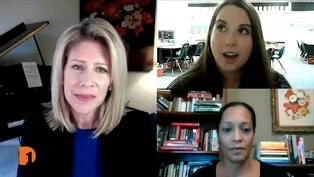
Well, we wanted to check in and see how teachers were doing so far this school year.
So we found two teachers willing to carve out some time after school to give me an idea of how things are going.
Meet Meghan Moxon.
She's a third grade teacher at Hiller Elementary School, which is part of Lamphere Public Schools, a district in Madison Heights.
And Dorothea Williams-Arnold, an English language arts teacher at Cass Tech High School in Detroit.
- I think that comparing from last year to this year, the students and staff were incredibly happy to have what kind of is structured more as a traditional school year prior to the year we had.
I know my students were incredibly happy to be back with their friends.
And it's really interesting because I teach third grade.
So these kids haven't had an uninterrupted school year since they were in kindergarten.
And that itself, really socially and developmentally, you see it in the room.
There are moments where I realize I have to reteach something because maybe we don't remember the proper way to sit on the carpet and transition to the next thing, when maybe students in the past did.
And that's just because we haven't had that practice.
- I agree with you, Meghan, the kids are excited to be back.
You know, our kids haven't been, some of our, I have teach 10th and 11th grade, and some of my students have never been in a high school.
So my 10th graders are a little nervous but excited, but we're in a couple cohorts where, I'm at a school where we have a lot of, probably about 2,500 students.
So I'm having to teach my kids in the classroom and engage the students who are at home as well.
So I'm faced with the similar challenges as I had last year, right?
So I'm kind of like, "All right, everybody," you know, and then I'm like, "How are you guys doing over here?"
So I'm going back and forth.
So in terms of preparing, yeah, I have to figure out how to, group work is more difficult.
So the preparation time takes a lot longer.
And often there is not enough time in the day.
I'm gonna be honest.
And we've taken on a lot of different, more responsibilities.
- Meghan, I can only imagine yours is a very different kind of preparation, but it has to be different.
So tell us about that.
- Yeah, I think that probably Dorothea can agree.
We're working in this moment where there's a lot of focus on social emotional learning.
We all just went through a collective trauma together and are still going through that.
At the same time, the demand of meeting benchmark standards and these metrics are incredibly challenging, considering all of the variety of situations that our students went through in these last two years.
We all learned in this pandemic, just in a different way.
So that in itself, using the assessments that we use, you see the challenge of looking at any data that got collected in the last year through the remote setting, you know, was it effective data?
Am I catching them?
So the first quarter was a lot of focusing on where are my students really at, like I said, developmentally, socially, and academically.
And now the second quarter is really gonna be focused in on how can I now take all this information that I have and kind of going back to what Dorothea said, the preparation of, which do I need to lean in more?
Am I leaning more into social emotional learning?
Am I leaning more into all of the academics?
It feels like there is not all the time in the world to do it all in that eight to three timespan.
- Our district allowed us a couple weeks to not just lean in on the academic piece, right?
They wanted us to kind of get to know the kids, give them a little bit of freedom to kind of relax and get to know each other.
And then I kind of began with the assessments and just kind of see where they are.
The district is also doing their own assessments and we've spent quite a bit of time in that area.
So I just wanted to talk a little bit about that.
But still, I don't know if my assessments are matching up with the district's in terms of where the students are right now.
- So let's talk about that acknowledgement of the teaching profession right now.
I want to get both of your opinions on, and maybe what you've talked to colleagues about, about teaching in general and how people now perceive teachers, what their role is and are more people thinking about, "I'm in here for the long haul," or do you hear more teachers saying, "You know what, a couple more years, and I'm done," or "This is too much for me."
How have you seen the role of teaching change and how do you feel about it?
- I am actually a member of my union and this was a conversation we've been having because we do see, and it's not just our district, it's really all at this time, where are you see many people maybe seeing openings in different districts, trying out different things, people leaving the profession entirely.
I think the pandemic shows that the K-12 structure is incredibly important to all working families.
It's incredibly important to, just, I mean our whole systems in our country.
And so we really need to make sure that this profession does not get lost and stop placing blame and all of those things that on top of working through a pandemic, teachers feel.
So this is a very complex situation.
And it doesn't mean if someone leaves the profession that they didn't have the heart or they didn't have what it takes, that they don't care about kids.
I mean, that is absolutely not true.
I mean, I've seen many of my friends choose to not be in this profession anymore.
I've seen many of my friends choose to try out different districts.
- You know, I hear a lot of the same things from my colleagues, you know, who are eligible for retirement in a few years and it's disappointing, but I understand.
I'm a die hard, but I'm even at the point now where I'm exhausted.
You know, I am, I love the kids.
We have great students at Cass.
We have great students all over the district, right?
But, and I can't be, Meghan, I'm with you.
I can't be mad when teachers say, "You know what, I'm done," right?
We need more support staff.
It's a tremendous challenge to try and teach two separate classes.
You have all of these kids and there might be a way to solve this problem or to help out by making it a little bit easier for teachers to get through their programs, offering some financial incentives for teachers to making it a little bit easier for them.
We have student teachers from Michigan State University who are struggling to get through their programs because they have to go a whole year with no pay, right?
How can the districts help with that?
- We know that education is the most crucial way to help promote a life for the kids that we have in our rooms.
And so when we give it our all every day, we, you know, we would appreciate that acknowledgement, really.
And that's kind of it.
I mean, I care deeply about my job.
I care deeply about my staff, my students, always will.
And I think that, you know, it just talks about the resilience of a teacher.
We go through a lot and you may not know it.
- My thanks to Megan and Dorothea.
just make sure you stay with us at onedetroitpbs.org for more of our coverage on education.
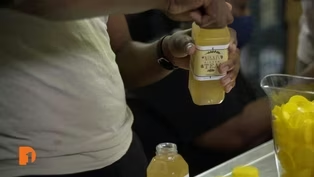
All right, a few weeks ago, shoppers in Detroit got another option when Meijer opened its Rivertown Market along Jefferson Avenue on the city's east side.
Along with the usual groceries, the store's dedicating shelf space to regional food producers.
It could be the start of a new trend, and some Detroit entrepreneurs are along for the ride, but how can they scale up to build their brand and deliver to more stores?
Bill Kubota checks in with a couple of very local producers that we've featured before here on "One Detroit," and meets a few more.
- Evidently left it, I had a easel, that I was gonna kinda- - [Bill] Every product tells a story, don't it?
Here is Nikki's Ginger Tea, it keeps pushing on, a Detroit brand for two decades.
Now at the new Meijer Rivertown market, just east of downtown.
- Oh this is good.
- [Bill] Nikki's from the city's east side Islandview neighborhood.
- It's really exciting to be right in the heart of our city doing this.
It's bringing quality to the community.
- [Shopper] Thank you.
- [Bill] An entrepreneurial hangout of sorts, the megastore chain trying something different.
A much smaller footprint, no clothes or home furnishings sold here.
- These small gourmet-type of Meijer, they do very, very well because it's a perfect mix of grocery and local and fresh produce.
- Elwin Greenwald's got his renowned Elwin and Company scones.
How often do you do this, come out and see the people like this?
- At openings, I always do, because it's important for us to be here, but I have a couple of different people that do the demos for me.
But at an important opening like this, you know, we of course are happy to do it.
- So when we think about our format where we're opening it up with 2,000 vendors now, that easily could grow to 2,500 or 3,000, it's really what the community wants.
- You got a winner.
- Thank you, sir.
- [Bill] Jacqueline Sanders took a buyout from AT&T.
She's from a family of bakers.
- And then I realized that I really had a love for it.
I enjoyed doing it.
And then people started calling and asking me to do personal baking for them.
And so that's how For Heaven's Cake was birthed.
- [Bill] For Heaven's Cake, making its retail debut at Rivertown, the kind of product Meijer's been looking for.
- We want to see the small businesses, local businesses, minority businesses, we want to see 'em thrive.
So if that's something we can do and aid in that process, you know, the pandemic was very hard for a lot of people to keep their businesses open.
So to be able to have a different avenue for us to be able to do that, that means a lot to us and Meijer as a whole.
- We call this caviar in a jar.
- [Bill] Tiffany Cartwright tried to help her daughter's skin condition, creating a line of body scrubs.
- There's no chemicals or anything.
It's actually a coffee scrub.
I was working as an administrative law judge and I unfortunately was laid off.
I lost my position.
I started mixing the products, pitching them out, reaching out to different retailers in order to grow my business.
- [Bill] Cartwright's Detroit-made G.L.A.M.
products, available nationally at Walmart, Stop & Shop stores on the east coast, and now, here in Detroit.
- Like to try a little ginger today?
- Yes.
- [Bill] Customers sample an unsweetened brew over at the Nikki's display.
- We just launched our Stevia line, that is with Stevia and monk fruit.
And that has really been doing exceptionally well.
We're launching some new flavors for the holidays, a blackberry and a cranberry flavor.
- [Bill] Nikki's home base had been in the basement of the Church of the Messiah in Islandview.
- Things were progressing pretty well, and then the pandemic happened and brought everything to a halt.
- [Bill] Nikki's shut down, too, for a while.
- And then we were really gaining some momentum and then the big flood happened.
- [Barry] And this is what it looks like.
We still got about 20 hours of rain coming.
- Now at Church the Messiah, it was waist high.
And we lost everything in that flood.
Had to start over from scratch.
- I'm like, wow, is this really happening?
'Cause at the same time, I had two floods at my house.
- When it was all said and done, it was over $750,000 worth of damage done to the church basement.
And that is not going to be open or usable for another year or so.
- [Bill] Their tea, now from another kitchen, further up (indistinct).
Along with Meijer, they sell at Whole Foods stores in Michigan and parts of Ohio.
Back in Islandview, Planted Detroit's making ready-to-eat salads indoors, year-round.
Some destined for Rivertown Market.
- Yeah, we're right at the stage now where we're really staffing up, looking for the people with the right skills and mainly the desire to learn this kind of thing.
- [Bill] Around 40 people work here.
Staff's nearly doubled in a year and more of an automated operation now.
- Oh, here, we've got some red radish, some purple radish, some daikon radish, some broccoli, some kohlrabi.
- The growth of cannabis has brought down the cost of the infrastructure that allows for us to grow indoors, namely the lights.
So I think that's gonna see more players, more investors, and eventually we'll figure out the way to do this efficiently.
- So this room is maintained roughly at 70 degrees, about 55% humidity.
- [Bill] The super clean operation, masks, gloves, suits, pandemic or no.
- These racks actually slide.
So it allows us to save even more space and maximize our growing square footage.
Having something like this available all year means people have fresh, delicious salads available all year from Michigan that didn't have to come from Arizona or California.
People essentially don't have that excuse of, well, oh, it's winter, I think I'll just have a pizza tonight instead of a salad.
- [Bill] Besides Rivertown, Planted had already been on shelves at some Plum Markets in the suburbs.
- Yeah, it was a really big win for us to gain placement in Plum Markets.
They're so well-known for their fresh products.
And it's nice to see someone who's focused on local and not just in name only.
- [Bill] At the end of the food chain, it's a team effort to reach customers.
- They don't know about it, but when they're seeing the marketing that we're doing in the stores and the promotions, the placement on the shelf, they're picking it up and they're returning for it.
- We anticipate by the end of this calendar year, finishing an expansion within the current farm.
And then we'll be able to add some more customers.
- [Bill] After that, maybe another indoor farm somewhere else in Detroit.
Nikki's poised for growth too.
What do you think's gonna be different next year than this year?
- Next year we'll hopefully be breaking ground on our facility.
That is a two- to three-year timeline.
- [Bill] The plan, the place in Islandview adding automation to the bottling line while providing space for other food producers.
- I think that there is two paths to this journey.
The quicker path doesn't necessarily leave room to build other businesses up along with you.
I feel like the slower path, it gives you an opportunity to bring other smaller businesses along on the journey with you and give them the tools and the benefit of your experience.
And I think that that's what we're doing.
It is going to be something unlike anybody's ever seen.
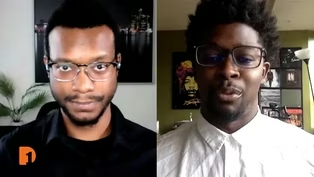
- When we talk about guns and gun violence, usually solutions point to getting guns off the street.
But our reporting partners at Bridge Detroit wanted to take a look at why more Detroiters are opting to legally carry guns.
For some, ownership is about a sense of protection.
And for others, it's to exercise their second amendment right to carry.
Will Glover talks with reporter Bryce Huffman.
- When you think about Detroit and guns, it doesn't necessarily translate to, oh, legal gun owners exercising their right to carry.
- That's right.
- And one of the things that you referenced in your article was the fact that not only are people deciding to purchase and carry guns legally for their own protection, but some of them are just exercising their right to bear arms.
My first question to you is, how is the right to bear arms not necessarily the same obvious right when it comes to black people in America and you know, black people in the city of Detroit, can you give us some context?
You know, Detroit's a city that has a lot of gun violence historically, this is something that a lot of people who live here, who visit here, who just talk about the city know.
And therefore, people who live here feel like, and not feel like they have the right to protect themselves, their family and their property.
And I think what gets lost along the way when people bring in the second amendment is a lot of the time when those people are talking, those aren't people that live in areas with lots of gun violence.
Those aren't people that live in Detroit, necessarily.
A lot of times, it's people from suburbs or rural areas who are the most vocal proponents of gun rights that you see in western media.
But people who live here have just as much a right to protect themselves, and maybe have more reason to be worried about gun violence than anyone else.
And the other part of it is, a lot of Detroiters feel like the police can't help them not be a victim, and that's not a slight against the Detroit police, but it's the reality of the situation.
The Detroit Police Department doesn't necessarily have any big say on legal gun owners.
You know, if you legally own a gun, if you're licensed, you're good to go.
What they're more interested in is finding people who have weapons that are not secured, are not being handled properly.
And then obviously the illegal weapons, weapons where the serial's scratched off, or ghost guns as they call them, guns that you can't trace back to their manufacturer.
They're much more interested in that than they are in stopping people or harassing people who are legally owning and carrying a gun.
In fact, back in 2014, when James Craig was still the chief, you know, he was very vocal and told people, arm yourselves, you know, like, that's the best way to defend yourself, arm yourself.
You know, that's what he said, not necessarily how I view it.
- What is the current police chief's stance on what he's seeing around the rise in legal gun ownership?
- Frankly, he believes there's too many guns on the street.
He doesn't necessarily think gun ownership is bad or wrong.
He's just speaking from someone who looks at those stats and sees how many guns officers are pulling off the streets, legal or illegal, he just thinks there's too many.
And the access to guns is just a bit too high for a city that, you know, has this kind of violence.
But again, he's never been someone who is anti-second amendment.
- In your reporting for this last piece, you spoke to quite a few people about, you know, what led them to gun ownership.
Can you just tell us a little bit about, you know, some of the people that you encountered and some of the things that they were saying, some of the reasonings behind, you know, them becoming gun owners?
- Yeah, so one of the very first people I talked to is Richard Faulkner.
He actually, his son is a police officer at DPD, or his stepson is assigned with DPD.
So that's how I was linked with Richard.
And he said that he saw someone trying to break into his neighbor's house and it dawned on him, you know, even if I call the police, you know, this guy wants to do harm to me.
He's here, the police are there.
So that is a story you hear often, you know, people either hear about a crime or they witness a crime.
And that's when they decide to arm themselves.
Other people like Tanisha Moner, she's a gun range safety officer.
She unfortunately was the victim of a robbery and a sexual assault at gunpoint when she was young.
And it actually took her a long time to get over her fear of guns.
But once she did, she realized, okay, now I have options.
You know, now I have some sort of defense and it might not stop you from being the victim of a crime.
And she's one of the first people who will tell you that.
But what it does, it gives you a sense of safety that you might not otherwise have.
- Have you heard or seen any pushback against all of this newfound, I guess, interest in firearms, and what was that pushback?
- I haven't heard that pushback from longtime Detroiters, necessarily.
I've heard it.
I've talked to people who didn't grow up surrounded by gun violence or surrounded by crime, who, you know, are pacifists, who don't believe in firearms, but even those people will tell you at a certain point, you got to do what is in the interest of you and your family.
So the pushback kind of goes, you know, they might not personally like it, but they're not gonna be campaigning against your ability to own a gun.
Some people are still not fans of the NRA, the National Rifle Association.
Some people are not necessarily a fan of big gun lobbyists like them, but at the end of the day, they're all for doing what you gotta do to keep your family safe.
And if owning a gun and keeping it secured and out of the reach of children is the way you want to do it, then they're all for it.
- For more stories from our partners at Bridge Detroit and all of the stories that we are working on, just head to our website at onedetroitpbs.org, and find us on social media at One Detroit.
That is gonna do it for us this week.
Have a great weekend.
See you on Monday for One Detroit Arts and Culture, at 7:30 p.m. Until then, take care.
You can find more at onedetroitpbs.org or subscribe to our social media channels and sign up for our One Detroit newsletter.
- [Narrator 1] From Delta faucets to Behr paint, Masco corporation is proud to deliver products that enhance the way consumers all over the world experience and enjoy their living spaces.
Masco, serving Michigan communities since 1929.
- [Narrator 2] Support for this program is provided by the Cynthia and Edsel Ford Fund for Journalism at Detroit Public TV, The Kresge Foundation, Community Foundation for Southeast Michigan.
- [Narrator 1] The DTE Foundation is a proud sponsor of Detroit Public TV, among the state's largest foundations, committed to Michigan-focused giving.
We support organizations that are doing exceptional work in our state.
Visit DTEfoundation.com to learn more.
- [Narrator 2] Business leaders for Michigan, dedicated to making Michigan a top-10 state for jobs, personal income, and a healthy economy.
Also brought to you by, and viewers like you.
(slow upbeat music) (soft piano music)
Video has Closed Captions
Clip: S5 Ep37 | 6m 34s | Local food producers are finding more shelf space at Rivertown Market. (6m 34s)
What It’s Like in the Classroom This Year For Teachers
Video has Closed Captions
Clip: S5 Ep37 | 7m 41s | How educators are grappling with shortages, demands (7m 41s)
Why More Detroiters Are Opting to Legally Carry Guns
Video has Closed Captions
Clip: S5 Ep37 | 6m 34s | Our partners at BridgeDetroit report on why legal gun ownership is increasing in the city. (6m 34s)
Providing Support for PBS.org
Learn Moreabout PBS online sponsorship
- News and Public Affairs

Top journalists deliver compelling original analysis of the hour's headlines.

- News and Public Affairs

FRONTLINE is investigative journalism that questions, explains and changes our world.












Support for PBS provided by:
One Detroit is a local public television program presented by Detroit PBS