State of Affairs with Steve Adubato
Robert Sinclair Jr.; Tara Colton; Michael Anestis
Season 6 Episode 14 | 26m 54sVideo has Closed Captions
Robert Sinclair Jr.; Tara Colton; Michael Anestis
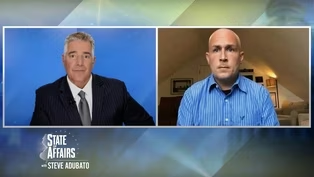
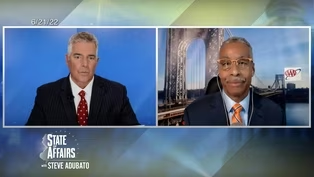
Steve Adubato sits down with Robert Sinclair Jr., Senior Manager, Public Affairs, AAA Northeast, to discuss travel in the wake of COVID; Tara Colton, Executive VP, Economic Security, NJEDA, highlights their new pilot program to improve childcare facilities; Dr. Michael Anestis, Executive Director, New Jersey Gun Violence Research Center at Rutgers University, examines gun violence in the U.S.
Problems playing video? | Closed Captioning Feedback
Problems playing video? | Closed Captioning Feedback
State of Affairs with Steve Adubato is a local public television program presented by NJ PBS
State of Affairs with Steve Adubato
Robert Sinclair Jr.; Tara Colton; Michael Anestis
Season 6 Episode 14 | 26m 54sVideo has Closed Captions
Steve Adubato sits down with Robert Sinclair Jr., Senior Manager, Public Affairs, AAA Northeast, to discuss travel in the wake of COVID; Tara Colton, Executive VP, Economic Security, NJEDA, highlights their new pilot program to improve childcare facilities; Dr. Michael Anestis, Executive Director, New Jersey Gun Violence Research Center at Rutgers University, examines gun violence in the U.S.
Problems playing video? | Closed Captioning Feedback
How to Watch State of Affairs with Steve Adubato
State of Affairs with Steve Adubato is available to stream on pbs.org and the free PBS App, available on iPhone, Apple TV, Android TV, Android smartphones, Amazon Fire TV, Amazon Fire Tablet, Roku, Samsung Smart TV, and Vizio.
Providing Support for PBS.org
Learn Moreabout PBS online sponsorship- [Narrator] Funding for this edition of State of Affairs with Steve Adubato has been provided by The Turrell Fund, supporting Reimagine Childcare.
RWJBarnabas Health.
The Port Authority of New York and New Jersey.
Moving the region through air, land, rail, and sea.
Choose New Jersey.
Horizon Blue Cross Blue Shield of New Jersey.
Here when you need us most, now and always.
The Healthcare Foundation of New Jersey.
New Jersey Sharing Network.
Summit Health a provider of primary, specialty, and urgent care.
And by Investors Bank.
Promotional support provided by Northjersey.com and Local IQ.
Part of the USA Today Network.
And by Meadowlands Chamber.
Building connections, driving business growth.
[INSPRATIONAL MUSIC] - Hi everyone, I'm Steve Adubato, we kick off the show with Mr. Robert Sinclair, Jr. Senior manager of Public Affairs at AAA Northeast.
Good to see you, Mr. Sinclair.
- Good to see you, thanks very much for having me.
- You got it.
Hey, listen, we're doing this as this summer gets underway in New Jersey, be seen a little bit later as well.
Travel, you cannot turn on a media program or social media, whatever it is, that more and more people want to travel at this point, particularly given cooped up two and a half years, COVID, et cetera.
Does the ability to travel, desire to travel, excuse me, match up with the ability to travel particularly with gas prices being what they are?
- Well, there's a strong desire for people to travel these days, having been cooped up for these two years and it looks like if you're going to drive to your destination, despite high gasoline prices, you're not going to have much of a problem.
We're seeing demand that was higher for Memorial Day week by about 220,000 barrels to a total of 386 million gallons per day, every day.
And that was higher compared to the week before, and going into the 4th of July holiday, we are anticipating record car travel, the most people driving to their destination ever for the holiday.
And this is despite the fact that gasoline prices approach $5 per gallon in many states or exceed $5 per gallon.
So it looks like the demand is very strong.
If you're going to fly, you might have a problem because the airlines got rid of a lot of people during the pandemic, and now there's an insufficient number of pilots, there's an insufficient number of cabin crew available, they even don't have enough people to staff the terminals at the gates.
So it's a tough situation and really it looks like folks are kind of voting with their feet, if you will, and driving to their destinations for the 4th of July.
- Yeah, I appreciate that we're taping this right before the 4th of July, be seen later, but here's the other thing.
You said it doesn't seem to be a problem for anyone but is it not a disproportionate problem for people in lower income communities, people disproportionately black and brown, disproportionately people who struggle to make ends meet?
$5 a gallon for gas but then they talk about, on top of that, the reality of cars cost more.
It is a real challenge and problem for many, is it not?
- Well, it is, without a doubt.
And when I say it's not a problem, I mean for that particular holiday.
But for a lot of people, it is a problem.
In fact, we did a driver survey back in March, we asked people what the pain point was for the price of gasoline and 75% said $5 a gallon, and we're there.
60% said $4 a gallon, if you go back to March of 2018, 40% said $3 a gallon.
So even if we went back to $3 a gallon, there would be a a problem for 40% of the population trying to pay for gasoline, at $5 a gallon, it's really difficult.
Drivers are coping by driving less, they are, if they're under 35, carpooling, if they're over, they're combining their errands with their commute, they're not eating out as much, if at all.
And they're putting off the purchase, a major purchase, like an appliance.
So most families don't have the elasticity in their budgets to deal with fluctuating gasoline prices, such as we're seeing.
But everything is fluctuating now and higher so it's a really tough situation for a lot of people.
And I just worry that a lot of folks are living paycheck to paycheck or running up credit card debt in order to be able to afford gasoline to get back and forth to work.
- Let me ask you this, you're not an expert on politics, public policy or international affairs, but if you were to say the primary reasons why gas prices are out of control, and President Biden calls it Russian President Vladimir Putin's gas price crisis.
There are OPEC issues, Saudi issues, there are people who take advantage of this situation by charging higher rates.
If you were to say the primary reason or reasons for gas prices being exorbitantly high, what would they be?
- Well, even before the war in Ukraine started, there were problems keeping up with demand, a lot of refineries got shut down during the pandemic, oil drilling rigs got shut down.
And in fact, April 20th, 2020, they were paying you to take crude oil off their hands.
Now the economy has come roaring back after we have gotten over COVID, and I would say, now, without a doubt, the main reason is the war in Ukraine.
Russia is a major producer of crude oil, upwards of nine or 10 or 11 million barrels per day, and global daily consumption is about 100 million barrels per day.
So you're taking 10% of the market off the market with the sanctions on the part of the European Union and the United States.
And so, that 90% that's left has to be distributed among all the nations and suddenly it becomes more valuable and more expensive.
So if we could stop this war and return to political and market stability, that would go a long way to helping with gasoline prices such as what we're seeing.
But in the meantime, there are all sorts of things being talked about, particularly limiting U.S. exports, because we produce a lot of crude oil, but we use more than we produce.
So we're sending oil out.
- Sorry for interrupting, but isn't there a conundrum here in this sense, on one hand, there's more and more pressure to reduce our carbon footprint, to reduce our focus on fossil fuel.
That being said, hey, let's move to electric cars, but we're not moving fast enough.
We gotta keep going in that direction.
Then all of a sudden you've got many, not just Republicans and Donald Trump, but others who are saying, "Hey, wait a minute, we should be taking advantage of the oil reserves we have, the places where we can drill.
Let's be less dependent on Russia, let's be less dependent on the Saudi."
Don't those two different mindsets conflict with each other?
- Well, part of the problem is the fact that you could pull all the oil out of the ground in the United States that you could, and you might not have enough refineries in order to process it into gasoline.
You don't have enough truck drivers to drive the trucks to get the gasoline to the stations.
So these are ongoing problems, but, really, ultimately, if the war were to stop and we'd get that market stability, that would help a lot.
Look, I'm reading a lot today about the fact that not only in the United States, but particularly in Europe, which depends very heavily on Russian crude oil and natural gas, that they're talking about restarting coal fired power plants, for at least a temporary basis, they're saying that, "Well, carbon footprint and all these other global warming things are just gonna have to be put aside because we're gonna have to stay warm during the approaching winter, and if we have to burn coal to do so, we're going to do it."
So a lot of things are being turned topsy-turvy as a result of this ongoing conflict and the problems that it's creating with the availability of crude oil, and as a result, the price.
- Hmm, so clearly the folks at AAA are thinking about a lot more than getting cars on the road or traffic or no traffic, et cetera.
They're very complex- - And, you know, all the talk about switching to electric vehicles, the grid is not ready.
You can't make the great American road trip with an electric vehicle without a lot of detailed planning.
And the average transaction price for an electric vehicle right now is $61,000.
So how are we gonna save money when the fuel might not be available, quote, unquote, for the electric vehicle, wherever you go and buying an electric vehicle is super expensive.
Conventional vehicles are expensive, new and used.
There's just seemingly no way around all these problems that we're seeing.
- Listening to Robert Sinclair, Jr., Senior Manager of Public Affairs, AAA Northeast.
Mr. Sinclair, thank you so much for joining us.
We appreciate your perspective.
- Thank you very much for having me.
- You got it.
Stay with us, we'll be right back.
(grand music) - [Announcer] To watch more State of Affairs with Steve Adubato, find us online and follow us on social media.
- We're now joined by Tara Colton, Executive Vice President of Economic Security at the New Jersey Economic Development Authority.
You'll see the EDA's website up.
Tara, good to see you again.
- Oh, it's my pleasure to be here.
Thanks, Steve.
- You got it.
Hey, listen, we're in the summer of 2022.
Be seeing a little bit after, as well.
Where are we, as it relates to the childcare crisis of accessibility, affordability, our Reimagine Childcare website will be up, right now?
A and B, what is its connection to the economy in New Jersey, and obviously beyond?
- I think we're at a really pivotal moment.
We're obviously now a couple years into the biggest amplification of why childcare matters to the economy, probably in our lifetime.
I think the recognition from both employers and workers and working families that childcare is not just an important educational and social development tool.
It's also critical to economic stability.
It's essentially part of our economic infrastructure.
And now that there is growing awareness and consensus around that, you have to compare it against, as you said, the affordability, accessibility, and quality of childcare providers throughout the state.
I say that both as someone who's leading the childcare work here at the EDA and as a working mom myself.
Something that's really crucial is ensuring that all New Jersey kids have access to a facility, whether it's a center or a home-based provider, that their parents feel is of the quality and the learning environment that their children deserve.
And so Governor Murphy's been very, very focused on this since the beginning of his administration, but then certainly over the last couple years, in terms of dedicating very significant resources, both state and federal, into strengthening the childcare system, because we recognize it's important, both as an employer itself, it's a significant employer in our state, but also how critical it is to our state's economy, on a broader level.
- Well, what is the specific role of the Economic Development Authority as it relates to helping to ameliorate the challenges of the childcare system.
What specifically is the EDA supposed to be doing?
Please share.
- Sure.
So we're really thrilled to be playing a leadership role in strengthening New Jersey's childcare sector.
It's a table that EDA has not historically been at, so we're very proud to be right up there with our sister agencies and with the governor.
The focus for us has been twofold.
So the first has been around dedicating resources to strengthen and improve the facilities that childcare providers operate in.
We recognize that many childcare providers throughout the state have facilities that, mostly not for their fault or any negligence, but really just tight profit margins and limited resources, a lot of these facilities have been either in disrepair or in dire need of improvements for years, sometimes decades.
It's windows that won't open, playgrounds that you can't get to easily, a roof that keeps getting patched instead of just replaced.
And so last year-- - I'm sorry for interrupting, Tara.
Is the EDA providing?
'Cause the program itself is a pilot program.
Are they grants, loans to these childcare centers?
I just wanna be more specific.
What are they?
- Yeah, sure.
So we are launching a program to provide grants that require no repayment between 50 and $200,000 each to childcare providers, for them to make these kinds of facility improvements.
- Who is eligible?
Who are the, what are the criteria, the income eligibility?
Talk to us about that.
- Sure.
So the pool of funding that we have to support these grants, total, is about 55 million.
We have announced the first round of funding, which is going to be at least $10 million in grants.
To be eligible for that, a provider needs to be a childcare center that serves six or more children and they need to have, within the last year, enrolled at least one child who is enrolled in the federal childcare subsidy program and they need to demonstrate a portfolio of projects that they feel could be supported with funding for facility improvements, and-- - Will that mean?
I'm sorry, Tara.
Will that mean they're disproportionately in urban communities, Black and Brown communities?
- So like many of the other programs that EDA has launched, both around small businesses and childcare, we are setting aside 40% of the funds for childcare providers that are located in Opportunity Zone-eligible census tracks.
- One second.
There's a lot of inside jargon here.
Not you, it's just, Opportunity Zones are zones established by the federal government and legislation sponsored by a Senator, Cory Booker, and one of his Republican colleagues, I think it's Senator Scott, in this regard, that established these zones that the federal government would say, that is a community we need to make more of an investment in to increase economic activity, job activity, and they are in urban communities.
- Absolutely, yeah.
So we expect that 40% of the funds will be earmarked for providers, set aside for providers within those communities, and we also know that, because we are requiring providers to currently or recently serve at least one child who receives the federal subsidy, that means that we're going to be able to target more providers who are serving children who are lower income and who are in facilities that have just not had the investment that's been sorely needed.
- And I believe that our, in post production, our Reimagine Childcare information will be up there so people can access the website and find out more, and Tara has joined us in the past to talk about this issue, as well.
And let me also disclose that the Economic Development Authority is, in fact, an underwriter of the Caucus Educational Corporation's programming, mostly on economic affairs.
Tara, thank you so much for joining us.
We appreciate it.
- My pleasure.
Thank you so much, Steve.
- You got it.
Stay with us; we'll be right back.
(grand music) - [Announcer] To watch more State of Affairs with Steve Adubato, find us online and follow us on social media.
- It's time to talk about gun safety, gun violence, gun control with Dr. Michael Anestis, who's Executive Director of New Jersey Gun Violence Research Center at Rutgers University.
Good to see you, Doctor.
- Thanks for having me.
- You got it.
We're taping this at the end of June 2022.
It's one horrific, either mass shooting or shootings in communities across the state and across the nation.
For those who are arguing vociferously for no changes in existing gun laws, we'll talk about what's supposedly going on in the United States Senate in just a moment, that leave it the way it is, that guns don't kill people; people kill people.
Let's just focus on mental health.
Talk to us.
What don't we understand?
- So I can understand the intuitive appeal of that, and I'm a clinical psychologist.
I love the idea of increasing access to mental healthcare.
But the data repeatedly shows that mental illness is not the primary driver of gun violence, and mental illness is not unique to America, but incessant gun violence is.
So it does not point towards mental healthcare as the solution to this problem.
- And New Jersey argues, the governor argues that, New Jersey leaders and governor Murphy argue that New Jersey has among the toughest gun laws in the nation.
But you believe there's some changes that need to be made.
What are they?
- So I agree we have some of the strictest firearm legislation in place, a lot of it data-driven, and as a result, we also have some of the least gun violence in the United States, as well.
But we can go further to do some things that make a difference.
For me, safe firearm storage is by far the most powerful tool we have at our disposal.
- What does that mean?
I'm sorry for interrupting, Michael, storage?
You mean where they are?
- Absolutely.
How people store their firearms in their home, or if they store them outside of the home during times of stress, a safe storage in the home approach would involve storing firearms unloaded, separate from ammunition, in a locked location, like a gun safe or a lock box, and then storing it outside of home during times of stress, just like you give someone your keys if you had too much to drink, and then you get 'em back when you're ready to have 'em back.
But you do it on your own terms.
- Lemme try this.
I saw you on the great "NJ Spotlight News".
You add perspective on a regular basis with our colleagues there, and you were talking about the effort going on in Washington right now, as we speak.
And again, things are moving quickly.
We'll see what happens.
There apparently is an agreement, a bipartisan agreement, to make some specific changes in federal gun laws.
First of all, what is a red flag law and why does it matter?
Let's start with that.
- Sure, a red flag law, or also an extreme risk protection order, it's a form of legislation that allows certain folks like family members or law enforcement to petition a court, to say we have evidence of imminent risk to self or other, and so we need to temporarily remove this individual's access to firearms.
So we get due process.
Certain individuals present a lot of evidence and a judge then issues an order, or not.
- What else is in that alleged or supposed agreement?
- A number of things.
They talked about expanding background checks for individuals under age 21 to include juvenile justice and mental health records.
They've talked about changing the definition of who is a firearm retailer to require background checks at more purchases.
There has been a vague reference to having federal legislation to work against firearm trafficking and straw purchasing.
And perhaps most importantly, they talked about closing the dating partner loophole for domestic violence so that individuals don't have to have been married to or lived with their partner for their domestic violence conviction to prevent them from having firearms.
- Yeah, but another thing about this, Doctor, which is so perplexing, not just to me, but to all kinds of people.
So when you think about the horrific events of Texas, and again, we don't know if there's going to be another mass shooting, and this is not just about the horrific mass shooting that had happened in Uvalde, Texas, but what is the resistance?
How do you explain the resistance on the part of gun owners, gun advocates, NRA, other organizations, to simply saying that, at 18, you should not be able to purchase an assault weapon, an AK/47, whatever, that the age should be 21?
What is the possible, conceivable opposition to that?
- It's hard for me to find a justification.
I would say that most gun owners are not against legislation like that.
If you look at polls, there's pretty bipartisan agreement, including firearms owners, that support most ideas like that.
It's the lobbyists, it's the manufacturers, and it's the elected officials who're beholden to them that resist very simple things like, for instance, limiting the capacity of a magazine so that you can't fire so much ammunition before you have to reload.
- On what grounds?
- They generally argue it's a slippery slope, that if you allow one thing to happen, that eventually everyone's gonna come for your guns, and quite frankly, this lines up with the general marketing scheme of firearms, which is, the world is dangerous, so protect yourself with firearms, and the government's dangerous.
They want your guns, so gather more.
If you maintain that narrative, it increases the profit margin.
- Doctor, the former president Donald Trump said that what we need, simply put, more guns, more guns in the hands of teachers, more guns in the hands of those who... You're shaking your head.
- Yeah, there's no way that that's gonna be an effective path towards reducing gun violence.
Where there are more firearms, there's more firearms deaths, and arming teachers, there's zero data that that's going to protect any students or any community members, never mind the insurance difficulties involved in thinking through the logistics of actually supporting an infrastructure where you have untrained teachers bringing firearms, concealed, to the schools.
- But can you understand average New Jerseyans, average Americans, who're basically saying, look, there's no one solution?
There may not be any solution.
Some have argued it's the way it is, which is so incredibly pathetic and sad to even think that.
It's tragic.
Let me, you know what?
I'm gonna make sure I protect myself.
Now, the Second Amendment is what it is.
It's in the Constitution, and I don't hear you saying it should be repealed or done away with, what would you say to New Jerseyans, Americans, people in our region who watch our programming, that say, you know what?
I'm gonna make sure I protect me, my family, our property.
I'm gonna go out there and get a gun.
- I think the drive to protect yourself, your loved ones, and your property is completely understandable, and people do have the right to purchase firearms, and I'm not here to argue that they shouldn't.
What I'd argue is that, when you bring a firearm into your home, like so many other decisions you make on a day-to-day basis, that means you're bringing risk into your home, and that risk extends to everybody in your home and everyone in your community.
And so, if you're going to bring that risk in, that's a decision you can make, but do it in a way that understands, how can I lower the risks associated with bringing that firearm in, and alternatively, are there different ways I can protect myself and my loved ones and my home that don't come with the risk profile of a firearm?
- Do you believe that, given the horrific events not just in Texas, but in Buffalo and other parts, just all over the place, with people being gunned down, innocent people, who was in church, who was in a supermarket, kids in a school, what is the reason that you believe that we, but also others, particularly our children, but it's other people in church, older people sitting in church, supermarket, to feel safe?
What's the reason?
We could and should feel safe?
Or do you think it just ain't safe?
- I think it is.
I think it's important to remember that, as horrifically common as these events are, as news stories, they're still what we call a low base rate of death.
The vast majority of people will never encounter this.
So I don't think people need to walk around feeling fear all the time, because that's not healthy, and it, quite frankly, that's what fuels people wanting to acquire firearms in the first place.
But I think that people should feel rage, that this is a legality that we live with, and I think they should feel entitled to change from their leaders that helps them live without that fear.
- And public officials need to be on the record as to where they stand, and people can decide accordingly at the election, at the ballot box.
- Absolutely.
People should be public about how they stand, and quite frankly, they should speak to what is the evidence supporting what they say.
Oftentimes elected officials use their platform to speak about ideas that sound appealing, but there's no evidence behind them.
But if they flood the zone with all that misinformation, then their community is not empowered to demand evidence-based solutions.
- Dr. Michael Anestis, Executive Director of New Jersey Gun Violence Research Center at Rutgers.
Thank you so much, Doctor.
We appreciate it.
- Thank you very much.
- I'm Steve Adubato.
That's the good doctor, and thanks for watching us.
We'll see you next time.
- [Narrator] State of Affairs with Steve Adubato Is a production of the Caucus Educational Corporation.
Funding has been provided by The Turrell Fund, supporting Reimagine Childcare.
RWJBarnabas Health.
The Port Authority of New York and New Jersey.
Choose New Jersey.
Horizon Blue Cross Blue Shield of New Jersey.
The Healthcare Foundation of New Jersey.
New Jersey Sharing Network.
Summit Health And by Investors Bank.
Promotional support provided by Northjersey.com and Local IQ.
Part of the USA Today Network.
And by Meadowlands Chamber.
- Hi, I'’m Dr. Shereef Elnahal.
Did you know that there are nearly 4,000 New Jerseyans waiting for a life-saving transplant?
And 67 percent of those people are people of color.
Just one organ and tissue donor can save 8 lives and enhance the lives of over 75 people.
Let'’s come together to raise awareness in our diverse communities.
Donation needs diversity.
You have the power to make a difference.
For more information, or to become an organ and tissue donor, visit: www.njsharingnetwork.org.
Combating Gun Violence in the U.S.
Video has Closed Captions
Clip: S6 Ep14 | 10m 14s | Combating Gun Violence in the U.S. (10m 14s)

How NJEDA is Improving Child Care Facilities
Video has Closed Captions
Clip: S6 Ep14 | 7m 23s | How NJEDA is Improving Child Care Facilities (7m 23s)
Traveling in the Wake of COVID-19
Video has Closed Captions
Clip: S6 Ep14 | 10m 2s | Traveling in the Wake of COVID-19 (10m 2s)
Providing Support for PBS.org
Learn Moreabout PBS online sponsorship
- News and Public Affairs

Top journalists deliver compelling original analysis of the hour's headlines.

- News and Public Affairs

FRONTLINE is investigative journalism that questions, explains and changes our world.












Support for PBS provided by:
State of Affairs with Steve Adubato is a local public television program presented by NJ PBS