State of Affairs with Steve Adubato
Robin Lavorato; David Wildstein
Season 8 Episode 8 | 27m 45sVideo has Closed Captions
Robin Lavorato; David Wildstein
Robin Lavorato, Executive Director of the Essex Health and Wellness Recovery Center, sits down with Steve Adubato to examine the dangers of fentanyl and the efforts to help those suffering from substance abuse disorders. Then, David Wildstein, Editor of New Jersey Globe, shares more insight on the state’s unique ballot design that gives preferential position to certain candidates.
Problems playing video? | Closed Captioning Feedback
Problems playing video? | Closed Captioning Feedback
State of Affairs with Steve Adubato is a local public television program presented by NJ PBS
State of Affairs with Steve Adubato
Robin Lavorato; David Wildstein
Season 8 Episode 8 | 27m 45sVideo has Closed Captions
Robin Lavorato, Executive Director of the Essex Health and Wellness Recovery Center, sits down with Steve Adubato to examine the dangers of fentanyl and the efforts to help those suffering from substance abuse disorders. Then, David Wildstein, Editor of New Jersey Globe, shares more insight on the state’s unique ballot design that gives preferential position to certain candidates.
Problems playing video? | Closed Captioning Feedback
How to Watch State of Affairs with Steve Adubato
State of Affairs with Steve Adubato is available to stream on pbs.org and the free PBS App, available on iPhone, Apple TV, Android TV, Android smartphones, Amazon Fire TV, Amazon Fire Tablet, Roku, Samsung Smart TV, and Vizio.
Providing Support for PBS.org
Learn Moreabout PBS online sponsorship- [Narrator] Funding for this edition of State of Affairs with Steve Adubato has been provided by Horizon Blue Cross Blue Shield of New Jersey.
Here when you need us most.
The Russell Berrie Foundation.
Making a difference.
Operating Engineers, Local 825.
New Jersey’s Clean Energy program.
Lighting the way to a clean energy future.
Rutgers University Newark.
Johnson & Johnson.
NJM Insurance Group.
Serving New Jersey’s drivers, homeowners and business owners for more than 100 years.
New Jersey Sharing Network.
And by The Healthcare Foundation of New Jersey.
Promotional support provided by Northjersey.com and Local IQ.
Part of the USA Today Network.
And by Meadowlands Media.
A print and digital business news network.
[INSPRATIONAL MUSIC] - Hi, everyone, Steve Adubato.
We kick off the program with Robin Lavorato, who is Executive Director of Essex Health and Wellness Recovery Center.
Good to see you, Robin.
- Thanks, Steve, nice to see you as well.
- You got it.
We're putting up the website of the organization right now.
Describe the work at the center and why it's so significant.
- Sure.
We are the Essex Health and Wellness Recovery Center, and what we do is recovery supports.
We really and truly do a lot of work with individuals and families who are struggling with substance use disorder.
We assist families to help their loved ones get into treatment, if they need detox, if they need treatment centers.
We help them to find sober livings, which are so very important.
We also will help them with recovery supports after they are successfully discharged from treatment.
We will help them get into programs for housing, clothing, food, and education, occupation, things like that.
- I should also thank our mutual friend, Judge Jose Linares, former Chief of the federal courts, Judge Linares, who reached out and shared about your work because he's deeply concerned personally, as well as professionally, about these issues of addiction.
And one of the issues he talked to me about that I know you're dealing with very directly is, now, I was gonna say the opioid crisis, but connect for everyone the opioid into the fentanyl crisis and why it's so incredibly significant and terrible.
- Absolutely.
First of all, yeah, thank you to Judge Linares.
He's been amazingly supportive of our work at the Essex Health and Wellness Recovery Center.
He has seen the devastation of opioids, fentanyl firsthand on the bench.
- In the courts, as a judge.
- Yep.
Yes, absolutely.
He has seen more than his share, and he knows the devastation.
He also knows that treatment is very important, and then, locking people up and throwing away the key is not really the answer.
So there has to be a combination, right?
We wanna keep those drug dealers off the street for sure, but people that are struggling with it, we wanna make sure that they get the help they need.
To answer your question, the opioid crisis really started back, you know, about 20-something years ago.
The pharmaceutical companies were strongly pushing the oxycodone to doctors, telling them that they really need for their patients to have no pain.
Insurance companies shouldn't be paying for doctors who can't get rid of pain.
And these doctors were prescribing oxycodone like crazy.
People were getting addicted left and right, as well as doctors themselves.
And they, at some point, had to get something a little bit cheaper, so they would go to the streets and get heroin, which is an opioid-based drug, illegally.
And what happened from there, we did start seeing some overdoses because of the heroin and also the large use of oxycodone and other opioids.
But all of a sudden, the drug dealers wanted something cheaper.
It was very expensive to make the oxy.
So they were getting the chemicals from China, which really just threw a whammy on us.
Coming in through the Mexican border, and we have drug dealers who are just mixing things up like they're a pharmacist, and they're not.
We see the DEA going into the, the United States Drug Enforcement Administration going into these drug dealers' homes, where they have these fake pharmaceutical labs set up.
And they're just putting the fentanyl in with oxys, in which cocaine, in with heroin.
It's even been found in marijuana.
We know these drug dealers, they're not really too worried about their clients, right?
There's many out there.
And they're bagging heroin, fentanyl, cocaine, marijuana all on the same table, in the same room.
And one speck of fentanyl getting into the marijuana can cause an overdose and a death to any of our people.
- Yeah.
That's what I was gonna ask.
Anecdotally, and it's funny, when you use the term anecdotally, it makes it sound like it's somehow less significant, but we hear these stories, these examples of this speck, as you say, of fentanyl that's someone's first time.
They didn't know it was in marijuana, whatever it is.
First of all, what is fentanyl, and why is it so deadly?
- So fentanyl is a synthetic opioid.
It's a man-made opioid.
And obviously, when it's man-made in a pharmacy, in a pharmaceutical lab, and distributed through a pharmacy, it helps.
It helps people, especially at the end of their life, if they're struggling with cancer.
It's a very strong drug.
It takes away the pain.
We have fentanyl patches for people who are struggling at the end of life with intense pain.
But when it's made in a basement lab or an apartment lab by a drug dealer who does not know what they're doing, yes, one speck, one little salt speck, one little sand speck of fentanyl can kill somebody.
We have Drug Enforcement Administration agents going in to make these arrests in these labs, and sometimes they get knocked down just by the fumes of the fentanyl.
It's a very, very- - Hold on, Robin, let ask you.
I'm sorry for interrupting, let me ask you this.
So you and your organization, we'll put up the website right now again of the Essex Health and Wellness Recovery Center.
You and your colleagues dealing with this every day.
When someone comes in addicted to fentanyl, how much more difficult is it for them to get the treatment that they need that would be effective to hopefully avoid them relapsing again?
Is it different than any other rehab?
- So an opioid, fentanyl detox is very, very, it's very trying for the person who is detoxing.
It's very different.
You have to go into withdrawal in order for them to start giving you the medications that you need to help you through the withdrawal symptoms.
But you have to go into the withdrawal first.
A withdrawal symptom is something like the flu times 1,000.
Withdrawal symptoms are probably one of the worst symptoms that I've ever heard of in anybody.
We have a great video up on our website.
Montclair High School students called me in to help them with the opioid documentary that they wanted to do, and we have three or four individuals on there explaining what a withdrawal feels like.
And it just, you feel like you're freezing cold, and then you're sweating hot, and you feel like there's bugs on you.
You're scratching away.
You know, your stomach is upset.
You know, you're just, you're sick.
- But they have to go through this, sorry for interrupting, Robin, they have to go through this in order to get to what?
- So what happens is, so they'll go into the detox center, and they have to wait 'til the withdrawal symptoms start.
Most people come into the detox center high.
They wanna get that last high in before they get sober.
They go into the detox center.
The doctors there have to wait for them to go into this withdrawal.
So and that can take up to two days.
So sometimes, at that second day, where the withdrawal is so bad but they're not ready to give the Suboxone or whatever drug that they're gonna give them to relieve the withdrawal symptom.
And then what they do over the five, six, seven days that they're in the detox, they start weaning them off of it.
And then, that's how they stop the withdrawal, and that's how they get them sober from the heroin, the fentanyl.
But- - But how common is relapsing?
- Well, first of all, what's even more common, which is very, very sad, is AMA, which is called, which is like leaving against medical advice.
- They just leave?
- Yeah, they, so after a second, you know, I'll drop somebody off.
I'll pick somebody up, drop them off at a detox center, get 'em in there, they're excited to be there.
By the second day, they're so sick, they can't take it.
All they wanna do is go out there and get their drug, and they actually leave.
They're in a nice, warm place, getting three meals, getting the care that they need, people that are compassionate, ready to help them.
The withdrawal symptom is so horrible, by that second day, they're just like, "I'm out."
And sometimes they walk right out in their hospital garb, not even waiting for their clothing.
They just wanna get that drug inside their system.
So we have that.
After somebody does come out of detox, they stay in for the six, 10 days, whatever it may be, depending upon their situation, we see about six to seven relapses before we see somebody really be able to grasp recovery, or unfortunately, pass away.
It's not something- - Robin, let's do that again.
I wanna make sure that's really.
Six or seven people that you treat who are dealing with, who are addicted, will relapse before you have, I don't even know how you define a success story.
And then some will die.
- Let me redefine that.
So when we have people coming out of treatment, detox, and even a 30-day treatment center, we see them relapse six or seven times until they really grasp recovery, or they die.
I mean, this is what we see.
Or they continue use.
It's very rare are you gonna see an opioid addict, someone who's struggling with opioid use disorder, get it the first time.
The drug is so strong.
It has affected the brain so intensely that it's something that I've never seen before.
I've worked with alcoholism.
I've worked with cocaine addiction.
I've worked with so many other things.
This is something I've never seen before.
We see, go ahead, I'm sorry.
- Robin, I'm sorry.
Only 'cause I- - I'm just very passionate, and I don't stop, so I'm sorry.
- No, listen, you're passionate for good reason.
But I'm also trying to manage time here.
Also, folks, our website will come up, SteveAdubato.org.
Go back and look at the interview we did with author Beth Macy, who wrote the book "Dopesick."
It is a corollary to this conversation.
Let me follow up.
Is there any silver lining here?
Where's the positive news?
And I'm not gonna say fake positive news, let's just come up with some positive news.
Is there reason to be hopeful, A, and B, what would cause us to be more hopeful as it relates to this opioid/fentanyl crisis?
- Steve, I wish I could tell you that I saw a silver lining.
I really and truly wish I could tell you that.
I don't right now.
What are we seeing?
So back in 2017, we had these big laws made, right, great laws- - Right.
- That, you know, the prescribing physicians had to keep a database.
- That's right.
- On who was prescribing, so the doctors weren't overprescribing.
- To keep track.
So people were not involved in a pill mill, if you will.
- Yep.
- Or and were potentially stopping, trying to stop people from shopping around to different.
So why that hasn't been overly effective?
- Well, we've arrested a lot of doctors, and we've gotten the doctors off the street that were illegally prescribing, which was great.
And we have seen, in America, we've seen our five million opioid prescriptions drop to about three million.
- Okay.
- But with that said, so from 2017, we've seen, from five million opioid prescriptions prescribed down to three million at this point, but our overdose rates are still up 'cause of the fentanyl.
- Okay, real quick, before I let you go.
What does Narcan have to do with this conversation?
What's Narcan and why is it relevant?
- Narcan, naloxone is the name.
Narcan is a brand name.
Narcan is a medicine that reverses an opioid overdose.
And it is extremely important.
We have saved thousands and thousands of lives.
In Essex County alone, we have saved 13,000 people by administering Narcan.
- What is it?
- So what it does, it's a medicine that goes into your brain and it attaches to your receptors.
And it redoes the opioid overdose, so the overdose goes away, the opioid comes outta your receptors in your brain, and hopefully you can survive.
Nowadays, when we see the fentanyl, sometimes we have to give two, three doses of it now.
- We haven't done enough from our platform with the Caucus Educational Corporation.
We haven't done enough.
I assure you, we'll continue these conversations with you and other leaders in this field.
And I cannot thank you enough for joining us.
Robin Lavorato is the Executive Director of Essex Health and Wellness Recovery Center.
Go to that website, find out more.
Robin, important work.
You're doing great work.
You are making a difference, and we'll continue the conversation.
Thank you, Robin.
- Thank you, Steve, thank you.
- You got it.
Stay with us, we'll be right back.
(grand music) - [Announcer] To watch more State of Affairs with Steve Adubato, find us online and follow us on social media.
- Recently, I had a chance to speak with David Wildstein, the Editor of "New Jersey Globe", about the ""party line."
When we talked about it, the federal judge had not declared the party line for the Democrats unconstitutional.
But since that interview, that's exactly what happened.
Party line is for the Democrats in New Jersey declared unconstitutional.
What happens to party organizations and the line and ballots moving forward?
Let's check out this conversation with David Wildstein.
We're now joined by David Wildstein, who's the Editor of NJ Globe, "New Jersey Globe".
Check out their website, doing important stuff every day.
David, good to see you.
- Good to see you, Steve, thanks for having me.
- Hey, listen, this isn't a fun topic, but it's an important topic.
Listen, we're taping at the end of March, 2024, there'll be a race for the US Senate, the Democratic and Republican nominations.
We'll see what happens on June 4th.
This isn't about that situation, but that situation has brought up the question of the "party line."
What the heck is the party line?
Why is it so significant/dangerous, and why is New Jersey the only state in the nation that has a party line to begin with?
- Well, I'm old, I've been doing this for a long time, and I don't remember life without a party line.
It's the only thing I've ever seen.
It's like you say, unique to New Jersey.
- What is it?
- It gives a preferential ballot position to candidates that have the endorsement of a county political party, and that allows names to be listed on the ballot ahead of others, in certain circumstances.
It makes name easier to find.
It links recognizable names on a ballot with unrecognizable names.
So if you're a new candidate, and you're in a tough race, and a lot of people don't know who you are, you benefit by the coattails of other people on the ballot.
whether it's Joe Biden this year, whether it was Cory Booker a couple years ago, you get a benefit of being in that same column with names that voters recognize and trust.
- David, let's do this.
Usame is our Executive Producer of Post-production.
Usame, can you put up the graphic that David provided us?
Okay, do us a favor, talk us through, David Wildstein.
Who's on the line?
- So you see column A, it was a drawing.
That's the organization column.
Some counties, remember in New Jersey, if you've seen one county, you've seen one county, so you have 21 different county clerks designing their ballots differently.
- [Steve] Is this in 2020?
- This is 2020 - Go ahead.
- Mercer County, there was a convention, and two of the candidates received 40% of the votes, so they get to run on the line.
That's Christine Conforti and Stephanie Schmid Schmid was actually the top vote getter, she got to use that same slogan, so if you look at it and you see, Biden slogan, Booker slogan, Schmid, you've got one candidate there, but then, in the next column you have another guy, David Applefield, he didn't hit that mark at the convention, he's off to the side.
Mercer is the only county in New Jersey that will put more than one candidate for the same office in their column if they hit a benchmark at their convention.
- Hold on.
So-called Ballot Siberia, meaning it's very hard to find a candidate.
P.S., Just so everybody understands this, we don't know who's gonna win the race for the Democratic nomination in the US Senate, not the issue here, but Andy Kim, the congressman who doesn't have the party endorsement in a whole range of prominent democratically controlled and influenced counties, if you will, the first lady, Tammy Murphy, does.
What Kim is saying is he could be in Ballot Siberia.
Is that what we're looking at right now, David?
Yeah, - So if you're looking at Cumberland County Democratic Primary, 2020, and this was the race for Jeff Andrew's seat right after he switched parties.
A lot of Democrats wanted to run for Congress.
Bridget Callahan Harrison was the organization candidate, line in Cumberland County.
So she ran with Biden and Cory Booker and the organization candidates for, in those days, still called Freeholders.
Then they do a drawing Bernie Sanders is running for President, He gets column B, he's in the next column.
And Larry Ham running for US Senate bracketed with Sanders.
- Who are these people over to the right?
So these are Will Cunningham, Bob Turkavage, John Francis, Amy Kennedy.
These are the ones that were also running for Congress but they're all the way over on the other side.
And then you look under Kennedy and see Jack Surrency and Donna Pearson running for freeholder.
They were on a line bracketed with Amy Kennedy.
And you've got a candidate for a local position.
LaRue Smith down at the bottom, you barely can even see her.
So what Ballot Siberia means is a huge amount of white space like snow in Siberia, a huge amount of white space that separates the organization candidates from the others.
- David, why the heck is New Jersey the only state in the nation that does this?
- I guess another way of asking it, Steve, is why don't the other 49 states do this?
It's not for me to say that it's right or wrong.
- Well, hold on, David, you know the answer to that.
The answer is most other states, - New voices.
- Well put it this way, and David knows I understand this from a certain perspective.
I'm from Essex County.
My dad who passed away three and a half years ago, David knew very well early on in his career, ran against the party bosses, ran quote off the line.
Then when he became more powerful, he was with the party line.
Translation, I understand this.
However, the question is this, what about if I said, David, devil's advocate, other states realize that it's unfair, some would argue undemocratic, and it makes it almost impossible, virtually impossible for a candidate who doesn't have the organization support to win off, off, off the line in Ballot Siberia and the people who do get elected are so beholden to the party bosses who gave them the line that they're really not voting on their own.
Is that a oversimplification of New Jersey politics, David?
- I don't think it's an oversimplification.
I think that there's a lot of asterisks there, take it for your second part first.
Does it make candidates beholden to the organization?
Absolutely.
Absolutely, positively, no doubt that better ballot position keeping somebody in office makes them beholden.
You and I have both seen countless people dumped from the line, denied organization support because they weren't voting or behaving in the way that people would like them to, - But okay, and also, isn't it true Andy Kim argues it, and again, this could be seen after the primary doesn't change anything.
Andy Kim argues that many of those party officials who jumped on the bandwagon for Tammy Murphy, and she was given the line in Essex County and Passaic County and Middlesex County and Camden County, I think, Bergen as well, because they didn't want to anger their party bosses or "they didn't want to anger the governor," that's the argument that Andy Kim makes.
And so that he's put in a ridiculously unfair position.
And Tammy Murphy has an absurd advantage.
Is that just politics in New Jersey, David?
- Well, it's partly politics in New Jersey, but it's also, not all of those counties had the same process.
Bergen had a secret ballot.
Tammy Murphy had the support of the party leadership, but county committee, and you and I probably could spend a half hour explaining what county committee are, but they are the lowest rung of political (inaudible) in New Jersey.
They are elected by people literally in own neighborhood to represent members of the party in that district.
They all voted in Bergen County and Tammy Murphy won, and it's a secret ballot.
- But that's the exception, David.
Respectfully, that's the exception, that in other secret ballot situations, and again, I don't wanna do the horse race thing, but Andy Kim's argument is that when you force people to vote publicly, and I was a county committee member at 18 years of age, quote off the line in my neighborhood in Newark, New Jersey, where we grew up - And I hear the point, (indistinct) off the line too.
And one was 68% of the vote because there's nobody who can't win a county committee seat in their own neighborhood if they work hard enough, regardless whether (audio warble).
- Agreed, but here's the thing, Andy Kim argues that a secret ballot in most cases allows people to vote their conscience by having to stand up and raise your hand or say who you're gonna vote for.
Many of those people, Andy Kim argues, have contracts and jobs and are connected to the party bosses and are afraid of pissing them off.
And so they did what they were expected to do.
Oversimplification again, - He's not completely wrong, he's not completely right.
But he's got some- - Also Andy Kim had the party endorsement in the line when he ran for the House of Representatives several times.
But go ahead.
- You and I both got the benefit of running on a line too.
- Right.
(Laughs) - Past life that neither of us really wants to talk much about but this is the system and maybe the system is broken.
I think there's a lot that they can do better.
I think some places do democracy better than others and sometimes it just doesn't work.
I’ll tell you- - Real quick, David, I'm gonna do this.
We'll do another segment 'cause we're running out time.
Yeah, I promise we'll do another segment 'cause it's not going away.
Yes or no, do you think the party line culture is about to end in New Jersey?
- I think the party line culture is about to change dramatically in New Jersey.
It might be gone completely, but it will most definitely be changed.
- David Wildstein, Editor, "New Jersey Globe,"" one of our media partners.
Check it out.
Interesting, important information.
Thanks David.
Appreciate it.
- Thank you.
- I'm Steve Adubato, that's David Wildstein.
We'll see you next time.
- [Narrator] State of Affairs with Steve Adubato is a production of the Caucus Educational Corporation.
Celebrating 30 years in public broadcasting.
Funding has been provided by Horizon Blue Cross Blue Shield of New Jersey.
The Russell Berrie Foundation.
Operating Engineers, Local 825.
New Jersey’s Clean Energy program.
Rutgers University Newark.
Johnson & Johnson.
NJM Insurance Group.
New Jersey Sharing Network.
And by The Healthcare Foundation of New Jersey.
Promotional support provided by Northjersey.com and Local IQ.
And by Meadowlands Media.
(light music) - The New Jersey Board of Public Utilities, in partnership with utility companies throughout the state, can help you save money and create a more comfortable home through Comfort Partners, a free program that helps income-eligible customers reduce their utility bills through cost-effective measures that save energy, including lighting, hot water heaters, large appliances, heating and cooling improvements, insulation, and much more.
Learn more at NJCleanEnergy.com/CP.
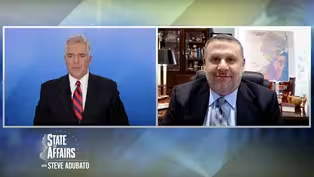
Editor of NJ Globe Gives Insight on NJ's New Ballot Design
Video has Closed Captions
Clip: S8 Ep8 | 12m 36s | Editor of NJ Globe Gives Insight on NJ's New Ballot Design (12m 36s)
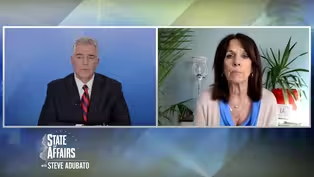
Substance Abuse Disorders & Dangers of Synthetic Fentanyl
Video has Closed Captions
Clip: S8 Ep8 | 14m 55s | Substance Abuse Disorders & Dangers of Synthetic Fentanyl (14m 55s)
Providing Support for PBS.org
Learn Moreabout PBS online sponsorship
- News and Public Affairs

Top journalists deliver compelling original analysis of the hour's headlines.

- News and Public Affairs

FRONTLINE is investigative journalism that questions, explains and changes our world.












Support for PBS provided by:
State of Affairs with Steve Adubato is a local public television program presented by NJ PBS