
Roe v. Wade, Patrick Lyoya Police Reform, AAPI Story Series
Season 6 Episode 28 | 26m 46sVideo has Closed Captions
Overturning Roe v. Wade, Patrick Lyoya & police reform, and One Detroit's AAPI stories.
One Detroit's Bill Kubota talks with University of Michigan Law Professor Barbara McQuade about the leaked draft opinion from the U.S. Supreme Court on the possible overturning of Roe v. Wade. Then, a roundtable talking about the death of Patrick Lyoya and police reform. Plus, for AAPI Heritage Month, a look back at One Detroit and WDET's AAPI Story Series with Chien-An and Jon.
Problems playing video? | Closed Captioning Feedback
Problems playing video? | Closed Captioning Feedback
One Detroit is a local public television program presented by Detroit PBS
Roe v. Wade, Patrick Lyoya Police Reform, AAPI Story Series
Season 6 Episode 28 | 26m 46sVideo has Closed Captions
One Detroit's Bill Kubota talks with University of Michigan Law Professor Barbara McQuade about the leaked draft opinion from the U.S. Supreme Court on the possible overturning of Roe v. Wade. Then, a roundtable talking about the death of Patrick Lyoya and police reform. Plus, for AAPI Heritage Month, a look back at One Detroit and WDET's AAPI Story Series with Chien-An and Jon.
Problems playing video? | Closed Captioning Feedback
How to Watch One Detroit
One Detroit is available to stream on pbs.org and the free PBS App, available on iPhone, Apple TV, Android TV, Android smartphones, Amazon Fire TV, Amazon Fire Tablet, Roku, Samsung Smart TV, and Vizio.
Providing Support for PBS.org
Learn Moreabout PBS online sponsorship- [Host] Just ahead on "One Detroit", University of Michigan Law Professor, Barbara McQuade, weighs in on the controversial US Supreme Court draft opinion that could overturn Roe v. Wade.
Plus, the President of the Greater Grand Rapids NAACP, and Co-founder of Black Lives Matter Detroit, talk about police reform and race relations after the fatal shooting of Patrick Lyoya by a police officer.
And we'll continue our recognition of Asian-American and Pacific Islander Heritage Month with a conversation about systemic racism after the murder of George Floyd.
It's all coming up next on "One Detroit".
- [Voiceover] From Delta faucets, to Behr paint, Masco Corporation is proud to deliver products that enhance the way consumers all over the world experience and enjoy their living spaces.
Masco, serving Michigan communities since 1929.
Support for this program is provided by the Cynthia & Edsel Ford Fund for Journalism at Detroit Public TV.
The Kresge Foundation.
- [Voiceover] The DTE Foundation is a proud sponsor of Detroit Public TV.
Among the state's largest foundations committed to Michigan focused giving, we support organizations that are doing exceptional work in our state.
Visit DTEfoundation.com to learn more.
- [Voiceover] Nissan foundation.
And viewers like you.
(mellow music) - [Host] Just ahead on this week's "One Detroit", George Floyd's murder at the hands of a police officer led to protests and conversation about law enforcement's interaction with people of color.
We'll hear from an Asian-American about this nation's troubled history of racism, as we continue our series of AAPI stories.
Plus, we'll talk about police reform and race relations in West Michigan, following the fatal shooting of an unarmed Black man by a white police officer in Grand Rapids.
"American Black Journal" sits down with the President of the Greater Grand Rapids NAACP, and the Co-founder of Black Lives Matter Detroit.
But first up, the investigation continues into who leaked a US Supreme Court draft opinion, suggesting Roe v. Wade could be overturned later this year.
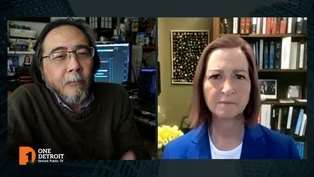
"One Detroit" Senior Producer, Bill Kubota, spoke with University of Michigan Law Professor, Barbara McQuade, about the security breach.
And what could happen in Michigan if the landmark 1973 Court decision, granting federal protection of abortion rights, is struck down.
(mellow music) - Barbara McQuade, Professor of Law, University of Michigan, former US Attorney for Michigan, thanks for talking to "One Detroit".
- Oh, you bet, Bill, thanks for having me.
- We're talking the latest about abortion, the draft opinion regarding the overturning of Roe versus Wade, being leaked.
"Leak", is that a common thing, and why would that happen?
- Well, first I think the substance of the opinion is the big news here, that there is this seismic shift, apparently, coming in reproductive rights in America.
But the leak is highly unusual.
You know, historically there have been some verbal leaks, of the way the court was going to be making a decision, or that somebody wouldn't be joining the majority.
But this is the first time ever, that an entire draft opinion, in hard copy, has been linked to reporters.
And I think it is a very significant matter, I think will tend to undermine the public confidence in the Supreme Court.
It tends to show that there is less internal respect than I think we had previously thought.
I think there are theories that conservatives wanted to do this to lock-in those votes, or liberals wanted to do this to generate outrage, and create public pressure to change.
But I think that you have to also expand the scope, to think about who had access to this.
Could it have been someone working from home, where a friend, or family member, or a household worker got ahold of it?
Could it have been obtained in a hack?
I mean, hostile foreign adversaries love to find wedge issues in America, and exploit people, you know?
The stealing of emails and other kinds of things.
So I think that we should not make any assumptions about who might have leaked it.
- How soon do you think we'll see an actual ruling?
- Typically, in these very significant cases, they come out very late in the Supreme Court's term, and that's because they are exchanging these drafts.
This looks to be a first draft, some of the language is quite strong.
And what often happens is, as it gets circulated, either votes change, or some Justices want certain language removed, or certain language inserted, and it often gets a little softer.
Some of those hard edges get rubbed off.
And so typically the court ends its term in late June.
Sometimes it's spilled even into July, just to get... give them sufficient time to exchange those drafts and get the final version out the door.
- [Bill] Legal folks say the Supreme Court will allow states to make any law they want, regarding abortion.
In Michigan, it gets a little complicated.
You've had an abortion law on the book since 1931, lying dormant since the Roe decision.
And then here in Michigan, you're looking at a, what we'd almost consider, an ancient law that might take effect, talk about that.
- Yes, so there are two types of laws that are already on the books.
One are what are called "trigger laws", about 13 states have those.
And those laws were passed after 1973 that say, "If Roe is ever overturned, these laws will go in place," and they ban abortion.
Michigan has a different category of laws, about a dozen states have these, and they're sometimes being referred to now as "zombie laws".
That is, they're ancient, as you say, but they're coming back from the dead.
They were on the books at the time Roe was decided in 1973, but they became moot once that decision was made, because it said that they were no longer good law.
So they've lingered there on the books all this time.
And if and when this decision becomes final, and Roe is overturned, then those laws will revert back.
So Michigan, we have one, it's a 1931 law that makes it a felony for a provider, a healthcare provider, to perform an abortion.
Now what's interesting about Michigan's law is the language of the statute is a little dated.
It talks about things like causing a miscarriage, which isn't exactly what happens in all abortion cases.
And so it may be that there are problems with that statute, it may be unconstitutionally vague.
And in fact, governor, Governor Whitmer, has already filed a lawsuit, saying that that statute violates the Michigan Constitution, under the due process clause, and the equal protection clause, of the Michigan Constitution.
- So that's before the State Supreme Court, is that the case?
So we have another Supreme Court that's going potentially affect all of this.
- Yes, you know, I think one thing that's important to understand is that all of us are protected by the US Constitution.
That is, you know, the safety net that protects us from either federal or state laws that might overreach and violate our constitutional rights.
But every state also has its own constitution, and that state can create even more protections than the federal constitution, or different protections.
And so in Michigan, we have a very different document.
And what's interesting about Michigan's Constitution is it was enacted in 1963, which is after this 1931 statute.
And so it is quite possible that it wasn't contemplating... You know, the people who wrote the statute were certainly not contemplating this constitution when they enacted the bill.
There are other state constitutions, including California, that protect, explicitly protect, the right to an abortion.
- [Bill] There are concerns the Supreme Court could put other rights at risk, rights not explicitly written into constitution, but accepted now.
Think birth control, or interracial marriage, things connected to the Roe decision.
- And so what Roe held is that there is this right of privacy that's not explicitly included in the constitution, but it is presumed.
There's a 9th Amendment Provision that says, "Rights that are not enumerated are reserved for the people."
And so Roe was based on that concept.
But since that time, the court has also used that same reasoning to find privacy rights that extend to, the right to contraceptives, the right to interracial marriage, the right to same sex marriage.
And so if you take away that grounding of that right to privacy, then all of those other things are built on a shaky foundation, and might fall as well.
- Are you concerned that that might actually happen?
- I think that it's difficult to say.
You know, the courts only decide cases that are in front of them.
And this draft, written by Justice Sam Alito, he does address these things, and say, "These things are different, we're not deciding those things today."
But that will later be dismissed to people as mere dicta, which is language in the speech, in the case, that's not controlling.
And so I'm sure we will get those challenges, I'm sure we will find states that want to pass those laws.
You know, we have some very aggressive, conservative lawmakers, and states like Florida and Texas, who are looking to make a name for themselves in conservative political circles.
And so, you know, enacting a law on those bases will work its way through the courts.
And, you know, I'm sure they would be challenged, and then we would find out.
- Well, I suspect we'll wanna check in with you again, as these things move along.
Barbara McQuade, Law Professor at the University of Michigan.
Thanks for talking to "One Detroit".
- Thank you, Bill.
- [Host] The Michigan State Police has submitted its investigative report into the fatal police shooting of Patrick Lyoya to the Kent County prosecutor.
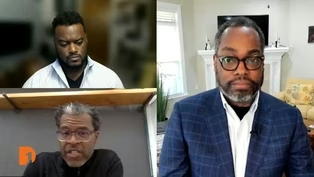
The office is now waiting on forensic reports from Officer Christopher Schurr's taser and body camera, before making a decision on whether to file criminal charges, "American Black Journal", Stephen Henderson, talked with Greater Grand Rapids NAACP President, Cle Jackson, and Black Lives Matter Detroit Co-founder, John Sloan III, about this latest deadly shooting of an unarmed Black man.
(mellow music) - Give us a sense of the way this feels, I guess, in the African American community in Grand Rapids right now.
We are still waiting to know much more about the consequences of what happened.
But what did happen, I think, not only shocks that community, but also reminds of such a long narrative of tension between the police department there and African Americans.
- The community is, of course, outraged, right?
The emotions are very high here, and they're... they have been.
And I should say, we have been, I think, patiently waiting for some answers.
So we're continuing to move forward, continuing to keep Patrick's name in the spotlight, continuing to support his family as best as we can.
And so we'll see.
And as you said, you know, this is a situation that we have been, in America, have been dealing with for years and years and years and years.
And it has to stop, at some point, it really has to stop.
We have to stop automatically being criminalized by local law enforcement agents across this country.
We have to stop being demonized by white America, and things have to change.
- I wonder if you can talk about for, you know, our viewers here in Detroit, I guess the differences between what it's like to be African American in a place like Grand Rapids in Michigan, a smaller city with a smaller African American population, than in some place like Detroit, where of course, we are the overwhelming majority.
- Well, I think there's a big difference, as you guys know, there's a... this is West Michigan.
You know, a lot of folks, they use this term here, we play west Michigan knives, right?
So what that means is that the drapings on the window are often not opened.
And so what happened during the pandemic, during the COVID-19 pandemic back in 2020, all of the curtains were pulled off the window, right?
And honestly, even the windows were broken out and busted, I'll just say that.
And what happened with that is it showed the gross disparities that exist here in West Michigan, not even from just a criminal justice lens, but also from a healthcare lens, from a economic lens, from a education lens, from a youth engagement and involvement lens.
And so the list goes on and on and on.
- I think what we saw with Patrick's murder... and I wanna...
I'm always gonna be clear about calling it a murder, and not a death or a killing, right?
Because that was intentional homicide.
There were so many opportunities for deescalation.
There were so many opportunities for that situation to go differently.
And so every time I hear somebody say, "Well, we just need to reform the police, if we give them more training and deescalation, then they'll be able to better handle situations like this."
This is one clear example about how that training doesn't work, right?
And so when we talked, one of the times that we spoke during the summer of 2020, when we were seeing protests all across Detroit, across the state, all across the country.
One of the things that we talked about, and that I hoped would happen and did, to a large extent, was that those protests created pressure on officials.
They allowed us to leverage that pressure into political engagement.
The problem is that there is such force, and when I say "force", I mean, political will, but also money, dollars, behind the opposition to those things.
I'm gonna point very clearly to Proposal P as an example.
So you saw the process for Proposal P, and the remaking of Detroit City Charter, start years earlier, right, as something that is part of how our system is supposed to work.
We, as the residents of the city, are supposed to have an opportunity to weigh-in about how our city is being run, and being governed.
The aftermath of the summer of '20, and George Floyd, Breonna Taylor, and the innumerable other names that we can't mention, a lot of citizens, including myself, and other residents of the city, got together and put forth up amendments for the City Charter, right?
Completely remaking the way the Board of Police Commissioners was structured, completely separating the Board of Police Commissioners from DPD, putting in mechanisms to give more teeth to how discipline could be meted out to agents of law enforcement agencies.
As well as a myriad of other things, participatory budgeting, like a lot of other things that were in there.
And we saw proposal P go down, unfortunately, as drastically as it did, because there was so much money that was put into the opposition, you couldn't drive anywhere...
I couldn't watch ESPN Monday Night Football, Hulu, anything, without seeing P as a problem.
And so what we're seeing is that, as much as we, as Black folk, might wanna disengage, as much as me, as we as Black folk, might wanna say, "Oh, I'm gonna step away from this problem," we can't step away from the problem, because the problem seeks us out, right?
This system of policing is not broken, it's doing exactly what it was designed to do.
It's upholding a social structure, it's upholding a social hierarchy, and it's criminalizing folk, that those that have power, wanna make sure stay without, right?
So the more that we can frame this conversation less around, "Let's fix a broken system," the more that we can frame this conversation less around, "Well, we just need to get the police to do X, Y, and Z."
And the more that we can take advantage of this opportunity, in so far as it's a horrible and unfortunate event, but leveraging this moment to be able to get legislative action, sustainable change, and progress through.
If we can't do that during moments like this, during moments like George Floyd's death, then the further away we get.
We've seen with our society, the further away in the rear view mirror, this event becomes, right, the less leverage we're going to have on our elected officials.
And the unfortunate reality of it is, for those of us who did not know Patrick, for those of us that aren't members of his family, we have the privilege of being able to put this in the rear view; they don't.
They're gonna have to live this every day for the rest of their lives.
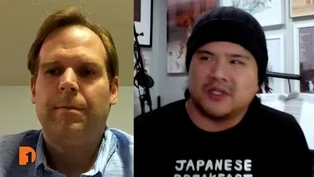
- [Host] Throughout the year, Detroit Public Television and WDET Radio are highlighting the contributions and challenges of Asian Americans, with a series of conversations between family and friends.
In today's AAPI story, longtime friends, Chen-an Yuan and Jon Eaton, came together for a frank conversation about systemic racism in this country, following the murder of George Floyd.
(mellow music) - I mean, we started just by trying to get through this, right, talking about pop culture, music, movies, people, all kinds of different things.
And then, you know, it was mostly lighthearted.
And then I think it started getting more like, serious in the racial component, I would say around last June.
- It was pretty therapeutic for us to connect and talk about what was happening just with COVID, from the onset.
And then when George Floyd happened, I think it was one of those moments where it was difficult for both of us to process.
Because I think for the first time, there was a moment where the entire world had stopped, then this video was released.
And I think it was just...
I think for anyone who lives in this country, it was like a reckoning for us, for how... to understand kind of how we were raised to believe the police functions.
And have that come into conflict with the obvious history of systemic, you know, racism that has happened, you know, that is prevalent in so many... you know, so much of law enforcement.
You know, coming from a family where my grandfather was a Chief of Police in Taiwan, that I was always raised to hold the police in high regard.
You know, and my dad was in the military.
But over the years, obviously, just growing up as a person of color in the United States.
And I think that's where our conversation started to really shift, that, you know, was because we were just... You know, it was like, I've had to reckon with this as a person of color, just to understand that, you know, things are very troubled.
You know, like the history of this country is very troubled.
And to confront that history, it's hard for anybody.
And I, you know... And then for us to start talking about it that night.
Yeah, it's like anger, confusion, we went through all the stages.
- You also helped me like, sort of translate it from like, a really, you know, a really bad like, news thing, you know, like an event, a really like, a tragic one, a really bad one.
And like, how someone I knew, that I didn't even really process how they could, but how you would view that, and how it could impact you differently than me.
And I think you shed a lot of light on that.
- We have never really talked about what it was like for me growing up in Bay, and all the, you know, the... Or, you know, just in Ohio, 'cause you know, once I moved to Ohio is when I first encountered like, actual, full-blown racism.
- Was that the first time, or like the most like, over time?
- No, first time was actually on a bus.
Some friends from Ann Arbor, that I went to elementary school with, were visiting.
And my brother and our friends were on this bus, and we took it downtown to...
I think to check out like a comic shop.
There were two kids got on, and they were both white.
But yeah, I was on the bus.
And so we're on the bus, and as the kids were getting up, this one kid got up, he like turned around and said, you know, like, "Get the (beep) off the bus, you (beep)."
And that's the first time my whole life.
And I was 11, and I was angry.
And my brother and I, and our friends, we were not raised to be quiet.
So, you know, we said some... we talked back just like...
But you know, because my brother, being the wise person he is, he didn't like, say anything.
He was just like, "You should be ashamed."
You know, he was just being... "You should be ashamed of yourself."
And I remember from that moment, you know, like his face was smug, but the fact that we were talking back kind of shocked him, because I think that's what so many racists count on, is that kind of, is the shock of the moment.
'Cause I was shocked, and I can remember that moment clear as day, but the moment actually that moment that sticks with me- - That's despicable.
It's that like, bully mentality, right?
- Yeah, it's like, the thing that sticks with me was his friend's face, because his friend sat there, and the kid who said the, you know, the... who did their racist verbal attack, got off the bus quickly, which is what always happens.
It's like, they never say anything and then wanna sit down and tell you, it's always like, you know, being a coward in the moment.
And I was like... You know, so he leaves his friend there, and his friend is...
I'll never forget the expression on his face, because he was embarrassed.
And I've always wondered what the rest of his day was like.
Guy who got off the bus, he sucks.
Like, you know, I have no confidence that he's become a worthy member of society.
(laughs) I really don't.
But I hope that moment was a learning experience for his friend, that it's like, if you're there, you're a part of it, you know?
And we were the only people on the bus, there's no one else on the bus, it was just these two kids and us.
- That's something I would hope and feel like, wouldn't hap... it's like, I don't wanna admit, like...
I wouldn't wanna admit that that could come out of someone's... but it does, it's just awful.
- But that's what I mean is like, without something like George Floyd, that there's, you know, there's no reason I would just, you know, oh, when we're eating wings at ABC, that I'm gonna start telling you guys about this.
- "Hey guys, let me tell you about this awful..." - Yeah, like, "Let me tell you about this horrible racist experience, this traumatic experience that happened to me."
Because in some ways the part that's frustrating is that when you are on the receiving end of a racist encounter, attack, whatever, it feels like it takes away your power, right?
Because like, in this moment, this kid just, you know, that he just absconded off the bus.
And then at OU I was eating at a Wendy's, and this kid said something, and then he, again, like ran, like basically ran out of the restaurant.
'Cause I like got up, and he like ran out of the restaurant.
So it's always this thing of like, they know in that moment, the shock feels like powerlessness, and it is like a vulnerability.
And that's why they do it though, you know?
Like that's why they do it, because it's like, confusion instantly, it's always like, "Is this actually happening?"
- You know, I don't think either of us is that confrontational, right?
And so if something... someone sends a comment or something, you might like take a minute to process like, "Wait, did that really happen?"
But I've never had anything like that even remotely happen.
To you, I could...
I mean, I can't even imagine.
- Yeah, but like in terms of talking about it, without something like...
I mean, unfortunately, without something like George Floyd, it is like sharing that experience is...
It's, no one likes to talk about when they felt attacked.
- [Host] For more conversations with members of Metro Detroit's Asian American Community, go to onedetroitpbs.org.
That will do it for this week's "One Detroit", thanks for watching.
Make sure to come back for "One Detroit Arts and Culture" on Mondays at 7:30 PM.
Head to the "One Detroit" website for all of the stories we're working on, follow us on social media, and sign up for our weekly newsletter.
- [Voiceover] From Delta faucets to Behr paint, Masco Corporation is proud to deliver products that enhance the way consumers all over the world experience and enjoy their living spaces.
Masco, serving Michigan communities since 1929.
Support for this program is provided by the Cynthia & Edsel Ford Fund for Journalism and Detroit Public TV.
The Kresge Foundation.
- [Voiceover] The DTE Foundation is a proud sponsor of Detroit Public TV.
Among the state's largest foundations committed to Michigan focused giving, we support organizations that are doing exceptional work in our state.
Visit DTEfoundation.com to learn more.
- [Voiceover] Nissan Foundation, and viewers like you.
(mellow music)
30-year Friendship Deepens After George Floyd Death
Video has Closed Captions
Clip: S6 Ep28 | 7m 48s | Friends Chien-An and Jon discuss deeper conversations after George Floyd's death. (7m 48s)
Patrick Lyoya and Police Reform Roundtable with NAACP, BLM
Video has Closed Captions
Clip: S6 Ep28 | 7m 12s | Stephen Henderson leads a roundtable about the death of Patrick Lyoya and police reform. (7m 12s)
Ramifications of Roe v. Wade Being Overturned in Michigan
Video has Closed Captions
Clip: S6 Ep28 | 7m 22s | Law Professor Barbara McQuade discusses the ramifications if Roe v. Wade is overturned. (7m 22s)
Providing Support for PBS.org
Learn Moreabout PBS online sponsorship
- News and Public Affairs

Top journalists deliver compelling original analysis of the hour's headlines.

- News and Public Affairs

FRONTLINE is investigative journalism that questions, explains and changes our world.












Support for PBS provided by:
One Detroit is a local public television program presented by Detroit PBS