
Ronald Weich; Nedia Morsy; Jacqui Tricarico
7/4/2026 | 27m 13sVideo has Closed Captions
Ronald Weich; Nedia Morsy; Jacqui Tricarico
Ronald Weich, Dean of Seton Hall University School of Law, examines federal checks and balances, political polarization, and how AI impacts the legal field. Nedia Morsy, Director of Make the Road NJ, speaks about advocating for NJs immigrant population. Senior Correspondent Jacqui Tricarico talks about the personal and professional fulfillment she's experienced in her journalism career.
Problems playing video? | Closed Captioning Feedback
Problems playing video? | Closed Captioning Feedback
Think Tank with Steve Adubato is a local public television program presented by NJ PBS
Ronald Weich; Nedia Morsy; Jacqui Tricarico
7/4/2026 | 27m 13sVideo has Closed Captions
Ronald Weich, Dean of Seton Hall University School of Law, examines federal checks and balances, political polarization, and how AI impacts the legal field. Nedia Morsy, Director of Make the Road NJ, speaks about advocating for NJs immigrant population. Senior Correspondent Jacqui Tricarico talks about the personal and professional fulfillment she's experienced in her journalism career.
Problems playing video? | Closed Captioning Feedback
Where to Watch Think Tank with Steve Adubato
Think Tank with Steve Adubato is available to stream on pbs.org and the PBS app.
Providing Support for PBS.org
Learn Moreabout PBS online sponsorship- [Narrator] Funding for this edition of Think Tank with Steve Adubato has been provided by The Fund for New Jersey.
The Turrell Fund, a foundation serving children.
The Burke Foundation The Adubado Center for Media Leadership.
Because media matters more than ever.
New Jersey Board of Public Utilities.
Providing New Jersey residents tools to save money on energy costs.
That’s what NJBPU does.
RWJBarnabas Health.
Learn More at RWJBH.org.
New Jersey Sharing Network.
Valley Bank.
And by NJ Transit.
Your ride to the world’s game.
Promotional support provided by NJBIA.
We put business at the center.
And by ROI-NJ.
Informing and connecting businesses in New Jersey.
[MOTIVATIONAL MUSIC] - Hey everyone, Steve Adubato.
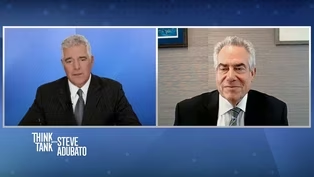
We kick off the program with Ronald Weich, who is Dean of the Seton Hall Law School.
Dean, good to see you.
- Thank you very much, Steve.
I'm glad to be with you.
- Do you also admit that in a former life you were Assistant Attorney General at the U.S.
Department of Justice?
Do you admit this?
- I do, sir, yes.
- Explain how that experience has informed your role as the Dean of the Law School.
- Well, I had a very interesting role.
I was the Assistant Attorney General for Legislative Affairs.
I was representing the Justice Department in Congress.
So I really saw our Constitution in action at the intersection of the branches of government.
And that informs what I'm trying to teach students.
And of course, I don't directly teach, I'm an administrator, but I have a role in shaping the curriculum and I want our students to understand how the Constitution is supposed to work.
And of course, separation of powers is the key to our Constitution.
And I saw that firsthand.
I had a really front row view of that when I was in the Justice Department in those years.
- Well, what would you say in terms of the degree to which the United States Congress, as the three equal branches last time I checked, the Constitution, the Executive, Judicial, and Legislative, from a legislative perspective, how would you rank and rate the United States Congress being a co-equal branch of government to create this balance of power?
- I have to say I am disturbed to see Congress not asserting its prerogatives.
And while I worked at the Justice Department for several years, before that, I spent about 14 years working in Congress for different senators.
And I saw how the Senate is supposed to work.
First of all, there should be more collegiality, there should be compromise, there should be legislation that emerges from those compromises.
And you don't see that happening in Congress today.
But the point you raised, Steve, is the Congress doing its role as a counterweight to the Executive.
And I think that's not happening in the way that it should.
I think there's an imbalance in our federal government right now that is unfortunate.
And we see an overextension of executive power because Congress hasn't checked it.
- I often ask this question, and people will say to me, "So Congress is loyal to the president, "could be this president, could be any president."
So they're loyal to the president.
And the president gets to pick or select, nominate people to the Supreme Court.
And if their party's in power, they pick the people they want and they support the president.
Someone says, "So why is that dangerous?
"Why is that dangerous for a representative democracy?"
They're just loyal to the person who's supportive of them, devil's advocate.
- Right, the framers of our Constitution didn't think we were going to have sort of two teams, a red team and a blue team.
- Yeah, one of my friends who went to your law school often, one of my closest friends says, "Steve, pick a side, which side are you on?
"You have to pick a side."
And I said, "Really, do we?"
What's the thing about sides?
- Yeah, it's just not supposed to be that way.
And it's dangerous because the parties are moving further away from each other.
We've lost a consensus about our national goals and values.
And as a result, they can't talk to each other anymore.
And so the majority party now, as you say, is loyal to the president, but they're not supposed to be teammates.
Congress is supposed to be representing the people and defending its institutional prerogatives and its role.
For example, it's Congress that's supposed to declare war.
And here we are in the middle of a war in Iran that is undeclared, and Congress is not taking the steps that it should take to oversee the actions of the military.
- By the way, we're taping at the end of April.
We hope that that conflict/war with Iran involving Israel and the United States and Iran is not going on, but we don't know what's gonna happen.
But I'm gonna play this out a little bit.
I mentioned my good friend who talks to me about sides and happened to come out of your law school, the great law school.
That, by the way, you didn't know this, Dean, I was accepted to Seton Hall Law School, went one day and decided, I don't know if I wanna be a lawyer.
Literally went the first day.
- You know, not everybody should be a lawyer.
First of all, we would have been delighted to have you as an alumnus.
- I would not have been a good lawyer, but that's okay.
- Look, it's not for everybody.
It's a rigorous program of education.
I think it's a great job.
I've enjoyed my time, my career as a lawyer, and plenty of happy students at Seton Hall.
But it's not for everybody, and there are so many other worthwhile professions, including journalism.
- The school's better off from me not being there.
But that being said, here's where I wanna go with this.
Your students today in the law school, how the heck, given as polarized as we are, as political people are convinced of the rightness, and I won't get on my soapbox here, but they're convinced they're right about the political ideology.
You're trying to teach them about the Constitution, the role of the other branches of government.
But they are ideologically locked into where they are.
Is it harder to teach students with that mentality?
And I don't wanna put everyone in one pile here, but you know where I'm going, right?
- I do, I do.
One thing about law school is part of the training is being able to represent both sides of a dispute.
And so that happens in our simulations, the moot court and trial advocacy program.
But then they see it in real life when they represent clients as part of the clinical program.
And they know that they have to be advocates for their side of a dispute, and that our adversarial system is meant to arrive at the truth.
So part of the training is helping students understand how to listen, and how to find common ground with the other side.
And, but it's tough, I mean, to your point, yes, in this current environment, it's a very tough time to teach law, but we're doing our best to making sure our students graduating from Seton Hall Law School understand how the constitution is supposed to work, how the legal system is supposed to work, and we're arming them to be effective participants in this system as they enter the profession.
- Before I let you go, I do a lot of leadership coaching in my other life at one of the major law firms in our state, and the issue of AI comes up a lot.
AI will not take the job of every great lawyer, correct?
- It will not, it will not.
Lawyers, you still need lawyers for the very human qualities of judgment and analysis.
AI is amazing, I'm using it, I'm sure many of your listeners are using it in different ways, and lawyers are using it, and we teach our students how to use it effectively and ethically.
But no, we're still gonna need lawyers, I'm happy to say.
- Ronald Weich, who is the Dean of Seton Hall Law School.
Dean, I cannot thank you enough, and I look forward to future conversations talking about the legal profession, the balance of power, the United States Constitution, and other pretty important issues.
Thank you, Dean.
- Thank you, Steve.
- We appreciate it.
Stay with us, we'll be right back.
- To watch more Think Tank with Steve Adubato, find us online and follow us on social media.
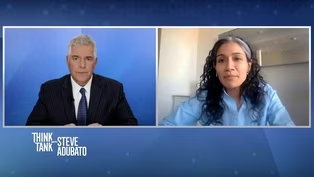
- We're now joined by Nedia Morsy, who's director of Make the Road New Jersey.
The website will be up.
Nedia, great to have you with us.
- Thank you so much for the invitation.
- You got it, tell us what the organization is.
- Yeah, so Make the Road is a member-led, grassroots organization with community centers at Elizabeth, Passaic, and Perth Amboy.
The mission is to win dignity and respect for immigrant communities through community organizing, through policy innovation, through transformative education, and we do that work day in and day out at our community centers.
We represent over 7,000 members, majority from Latin American countries, majority are working class people, but together, we have been able to deliver, you know, historic wins for immigrant families and all New Jerseyans across the state, including expanded access to drivers licenses, a $15 minimum wage that included teen workers, the strongest wage theft protections in the entire country.
And that work continues today.
- Nedia, what is the greatest concern you have about the federal government, particularly the federal government agency ICE and their, quote, "mass deportation" effort?
Be as specific as possible, please.
- Yes, I think it's helpful to start with some framing.
So New Jersey has more than two million immigrants.
One million of those New Jersey residents are naturalized citizens.
Half a million New Jersey residents are undocumented.
One in four New Jerseyans have an immigrant family member.
One in six New Jersey children have an immigrant parent.
And the sort of frame, for the moment, that we're in is New Jersey now has the most ICE detention beds on the entire East Coast.
We started the year in January 2025 with 360 beds.
We now have more than 2,000 beds, and we're projected to add an additional 1,500 with the- - Nedia, before you go any further, why is that significant?
- So, you know, the size of the- - That there are 2,000 beds.
Why is that relevant?
- Yes, so these are all privately-run detention centers.
And so, by their very nature, there is an incentive to fill in order to invoice, then to move people quickly, to then bring in more folks, right, 'cause you're turning a profit with however quickly you're turning people in and then turning them out so you can fill the beds again.
So a high concern, right, especially now that we have, you know, ICE agents that have quotas, they have deliverables in order for them to maintain their own work and their own livelihood.
And as a result of that, in the last year in New Jersey, immigration arrests have gone up 400%.
And our state infrastructure is only able to provide representation to 18% of detainees currently.
And we have seen further economic ramifications of detention.
So, you know, in 2021, eviction filings were 44,000.
In 2025, estimates from DCA suggest that, you know, it will be more than, it was more than 100,000.
- Yeah, but Nedia, I know there's a lot of numbers here by the DCA, a lot of jargon here, I believe the Department of Community Affairs, if I'm not mistaken.
But here's a question a lot of people are asking (coughing) wondering right now.
People can question ICE's tactics, how they approach this deportation effort.
When you said New Jersey has an estimated, how many people here who are undocumented?
Is it half a million?
- Half a million, likely more.
- Say someone says, "Look", and you've heard this a million times, but let's try it again.
All the federal government is doing, all the Trump administration is doing through ICE is trying to get those who are undocumented out of the country.
Your response to that?
- I think two things.
The first is the federal government is undermining due process rights and they're undermining the Constitution.
- How?
- What we've seen is that there have been detentions of U.S.
citizens, of folks that are in court proceedings, and so you're seeing hypocrisy in two forms.
The first is people are going to their ICE check-ins, right?
Part of their process as they're pursuing a pathway citizenship.
When they enter the courthouse, the judge is saying that they are not interested in pursuing any action against this person.
And then, when they exit the courthouse, they're being detained by ICE.
And so, in a matter of a couple of square feet, you're watching the hypocrisy of this administration.
Secondly, because so many people are being unlawfully detained, legal providers are not able to file habeas filings as quickly as they can be.
And then, the other piece of this is we can't forget the profit that is being made.
So there's profit being made by putting people in detention centers.
You know, we have sort of created, the administration has come up with a new way to revive Jim Crow, right?
You're moving people in detentions, you're turning a profit, you perhaps have them working and making materials in the detention center and then invoicing again.
And then, we're conducting surveillance on these people.
And I think the thing to remember is the undermining of due process, the mass surveillance is something that is coming for all of us, and not just immigrants.
It's being tested on immigrants, but it is much more expansive.
- So let me try this.
The term data mining is being thrown around a lot.
What exactly is data mining?
And why is it relevant to the issue of the federal government engaged in this mass deportation of those who are here illegally?
And again, I'm not gonna play word games, undocumented, if you are here illegally.
My grandparents came here from Italy.
They went through the process, and I know it's not the same time, I get it, but that means you're here illegally.
It's not a felony, but you're here illegally.
Question, what the heck is data mining?
And what does that have to do with the feds in this deportation effort?
- Yeah, I think, just to your first point, right?
The Trump administration has terminated immigration relief programs.
So you have folks who are here on TPS, who have had that for 20 years.
- There's a lot of jargon.
Not everyone knows what those acronyms mean.
TPS, temporary?
- Temporary protected status.
- Got it.
- You have folks that have, you know, received deferred action.
You have folks that have relief programs.
And in this last year, the Trump administration has eliminated those programs.
- Because?
Because?
- Because he has decided that he wants to terminate it.
And again, you know, these are folks who have already offered all of their information to the United States government.
And again, it's so important to remember very often we talk about tax the rich campaigns and it can sort of seem isolated, but these are not isolated events.
We are using immigration in order to turn massive profits.
- What's data mining?
I get that point, what's data mining?
- So data mining, and Palantir is a perfect example of this, where you have now corporations that are taking massive data sets, right, so culling personal and private information, and then turning that into surveillance equipment, right?
Because, otherwise, you're just collecting all this data, but you're not able to use it into, you know, move it into a way that people can use.
So for example, Palantir is a tech backbone of ICE.
So basically, they've created what it's called the Elite app.
The Elite app is the application that ICE agents use when they're conducting foot patrol.
And so it essentially looks like a Google Maps and has confidence scores on people based on data that's been culled- - That's a lot, I appreciate it.
We're so deep into the weeds.
What is the bottom line?
- I think the issue is that all this data mining, you know, it's not being sectioned out, siphoned off, for immigrants or (indistinct) immigrants.
They're collecting the data on all of us.
They are using this, right, and the federal government uses it for tracking and for surveillance, but that will continue.
The populations that they use a surveillance on will continue to expand unless we draw- - And that's dangerous?
- That's incredibly dangerous.
I mean, you see it in sort of light ways, right?
Where your data is collected and data is mined so that, you know, they can entice you to buy this soap or this shampoo.
But, you know, we've also seen how it's been used harmfully, right?
Where people have been taken off the street and they've been confused for other people.
And that work will continue.
And people have a right to privacy.
All people have a right to privacy.
- Whether they're documented or not?
- Whether they're documented or not.
- Nedia, let's agree this is complex, multifaceted.
People need to better understand it.
We appreciate you joining us, and we'll have you back as this, by the way, 2026 election may impact what moves forward or doesn't move forward in the federal government in terms of immigration policy.
But Nedia leads the organization called Make the Road New Jersey, and we'll continue the conversation.
Nedia, thank you so much.
- Thank you for the time.
- You got it.
Stay with us, we'll be right back.
- To watch more Think Tank with Steve Adubato, find us online and follow us on social media.
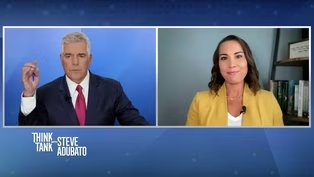
- Hey, folks, that's Jacqui Tricarico.
Jacqui is Senior Correspondent for "One-on-One."
She's executive producer of "Think Tank."
She's also the executive producer and co-anchor of "Remember Them," our series.
Jacqui, how you doing?
- Doing great, Steve.
Happy to be here with you today.
- You got it.
Hey, this is part of a series we're doing called "Media Matters" on media leaders, media leadership, done in cooperation with the newly-established Adubato Center for Media Leadership.
Why does all that matter?
Because Jacqui Tricarico, I first met you at Montclair State University.
I was teaching a course in journalism and media.
You were not Jacqui Tricarico then, were you?
- (chuckles) No, Jacqui Cooke back then.
(laughs) - What you studied, along with the other Jackie, Jackie Heyer, who was not Jackie Heyer then, Jackie Velez.
Quick question.
What you studied in media journalism, at the time, compared to what being in media is today, two different worlds?
- Definitely, and it's hard to even think back to that time.
It feels so long ago that I was sitting in the classroom there, at Montclair State, introduced to you and it was- - Was that like 15, 16 years ago or do I have that wrong?
- A little bit longer than that.
(laughs) - I'd say more.
Longer than that?
- We're not saying how old we are, Steve.
- Okay, go ahead.
- But sitting in that classroom, learning from so many different professors, and then visiting professors like yourself, nothing really prepares you for the job until you're in it and you're doing it.
And I've had the privilege of doing this with you for over 15 years now, Steve.
And my role here in the organization has shifted and evolved so much over the years.
And I've had such a great opportunity to be able to do so much behind the scenes, but also now so much in front of the camera, which really means so much to me on so many different levels because when people ask me what I do and what our organization is all about, it's hard to explain it all 'cause I wear a lot of hats here.
We do a lot of different things, but at the core of it, I say we really offer reliable, important, trustworthy information to people across the state and across the tri-state area that might not impact you, which a lot of it does impact you, the viewer, but impacts your neighbors, and just information that you need to know and is important for you to know about what's going on around you.
And I always say me being in front of the camera, when I'm interviewing people, it's not about me whatsoever.
I'm just a vessel.
I'm there to help facilitate a conversation, to help that person on the other end deliver their message and get the important information out that our viewers need to know.
- And it's very well said, Jacqui.
And Jacqui is one of the few people who was a behind-the-scenes, was and is, a behind-the-scenes senior and then executive producer who also happens to have exceptional on-camera skills.
But this is what's fascinating to me.
That one of the things about you, which is tied to media leadership, and you know this well, newspapers folding, media organizations struggling, our partners in public broadcasting from a financial point of view, we know about public funding, about public media, all that.
Why is this relevant?
Jacqui, did you ever think when you were a student studying journalism and media with me and other much better professors at the university, did you ever think that you'd have to be that aware of the economics and the business of- - No, I mean, not really.
(laughs) Because we- - Not really, and even- - That wasn't in the curriculum.
- No, not so much.
And even looking back, even two years ago, yeah, we're being a nonprofit, right?
The people who are supporting us, the organizations and corporations who are supporting us is the backbone of our organization.
It's really important for us.
But even just in the last two years, and even, we're coming up on a year that public broadcasting was defunded, federal government is no longer funding PBS stations and NPR and it's just- - Through the Corporation of Public Broadcasting.
But go ahead.
- Exactly, that's gone.
That's gone.
Right?
- Yep, doesn't exist.
- So there's just this huge shift in public media right now.
And as much as it's been really hard on so many organizations, especially small organizations and people delivering news in news deserts across the state and across the country, it's opening up an opportunity to really look at how we can evolve and change the way public broadcasting is delivered and how we're able to get the support that is needed.
I just saw NPR just said and released a statement a few days ago, actually, about the fact that they were able to raise $113 million recently in philanthropic gifts to help continue NPR because, of course, they were really impacted by all of this too.
And which is a huge statement to saying people know this matters.
This needs to be funded.
We need to support this.
So I'm hoping that helps continue the conversation and continue to move in the right path to support public broadcasting across the spectrum, across New Jersey, across the nation.
But there's a lot of shifting, a lot of things that are going to continue to change, going into the summer here in New Jersey, especially.
- But here's the funny, interesting thing about this, really interesting, is that Jacqui and, by the way, many of our producers and leaders in our organization come out of Montclair State University, and I'm an alum at MSU as well.
We have a long history with them as well.
What's fascinating to me is that the media leaders of tomorrow, and that's why we established this Center for Media Leadership.
If the media leaders of tomorrow, and I won't get on my soapbox, but Jacqui knows this is true.
If they only say, "I just wanna be involved in journalism and I don't wanna know about the business.
I don't care about the economics.
That's not my thing.
The old expression, no money, no mission, is relevant here.
I don't love raising money.
Jacqui doesn't love being involved in it.
But the last time I checked, if we don't work at that as hard as we do, you can't do this.
You just can't.
- Exactly, it's- - Final words, Jacqui, go ahead.
- I mean, the reason the money- - Do you have any regrets going into media?
- No, definitely not.
I love what I do.
- With all the challenges?
- No, I love what I do.
I'm passionate about it.
When I am interviewing someone that their story is so impactful and they're doing something that's really, truly, we throw the phrase around, making a difference, a lot.
- That's right.
- But they're truly doing things in their communities to try to make a difference.
There's so much bad going on in the world around us.
There really is.
And now that we have access to nonstop news cycles and social media and all these things feeding us all the worst things that are happening around us, to be able to use our platform, Steve, to showcase people who are actually making a difference and doing things in their communities that we can look up to as role models is really something that I love so much about this job.
- Jacqui Tricarico makes a difference every day as a media leader.
I'm Steve Adubato, that's Jacqui Tricarico.
I'm predicting she has a very bright future in this business.
We'll see you next time.
- [Narrator] Think Tank with Steve Adubato is a production of the Caucus Educational Corporation.
Funding has been provided by The Fund for New Jersey.
The Turrell Fund, a foundation serving children.
The Burke Foundation The Adubado Center for Media Leadership.
New Jersey Board of Public Utilities.
RWJBarnabas Health.
Learn More at RWJBH.org.
New Jersey Sharing Network.
Valley Bank.
And by NJ Transit.
Promotional support provided by NJBIA.
And by ROI-NJ.
- Next, please.
Okay, we need a neutral expression.
Sir, you're smiling.
- Oh, am I?
- [Narrator] Over 1 million lives in the US have been saved by organ donations.
So when you choose to become a donor, you're doing something good, which can make you feel really good.
- Next.
(woman sighs) - [Narrator] Register today at NJSN.org.
 New
NewAdvocating for New Jersey's vulnerable immigrant population
Video has Closed Captions
Advocating for New Jersey's vulnerable immigrant population (10m 40s)
 New
NewHow politics, polarizaiton, and AI impacts the legal field
Video has Closed Captions
How politics, polarizaiton, and AI impacts the legal field (8m 30s)
 New
NewNavigating an evolving media landscape as a journalist today
Video has Closed Captions
Navigating an evolving media landscape as a journalist today (8m 41s)
Providing Support for PBS.org
Learn Moreabout PBS online sponsorship New Episode
- News and Public Affairs

Top journalists deliver compelling original analysis of the hour's headlines.

- News and Public Affairs

Today's top journalists discuss Washington's current political events and public affairs.




 New Episode





 New Episode
Support for PBS provided by:
Think Tank with Steve Adubato is a local public television program presented by NJ PBS