One-on-One
Rosie Grant; Rev. Forrest Pritchett; Richard & Donald Heddy
Season 2021 Episode 2438 | 27m 8sVideo has Closed Captions
Rosie Grant; Rev. Forrest Pritchett; Richard & Donald Heddy
Rosie Grant discusses the importance of encouraging parents to interact more with their children; Rev. Dr. Forrest Pritchett talks about African American leaders in history who made a lasting impact on New Jersey and the nation; Donald Heddy and Richard Heddy share the ways they helped each other overcome their personal battles with COVID-19 and Colorectal Cancer.
Problems playing video? | Closed Captioning Feedback
Problems playing video? | Closed Captioning Feedback
One-on-One is a local public television program presented by NJ PBS
One-on-One
Rosie Grant; Rev. Forrest Pritchett; Richard & Donald Heddy
Season 2021 Episode 2438 | 27m 8sVideo has Closed Captions
Rosie Grant discusses the importance of encouraging parents to interact more with their children; Rev. Dr. Forrest Pritchett talks about African American leaders in history who made a lasting impact on New Jersey and the nation; Donald Heddy and Richard Heddy share the ways they helped each other overcome their personal battles with COVID-19 and Colorectal Cancer.
Problems playing video? | Closed Captioning Feedback
How to Watch One-on-One
One-on-One is available to stream on pbs.org and the free PBS App, available on iPhone, Apple TV, Android TV, Android smartphones, Amazon Fire TV, Amazon Fire Tablet, Roku, Samsung Smart TV, and Vizio.
Providing Support for PBS.org
Learn Moreabout PBS online sponsorship- [Narrator] Funding for this edition of One-On-One with Steve Adubato has been provided by PSE&G, committed to providing safe, reliable energy now and in the future.
The Turrell Fund, supporting Reimagine Childcare.
PNC, Grow Up Great.
New Jersey Sharing Network.
The Healthcare Foundation of New Jersey.
Summit Health a provider of primary, specialty, and urgent care.
Horizon Blue Cross Blue Shield of New Jersey.
Here when you need us most, now and always.
United Airlines.
And by The Russell Berrie Foundation.
Making a difference.
Promotional support provided by NJBIZ, providing business news for New Jersey for more than 30 years, online, in print, and in person.
And by New Jersey Family A resource for New Jersey parents.
- This is One-On-One.
- I'm an equal American just like you are.
- The jobs of tomorrow are not the jobs of yesterday.
- Look at this.
You get this?
- Life without dance is boring.
- I don't care how good you are or how good you think you are, there is always something to learn.
- Do you enjoy talking politics?
- No.
- People call me 'cause they feel nobody's paying attention.
- Our culture, I don't think has ever been tested in the way it's being tested right now.
- That's a good question, high five.
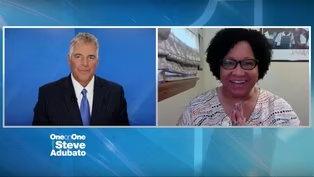
(upbeat music) - Hi, I'm Steve Adubato and it is my honor and pleasure to introduce for the first time with us it will not be the last, she is Rosie Grant.
Executive Director of a compelling important organization called the Paterson education fund.
Ms. Grant, how are you?
- I'm doing well.
Thank you.
Thank you for having me here this morning.
- Great to have you.
By the way, for those who don't know the Paterson education fund what is it and why does it matter now?
More than ever as we enter the summer of 2021.
- Our mission is to stimulate community action for change so that Paterson public schools insure that all children are educated to high standards.
It's a powerful mission.
And it's a lot of work.
We do it by engaging the community and by engaging with the district and the schools.
So we try to get education on everybody's agenda.
As we do our work.
- Ms. Grant let me ask you this and the research, getting ready for this, we talked to our friends at the Turrell Fund about this.
A big focus of yours is getting children, 0 to 3, ready for kindergarten.
So many children, particularly in urban areas, underserved communities their vocabulary is not where it needs to be.
They're way behind.
And you have an initiative called talk, read, sing.
What is that?
And how does that connect to helping our youngest children get prepared for kindergarten and life?
- Sure.
We realized that we have to start early if we want to get them ready by the end of 12th grade.
And particularly if we want to get them reading on grade level by the end of the third grade, so that they can then read to learn.
Talk, read, sing is an initiative of the Clinton foundation.
And we found out about it through our partners as a grade level reading campaign.
And it's an initiative to bring resources, tools, and tips to parents of the very young children, 0 to 3 so that they're talking more with their kids they're singing with their kids and they're reading with their kids and these interactions in any language help with brain development and language acquisition.
So we were very fortunate to be able to launch that program as we went into the pandemic shutdown last year because it gave parents at home with their kids these tools to help them with this development.
- Ms Grant, What was the response to the program?
Meaning how, what kind of people, how many people took to and said, Hey, we're going to be involved.
We're going to do this.
- The response was surprising in a wonderful way.
We wanted to train 20 people in the community as trusted messengers to bring the messages and the tote bags and tips to the parents.
We advertise to our partners and we ended up training 72 people as trusted messengers.
And these 72 people brought the back tote bags and tools and so on to the parents to just about 700 parents now.
And we're in a second round, we keep going we started posting tips on our website, our Facebook page about how to use these tools and how to remain engaged and our usage or hit viewership I guess, went up from about an average of 400 to 14,000.
So it told us that the parents were welcoming these tips and tools, and were hopefully practicing them at home but there are certainly looking for them.
- Ms. Grant, you know, that we're involved in an initiative.
It's three years, I believe now, potentially going into the fourth, it's called Reimagine Childcare.
It's about creating greater public awareness around the need for quality affordable, accessible childcare.
The work that your organization is doing as it relates to re-imagining childcare and having it be what it needs to be in these very difficult times.
- Childcare, is more than babysitting, right?
Whether you're the parent or you're in a daycare center or some other situation, we want people in childcare to engage with the kids.
You've mentioned the vocabulary difference.
Earlier as we start, we want our kids to have this vocabulary to be ready to learn when they go into preschool.
So yes, we do need to re-imagine childcare.
It's not, it's, it's important that it's about their wellbeing.
Yes.
Their physical wellbeing.
But it's also important that we're doing these things to develop them.
And so that they're ready to learn.
- But, before I let you go, Ms. Grant, give some advice to parents right now.
I mean, our daughter is 10 and I try to read to her and she's like, dad are you serious?
Like, I don't need you to read to me but I remember doing it and not enough when she was of this, the age you're talking about, give some advice to parents who have children at that age, as it relates to reading to them, talking to them, singing to them particularly the reading and vocabulary literacy part.
- Read to them all the time.
My kids, I read, I think about 13.
They had had enough, but they're both readers.
(laughing) But always read to them, let them choose the books.
Let them talk about what they're hearing in the story.
You know, use their imagination pull on their creativity.
They have so much of it to give at that age and then sing and talk about commonplace things with the little ones.
When they're eating, let's talk about food.
What is this?
Oh my gosh, look, they have mango!
You love mango!
You know, so it doesn't matter the content so much as the fact that you're having these conversations.
If you're riding through, look for the colors of the cars, let's talk about cars.
You know, let's talk about trees.
So whatever the topic is, even as you're in the home and and the little one can't respond and maybe he or she will respond with smiles - Right.
but talk about whatever it is that you're doing so that they have that exposure to the words.
- Awesome.
I think the problem was I started reading excerpts from my book Lessons in Leadership.
And my daughter was like, dad are you serious?
I'm 10.
I don't need this.
I need, we need to be more creative.
We should be reading.
Don't read your own book.
Listen, Rosie Grant, who is the Executive Director of the Paterson education fund cannot thank you enough.
Part of our Reimagine Childcare initiative.
We wish you all the best and this will not be the last time you join us.
Thank you so much, Ms. Grant.
- Thank you so much.
Be well.
- Same to you.
I'm Steve Adubato - That is Rosie Grant and we'll be right back.
- [Narrator] To watch more One on One with Steve Adubato find us online and follow us on Social media.
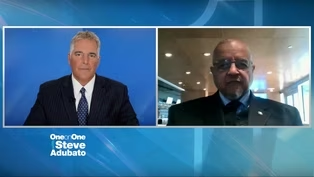
- We're now honored, we're honored to be joined by Reverend Dr. Forrest Pritchett, who was Senior Advisor to the Provost for Diversity, Equity and Inclusion and program director of the Dr. Martin Luther King Jr.
Leadership Program at Seton Hall University, one of our academic higher ed partners.
Dr. Pritchett, thank you so much for joining us.
- Thank you, Steve, for all the work that you do.
- That's very kind of you, listen, on this segment, we're gonna feature three leaders, African American leaders who mattered greatly, two of them are from New Jersey.
Part of our initiative called New Jersey leaders Who Matter: Powering Equity and Social Justice.
But let's start with arguably the most important African American leader, one of the most important leaders in the history of our nation and the world, Dr. Martin Luther King.
Your program is named after him.
What would you say his greatest contribution to our country was/is?
- Yes.
I am not going to say it was his I Had a Dream speech at all because most people only remember that about him.
I attempt to make him, transform him from being a one dimensional leader with that one fact to making him three dimensional.
I think his most important contribution was to appeal to the moral consciousness of America.
He not only spoke to the civil rights of the negro.
Ultimately, he was talking about the rights of poor people.
He even, in one of his quotes, gave us some insight to the events that had occurred even in Europe during the Nazi period, one of his quotes was, everything that Hitler even did was legal.
When you find that quote, you may say, what is he talking about?
Well, you know, he gets even into history.
So he was, I think his presence was prophetic.
Not just civil rights and social activism, it was prophetic.
- You know, and the I Have a Dream speech talked about by many, revered by those of us who are in the world of communications.
But I often think what Dr. King would think, but more importantly, the impact he would have today.
Do you ever think about that?
- By all means, as a matter of fact, that thought infuses everything that I attempt to do through the Martin Luther King Leadership Program at Seton Hall University.
The university started that program in 1970 as a full scholarship to African American students.
In today's world, we offer 20 scholarships to students from around the world who have a vested interest, whether they're from Africa, Venezuela, or from Newark, who have, can articulate strategies and plans for very specific social action, social justice projects.
That's how we carry out the legacy.
- Real quick, I'm sorry for interrupting, Doctor.
Real quick on this, as a student of leadership, I often think about servant leadership which you are, which you teach and coach and help your students understand that at the university.
Dr. King was a servant leader.
- Absolutely.
Before- - In the greatest sense.
- Exactly, even before we use the term servant leader.
I often would like to say- - Go ahead, I'm sorry.
- His model for leadership is actually the servant leadership of Jesus Christ.
Basically.
- Let's talk about another leader who served with great distinction.
Part of our New Jersey leaders Who Matter: Powering Equity and Social Justice, you'll see the chyron come up the bottom of the screen.
State Senator Wynona Lipman, I, you know, being born and raised in Newark, as a Newark kid in the 70s, you could not come from Newark and not just know but be proud of Senator Wynona Lipman, the first African-American woman to serve in the state Senate from 1972 to her death in 1999. Who was Senator Lipman and why did she matter so much?
- She was a woman ahead of her time.
When I look at her career, I think about something my grandmother said to me and probably said to her by her parents.
That is when you are being born into the America of the 1920s, the 1930s, the 1940s.
And when our parents and grandparents had either picked cotton and/or saw how racism had ravaged our communities, had already killed off many of our men, what our parents would tell us is that it's not about keeping your head low, they said, but if you're going to get educated, for example, we think you have to have twice as much education as any white person out there to escape racism.
So by looking at Wynona Lipman, someone who has a PhD where she studied in French, studied at the Sorbonne in Paris after starting at Columbia, that's the model that I often share with young people today.
And some of them are thinking, that's about, that's too much work.
If they're going to approach the feel of inequity, so to speak, you are best prepared, so to speak, in terms of your mindset as a leader, to penetrate it with excellence, do all that you can do.
And I think she represents that model.
And yes, sir.
- She was a role model for so many others and was a real trailblazer.
- Absolutely, the only woman, ultimately, in the state Senate.
She demanded respect, not only in the context of her being, quote, a negro at the, as they were called at that time, but also being the only woman.
So she represented that double jeopardy, so to speak.
But she did it with excellence.
I think somebody once called her the steel magnolia, that is when you look at her, she was always dressed very refined- - Very classy.
- Exactly.
But when you stepped out of line, verbally or physically, she really brought it to bear as she would respond to you.
- And by the way, before we talk about Gil Noble, the great broadcaster at WABC in New York based here, his home was in New Jersey.
And I believe, by the way, did you say he was from, I live in, I'm born and raised in Newark, but I live in Montclair now, was he from Montclair?
- To the best of my knowledge, as a married man, his residence was in Montclair, New Jersey.
- Okay, by the way, I just wanna say this about Senator Lipman.
Being born and raised in Newark in Essex County, rough and tumble politics is not a cliche, very rough.
A lot of fighting.
- Well said, well said.
- And vicious, and she, Senator Lipman navigated that, negotiated that.
Don't underestimate that.
Gil Noble.
For those of us in broadcasting and growing up, you see Gil Noble at WABC.
I mean, his program for so many years was the longest running public affairs program.
It made such a difference at a time when nobody was doing what he was doing, talk about Gil Noble.
- A giant in the field and a pioneer.
By the way, Gil designed, at the height of his career, he designed and taught at Seton Hall in our black study center a course called Media and Minorities.
- While he was doing Like It Is?
- That is correct.
We teach that course to this very day.
Media and Minorities.
Gil wanted to get across what are the complexities of the media industry, but also how had media been used historically in America in a sense to be part of the platform for inequality toward black folks.
And another trivia fact, if you don't mind me mentioning, is state Senator Lipman was the chairman of the advisory board also for the black studies program at Seton Hall University in her private life.
She even created a scholarship in the black studies program named after her son.
- Let me ask you something.
As you talk about Senator Lipman, as you talk about Gil Noble, who we'll talk about some more and also, there are no words for Dr. King that are enough or appropriate or do justice to him.
Why do you think, Dr. Pritchett, it's so important for us to be doing what we are doing, and then this is not to, to kiss up to us or what we're doing.
But we decided to do this because we thought it was important to feature people of all different backgrounds, but particularly in the African American community in this program.
Why do you think that's important, particularly now?
- It is important because the issue of race, the issue of systemic racism is not going away, it's almost very cyclical.
For example, if I were looking at my own life as a parallel, I'm born during World War II, 1940s.
My parents may have discovered by the late 50s that perhaps I was a bit too outspoken.
So they, without telling me, as a pre-teenager, about the social consequences, all they did was, as a parent, tried to keep me a little bit more humble and keep my mouth shut more because they really thought, without ever telling me, that that can get a black man into a lot of trouble.
And matter of fact, it can cost your life.
- That was then?
- Yes, sir.
So the answer to the larger question is that what goes around, it seems to come around back once again.
The only difference between the 1940s and 50s perhaps and what has happened with George Floyd in the spring of we'll say 2020 is that we now have cell phones and cameras.
What we said as eyewitnesses through our mouths, the world can see it through these cameras.
- Yeah.
And I wanna thank you, Reverend Dr. Forrest Pritchett, for shedding light, for teaching us, for helping us understand what we need to understand and not forgetting not only Dr. King, but also Senator Wynona Lipman and the great Gil Noble who, for those of us in the world of broadcasting, his weekly public affairs series, Like It Is, must see TV, a cliche, but so true for him.
Thank you so much, Doctor, we appreciate, we're honored by you joining us.
Thank you, Doctor.
- Thank you, Steve, keep up the good work with the Caucus.
Thank you.
- Same to you.
I'm Steve Adubato, we'll be right back, stay with us.
- [Narrator] To watch more One on One with Steve Adubato find us online and follow us on Social media.
- Okay folks, we're taping on May 20th and this will be seen later but this is a Father's Day special, which is on June 20th.
Even those, this will be seen after that.
Check out this.
I want to introduce Donald and Richard Heddy.
They are colorectal cancer survivors.
And tell me if I got this right, okay Donald?
51 year old Donald Heddy has just overcome colorectal cancer.
You were treated at Ocean Medical center down in Brick Township, right?
- That is correct.
- And also your 91 year old father, that's Richard Heddy, Richard that's you?
- That's me.
- You were treated by the same doctor, same treatments for the same situation?
- Correct.
- Exactly correct.
- Donald, what is the Father's Day message to everyone right now listening, me and every other father who needs to be aware of what we need to do to take care of ourselves?
Go ahead.
- Well, what I would say Steve is, I don't know if I would have been able to get through the treatments and the cancer as well as I did without my father.
I mean, I wish he didn't have to go through it as well as I wish I didn't have to go through it, but we're both survivors.
And again, I don't know if I could have done it without his help and his love and all the support he gave me.
So I would say, you know, it's gonna be a great Father's Day this year with both of us cancer free and everything.
We're looking forward to it.
- Richard, let me ask you, what was the best or most important piece of advice you gave your son because unfortunately you had dealt with this cancer as well?
- Well, I told him to always look at the bright side of things because it's possible to defeat the cancer and get back to your normal life.
- Having a positive attitude, Donald, that was a key to it, in addition to great clinical care?
- Oh my goodness.
Steve, I couldn't tell you how great everybody at Hackensack Meridian Ocean Medical Center was.
I mean I just thought the care they gave me was super.
And you know, for that, I can't thank them enough so.
- But Donald, let me ask you this, you were also treated during COVID?
- I was Steve.
I first went into the hospital January 3rd prior to COVID and then my operation, my first operation was right around February, so right when COVID was starting to hit.
And you know at that time nobody was allowed to come into the hospitals, no guests or anything.
So it was kind of a stressful time to be doing it.
I mean not only because I had the cancer, but knowing that I wasn't gonna be able to see any family or friends while I was in the hospital.
- So Donald, let me ask you, obviously, your dad Richard dealt with the cancer situation.
He had colorectal cancer, not during COVID.
You did deal with it during COVID.
What was most challenging about that?
- Well, COVID being so new to everybody, of course not knowing what was gonna happen with the COVID, but also going through the cancer as well.
You know, I went through my first surgery when COVID was hitting very hard with everybody.
And that was the time period that there was nobody allowed to come in to visit, no guests.
And luckily with the technology we have today with the FaceTiming and the text messages, I was able to get the support through my family and friends with again the FaceTiming as much as I could, because of course I was by myself.
But I couldn't say enough about the nurses as well because they were going through it too.
They were on the front line, as we all know and they helped me out the best that they possibly could I believe and I couldn't thank them enough for that.
- Richard, let me ask you, you're 91 years young, you're there with your even younger son.
What is it like?
And I know this is a Father's Day segment, we're also trying to promote colorectal cancer awareness and doing the right thing and getting tested and doing what you have to do, but what is it like for you right now to be there with your son, Donald, not just for Father's Day, but in this broadcast right now talking to us about your individual experiences?
What's that like for you sitting next to him?
- Well, it's a joy to have your children around for one thing.
We have a lot of the same interests.
We're looking forward to summer activities.
- One of our main hobbies, Steve, is fishing.
- You fish together?
- We fish together and I have since I was born, I think he had me out on the water.
And so last year, again, I was going through the treatments and everything else and so last year was a little more challenging getting out there, but we're gonna definitely go as much as possible as we can this year and looking forward to that.
He's not as stable as he used to be but we're gonna get him out there.
You know, he can still show me some tricks, so.
- Steve we've been a boating family for over 50 years so we get out on the water a lot.
- Yeah I know you're down in the Ocean County area.
By the way, Donald, before I let you go, you and your dad, Richard, who we offer a wonderful blessed Father's Day and beyond, but I'm gonna ask you one more thing Donald, give me 20 seconds on advice for someone who's recently been diagnosed with colorectal cancer.
- I would say be positive about it.
There's great technology out there.
I had my surgery robotically where my dad did not from 10 years ago.
So there's a lot of advances.
But I would say the main thing right now is to get it checked.
You know, you have to get it checked out before and stay positive.
I know that's kind of cliche, but you gotta have the positive in your heart to get through it so.
- It's not a cliche and you put things in perspective to Donald and to Richard Heddy.
You honor us by being with us.
We wish you nothing but good health and good things in your life, down by the Jersey Shore.
Thanks so much.
- Thank you, Steve.
- Thank you for having us on.
I appreciate it.
- You got it.
I'm Steve Adubato, that's Donald and Richard Heddy.
Sound advice.
We'll see you next time.
- [Narrator] One-On-One with Steve Adubato has been a production of the Caucus Educational Corporation.
Funding has been provided by PSE&G, The Turrell Fund, supporting Reimagine Childcare.
PNC, Grow Up Great.
New Jersey Sharing Network.
The Healthcare Foundation of New Jersey.
Summit Health Horizon Blue Cross Blue Shield of New Jersey.
United Airlines.
And by The Russell Berrie Foundation.
Promotional support provided by NJ.Biz, And by New Jersey Family Magazine.
- New Jersey's early educators and childcare providers are more than twice as likely to live below the poverty line versus the general workforce.
Reimagine Childcare formed by a coalition in New Jersey is dedicated to improving accessibility, affordability and quality of childcare and re-imagining the way we support these essential providers.
African American Leaders Who Impacted NJ and the Nation
Video has Closed Captions
Clip: S2021 Ep2438 | 11m 43s | African American Leaders Who Impacted NJ and the Nation (11m 43s)

Father & Son Overcome COVID and Colorectal Cancer Together
Video has Closed Captions
Clip: S2021 Ep2438 | 8m 19s | Father & Son Overcome COVID and Colorectal Cancer Together (8m 19s)
The Importance of Interactions Between Parents & Children
Video has Closed Captions
Clip: S2021 Ep2438 | 7m 47s | The Importance of Interactions Between Parents & Children (7m 47s)
Providing Support for PBS.org
Learn Moreabout PBS online sponsorship
- News and Public Affairs

Top journalists deliver compelling original analysis of the hour's headlines.

- News and Public Affairs

FRONTLINE is investigative journalism that questions, explains and changes our world.












Support for PBS provided by:
One-on-One is a local public television program presented by NJ PBS