
Rosie White, George Shirley, Michigan politics, March events
Season 8 Episode 35 | 26m 46sVideo has Closed Captions
Detroiter Rosie White, Opera singer George Shirley, Michigan politics and upcoming events.
Eight-year-old Detroiter Rosie White goes viral with her video impressions of Black icons and historical figures. African American trailblazer George Shirley reflects on his career in opera and as a music educator. One Detroit contributors Stephen Henderson and Nolan Finley discuss how Michigan’s primary results may impact the presidential election. Plus, upcoming events on “One Detroit Weekend.”
Problems playing video? | Closed Captioning Feedback
Problems playing video? | Closed Captioning Feedback
One Detroit is a local public television program presented by Detroit PBS
Rosie White, George Shirley, Michigan politics, March events
Season 8 Episode 35 | 26m 46sVideo has Closed Captions
Eight-year-old Detroiter Rosie White goes viral with her video impressions of Black icons and historical figures. African American trailblazer George Shirley reflects on his career in opera and as a music educator. One Detroit contributors Stephen Henderson and Nolan Finley discuss how Michigan’s primary results may impact the presidential election. Plus, upcoming events on “One Detroit Weekend.”
Problems playing video? | Closed Captioning Feedback
How to Watch One Detroit
One Detroit is available to stream on pbs.org and the free PBS App, available on iPhone, Apple TV, Android TV, Android smartphones, Amazon Fire TV, Amazon Fire Tablet, Roku, Samsung Smart TV, and Vizio.
Providing Support for PBS.org
Learn Moreabout PBS online sponsorship- [Narrator] Coming up on "One Detroit," we'll meet a young Detroit girl who's captured the country's attention with her impressions of African-American trailblazers.
Plus, African-American opera singer George Shirley talks about his legendary career.
Also, with the Michigan primary behind us, Nolan Finley and Steven Henderson discuss what's ahead for the presidential election.
And if you're looking for something to do this weekend, we have some ideas for you.
It's all coming up next on "One Detroit."
- [Announcer] From Delta faucets to Behr paint, Masco Corporation is proud to deliver products that enhance the way consumers all over the world experience and enjoy their living spaces.
Masco, serving Michigan communities since 1929.
Support for this program is provided by the Cynthia and Edsel Ford Fund for Journalism at Detroit Public TV.
- [Announcer] The DTE Foundation is a proud sponsor of Detroit Public TV.
Among the state's largest foundations committed to Michigan-focused giving.
We support organizations that are doing exceptional work in our state.
Visit dtefoundation.com to learn more.
- [Announcer] Nissan Foundation, and viewers like you.
(upbeat music) - [Narrator] Just ahead on "One Detroit," the first African-American tenor with the Metropolitan Opera shares how he became an opera singer.
Plus, Steven Henderson and Nolan Finley examine the results and impact of Michigan's presidential primary.
And Cecelia Sharpe and Peter Whorf of 90.9 WRCJ run down a list of activities for you to enjoy this weekend in Metro Detroit.
But first up, February is Black History Month.
But an 8-year-old Detroit girl is making sure Black history is celebrated all year long.
Robin McKee, who goes by Rosie White on social media, is well known for her impersonations of African-American pioneers past and present.
"One Detroit" contributor Deja Mosque caught up with her and her family to find out what inspires them to create these Black history videos.
(upbeat music) - I'm the minister for Muslim Temple number seven.
- Never heard of you.
Nobody here by that name.
- Wait a second.
What is your name?
- Don't worry about what my name is.
- We are content creators.
We call ourselves the big three, which is a nod on Detroit's automotive legacy.
We typically make videos about our culture.
This is our talent, Rosie, where we do movie portrayals that's really popular on our content.
Black History, anything funny that's culturally inclined with our community.
On Instagram, that's our biggest platform, it has always been where we got the most love and the most comments or the most interaction.
Black History specifically is how we started.
Our first viral video was the Rosa Parks video and it got about 580,000 views.
- And then, and then, and then I hop on the bus and then the driver tell me to sit on the back.
And then, and then, and then I said, "No, I'm not sitting in the back."
- It was an accident.
I was just reading her a paper from school, homework, she's three, read this package about Rosa Parks to your student.
To your child, ask her what she learned.
And I said, "All right Rosie, tell me what you learned."
And she said it back, every single word.
- So I was three of course, she didn't know.
She thought I wasn't listening.
So soon as she asked me, "Rosie, tell me what you learned," I said everything to the end on that paper, everything.
So then she ran around her house, tried to find everything that looked like Rosa Parks.
And then she got her phone out and again she told me, "Rosie, say it again."
And I said everything from the start.
And then everybody can ride a bus and Africans ride the bus now.
Me, Rosie Parks.
- We continued making the videos.
There were no worries because she absolutely loved to do it.
I absolutely love to dress her.
You know, Halloween, it's actually my favorite holiday and it's because I like to dress up, I like to create.
And then A'blesyn just so great with the camera just all came together.
- Our videos help because it's like, it is not only educational, but it's also fun.
So like when you're watching it, you're learning, but you don't really realize that you're learning something.
- Every time when my mom write the script, I'm just learning about history like every time.
Like he did this?
Oh wow.
She did this?
Oh wow.
- Now what's going on, Robin?
- Well my mom teach me about Black history and I teach others.
- My favorite history is Carter Woodson because he's the father of Black history.
Even my auntie, she gave me this book all about Black people.
And I was scrolling through it and I saw a lot of important people that changed the world.
Like Carter Woodson, I did not know he's the father of Black History.
So I told my mom, "Mom, we should talk about Carter Woodson."
And she said, "We're gonna add that in our rap," the Black History rap.
♪ Carter Woodson lead the fight ♪ ♪ To promote Black achievements ♪ ♪ And stop racist stereotypes black.
♪ ♪ Black, Black history ♪ ♪ Black, Black history ♪ My mom and sister inspire me because they helped me out.
- Some of the things we record, they're fun, lighthearted, it's just cool.
And then some are like, oh, we gonna be here a while.
- Like with the Harriet Tubman video, we were on Bellow in the midst of the winter time and ice on the river, shooting that video, we were tiptoeing on grass.
- I was a conductor for eight years of the Underground Railroad.
It was serious.
- We didn't have all the nice equipment.
I had a light, like a flashlight so she can get a good lighting because it was dark.
And Rosie had on like this costume and she was trying to get the best.
She is really, really particular about her shots.
So we were just towing together like.
- I am Harriet Tubman.
- It gave us the actual feel of what she did for our people because we were like complaining and she did that on a regular basis.
- My work as Moses was serious business.
- We're more focused on people like more popular.
So it's really like a reminder, a refresher.
- Rosie's videos are important because she's teaching more current state of people and not necessarily the horror that came with Black history, but the celebration that we are in now.
- Has two of the greatest business man in front of me.
All I can say is wow.
- We were doing this for family fun.
So the outpour of love and support we're getting is really astounding.
- Hi baby.
- You know Rosie?
- When people say, "Hey, I was having a bad day, thank you for your videos," my only response usually is mission accomplished, because that's all we wanted.
- I want them, the boys and girls to feel like they at school by teaching Black history like Carter Woodson, Rosa Parks, these people that changed the world.
- [Narrator] As we close out Black History Month, we're shining a light on a trailblazer here in Metro Detroit.
Renowned operatic performer George Shirley was the first Black tenor to join the Metropolitan Opera in 1961.
He also holds other firsts as an African-American musician and educator.
Contributors Cecelia Sharps of 90.9 WRCJ sat down with Shirley for a conversation about his remarkable career.
(upbeat music) - I am here with Professor George Shirley, the first African-American member of the Army Chorus, the first African-American to teach music in Detroit public high schools, the first African-American male tenor to sing leading roles with the Metropolitan Opera, and the list goes on.
Let's rewind time just a little bit.
Professor Shirley, you really didn't have plans to be an opera singer.
You were about to get married and teach music in Detroit public schools.
And then what happened?
- Well, the Army happened, the draft happened, my life was set, my dreams were fulfilled.
And we were planning on getting married in August of 1956 and got a letter from Uncle Sam in about March or April 1956 saying basically, "You're going to be married to me."
In June, the word went out that the Army was going to create a singing organization to be attached to the United States Army Band in Washington DC.
The band had been formed in 1934, '35, and it had never had a Black member.
So I decided to go in as a bandsman.
So I went into the army playing euphonium.
- How did you really matriculate into the world of opera?
- So along with two other members of the band who were not that happy with that prospect, both of them were white, we decided to take a leave of absence and go to Washington and audition for the chorus.
A conductor of the chorus, fellow named Samuel Loboda, he was a captain, he was second in command of the Army band.
And my two colleagues sang their auditions.
And Loboda, who was very direct, a really incredible man, he said, "Well thank you very much for coming.
We won't be able to use you."
And I thought, mm-mm.
My turn came and I sang and he said, "Can you wait a few minutes" after I finished.
I said, "Yes sir."
And he disappeared into the command room.
A few minutes became at least a half hour.
And I'm sitting there thinking, that's the same old stuff.
Same...
So he finally came out and he said, "Well, we decided that we would like to have you join us if it's what you really want."
I found out years later that Sam Lobodaa had to go all the way to the Pentagon to get me in.
That was America.
- Tell us about the value of a quality music education at the elementary level on up through high school.
- I didn't, I mean, I'd been singing ever since I was five years old with my parents in church in Indianapolis.
And then we came here and encountered one of the greatest systems of public school music education in the country in Detroit.
And for me, it's a primal force in educating people.
It doesn't mean that someone who has profited by studying music is going to become a necessarily a professional musician, but it means that the brain has been trained in certain ways that can be used, activated in professions that have nothing to do per se with music.
There are people who are CEOs of companies who are excellent musicians.
I mean, Einstein was a musician.
So you're taking away something that is essential, really essential in helping to grow the brain.
- You've taught at universities, you're teaching, you're a distinguished professor at the University of Michigan, but you also have a vocal competition that started about 11 years ago.
- I have a former student, Louise Toppin.
She and I came up with this idea of a vocal competition focused on the art songs and the classical compositions of African-American composers.
It has grown over the years to include university students, still has high school level, and it has become international.
The University of Michigan School of Music Theater and Dance is now going to house this competition.
And it's a dream come true.
The music, the so-called classical music of Black composers, has not really been made as accessible and has not been taught to the degree that it should be.
And that's being changed now at Michigan, at the School of Music.
And it's open to all ethnicities because music belongs to everyone.
I don't care what you look like.
If I can sing Italian to Italians or French to the French or German to the Germans or anything else, then everybody has a right to sing the works of African-American composers.
I don't take credit for having been given the gift of song.
I had nothing to do with that.
I couldn't remember asking the intelligence that created me, can I be a singer?
Can I be an opera singer?
Can I be a teacher?
I was given the gift, and I was also given the work ethic to develop the gift.
(singing in foreign language) - [Narrator] Now that the Michigan Presidential primary is over, attention is turning to how the results will impact the fall election.
More than 100,000 residents voted uncommitted in the Democratic primary.
And the Michigan GOP is in the midst of a dispute over leadership as it prepares for this weekend's caucus.
"One Detroit" contributors Nolan Finley of the Detroit News and Stephen Henderson from "American Black Journal" discussed where both parties go from here.
(upbeat music) - So Nolan, presidential politics, primary politics, they're never boring here in Michigan.
Our history is that we always make news in a way that surprises people.
This year was not an exception, both on the Democratic and the Republican side, we got a little bit of turmoil.
- Yeah, we do.
I mean there of course everybody focused on the uncommitted drive, the drive to get voters to cast an uncommitted ballot to protest Joe Biden's Middle East position and his support for Israel.
I view it as a bit of a fizzle.
Numbers weren't that high, I don't think, to make a huge difference or to send a huge message to the president.
Unless that replicates in other states, I think it's just gonna be a flash in a pan.
- It's a huge number.
13% statewide, almost 17% in Wayne County, 17% in Washtenaw County.
They were hoping to get 10.
That's what they said.
The organizers thought that would be a tremendous success.
They exceeded that in so many ways.
There's no way this doesn't send a message to the White House.
That's why the Biden folks have been here as much as they have been, why they've been meeting with members of the Arab-American and the Muslim community about it.
I think that as strategy goes, what they're after here is an audience with the President and some consideration for their side of this issue.
I can't think of a better way to have done that.
These are not people who are gonna vote for Donald Trump in November.
- And the administration knows that.
They also know that they've gotta be mindful on the other side of this issue of Jewish voters who are also very loyal Democratic voters and supporters of the party.
So it's a delicate balancing act.
I wouldn't expect this to influence the decision making on policy in here.
They make it a larger voice.
But there are a lot of interesting elements in the numbers here.
Donald Trump lost 90,000 Republican voters in Oakland and Kent and Ottawa counties, and Ottawa and Oakland counties were the counties that sort of turned against him in 2020, cost him Michigan.
And so he's got the same problems in those counties this year as he had last year.
But I think what we're seeing in this election that's unique perhaps to any others we've ever seen is the emergence of a really potent voter force, the double unfavorables, the people who don't like Trump and don't like Biden and are going to go into that ballot booth and either not vote for president or hold their vote nose and vote for the one they dislike least or vote on issues that are important to them rather than the personalities.
And whether it's abortion or immigration or the Middle East, I think issues will be more important than personalities perhaps this year based on what we saw Tuesday night.
- No, I think that's right.
And then you have this other problem on the Republican side, which is about to play out, which is the question of leadership and you still have caucuses to be held over on that side.
And neither side's banking down here, Kristina Karamo still says, "Hey, I'm the party leader and I can lose in court all day, but I'm not gonna act any differently."
What will happen though if she decides to go ahead and keep acting that way?
- Well, there's only so far you can go in defying a court's order.
I mean, that's serious business now, that takes it out of political squabbling and into the courts and she's been told by the court to do some very specific things, primarily to stop pretending you're the chair of the Republican party.
So she's gotta start turning over the Twitter handle, the empty checking account, the other paperwork, those have all gotta go to Pete Hoekstra who has now been recognized by the courts as the legitimate chair of the Republican party.
So I think she'll back down.
But the long-term impact on the Republican party of all this has been tremendous.
And I don't think even if Hoekstra is able to get people to come back together, Pete Hoekstra the new chair, even if he's able to get everybody to come back and act as an organized civil party again, he doesn't have enough time to make it into the sort of force Republicans will need to help them win Michigan in the fall.
- Yeah, I think that's right.
I think that's gonna play out even more dramatically in the state races, in the senate race, in the congressionals, and in the State House, where Republicans at one time had kind of high hopes that they could make some inroads.
if the party is not in a position to help them in the right way, I don't know that that has much of a chance of happening and it's still this hangover I guess from the effect of Donald Trump on the party that's causing all of that.
- You do have a lot of people doing workarounds.
Rick Snyder and Bobby Schostak raising money, recruiting candidates for State House races, the Senate candidates, the ones who have the resources, Rogers and Pimsleur are planning to sort of create their own surrogate state parties to do get out the vote, fundraising, mailings, et cetera, going through county parties for a lot of that work.
So there's workarounds at the state level, and in the Senate race, I think where it does get tough is to turn out a big vote for your presidential candidate and do the sort of organizing you need to do in the fall, I think it'd be very difficult for Donald Trump to win Michigan if the State Republican Party is at this level of disarray between now and November.
- Yeah, All right.
Well, another primary in the books, another primary making news, Nolan, we'll talk, I'm sure, more about this in the future.
- [Narrator] As we enter the month of March, there are lots of things to do in Metro Detroit, both outdoors and indoors.
Cecelia Sharpe and Peter Whorf of 90.9 WRCJ have some suggestions in today's One Detroit Weekend.
- I love this time of week where you and I can sit down and chat about the great weekend that's up ahead.
So what do you have in store for us?
- Let's kick things off with Mosaic Youth Theater, whose actors will perform "Debating Destiny" tomorrow and Saturday at the Senate Theater.
It's the world premier performance of the play by James Anthony Tyler.
The story immerses the viewer in the complexities of growing up through the art of debate.
- I love the talent of the youth at Mosaic.
And speaking of youth, parents can take their kids to "Paw Patrol Live" at the Fox Theater this Saturday and Sunday.
This action-packed storyline take the Paw Patrol on the great pirate adventure.
- [Peter] Let's keep the fun for the kids going.
On Sunday, "The Magic School Bus: Lost in the Solar System" is headed to the Berman Center for the Performing Arts.
Ms. Frizzle and her class will be flying across the galaxy and learning about the solar system.
- I used to absolutely love "The Magic School Bus" as a kid.
And actually, maybe I still do.
I also want to remind everyone that this is the last weekend The Rink at campus Marshes will be up and running for the season.
So grab your ice skates or rent some at the park and take a spin around the ice while it lasts because spring is right around the corner.
- [Peter] And speaking of spring, the Hospitality House Food Pantry is hosting A Taste of Spring March 6th.
This is a strolling fundraiser for the food pantry where people can take part in delicious cuisine, drinks, and live entertainment while supporting a great cause.
- And there's always a plethora of other events to check out in and around Metro Detroit.
Here are some more.
Have a wonderful weekend, everyone.
(upbeat music) - [Narrator] That'll do it for this week's "One Detroit."
Thanks for watching.
Head to the "One Detroit" website for all the stories we're working on, follow us on social media, and sign up for our weekly newsletter.
(upbeat music continues) - [Announcer] From Delta Faucets to Behr paint, Masco Corporation is proud to deliver products that enhance the way consumers all over the world experience and enjoy their living spaces.
Masco, serving Michigan communities since 1929.
Support for this program is provided by the Cynthia and Edsel Ford Fund for Journalism at Detroit Public TV.
- [Announcer] The DTE Foundation is a proud sponsor of Detroit Public TV.
Among the state's largest foundations committed to Michigan-focused giving.
We support organizations that are doing exceptional work in our state.
Visit dtefoundation.com to learn more.
- [Announcer] Nissan Foundation, and viewers like you.
(upbeat music) (bright music)
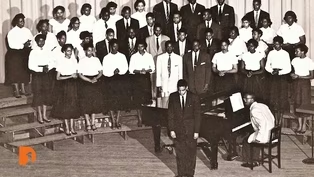
African American opera tenor, trailblazer George Shirley
Video has Closed Captions
Clip: S8 Ep35 | 6m 52s | As one of the first African American operatic performers, renowned tenor and trailblazer G (6m 52s)

Contributors discuss divide in Michigan GOP leadership
Video has Closed Captions
Clip: S8 Ep35 | 6m 58s | Turmoil for Michigan Republicans, Democrats ahead of the 2024 presidential election. (6m 58s)
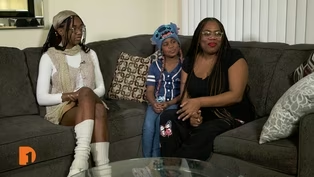
Detroit girl goes viral for her impressions of Black icons
Video has Closed Captions
Clip: S8 Ep35 | 5m 55s | Eight-year-old Rosie White gains national attention from her viral social media videos. (5m 55s)

One Detroit Weekend: March 1, 2024
Video has Closed Captions
Clip: S8 Ep35 | 2m 3s | Peter Whorf and Cecelia Sharpe share some events happening around Detroit this weekend. (2m 3s)
Providing Support for PBS.org
Learn Moreabout PBS online sponsorship
- News and Public Affairs

Top journalists deliver compelling original analysis of the hour's headlines.

- News and Public Affairs

FRONTLINE is investigative journalism that questions, explains and changes our world.












Support for PBS provided by:
One Detroit is a local public television program presented by Detroit PBS