If You Lived Here
Bringing History Alive at Arlington House
Clip: Season 3 Episode 13 | 3m 48sVideo has Closed Captions
The rich history of Arlington County and the Rosslyn neighborhood.
Arlington historian Charlie Clarke and National Park Service historian Mark Maloy discuss the rich history of Arlington County and the Rosslyn neighborhood. Arlington House, from which the county gets its name, was originally built by George Washington Parke Custis and his slaves in 1802. The estate played a crucial role in the life of Robert E. Lee and the events leading up to the Civil War.
Problems playing video? | Closed Captioning Feedback
Problems playing video? | Closed Captioning Feedback
If You Lived Here is a local public television program presented by WETA
If You Lived Here
Bringing History Alive at Arlington House
Clip: Season 3 Episode 13 | 3m 48sVideo has Closed Captions
Arlington historian Charlie Clarke and National Park Service historian Mark Maloy discuss the rich history of Arlington County and the Rosslyn neighborhood. Arlington House, from which the county gets its name, was originally built by George Washington Parke Custis and his slaves in 1802. The estate played a crucial role in the life of Robert E. Lee and the events leading up to the Civil War.
Problems playing video? | Closed Captioning Feedback
How to Watch If You Lived Here
If You Lived Here is available to stream on pbs.org and the free PBS App, available on iPhone, Apple TV, Android TV, Android smartphones, Amazon Fire TV, Amazon Fire Tablet, Roku, Samsung Smart TV, and Vizio.
Providing Support for PBS.org
Learn Moreabout PBS online sponsorshipCHARLIE: Captain John Smith would've come through what today is Rosslyn in 1608.
But there's no archeology showing the real settlements in Rosslyn before the early 19th century.
The Alexandria people had the idea of creating what became the Aqueduct bridge that would allow barges to be transported across Potomac in a water trough atop the bridge with a carriage path next door to it.
And it was started in the early 1830s and it was completed around 1843.
Then, you have the Civil War where Fort Corcoran was quickly assembled in 1862 to guard the Aqueduct bridge to prevent Confederates from using it.
The Union planners knew that they were very capable of sacking the nation's capital, so they had to guard every entranceway.
♪ ♪ MARK: Fort Corcoran was one of many forts that were built here in the Arlington area, but it was here at Arlington House that was an important communication center between these different fort sites.
This was originally established by a man named George Washington Parke Custis, back in 1802.
He moved here with his wife and their daughter, Mary Anna Randolph Custis is going to actually marry in 1832 in the house, young Lieutenant Robert E. Lee.
So it was here at Arlington House in 1861 that Robert E. Lee is going to face the decision of whether to resign from the army or not.
He signs his letter on April 20th, 1861, leaving the United States Army.
A couple of days later, he's going to leave Arlington House never to return.
The following month, Union soldiers are going to cross the Potomac, come up here, they're going to occupy the house and grounds.
The house becomes a headquarters to the Union Generals.
And then later in an act of spite and revenge to the Lee family, they're going to start burying dead union soldiers here at the House.
Arlington House today is still at the center of a living cultural resource in Arlington National Cemetery.
It's become the most important burying ground in the entire nation.
It's a cemetery for those who have given their lives for the country and those who have served this country with distinction.
Arlington House was restored by the Army to be what it was like in 1860, right before the American Civil War.
On the north side of Arlington House is the kitchen garden.
This is set up to be what a kitchen garden was like right at this spot back in the 1860s.
It was farmed by the enslaved people here at Arlington House.
They would grow food for the Lee family and they would grow food to bring down to Washington DC to sell.
Today we're growing food there except we are donating the food that we're gathering here to the Arlington Food Bank.
And it's maintained by National Park Service volunteers who come here to help grow the food, to show people the plants and vegetables and fruits that they would've grown here.
Irish potatoes, carrots, cabbage, fruit trees lining the path.
All of this is actually very historically accurate.
This is close to what would've been here back in 1860.
So it's just neat to see the amount of thought that goes into this garden.
People can connect with their history here, but then also to have that added benefit of knowing that you're doing something to help the community as well.
♪ ♪ (doorbell)
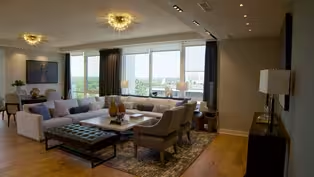
Luxury Condo Living in the Heart of Rosslyn
Video has Closed Captions
Clip: S3 Ep13 | 7m 25s | A private elevator ride to a rooftop pool and more in Rosslyn, VA! (7m 25s)
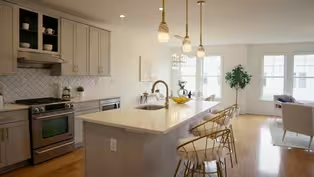
A Perfect Blend of Suburban Comfort and Urban Convenience
Video has Closed Captions
Clip: S3 Ep13 | 5m 35s | Welcome to the serene and stylish world of Rosslyn living! (5m 35s)
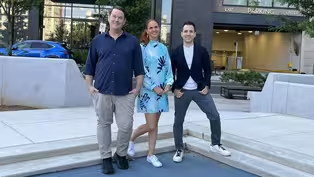
Preview: S3 Ep13 | 30s | John and Christine tour three homes in Rockville, Maryland with realtor Rowena De Leon. (30s)
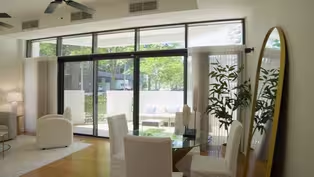
This Rosslyn Condo Has Cool City Living Vibes in Arlington
Video has Closed Captions
Clip: S3 Ep13 | 5m 54s | A one-bedroom, one-bathroom unit in the Atrium Condos community in Rosslyn, Virginia. (5m 54s)
Providing Support for PBS.org
Learn Moreabout PBS online sponsorship











Support for PBS provided by:
If You Lived Here is a local public television program presented by WETA