
Rural Hospital Closure Risks in Kentucky
Clip: Season 2 Episode 80 | 3m 44sVideo has Closed Captions
Almost a quarter of all rural hospitals in Kentucky are at risk of closing.
Almost a quarter of all rural hospitals in Kentucky are at risk of closing.
Problems playing video? | Closed Captioning Feedback
Problems playing video? | Closed Captioning Feedback
Kentucky Edition is a local public television program presented by KET
Rural Hospital Closure Risks in Kentucky
Clip: Season 2 Episode 80 | 3m 44sVideo has Closed Captions
Almost a quarter of all rural hospitals in Kentucky are at risk of closing.
Problems playing video? | Closed Captioning Feedback
How to Watch Kentucky Edition
Kentucky Edition is available to stream on pbs.org and the free PBS App, available on iPhone, Apple TV, Android TV, Android smartphones, Amazon Fire TV, Amazon Fire Tablet, Roku, Samsung Smart TV, and Vizio.
Providing Support for PBS.org
Learn Moreabout PBS online sponsorshipAlmost a quarter of all rural hospitals in Kentucky are at risk of closing.
That's according to a report by the Center for Health Care Quality and Payment Reform.
We talked to the president of the center who says the way rural hospitals get paid needs to change to keep communities from losing essential health care services.
There are a lot of rural hospitals all over the country that are struggling because they're losing money delivering patient services.
Kentucky has 72 hospitals in total rural hospitals, and we've estimated, based on the most recent data, 42% of those have been losing money on patient services.
That's a total of 30.
30 rural hospitals have been losing money.
16 of those hospitals we have estimated, are at risk of closing over the next 6 to 7 years because those losses have been sufficiently large and sustained that they may not be able to continue operating.
And the ones that are most of concern, ten hospitals, which is 14% of the total, are at immediate risk of closing.
And that's about the 10th highest number in the country.
Those are all hospitals that are really provide critical services in their own communities.
And so if they close, there may be no no health care services left at all.
Rural hospitals can't operate if they don't receive enough revenues to be able to cover their costs in about half of the patients in rural hospitals have some kind of private insurance.
The issue is that in big hospitals, private insurance plans tend to pay the hospital a lot more than Medicare does, and often much, much more than it actually costs the hospital to deliver services.
The exact opposite is true in small rural hospitals.
Medicare is, in many cases, their best payer.
Many state Medicaid programs provide special payments to be able to help sustain rural hospitals.
But private insurance plans don't don't do that.
The other problem is that it's not even just enough to pay for individual service delivery because rural hospitals actually deliver two kinds of services and they only get paid for a while.
If someone has an emergency and they come to the emergency hospital or to the rural hospital, the hospital gets paid for the emergency care.
They may not be paid enough, but they get paid for that.
But the hospital is also standing by, waiting with a physician ready to go in case there is an emergency.
And that's also a service to the community.
But the hospital doesn't get paid to be available and only gets paid or delivers a service.
What we argue for is that not only do hospitals need to be paid adequately whenever they deliver a service, they also need to receive a payment for their standby capacity, what we call a standby capacity payment.
This is a hospital should get a certain amount of money to be able to operate an emergency department, to be able to have maternity care services available, those essential standby services.
So that the hospital will know that it has adequate revenue coming in to support that service regardless of how many people need it.
And the people in the community will have the confidence that that service will be there.
The report does not list the Kentucky hospitals at immediate risk of closing.
Reed tells us that's because the financial status of the hospitals can change.
And I don't want to imply these are the only rural hospitals struggling.
Education Commissioner Jason Glass
Video has Closed Captions
Clip: S2 Ep80 | 5m 20s | Ed. Comm. Jason Glass reflects on his time serving in Kentucky and why he's leaving. (5m 20s)
KY Senators On Possible Government Shutdown
Video has Closed Captions
Clip: S2 Ep80 | 2m 44s | KY Senators Mitch McConnell and Rand Paul weigh in on the possible government shutdown. (2m 44s)

Midweek Political Check In With Ryland Barton (9/20/23)
Video has Closed Captions
Clip: S2 Ep80 | 6m 34s | Abortion a key topic in Gov. race and KY Supreme Court considers congressional maps. (6m 34s)
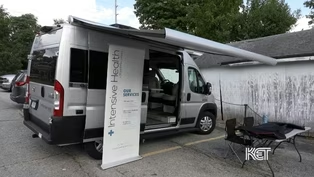
Video has Closed Captions
Clip: S2 Ep80 | 3m 45s | A new mobile healthcare unit from Stepworks is helping people in rural Kentucky. (3m 45s)

Protecting Butterflies in Kentucky
Video has Closed Captions
Clip: S2 Ep80 | 3m 9s | A new butterfly greenhouse to educate guests on the importance of butterflies. (3m 9s)
Providing Support for PBS.org
Learn Moreabout PBS online sponsorship
- News and Public Affairs

Top journalists deliver compelling original analysis of the hour's headlines.

- News and Public Affairs

FRONTLINE is investigative journalism that questions, explains and changes our world.












Support for PBS provided by:
Kentucky Edition is a local public television program presented by KET