
Rural Kentucky Continues to See Population Growth
Clip: Season 4 Episode 78 | 5m 48sVideo has Closed Captions
Why rural Kentucky has seen a growth in population over the last four years.
After nearly a decade of losses, rural Kentucky, as a whole, experienced population growth. Renee Shaw spoke with Alison Davis, a Professor of Agricultural Economics at the University of Kentucky and the Executive Director of Blueprint Kentucky, an integrated engagement and research center. She tells us that while the data trend may be surprising, the reasons behind may not be.
Problems playing video? | Closed Captioning Feedback
Problems playing video? | Closed Captioning Feedback
Kentucky Edition is a local public television program presented by KET
Rural Kentucky Continues to See Population Growth
Clip: Season 4 Episode 78 | 5m 48sVideo has Closed Captions
After nearly a decade of losses, rural Kentucky, as a whole, experienced population growth. Renee Shaw spoke with Alison Davis, a Professor of Agricultural Economics at the University of Kentucky and the Executive Director of Blueprint Kentucky, an integrated engagement and research center. She tells us that while the data trend may be surprising, the reasons behind may not be.
Problems playing video? | Closed Captioning Feedback
How to Watch Kentucky Edition
Kentucky Edition is available to stream on pbs.org and the free PBS App, available on iPhone, Apple TV, Android TV, Android smartphones, Amazon Fire TV, Amazon Fire Tablet, Roku, Samsung Smart TV, and Vizio.
Providing Support for PBS.org
Learn Moreabout PBS online sponsorshipWhat was declining is now seeing an upswing.
That's in reference to the numbers of small town Kentucky residents.
After nearly a decade of losses, rural Kentucky as a whole experienced population growth the last four years, partly driven by the uptick in remote and hybrid work arrangements during and after the Covid 19 pandemic.
But not all rural communities are seeing a growth spurt.
I talked earlier this week with Allison Davis, a professor of agricultural economics at the University of Kentucky and the executive director of Blueprint Kentucky, which is an integrated engagement and research center.
She tells us that while the data trend may be surprising, the reasons behind them may not be.
We learn more in tonight's Business Beat and.
When a couple of years ago, a report came out nationally saying rural communities were gaining population, we all sort of twisted our head a little bit and said, I can't be true for all rural communities, but when you aggregate them together, it seems like certain pockets of rural places are inviting to new populations.
In our report, we found that a lot of communities that are just near an urban area tend to be increasing in population.
Unfortunately, in some of our, you know, our Far Eastern communities and far western communities, particularly those that are right on the Mississippi River and Appalachia, continue to see a population decline.
But some communities that surprise me, are increasing in population and probably will continue to do so, particularly as, like the Blue Oval plan is going to be.
That's a big yes.
Down.
You know, the Bowling Green area, right?
It's an area was growing.
And this was prior to some of this economic activity.
So I expect that to continue.
So I'm really curious about what is the definition of a rural community.
We are too.
There is you would think by now there would be, you know, some consensus, but yet there is not really.
Yes.
Every federal agency has a different definition.
And so when we do reports like this for different agencies, that definition is different and it often changes.
And it's really important though because rural designation is determined investments and priorities.
And so we chose one definition here and we stuck with it.
But you could easily find a different agency that says, well, that's kind of rural kind of urban.
And so it's really tricky.
So what's your definition?
Our definition is basically anything that is, touching an urban area.
Okay.
So we you know, we had, I think, about eight regions that were considered urban, including even out in like Owensboro, obviously Bowling Green down and Murray, Paducah.
Even in let's see like obviously Northern Kentucky and so forth.
Yeah.
But you think about Eastern Kentucky and I think of like Pikeville or Preston Ville or Prestonsburg are are a hazard.
But they may not be considered urban centers.
No, they are definitely they're not even micropolitan yet.
But they have I think Perry County and Hazzard saw a bit of a population increase, which was really that's encouraging to see an increase in, per capita income, which is greater over 50% increase in per per capita income.
So it looks like the some of the great initiatives going on in eastern Kentucky are beginning to pay off.
So the big question is why did some of these areas are seeing population increases?
Well, you know Covid we're still you know, I can't believe we're still talking about Covid.
But we are because the Covid has sort of led to this very kind of structural shift in how people live and work and what what some had hoped for is that folks would leave sort of our coastal areas that were really expensive and move to any place.
Right.
And so a lot of our really small places were kind of fighting for these new populations.
But really what happened is that folks were going kind of one tier down in terms of kind of the population density and sort of amenities.
And so if they left San Francisco, they wouldn't necessarily go to a small pocket rural area.
They would go to sort of a suburban area where they still had proximity to some of those urban amenities, but they were able to enjoy the kind of the rural esthetic and quiet and peace.
And so we did see, post Covid that folks were moving.
Yeah.
And Kentucky was a good home to them.
You know, we have lots of water.
We tend to be insulated at times from natural disasters, and we have a great cost of living.
And so we're attractive to many folks.
And what should be the take away from policymakers and decision makers when they think about how to to bui the entire state's economy, but particularly putting some emphasis on rural communities?
What is the message to them?
Right.
I saw a great quote the other day that said something about, you know, there's urban and rural is not an urban echo.
Right?
And I thought that was just it really resonated with me.
I don't remember who said it.
I can't give credit, but I just thought we tend to treat rural as like a smaller urban, and that just doesn't do it justice.
And we have to recognize that rural communities are where food is made, where a lot of products are made.
Manufacturing is much heavier in rural places than urban places.
But recognizing that infrastructure is different, access to services is quite different.
Health of our folks is very different.
And so blanket policy is just not going to be successful across the board.
And we just tend to think that, you know, well, we'll do it for, for urban and it should work for rural.
Maybe we'll just take a little bit longer.
And I just don't think that's the case.
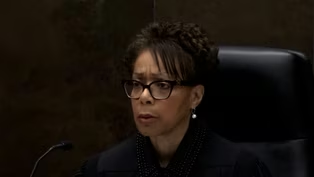
Kentucky Supreme Court Hears Body Cam Case
Video has Closed Captions
Clip: S4 Ep78 | 3m 5s | Case involves police body camera footage used as evidence in criminal trial. (3m 5s)
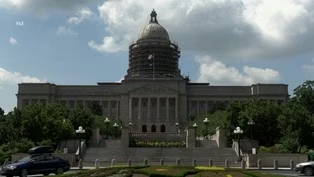
Lawmaker Calls for New Rules for Criminally Insane
Video has Closed Captions
Clip: S4 Ep78 | 3m 28s | State lawmaker wants to introduce "Logan's Law" during next session. (3m 28s)
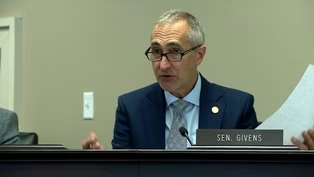
Video has Closed Captions
Clip: S4 Ep78 | 3m 36s | Panel hears from Kentucky Department of Revenue about student debt collection. (3m 36s)
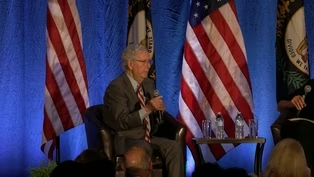
U.S. Senator Mitch McConnell Honored in Louisville
Video has Closed Captions
Clip: S4 Ep78 | 3m 19s | Hundreds gather in Louisville to honor U.S. Senator Mitch McConnell. (3m 19s)
Providing Support for PBS.org
Learn Moreabout PBS online sponsorship
- News and Public Affairs

Top journalists deliver compelling original analysis of the hour's headlines.

- News and Public Affairs

FRONTLINE is investigative journalism that questions, explains and changes our world.












Support for PBS provided by:
Kentucky Edition is a local public television program presented by KET