
Rushville Fitness Center
11/4/2021 | 28m 50sVideo has Closed Captions
Mark McDonald visits a state of the art Fitness Center in Rushville.
Thanks to an anonymous donor and a true community effort, the city of Rushville has a state of the art fitness center.
Problems playing video? | Closed Captioning Feedback
Problems playing video? | Closed Captioning Feedback
Illinois Stories is a local public television program presented by WSIU
Illinois Stories is sponsored by CPB, Illinois Arts Council Agency, and Viewers like You. Illinois Stories is a production of WSIU Public Broadcasting.
Support provided by:


Rushville Fitness Center
11/4/2021 | 28m 50sVideo has Closed Captions
Thanks to an anonymous donor and a true community effort, the city of Rushville has a state of the art fitness center.
Problems playing video? | Closed Captioning Feedback
How to Watch Illinois Stories
Illinois Stories is available to stream on pbs.org and the free PBS App, available on iPhone, Apple TV, Android TV, Android smartphones, Amazon Fire TV, Amazon Fire Tablet, Roku, Samsung Smart TV, LG TV, and Vizio.
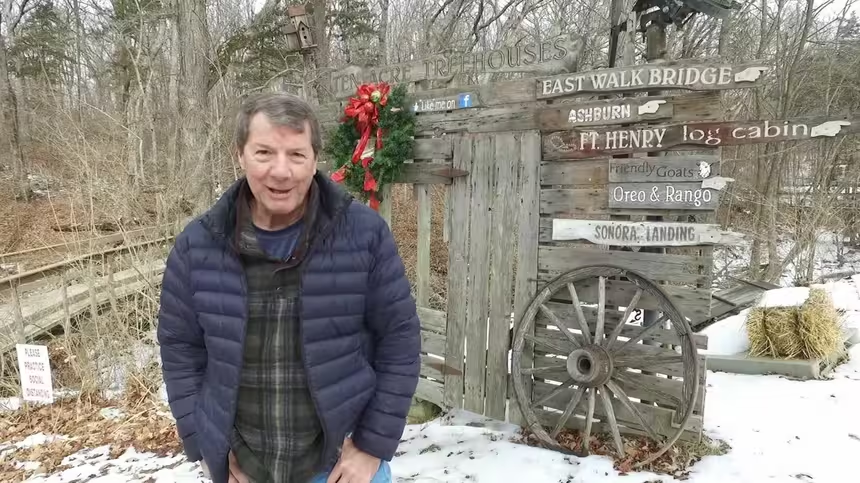
Illinois Stories
Join Mark McDonald as he explores the people, places, and events in Central Illinois. From the Decatur Celebration; from Lincoln’s footsteps in Springfield and New Salem to the historic barns of the Macomb area; from the river heritage of Quincy & Hannibal to the bounty of the richest farmland on earth.Providing Support for PBS.org
Learn Moreabout PBS online sponsorship(Upbeat Jazz music) - Illinois stories is brought to you by the corporation for public broadcasting, Illinois arts council agency, and by the support of viewers like you.
Thank you - Hello, welcome to Illinois stories, I'm Mark McDonald in Rushville.
If you drive highway 67 in Rushville, you'll notice this enormous building has sprung up.
Talk about a community effort.
The city of Rushville donates the land, more than 400 local Rushville residents decide that they're committed to membership.
An anonymous donor gives millions and up Springs, a $7 million 30,000 square foot fitness facility.
And it is truly a community effort.
Becky Jones, Rushville to many of our viewers is a pretty small city.
- Yes It's what three, 4,000 people.
And the people in Rushville now have a really state of the art exercise facility.
It's remarkable.
- It is remarkable.
It is remarkable.
And it's because of an anonymous donor has given the money for this facility to be built.
And for many other things in Rushville, the library, improvements on the princess theater, the humane society and an outdoor pool that was all anonymous donor money.
So we're a blessed community.
And I think I've told you this before that we feel like when as community members, we are on the standing on the shoulders of a giant who gave the money, who believed in this community enough to give them money for these things.
Okay.
- And this is really getting used to as - Ah, yes, - It opened at a pretty precarious time.
(Laughing) - Yes.
- November of 2020 was like right before a spike in the virus happened.
So, so this facility was open for like a week and then had to shut down.
- And then we had to shut down capacity numbers.
It had to change all the group exercise went on zoom as it did statewide.
And then we had to look at capacity numbers.
We couldn't become a 24 7 facility at that time because we were taking temperature.
And as, as everyone came in, so we had to just watch capacity numbers.
And it, it somehow has worked out through this year.
- Yeah.
- For this too, to just go forth, even in a time of a pandemic, but people have been supportive.
And that's why is because the community was ready for this to open.
They had waited almost three years and they were ready for it to open.
So.
- We'll get into specifics about all that later.
But first, when you first walk in, if you come in the main entrance, this is what it looks like.
- This is what it looks like.
- Describe this area, what's this for what's all this.
- Well, this is of course the, the, where you would register, you would scan in.
This is just kind of the, it's a community fun room, free coffee to all the members.
There's vending machines, there's pool, there's foosball.
And just, we have a group of gentlemen that sit every day and have coffee.
There's one of them right there, Jim.
And, but not only them, just a lot of people come and just, it's just a place of fellowship, really?
A place to just enjoy coffee and chat and, and in between workouts or just to come and just sit and relax.
- Yeah.
And then on this side of this, lets go through this door, because this room gets used a lot because it's your, I guess it's your class, not a classroom, but an exercise room.
- Right?
It's the, it's the group fitness room.
It is also just a community room that can be rented out for birthday parties.
It can be rented out for anniversary parties for community meetings, flu clinics.
Right now, Barb is teaching a chair class.
We have a full schedule of classes, so.
- Okay.
So we're here at 10 o'clock in the morning.
So this is a, this is a sit-down stretching, stretching.
- This is chair yoga.
- And for instance, what was in here before, the hour before.
- The hour before was my class, power zone.
So we had 16 people in here before lifting weights and - That's pretty well attended.
- Yes.
And before that was Zoomba class.
And we had.
- So, at 8 it was Zoomba, okay and alotta those - And before that at 6am was a pilates class - Wow, okay - So it's very, it's very utilized room in the morning and in the evening.
- Yeah, And those classes are bigger than this class.
- Yes, yes.
- Yes.
And then later, throughout the day, I guess there'll be other classes in here throughout the day - Yes.
Yes.
Evening classes and noon time yoga class.
On Monday night, we had a big event.
We had a, the swing dance finale where we had 35 people in here that had learned swing dance and people were watching and it was just a good community time.
Yeah.
- Yeah.
So that's a place for, in anybody in the community, if they reserve it right.
It's open to the community.
- It is open to the community Okay.
Where do we go next?
- I'm going to go take you through this way.
That's what we call the brains and storage room.
(laughing) So right here, if you go to the left, it would take you back to the, what I call the coffee area and a charter membership wall.
And Tim will tell you more about that.
I'm sure.
Then we come through this way and we are into the Weight room.
- Thank you.
- This is, if you come around here, this is the part that we could finally open because it's a 20 it's 24 7 access.
This is locked out.
This part is locked out.
The spin room is locked out when we close at night and then, people - Okay, let me get the, let me get this straight.
Okay.
This door over here.
- Yes.
- If you have, if you have a key or a code you can get in here 24 hours a day.
Okay.
And if you want to lift weights or use the exercise equipment, it's open 24 hours.
- It is.
The main part of the building's closed off, but you have shower facilities here.
So if you want to shower up at two in the morning, you can do that.
- Right - And then if you have kids, right, you've got a place for them to, they can be separated and safe here and not get in the way of weightlifters and those kinds of things.
- And then in the evening - That's a pretty fancy, a little gym for kids too.
- Yes, and the evening, there is a staff member that sits here and does some activities with them.
But we wanted not just a place where they sat down, but an active area where they could actually do some fitness things also, while their parents were working out.
- I wish there were some kids here right now.
(Laughing) - And there are most evenings.
- Grown kids.
- This is all Nautilus equipment.
And Colin will tell you a whole bunch more about it.
- Yeah.
- And yeah.
- Well, this is kind of an off time when we got here 30 minutes ago, there were numerous people working out in here.
- Yeah.
You know, here we are.
It's 10, it's 10 30.
It slows down.
Yeah.
- Right.
- And then more, more back here.
This is back here.
- More back here, and then right into the spin room.
There's two ways to access the spin room.
You can access through the gym or through the weight room.
- We'll learn more about this from Tim.
Is it Tim ward who's the spinner?
- Yes, yes.
- Okay.
We'll learn more about this.
As we go through the programme - We have a dozen schwimm bikes.
- Tim, we just mentioned the fact that you are a spinner, right?
- Yes, I am.
- We're in the spin classroom.
And there aren't even, even really upscale health clubs, don't all have a spin room.
This is a pretty, pretty upscale deal isn't it?
- It sure is.
Front from the beginning, we wanted this because we knew a lot of people enjoy spinning.
It's a great cardio workout.
It's one of the best you can.
You can, you can do as far as your, your heart.
So here we have classes at 6:00 AM and five 30 Monday through Thursday, we take Friday off.
We come back for a Saturday morning class at 8:00 AM.
So if you haven't had enough, Monday through Thursday, we'll give you one more shot on Saturday.
- Is it pretty well attended?
- Yes.
Its very well attended.
Yeah.
You would be surprised at the ages and men and women who are involved in and I teach a 6:00 AM Wednesday morning and it's an awesome class.
And people, you get to know each other at the end of 45 minutes an hour, you've had a great workout.
Your body feels great and you're ready to tackle the day.
- You're more than a spinner though.
You are also the president of the board and have been, since it was formed.
- Yes.
- And it was kind of a rocky start because you all were looking for a place.
You knew you wanted that.
The, that the, that the people of Rushville wanted a health club, a fitness center.
And so you did a lot of background work on that.
And you looked at locations and you looked at existing buildings and you looked at properties and nothing quite seemed to work out.
Yeah.
- Nothing fit.
And we try to do as much due diligence as we could, but it was difficult to find the right building with the right size.
And when we did that, when we would look at rehabbing a new that existing building, a subcontractor would come back to us and say, it will work, but it's not energy efficient.
It's still an old building.
It's still gonna cost you a lot of money.
You'd be better off building something new.
That's when our anonymous donor got involved.
- Wow.
- Said I'd like to help.
- Wow.
And not only it wasn't only help that anonymous donor actually put up enough money for you to make the commitment to go forward.
- That's right.
We never had a capital campaign.
Can you, can you believe that?
And here's the great thing about Mark.
When we had the plans were withdrawn.
I sat down with someone from the anonymous donor.
They said, where's the pool?
I said, well, we didn't really, we ran on that.
What's the cost of a new indoor pool.
I said, well, you're probably talking a million dollars.
And they said, well, just add it on.
- Oh, wow.
- Easiest sale in my life.
Okay.
Yeah.
So what a blessing that was, and that completed the facility from indoor swimming, the gymnasium, spin classes, weights, community.
We had everything we'd ever wished for.
Yeah.
- Well, congratulations.
It is beautiful.
And I hear it's getting used pretty well too.
- Yeah.
It's close to 5,000 people every month.
Walk through our doors in a town of 3,200.
- That's great.
It's great.
- So Becky, the anonymous donor says, well, you know, so what's a pool going to cost and this person finds out, oh, you know, maybe a million dollars worth to go ahead and add it on.
- Right.
- Build it.
- Build it.
- And they will come.
And there's Bob, your husband in the pool right now.
- Right, right.
And the research that we've done about fitness centers always came back to one point.
People will join a fitness center because there's an indoor pool.
Even if they never set foot in that indoor pool, they will join because of it.
- Do you think that do you suppose, that's because they think it sounds like something I gonna want to do.
So I'm going to join.
And then they never get around to it or what?
- That could be and for families.
And because you can rent this for birthday parties and that's been very popular.
So.
- Yep.
You got three lanes here and you mentioned your husband, Bob was using the pool.
He really helped design this because you needed a swimmer somebody who really is a swimmer too, to know what the needs are.
So you got a three-lane pool here and it looks like it.
It would be, it looks perfectly functional to me.
It's the right length.
- Yes, 37 Laps down to the end and back.
Will get you one mile.
Actually.
I think Julia told me it's 37 and a half, but that will get you one, one mile.
Also the, we have this piece of equipment here.
It's very easy to pull those ropes out because the lane markers, - The lane markers?
The lane markers because we use this every single day for Aqua exercise, which is probably the most trending thing in fitness right now is Aqua exercise.
- So you got to have those, those, those lane markers out of there.
So you have an open pool - So right.
And the instructor stands over there and on the deck.
Of course.
And then you can get, you can get 20, 25 people very easily in a class - Oh heck yes, easily - Very easily, yeah.
- You also mentioned something I thought was very interesting You don't have a lifeguard obviously on duty.
- Right, right.
- So you're able to people at the front desk are able to keep an eye if there are people in the pool.
- Yes, absolutely.
- And if anybody had any distress of any kind or needed assistance, - Yes.
- That person would know that the cameras are on.
- And this lighting is something that Morton came up with.
It's kind of state of the art because anytime of day, you can on camera, you can see this, especially when you look down in the pool, it's very clear on the camera and you can see if someone gets in trouble.
So also during the day, Mondays through Thursdays, Colbertson Memorial hospital here in Rushville, they rent this for a couple of hours to give therapy sessions.
And that is really catching on.
And that's been very popular too.
- That's terrific for everybody.
- Yes, yes.
- You want to make sure it gets used and they, they need, they need a pool.
- Yes.
- Before we leave this area, I want to show one thing outside here.
Th- this property was not where we see these courts was not originally part of the plan.
Was it?
- It was not the, the owners of the carwash, Keith DeMoss.
And I believe we got some property from the people that live in the house, right.
At the end of that, the Zeke family sold us the extra property that we needed, the, for the pickle ball courts and the tennis courts.
- The pickle ball courts are these small courts toward us - Yes - And then on the other side of the blue curtain would be the tennis courts.
Right.
- Yes, Yes And then when you see the past that that's a batting cage.
- That's an outdoor batting cage.
- Now that is a thing that not, you know, not everybody has.
And it's very with the high school boys love that.
Yes.
- Yes.
The baseball team and the girl's softball team.
And we have a lot of traveling teams.
That's very popular.
- Yeah.
- During the summer.
Yeah.
- Yep.
And while we're on the topic of property, I was surprised to hear that this, this property, that this part of the treatment centers on was donated is that right.
- The city of Rushville - The city of Rushville had the property and gave it to the, to the fitness center.
- For this facility.
- That makes the bite a little bit easier to take.
Doesn't it?
- Yes, and one thing that the city really wanted was the tennis courts, because when the new pool was built, the tennis courts where the, the new pool outdoor pool is built, the tennis courts had to disappear because that's where the pool was built and they were never rebuilt.
So the city wanted that.
Yeah, we did too as a fitness center, we wanted to have the tennis courts and they're popular too.
But those pickleball courts, those courts are very popular.
Yes.
And we can do that inside, too in the gymnasium.
There's pickleball.
- Well, let's go see the gym.
- Okay.
- Wow.
Becky, you can have two full length basketball games going on at the same time in here.
- Yes.
- This remarkable.
- Yes.
The floor is marked.
The green is the pickle ball.
The red is volleyball and the blue and black are basketball.
And then there is a dropdown divider.
And then the netting you see is a indoor batting cage.
- Wow.
Okay.
So if you don't want to get the, you got the one outside and you also have one inside.
- Yeah.
When there's snow on the ground, you can't be outside.
So we had a lot of softball players, especially come last year during the winter to keep that the pitching going and, and the batting skills.
So.
- Yeah, this is really terrific.
Even have a riser.
So if you wanted to be, if somebody had a competitive basketball game and they want to do, you know, use it for that, you could have a, you could have your fans.
- And e have had that with our, our kids basketball program, which was very popular this year.
And they could have two games going.
And of course the parents, because of COVID, that was and Colton can tell you more about that.
They limited the people that they had on bleachers, but because we had this track, the parents could come up here and watch.
- Yeah.
Yeah.
And the track is great too.
I mean, you can see people are using it.
We just talked to a fellow over there that walk six miles a day here.
- Yes.
- And so when you're on the track, what, what equals a mile up here?
- 12 laps.
- 12 laps to a mile.
- Yes.
- Okay.
So he's going to be here a while.
- He's probably, he probably already started an hour ago, so.
- Well, good for him, good for him.
- He does a lot of walking - Spaces like this are hard to find and community groups really need these.
Yep.
- Yeah.
- Well, Colton mail.
This was your first gig.
As an executive director of a health fitness center I think.
- Yes, sir.
- But you were at Lincoln college.
So you worked in the university system in the athletic department, I guess.
- Yep.
I was an assistant baseball coach.
I ran our fitness center.
I was our intermural coordinator and I did strength conditioning for a few sports as well.
- Well, we're in the strength conditioning area right here.
So you feel very much at home.
I'll bet.
- Oh yeah.
This is very much home in here.
- Are you here every morning, working out?
- Usually I try to be at least five times a week and then every other Saturday, I usually assume I'm here outside of work a lot.
- Okay.
So this is cardiovascular equipment over here.
And we can see there is a treadmill, people are familiar with that.
People may not be as familiar with, with this weightlifting system.
So let's walk through and you can kind of describe describe what you have here.
- So the one thing, all of our equipment is from core health and fitness it's a company based out of California and all of our select derived weight equipment on the floor that you're gonna see are from Nautilus, great equipment, been around a long time.
And one thing I really like about the equipment we have here in the last few years, they've changed the technology.
Normally you'd have the pen, you'd pull out, lose them.
Now it's as easy as flicking a switch and you're weights selected.
- Oh, that's nice.
And they don't have to try to hit the hole like we do with pin, you know.
- Nope, you just flip the switch over.
It's like turning the light on or off, and then you're ready to go.
So we've got all these, a select drives equipments throughout the floor.
And every body part you can think of upper body legs, core, arms.
And then we have our dumbbell sets over here.
- I've done weights, yeah.
- So if you're more of a free weight type of person, we've got a small kettlebell collection, some slam balls, lighter weights, things like that.
- Do you have a busy time of day in here?
- Yeah, I would say anytime from about five to 7:00 PM, you know, everybody getting off work and coming out and working out after that.
And I've been, I work out at 5 15, 5 30 and I'll walk in and there'll be people leaving that have already been in in the morning.
They got their whole workout done.
So I'd say probably from about four 30 to six in the morning and then the evenings.
Yeah.
- How many employees do you have?
- 35.
That's in, that's counting group exercise instructors and front desk workers - Yeah.
Most of that is part-time ?
- Yes.
- Right.
But some of it is full-time.
- We have three full-time employees and myself, our maintenance man, bill LeCroy and our, my assistant director, Aaron Rittenhouse.
- 35 Employees.
That's that's kind of a boost to the community too.
- It is, yeah.
- that's terrific.
Okay.
I got to ask you this because you guys opened up right before that COVID spike of November in 2020.
So you get your grand opening, you get people coming in, then what happened?
- Then we had to limit how many people could come in.
Our capacity, got cut from the the hundred percent that it was at down to 25%.
And then it posed a little bit of an issue because then people had to schedule our time slots.
They come in because we can only allow 12 people in this 4,000 square foot room at one time per the mandates.
So did that for a few months.
Then it went back to 50.
And when we went back to 50, we got to bring back our group exercise classes.
So when we had to drop that capacity, we also took all of our in-person classes and offered them via zoom.
So people could still work at home and get a benefit of their membership.
- How did you know to do, I mean, zoom was kind of new at the time.
How did you, how did you get that working?
- I'm actually a part of a Facebook group online of executive directors for non-profit health and fitness clubs.
And I just kind of popped on there and was seeing what everybody was talking about at the time, because everybody was dealing with it.
And I actually pulled that resource from there.
And that's how we got that going.
- Were people using it?
- Yeah.
- They responded to it.
Huh?
- Yeah.
They did.
Yeah.
- Are they still using zoom or?
- Well, we don't know.
Since we've been back in person, we've encouraged our members to come actually see us and socialize.
And you know, - They liked that a lot better, don't they?
- they liked that better than looking at the computer screen.
- No kidding.
And how many, how many members do you have?
- Right now?
Just a touch over 1700.
- Wow.
- Yep, we have a right around 700 units.
So a unit could be one person or a family of five.
So, and that equates to the 1700 members.
- You still can take new members.
So you're not ever going to acetate.
You can do it.
What's your square footage of the total, the whole place?
- The whole place.
I want to say it's right around 20,000, maybe a little bigger.
If you count in, that's just the structure itself.
Not counting the courts, but yeah, probably 20,000 a little more because this is four the gyms 10 and then I'm not sure on the hallways and lobbies and everything.
So I'm just estimating.
But that'd be my guess.
- I I'm, I'm really pleased to hear that it's getting used the way it is because you know, you would hate to see something so much work went into this and that one anonymous donor puts so much emphasis on this for this community.
That if it weren't being utilized, you'd go, oh man, what's the point.
Yeah.
- Yeah.
So the really cool thing about that was before this really got going off the ground and you guys are gonna talk about it here in a little bit, but you'll notice the wall in the hallway down here has all the names on it.
Without those people, this place wouldn't exist.
So those are the names of people the donor said, Hey, I'll do this, but make sure it's going to be sustainable.
Get 400 names.
They ended up getting 430.
That was prior to my hiring, took it to the donor and said, look at this, the community stepped up and then now we're standing in it.
- All right.
Thanks Colton.
- Hey, no problem.
Thank you.
- Harold Sergent, you're one of the original board members.
And the reason I wanted to talk to you in front of these charter members here is because it's a couple of years ago, you, you all figured, well, you know what?
We can't do this unless we have some commitment right from the communities.
- Yes, yes.
- And they really responded didn't they?
Who are these folks?
- Well, I actually wrote the original business plan for the fitness center.
And we knew that we needed about 400 member units, families, individual people to make this thing a going concern.
So we launched a membership drive in June of 2018, actually over three years ago.
And we pushed to get 400 people signed up or 400 units, families, individuals signed up and we ended up with 435 member charter member units at that point in time.
So those people, and at that point in time, you just had to make a commitment, pay a registration fee and say that you registered, interested, fill out your membership information and so forth.
And those people knew it was going to be some time before we had a facility for them to actually come to, but those people have stuck with us.
And so these are the charter members and we actually made the commitment that we would have a charter member wall and put their names on our charter member wall.
So if you look at it, it says established 2018.
That was actually when we formed the Rushville fitness and community center as a 5 0 1 C3 corporation.
And then we opened in November, actually November the ninth of 2020, just about a year ago now.
And our membership has actually grown since then from these original 450 units to about 750 units at this point in time.
So community support has just been.
- My guess is that this the anonymous donor would not have been interested in helping you build this without this level of commitment.
- Th this helped make our case with the anonymous donor.
Yeah.
- I got to ask you, who is the anonymous donor?
I got.
- I actually don't know who the anonymous donor is.
Honest to goodness.
It's all done very discreetly through the Chicago community foundation or Chicago community trust.
And I, I honestly can say I have never met and you know, so - And you don't want to know because you don't want people asking you about it.
So the.
- The community has done an excellent job of being very discreet about this.
So.
- Okay.
How about these financial challenges going forward?
Are you in good shape now, or are you still concerned about, about growing this to the point where you'll be able to pay your bills.
- A year and a half ago?
Mark, I was sweating bullets about what this is going to look like when we finally opened our doors and I really sweating bullets and waking up in the nights and how's this going to work and where we are today?
I am so pleasantly surprised.
I mean, like I said, community support has been great.
Our membership has actually grown.
So we are, we are solid financial shape right now, obviously having an anonymous donor to finance the facility.
But we are on our own.
At this point in time, we have to make this a going concern as a small business, essentially.
And that was the agreement all along with the anonymous donor.
So retention is going to be key.
So we're coming up on our one year anniversary and how people sign up for the next year and the next two years.
- Yeah.
- And you you've been out in the gym here and seen some of our sponsors and donors.
And when we started our first drive fundraising drive here in the community, we asked people to make five-year commitments.
So a lot of those donors and sponsors have actually made five-year commitments, not one year commitment because getting into the second, third and fourth year is key to making something like this work long term, - That's what you need.
- And even though, you know, the building was donated to us with a facility that's over $6 million, we have to be putting away over a hundred thousand dollars a year and into a capital replacement fund because things like our, our HVAC units are going to need replacement.
- Sure, sure.
- And even the equipment down in the fitness room will need replacement in a few years.
And there's a, you know, one can go to, and I'm actually in the process of doing this right now, putting together a schedule of the equipment and furnishing windows, HVAC, and so forth within this building, what the expected lifetime is and what sort of, how much money we should be putting away each year to fund that going forward.
And that's part of our campaign to, to, you know, continue the community support for this.
But, but it's been excellent so far.
I'm really, really pleased.
- Thank you, you should be proud.
Thank you - That we are, we are.
Community effort - Coming up on a year, open 1700 or so people already joined and they're asking for the community to ,their saying hey, there's more capacity.
Come on along.
With another Illinois story in Rushville.
I'm Mark McDonald's.
Thanks for watching.
(Jazzy upbeat music) - Illinois Stories is brought to you by the corporation for public broadcasting, Illinois arts council agency, and by the support of viewers like you.
Thank you.


- Arts and Music
The Best of the Joy of Painting with Bob Ross
A pop icon, Bob Ross offers soothing words of wisdom as he paints captivating landscapes.





 New Episode


 Recently Added

Support for PBS provided by:
Illinois Stories is a local public television program presented by WSIU
Illinois Stories is sponsored by CPB, Illinois Arts Council Agency, and Viewers like You. Illinois Stories is a production of WSIU Public Broadcasting.