
Ruth Carter exhibit at The Wright, Dance Theatre of Harlem
Season 51 Episode 42 | 26m 46sVideo has Closed Captions
Ruth E. Carter’s Afrofuturism exhibit and Dance Theatre of Harlem’s Detroit performances.
Oscar-winning costume designer Ruth E. Carter showcases her illustrious career as a costume designer in a new exhibit, “Ruth E. Carter: Afrofuturism in Costume Design,” at The Wright Museum. Plus, Dance Theatre of Harlem Artistic Director Robert Garland shares details about the troupe's upcoming Detroit performances and how the pandemic has influenced the current and future landscape of dance.
Problems playing video? | Closed Captioning Feedback
Problems playing video? | Closed Captioning Feedback
American Black Journal is a local public television program presented by Detroit PBS
Ruth Carter exhibit at The Wright, Dance Theatre of Harlem
Season 51 Episode 42 | 26m 46sVideo has Closed Captions
Oscar-winning costume designer Ruth E. Carter showcases her illustrious career as a costume designer in a new exhibit, “Ruth E. Carter: Afrofuturism in Costume Design,” at The Wright Museum. Plus, Dance Theatre of Harlem Artistic Director Robert Garland shares details about the troupe's upcoming Detroit performances and how the pandemic has influenced the current and future landscape of dance.
Problems playing video? | Closed Captioning Feedback
How to Watch American Black Journal
American Black Journal is available to stream on pbs.org and the free PBS App, available on iPhone, Apple TV, Android TV, Android smartphones, Amazon Fire TV, Amazon Fire Tablet, Roku, Samsung Smart TV, LG TV, and Vizio.
Providing Support for PBS.org
Learn Moreabout PBS online sponsorship- Coming up on "American Black Journal," costume designer Ruth E. Carter talks about a new exhibition of her designs at the Wright Museum and about making history as a two-time Oscar winner.
Plus the Dance Theatre of Harlem is returning to Detroit.
I'll talk with the troops artistic director about the upcoming performances and the history of the internationally acclaimed company.
Stay right there.
"American Black Journal" starts right now.
- [Narrator] From Delta Faucets to Behr Paint, Masco Corporation is proud to deliver products that enhance the way consumers all over the world experience and enjoy their living spaces.
Masco, serving Michigan communities since 1929.
Support also provided by the Cynthia & Edsel Ford Fund for journalism at Detroit Public TV.
- [Narrator] The DTE Foundation proudly supports 50 years of "American Black Journal" in covering African American history, culture, and politics.
The DTE Foundation and "American Black Journal" partners in presenting African American perspectives, about our communities, and in our world.
- [Narrator] Also brought to you by Nissan Foundation and viewers like you.
Thank you.
(gentle upbeat music) Welcome to "American Black Journal."
I'm Stephen Henderson.
A new exhibition featuring the original designs of Academy award-winning costume designer Ruth E. Carter is on display at the Charles H. Wright Museum of African American history.
The exhibit is called "Ruth E. Carter: Afrofuturism in Costume Design," and it includes costumes from iconic films like "Black Panther," "Coming 2 America," "Selma," and "Malcolm X."
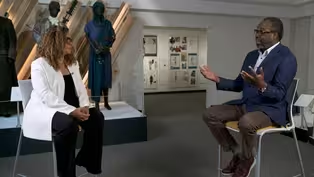
I had a chance to sit down with Carter to talk about her stellar career and the inspiration behind her creative designs.
Ruth Carter, welcome to Detroit, and welcome to "American Black Journal."
- Thank you.
Thank you for having me.
- It's really great to have you here.
Among, as you said, when you walked in, all of your children... - All of my children are here with us.
- That's a really great way to think of all the work that you do.
You know, taking in all of this work, the time over which it all unfolds, of course, in the range, but I always wanna start with artists talking about inspiration.
Where do you come up with all of these things?
- So each project has its own story and its own process.
Some of the process is the same.
You know, for me, I like to have conversations with the director and the production designer, and that sort of dictates what colors you're gonna use.
But also there is, you know, the research of the storytelling and what's the time and place, what was happening during that time, and then that travels you down another road.
So it really is like one step at a time.
We do a lot of illustrating.
And you know, like, when I look at some of the photographers of the time like James Van Der Zee and Teenie Harris, you know, it's inspiring to bring some of those images to life, and that's where a lot of the images come from.
- Yeah, yeah.
I know it's unfair to ask an artist which are their favorite (chuckles) children, but some of the work really stands out as maybe a more personal expression, or more of you that you put into it to make a statement.
- You know, I get that question a lot, favorites.
You know, they're like, my children.
I can't have a favorite.
- I can't choose.
- But there are some that the whole experience was amazing.
I mean, being in the desert, at the pyramids in Egypt, on a Spike Lee Joint, doesn't get much better than that.
But at the same time, you know, learning about our journey from when we landed here, going through all of the different ways we clothed ourselves, and I didn't know that they had these special places on the plantations that were just dedicated to spinning cloth and sewing garments.
And so that was exciting for me, you know, to get into that.
So, you know, every single one.
I mean, of course, "Black Panther" being a very, very special film.
- Sure.
- It is like a favorite.
I learned a lot.
Even after 30 something years in the business, I was still learning.
But, you know, "Malcolm X" was wonderful too.
So it's hard to really say one.
As soon as I say one, I think of another one.
(Stephen chuckles) - Right, right.
And again, the range of of material here, in terms of the story, it's so broad.
I mean, clothing people for "Roots" is really different than clothing people for... - Wakanda.
- Wakanda, or for "Do The Right Thing."
- But actually it isn't.
- It's not.
Okay, tell me why.
- It really isn't.
I have utilized the African diaspora on everything.
- On all of them, okay.
- And sometimes it's the way we combine the colors.
Sometimes it's bringing in the messages, you know?
In "Do The Right Thing," they had little lanyard that they would wear around their necks, Africa with the colors of the flag, and, you know, kitenge.
And we used a lot of Ankara in "Do The Right Thing."
So just like, you know, you and I, you know, we can trace our roots back.
- Sure - And that's the same with clothing.
We can look at clothing like for "Roots," I wanted to use like the indigo, and how, you know, indigo was used quite a bit in Sierra Leone.
And so I used the blue as a family color.
And I carried the blue in every episode of "Roots" reboot because I wanted to have a lineage and a legacy.
So really there is a lot of our past woven in the present - To all of it.
- Yeah.
- Yeah, yeah.
We also have here on the exhibit the sewing machine.
I believe you used as a child.
Is that right?
- Yes, my sewing machine that was in my room.
- Yeah.
- My mom put it in my room.
Actually, it was folded up and it looked like a desk.
- Okay.
- So, you know, I guess my mother like pushed that thing in my room and said, you know, she can do her homework on it, or maybe she'll discover that this is a sewing machine and she'll wanna use it.
- Yeah.
- You know, single parent household.
You know, there's eight children, five brothers and two sisters.
So, you know, we were very inventive as kids.
I have two brothers that are artists, and they were painters and sketch artists.
They didn't work at that, that wasn't their primary job.
I mean, I'm a child of the '70s, you know, and so they were before me.
And we had to actually go get a job, you know, and painting was like a hobby.
So I had that sewing machine in my room, and when I discovered it, it kind of replaced my sketchbook.
So I like to think that I'm the sum of my parts.
That I had this love for sketching and drawing that I got from my brothers.
And then I discovered this way of working with textiles and making art with the sewing machine.
- Yeah, what was it back then that was attractive to you about the sewing?
Is it material?
I always think that for people who are making costume, for instance, material, obviously, plays a huge role, but also that feel of that material as you're working with it.
- Yes.
I think as a kid, no one was giving me instruction, right?
- Yeah.
- So I looked in the drawer and there was like a Singer pattern in there, and I was like, "What is this," you know.
And there's like this white lady on the pattern and she's posing in some kind of outfit.
And I was like, "I'm gonna make that."
And just the journey of learning the instructions inside, and you know, as I said, my mother wasn't going to the store and buy me reams of fabric.
So I was going in the attic and getting like... You know, that was the place where clothes went to live in infinity.
And I would get things from there and repurpose them and turn jeans into skirts and, you know, jean jackets and things like that.
So I think it was the exploration of how I could change things, you know.
There were scissors in there and sewing needles, and how I had to learn how to thread the machine.
And so it was like this exploration.
And I thought like, "What could I make with this?"
- Sure, sure.
- You know.
- Yeah, and so how do you get from there to this could be a career, this could be a life?
- Yeah, I guess you could say that, you know, I was a costume designer even then, right?
Because I never wore anything that I made.
I was like trying to create things.
And so from there, I actually went to Hampton to study special education.
So I don't know why there was a disconnect.
Well, I do know why, you know.
You know, my mom respected teachers.
It's like an old thing that, you know, we as a Black community, teachers, nurses, you know, were held in high esteem because that's how we survived.
And I didn't know really what I wanted to major in, but education was something that she was pushing for me.
And so I went and I majored in special ed.
But after two years, I realized, from a lot of experiences I had in the summers, that I wanted to be in theater.
And I changed my major two years into Hampton to theater arts.
And so that was different, you know?
And I was auditioning.
And then one day, I didn't make an audition and the instructor asked me if I wanted to do the costumes.
He says, "We don't have anyone to do the clothes, so if you wanna do the costumes for the play, you know, if you don't have a part?"
I was like, "Hmm, okay."
(Stephen laughs) But it stuck.
- Apparently, right?
(both laugh) - I enjoyed it.
And I saw that you could actually, not just examine one character, all of the characters became an exploration for me.
And I could sit back in the audience and I could see how the colors work together on the stage.
And so I think like there's like this artist in you that really does want to emerge and come out.
- Yeah.
- And it comes out in lots of ways.
And for me, it started with sketching, and then it went to kind of playing with sewing machine and figuring things out to the stage.
- Yeah, yeah.
In a lot of ways, I feel like when I'm watching movies, the clothing that the characters are wearing is speaking as much as they are, right?
It's a part of their voice.
It's a part of who they are.
And I always wonder if the person who made the clothes is thinking of it in that way.
Are you giving them voice through what they're wearing?
- Yes, that's wonderful.
And awareness, because that's exactly what we do.
And, you know, we're storytellers first.
A lot of people want to, you know, put us in the fashion field.
And even though we love and appreciate fashion, we're actually storytellers, you know.
People think I got into this because I had dolls, or I like Dior, and I do.
But it was really like playwrights and poets that I learned about.
And I could see the images, especially with Black theater.
And it was, well, a way of me connecting to my community and really embracing, like, you know, the images that I could bring to life that I saw at the Schaumburg when I looked at the 1940s Harlem for "Malcolm X."
It was like, "Wow, I need to figure out how to bring these images to life."
And I think that's what you see when you see these garments performing, 'cause the garments are performing too.
- Are performing as well.
Right, right.
So you are the first African American woman to win two Oscars.
- Yeah.
- I mean just saying that, (chuckles) it's kind of remarkable, right?
- Surreal.
Yeah, thank you.
- But the work that took you to that moment is also really special.
I mean, it's special to so many people.
- Yeah, yeah.
- Talk about the Wakanda.
- Yeah, well, I worked really hard.
And you know, when I met Ryan Coogler at Marvel, I had amassed a lot of images on my computer in a Dropbox.
I didn't know that once you got into the Marvel studio that you couldn't open things like Dropboxes.
You know, they have a firewall.
And I'm kind of a little concerned because I'm in an interview and I can't open the images that I collected over days to show him.
And he was sitting there very relaxed.
And now that I've worked with him on two movies, I see that disposition.
I can remember this disposition.
Even though it was new to me then, he was very laid back.
He was very patient, and he said, "Ruth, I'm really glad you're here.
I was a little boy growing up in Oakland when "Malcolm X" came out.
And I remember, it was a family environment in the theater.
People are excited about the movie opening.
I went with my family.
I sat on my dad's lap and watched "Malcolm X."
And I remember as a little boy seeing the costumes."
- Wow.
- And when he said that, you know, what I was concerned about on that Dropbox was no longer important.
- That's not the issue, right?
- Yeah, and I realized I could contribute something to this young man.
He had studied Spike Lee's work.
He had studied, and consequently my work.
And I felt like I really have something that I can give to this filmmaker.
And so with that spirit, I...
Eventually, I did get to show him everything that I had.
But with that spirit of sharing and knowing that I was in a position to give him something, it made our relationship very strong.
So I could walk up to Ryan Coogler on set, and it would be a welcoming feeling.
It wouldn't be where I was afraid or intimidated or... You know, sometimes that does happen in Hollywood.
It was a family spirit and... - You created a Black world together.
- We created this world together.
- Yeah.
- It was a very collaborative field.
Hannah Beachler was nominated and won also.
You know, there's a cinematographer that's talking about the lighting.
So the understanding of the whole, the whole thing is very important.
So by the time it was released, the trailer came out, I was sitting there watching.
And I immediately started getting like text messages and tweets and all kinds of stuff.
And I thought, "Wow, this is really gonna be big."
And then there I was on the Oscar stage and Spike Lee was in front of me.
- [Stephen] Oh wow, oh my goodness.
- And part of my speech that I went off book was the very beginning where I said, you know, "Thank you Spike for my start."
- Right.
- "I hope this makes you proud."
- [Stephen] (chuckles) Right.
- And he leaped up out of his chair.
(both laugh) So I felt I had such a special night, winning that Oscar.
Not only being the first African American to win the Oscar for costume design, to have my mentor, Spike Lee, sitting right in front of me from the stage.
And also to bring this "Black Panther" film, this, you know, African fictitious place of Wakanda.
- Right.
- But this beautiful world of Africa to bringing it to life.
- Yeah.
- It was the perfect film to win the Oscar for.
- Yeah, yeah.
And you can see Ruth E. Carter's designs at the Wright Museum through March 31st.
The acclaimed Dance Theatre of Harlem is also coming to town with performances at the Detroit Opera House on October 21st and 22nd.
(gentle rhythmic music) (waves lapping) - [Narrator] My mother left Trinidad when she was three years old, but Trinidad never left her.
The music, the rhythms, the food, the culture, (waves lapping) carnival, church bells, they never left her.
(upbeat rousing music) (rhythmic music) - The company combines classical ballet with the music of the cultural movements and communities that inspired its creation in 1969.
I spoke with artistic director Robert Garland about the troop's innovative style.
Robert Garland, welcome to "American Black Journal."
- Oh, it's good to be here.
I love Detroit.
So it's a very exciting moment for me.
- Yeah, yeah.
So we're excited that you guys are coming to Detroit.
Tell us what people who go to the show are gonna expect and experience.
- Well, it will be a performance at the Opera House.
I want to say typical dance at the Harlem theater, but, you know, I mean, I've always said our company is for the people by the people.
And so the program is full of things that are for people that are looking for, things that touching the Black experience, to contemporary, to the purely classical.
So it's a mix of things.
Opening the program will be my ballet "Return," sets the music of James Brown and Aretha Franklin, which is a crowd favorite.
- Yeah.
- And then we move into a Balanchine ballet, who is Arthur Mitchell, our founder's mentor, which is purely classical.
Then there's a duet called When Love, which is contemporary.
We're closing with something called Blake Works IV, choreographed by the great and well-known choreographer, Bill Forsythe.
- Wow.
- So, it's a well-balanced program.
- Yeah, yeah.
One of the great things about the Dance Theatre is the way it draws on history and the movements that have shaped our history to kind of present, you know, modern dance, modern interpretations of it.
I would imagine that that's an ever changing dynamic and equation though, right?
Like how you draw in the past to frame the present.
- It definitely is.
It definitely is.
Last year, I premiered my Stevie Wonder ballet, of course, in Detroit, (Stephen chuckles) which is much of the same thing.
I often say that, you know, there are two major institutions devoted to dance that were founded by Black people.
That is of course Alvin Ailey, and it's founder Alvin Ailey, and Dance Theatre of Harlem, founded by Arthur Mitchell, who knew Alvin Ailey very well, by the way.
They worked together on several Broadway shows.
But I've always said that Dance Theatre of Harlem is unique in the sense that we were founded after the civil rights movement.
- Yeah.
- That we were the company that said, "You know, what, why can't we do ballet?"
- Right.
- When Arthur Mitchell first started then, he said, "Ballet, Harlem, how is that gonna go together?"
And it did.
And it still does to this day, 54 years later.
- Yeah, yeah.
Talk about the dance and the comeback of live performances since the pandemic and the fact that we can all enjoy these things in each other's company again.
What's different about it now?
- You know, what's different, I think, is that we have a complete appreciation for being with one another that we did not have heretofore.
- Yeah.
- I will shift a little, I was director of the school before I was artistic director.
And prior to the pandemic, our three-year-olds, when they would audition, there was a lot of crying, lots of screaming, they'd start classes, lots of separation anxiety, all of that.
Since the pandemic, the three-year-olds are with each other, they put their hands on their shoulders.
They do their choo-choo train.
They wave goodbye to their parents and they keep it moving.
And I think that that has come about because they had no physical interaction with any other kids for almost a year and a half.
- Yeah, sure.
- You know, and so that has been a blessing.
And so the theater is happening in much the same way.
- Yeah.
- Being with one another in these spaces, be it church or the theater, where we get to share the things we love.
- Yeah, and I would imagine, of course, the response that you're getting from these live audiences is, you know, celebration, but also relief, right, that this is all back.
- That's right, celebration and a lot of relief.
- Yeah.
- You know, here in Harlem, and for our people nationwide, you know, we were the first responders.
- Right.
- Our parents and the schools were first responders.
Our communities were first responders.
So we bore the brunt of a lot of the things that happened that were not so pleasant.
So this gives us an opportunity.
Yes, go see the Little Mermaid, but then also come to see Dance Theatre of Harlem.
- Yeah.
- Where you get to meet and greet and see people live, and, no pun intended, in living color.
- Yeah, right.
(chuckles) I also wanna talk about the future of Black dance, Black performing arts.
I mean, you work with young people.
You see them and interact with them.
How hopeful are you about what's to come?
I mean, all of this changes over time, of course, but we gotta keep it going.
We gotta sustain it.
Where do you see that coming from?
- I see that coming from local communities, you know.
By and large, the dance environment in the major areas, New York, LA, Detroit, often relied on a lot of out of town activity moving inwards.
And I think the pandemic helped us to kind of get to a space of understanding that, hey, you know there's someone right down the street.
You know, there's someone that's right here that can help to create a vibrant arts environment.
So for me, that is what I'm looking for.
And also relationship with communities that are similar to Harlem.
- Yeah.
- I love Detroit.
Arthur Mitchell, our founder, love Detroit.
- Yeah.
- Our executive director, Anna Glass is from Detroit.
You know, so I'm just really excited to, not only have a performance, but also reengage with people that I don't consider as just colleagues but also family at the Opera House and et cetera.
- Yeah, as you mentioned before, you're in this role somewhat newly, but you've been with the Dance Theatre for some time.
Talk about the things that you're seeing and experiencing for the first time.
- Well, you know, as I said in another space where I was talked to a funder, actually.
- Yeah.
- I said, you know, I was resident choreographer and I ran the school.
So I ran the school and I created work for the company.
And in that space as a choreographer, I'm sort of like the babysitter, you know?
But now I'm the parent.
- Yeah, right.
- And it's a completely different vibe.
Like completely different, you know.
So not only do I, you know, come in for the moment as not as the babysitter, but I come in, I have to make sure everything's in place.
I have to put the tours together.
I have to be that person.
And so it's been very exciting, very different, but very exciting for me, this shift into the artistic directorship role.
- Yeah, yeah.
Okay, well, we're excited y'all are coming to Detroit.
We, of course, love to see the theater here, but thanks for coming and talking to us on "American Black Journal" as well.
- Thank you so, so much.
It's an honor and a pleasure, Stephen.
- That'll do it for us this week.
You can find out more about our guests at americanblackjournal.org, and you can always connect with us anytime on social media.
Take care, and we'll see you next time.
(gentle upbeat music) - [Narrator] From Delta Faucets to Behr Paint, Masco Corporation is proud to deliver products that enhance the way consumers all over the world experience and enjoy their living spaces.
Masco, serving Michigan communities since 1929.
Support also provided by the Cynthia & Edsel Ford Fund for journalism at Detroit Public TV.
- [Narrator] The DTE Foundation proudly supports 50 years of "American Black Journal" in covering African American history, culture, and politics.
The DTE Foundation and "American Black Journal" partners in presenting African American perspectives about our communities and in our world.
- [Narrator] Also brought to you by Nissan Foundation and viewers like you.
Thank you.
(gentle music)
Dance Theatre of Harlem returns to Detroit on 2023-2024 tour
Video has Closed Captions
Clip: S51 Ep42 | 8m 28s | Dance Theatre of Harlem returns to Detroit Opera for its 2023-2024 tour performances. (8m 28s)
Ruth E. Carter’s Afrofuturism exhibit at The Wright Museum
Video has Closed Captions
Clip: S51 Ep42 | 15m 35s | Oscar-winning costume designer Ruth E. Carter’s exhibit at the Charles H. Wright Museum. (15m 35s)
Providing Support for PBS.org
Learn Moreabout PBS online sponsorship
- News and Public Affairs

Top journalists deliver compelling original analysis of the hour's headlines.

- News and Public Affairs

FRONTLINE is investigative journalism that questions, explains and changes our world.












Support for PBS provided by:
American Black Journal is a local public television program presented by Detroit PBS