One-on-One
Ryan Stevens; Rakia Reynolds
Season 2024 Episode 2669 | 26m 46sVideo has Closed Captions
Ryan Stevens; Rakia Reynolds
Ryan Stevens, Founder & Organizational Coach/Speaker at cATalyzing Coaching & Consulting, shares his perspective on the connection between trust, collaboration, leadership, and building collaborative teams. Then, Rakia Reynolds, Founder and Executive Officer of Skai Blue Media, discusses entrepreneurship and why she believes authenticity is one of the most important qualities in business.
Problems playing video? | Closed Captioning Feedback
Problems playing video? | Closed Captioning Feedback
One-on-One is a local public television program presented by NJ PBS
One-on-One
Ryan Stevens; Rakia Reynolds
Season 2024 Episode 2669 | 26m 46sVideo has Closed Captions
Ryan Stevens, Founder & Organizational Coach/Speaker at cATalyzing Coaching & Consulting, shares his perspective on the connection between trust, collaboration, leadership, and building collaborative teams. Then, Rakia Reynolds, Founder and Executive Officer of Skai Blue Media, discusses entrepreneurship and why she believes authenticity is one of the most important qualities in business.
Problems playing video? | Closed Captioning Feedback
How to Watch One-on-One
One-on-One is available to stream on pbs.org and the free PBS App, available on iPhone, Apple TV, Android TV, Android smartphones, Amazon Fire TV, Amazon Fire Tablet, Roku, Samsung Smart TV, and Vizio.
Providing Support for PBS.org
Learn Moreabout PBS online sponsorship- [Narrator] Funding for this edition of One-On-One with Steve Adubato has been provided by The North Ward Center.
The New Jersey Economic Development Authority.
The New Jersey Education Association.
Wells Fargo.
PSE&G, committed to providing safe, reliable energy now and in the future.
The Russell Berrie Foundation.
Making a difference.
The Fidelco Group.
Prudential Financial.
And by Englewood Health.
Promotional support provided by CIANJ, and Commerce Magazine.
And by Northjersey.com and Local IQ.
Part of the USA Today Network.
- This is One-On-One.
- I'm an equal American just like you are.
- The way we change Presidents in this country is by voting.
- A quartet is already a jawn, it’s just The New Jawn.
- January 6th was not some sort of violent, crazy outlier.
- I don't care how good you are or how good you think you are, there is always something to learn.
- I mean what other country sends comedians over to embedded military to make them feel better.
- People call me 'cause they feel nobody's paying attention.
-_ It’s not all about memorizing and getting information, it’s what you do with that information.
- (slowly) Start talking right now.
- That's a good question, high five.
(upbeat music) - Recently my colleague on our sister program Lessons in Leadership, my colleague Mary Gamba and I sat down and spoke to a gentleman by the name of Ryan Stevens, speaker, organizational coach with an organization called Catalyzing, Coaching and Consulting.
What did we talk about?
Teamwork.
An old mentor of mine back in the day when I was playing football.
I was a place kicker, so some people say it wasn't really football, but the reality is he said there's no I in team.
And so the question is what does a great team look like?
What does it take in this post COVID world to be cohesive and be together with a lot of different egos?
People have different agendas.
That's exactly what Ryan Stevens talks about.
Teamwork in 2023 and beyond.
Welcome to Lessons in Leadership.
Steve Adubato, Mary Gamba.
Mary we have a fascinating guest who has props.
I thought I had props here.
I got a giant thing.
I got a Jet football.
I've got all kinds of props here.
I got T-shirts.
By the way, can people go on our website, Mary, to get a T-shirt?
- I have my prop too.
Actually we didn't put it on our website, but why don't I?
That'll be fun.
- Yeah, it's a hundred bucks a shirt.
Hundred bucks a... No I'm joking.
It's not.
It's going on our website.
We're gonna put it up there.
But Mary, do me a favor introduce Ryan 'cause we're gonna talk about team building and you are a great team member.
- Absolutely.
Ryan Stevens, nice to have you with us.
Speaker and organizational coach for Catalyzing, Coaching and Consulting.
Ryan, thank you so much for being with us today and for just bringing the energy level.
It's just a pleasure to have you on.
- Absolutely.
So glad to be here.
Steve I know you like props.
That's why I had it ready to go in case it came up so.
- Okay, I got this ball from the Somerset Patriots.
Patrick McVerry, the general manager there recommended you.
Did you know that I threw out the first pitch at a Patriots game and threw a 94 mile an hour strike off the mound?
- I did.
Actually I saw the video.
It looked like a two seam that was movement on it and it was, you know, people talk about it still to this day.
- It's like the shot heard around the world, right.
It's like everybody has heard about this.
- Since leadership is about being honest, it was actually not on the mound.
It was at the bottom of the mound and is, it was 56 miles an hour.
I just wanna clarify that.
- Did they actually, did they actually clock it?
- No, I made that Mary, I made the whole thing up.
Will you stop?
So do us a favor, Ryan, Catalyzing Coaching and where the heck's the name come from?
When people see the graphic, they're gonna be like, hey, what's up with that?
Go ahead.
- Absolutely.
First of all, when it comes to the catalyzing, you know, the catalyzing concept is something that sparks change in something else.
And that could be in a good way or a not so good way.
So the catalyzing brand, the igniting potential being a spark or finding, helping someone bring out their own spark, that's really where the brand came from, when I launched my podcast four years ago, the Catalyzing podcast.
The Catalyzing Coaching and Consulting, the big A and T is for awesome teams.
My foundation for 20 years, I've been a licensed healthcare provider, an athletic trainer.
So of course there's the AT there, but awesome teams is really what I'm here to help guide organizations for because it feels really great to be a part of that.
And there's so many different things to go into that.
- Good stuff.
And Ryan, you also came from our good friend Rob Sansone up at Fedway.
Talk about great teams.
Our company, our firm Stand and Deliver has been doing the, leading the Fedway Leadership Academy for going into the third year.
And I'll tell you that is a great team, Fedway is a great team.
It also happen to be a sponsor of Lessons and Leadership, if you will.
But I gotta ask you this, is being a great team member.
Our daughter is 13 playing softball and there are times when she's doing really well.
She's a great team member.
But she literally, I hope she's not watching this.
She got pinch run for the other day because someone was actually faster than her on the team and I saw her sulking and not happy and she went out to play third base next inning and made an error.
And I could tell she wasn't there.
Question.
Is it natural for us to be great team members and sometimes realize that the coach makes a decision that's best for the team, even if we don't like it?
I know that's complicated.
Not about our daughter, it's about being a team member, which ain't about us.
Go ahead.
- No, that's a great question.
And I think that's one of the biggest challenges leaders face now with such a diverse workforce.
And then you've got people that are working hybrid, they're working remote, they're in the office.
You have all these personalities, all these different areas that people, that are important to each of those team members.
I feel one of the most important things you can do as a leader is really empower the concept of shared leadership.
What I mean by that is everybody has to take ownership of what they can control and what their role is in the bigger picture.
And it's a leader's job and responsibility to communicate that clearly, but also empathetically.
And what that comes down to is if you have people with different skill sets, they have to be very clear on what their expectations are as well as what their expectations are of the leader, and where they fit into that journey and that mission.
So in the example of that you gave, there may be times where there's someone else on the team that is more appropriate for that role or that project.
- Absolutely.
- And you have, as a leader have to make that decision.
But here's the key.
If you just do it and you move on, that doesn't help the future.
This is an opportunity where you can have a mentorship opportunity or you can build up that person that wants that, tag them together in small group work and then have shared leadership and empower them to be a part of it, which is so crucial.
And then you get them to buy in and then next time that comes out, it's their time to step in and hit.
- As Mary jumps in here.
The mistake that was made was that the coach did not explain, and she's a great coach, love her.
But then the next morning I said, Olivia, "Do you know why you're a pinch run for?"
She goes, "No."
I said, well, so-and-so was a faster runner.
No she's not.
And so now our daughter's delusional about how fast she is.
That being, I'm sorry Mary.
I'll deal with our family issues separately.
Go ahead Mary.
- I swear we share a brain though, 'cause I was just gonna talk about that defensiveness and that defense mechanism.
Steve and I often, I mean-- - I'm so fast!
- Yeah right, and I have talked, yeah.
Ryan, Steve and I have worked together for 23 years.
So I used to be defensive.
I used to not be able to be open to hearing feedback right.
It's a gift they say, yeah, it's not a gift 'cause it doesn't feel like a gift.
If that's a gift it's a gift I don't want.
But how do you manage building a collaborative team where one that, I know you talk a lot about trust, I did my research.
But when you give that feedback to your team members and like Steve was just talking about Olivia, you know, yeah, I'm just as fast or I'm faster than her.
So where does the whole defensiveness and trying to get that team to not be defensive when you are having to make tough decisions?
- And I can relate to that because especially early in my career as a young adult, that was me.
I was stubborn.
I was set in my ways.
I had to, I was really effective at what I did.
But I didn't have a good, I didn't do a good job of accepting feedback.
And what I've learned through, I got my master's degree in humanistic and multicultural education.
I've studied under Dale Carnegie training systems.
Daniel Goldman, the man there.
Emotional intelligence is so-- - I'm just saying.
Go ahead.
- Absolutely.
And what I feel, Mary, it's a great question.
Affirmation and demonstrations of support are so crucial as a leader, but then also a leader, empowering an environment where team members do that for one another.
When you can feel like you can be yourself on the team.
When you can feel a little vulnerable.
And I always took pride in that as a leader, being vulnerable with my team when I needed support with things, when I was looking for feedback because I wanted to be best, my best version for them.
So when you do those things, you bring the walls down, you build bridges, not walls.
So you have to find ways in order to have that conversation.
You affirm them, you provide feedback that's constructive, but you also help them realize it's not that they're being reprimanded or that they're wrong.
It is helping them make a decision together of next time this happens, how do we handle this?
What can we do?
We're all human.
We make mistakes.
As long as we learn from 'em.
But the key is as a leader and team members is having conversations that are open for two-directional conversation that allows you to let that wall down.
- I appreciate that, but Mary, but let's play this out a little bit more.
I will be "Vulnerable," and show my vulnerability otherwise in my family known as weakness.
I don't wanna play word games.
I'll let Mary see it, because there's 23 years, there's trust and whatever.
I can't let the rest of the team know that I am as vulnerable as I let Mary know I am.
So it isn't the degree to which we demonstrate or show vulnerability strategic based on who our audience is?
- It's strategic in terms of who else is in the room, in the audience.
Absolutely.
Because it's a matter of as a leader, it's about them it's not about me.
It's about what is best for my team while I'm driving the bus and putting people in the right position to be successful.
- Is there no, I in team?
- What was that?
- Is there no, I in team?
- I's make up the team, but they have to be a collective we.
So everybody has to be an I in terms of owning their space and what they do.
But the team is the we.
Does that make sense?
- It does.
But I... Mary, real quick 'cause Ryan's with us right now, and I don't wanna take up too much time back and forth.
Mary, do you believe that the rest of the team could and should know that I'm feeling vulnerable as the leader or you as a co-leader of the team feeling vulnerable about fundraising or about our future?
Or do we have to present to them, hey we got this?
- I'm gonna do an answer of both?
I think that the team does need to know that their leader is a human being and that they do sometimes feel vulnerable.
Because once you show that, but then you also give them the confidence in your next breath of, yeah.
You know, is it gonna be hard to reach our numbers this month?
Absolutely.
- Absolutely.
- I feel that.
But I'm gonna, I'm here to tell you that I have the confidence in us and our team to get there.
So I think you need to have a little bit of sprinkling of both.
- Hold on we're taping this late.
Hold on, Ryan, we're taping this.
- Here we go.
- No, I'm gonna do it.
We're taping this in late September.
It'll be seen later.
The season will be over.
It's already over for the Jets.
Robert Saleh, who right now is the coach of the Jets, we don't know what's gonna happen.
Scarlyn's looking at me.
He had to tell his team that their best chance to win was with Zach Wilson, who's probably, I don't know where he is right now as we, as it is gonna be seen.
I don't believe he believed that.
Can he be vulnerable enough to say, listen, I know we can't win with this guy.
I know that we have no chance.
We lost Aaron Rogers.
I mean, what are we gonna do?
You can't put that out there, Ryan right?
- Well I agree with you in that you can't be demonstrating vulnerability in a way that brings others down.
I look at it as demonstrating vulnerability in that we can do this together.
We're gonna figure it out.
We may not have it figured out yet.
Or I need help with X, Y, and Z.
And you know what, Mary, Steve, you two are fantastic at that.
Can I get your support with this, because we have the opportunity to take this on?
So you reframe the vulnerability in a way that is beneficial and brings them in to the shared mission versus looking like it's a me versus them or pointing fingers type thing.
But you're right, there's times where you have as a leader, you have to shield them from the crap.
You have to shield them from the bad stuff and be like, listen, we got this.
This is our best opportunity.
In your head you may be thinking, oh crap, we lost Aaron Rogers.
But, everything is in this guy right now, Zach Wilson.
He's the man.
We're gonna make it happen.
- Well, as we speak, you can't go in and say we suck.
We know we're not gonna win.
You can't do that.
- Exactly.
- Even if you think, hold on.
I'll let you go after this.
Even Ryan, if you think it in your heart and in your head, we stink.
We're never gonna win.
We lost our guy.
He was everything us.
You can't do that.
- You're right.
You gotta build him 'em up.
- No, I'm asking.
You can't do that?
- No, no, you're right.
You have to build up your team.
And that's demonstrating support and affirmation.
- That's Ryan Stevens, speaker organizational coach with Catalyzing, Coaching and Consulting.
We wanna thank Rob Sansone from Fedway and Patrick McVerry.
- There's your prop Steve.
There's your prop.
You got that wrestling belt.
- Oh Mary and I love WWE and what's the other wrestling?
- And AEW.
- AEW yeah.
- It's the Catalyzing team champion.
And then we've got the own your spark side plate.
- [Mary] Oh my gosh.
- [Steve] Look at the... - And the fire within side plate.
- [Mary] I am in love.
- How do we get?
- That belt's amazing.
- I bring this my gigs and people love it.
And my clients, they get to take advantage of some stuff with it.
- That's great.
- Ryan thank you my friend.
Good stuff.
- I appreciate you both.
- Mary and I will be back right after this.
- It's an honor belt.
- [Narrator] To watch more One on One with Steve Adubato find us online and follow us on Social media.
- Folks, recently on our sister program, "Lessons In Leadership," my colleague, Mary Gamba, and I spoke to a dynamic entrepreneur who is very successful and has a powerful message.
She's Rakia Reynolds, who is founder and executive officer at Skai Blue Media.
Rakia is tough, gritty, as I said, a successful entrepreneur, born and raised in Newark, New Jersey.
The message she has for all potential entrepreneurs is important.
You gotta check it out.
Welcome to "Lessons In Leadership."
Steve Adubato with my trustee colleague, trusted and trustee colleague, Mary Gamba.
"Lessons in Leadership."
Mary, how are we doing today?
- Doing really great.
I said every single time we start a new show, you ask me that question and the only attitude that you can have is positivity and greatness.
Though it's another great day.
- It is bordering around four o'clock.
We've been taping since 9:00 AM.
4:00 PM, not AM, that would be insane.
And the energy level is as high as it was when we started.
How does that happen?
- It's just, it's all about a mindset and an attitude, and I say it every time we get to this point of the day, I could probably do about two more shows.
I'm sure our director... (Mary laughs) No, but because we have a talented crew, we plan, we prepare, so it's just really great being here today.
- Well, talk about people who have busy schedules, who multitask, who juggle a lot.
We're joined by Rakia Reynolds, founder and executive officer of Skai Blue Media.
Rakia, good to see you.
- Great to see you, and I am so excited to be here.
I am now impacted by your energy, so thank you Mary, and thank you, Steve.
- That's great.
- Wait, we infected you?
- We're contagious.
- I needed it.
I needed it.
I needed it.
So, thank you.
- I'll tell you who else in a positive way affects and infects all of us, and that's our good friend and board of trustee member at the Caucus Educational Corporation, Michellene Davis, who connected us with you, and so she bats a thousand when it comes to recommendations for "Lessons In Leadership" as I'm losing my voice.
Rakia, tell folks about Skai Blue Media as we put up the website.
What is it?
- So, Skai Blue Media is a strategic communications agency.
I started the agency 11 years ago, and we focus on thought leadership, strategic narrative and story building for people, products, and places.
On the people side, celebrities and C-suite executives.
On the product side, we have Fortune 500 companies, large corporations, and pharma, technology, artificial intelligence.
And the last "P" was place branding, but during the midst of the pandemic, we changed it up a little bit.
We used to be recruited and hired by cities for them to articulate their stories, and one example of that is the Amazon HQ2 bid that all of the cities were working on.
My agency served as the creative director for the city of Philadelphia to help them to articulate their brand story and brand voice.
- I'm curious about this.
I'm fascinated by entrepreneurs, I'm fascinated by people who bet on themselves.
It's a big part of leadership, betting on yourself, having confidence.
Where does your obvious confidence in yourself come from?
- Oh my gosh, I love that question, and, you know, I think for a lot of people, confidence comes from doing.
And if you look confidence up in the dictionary, it is defined by tackling a task.
And if you are an entrepreneur or an intrapreneur, you know, intrapreneur is the person within an organization an entrepreneurial organization that keeps the spark going, you are tackling tasks every day.
So if you can tackle a task, the more tasks you tackle, the more confidence you build.
- Even while you make mistakes and learn from it?
- Of course, that's the best way to learn.
You know, you've gotta skin your knees a little bit, you've gotta fall off the bike a few times to really understand how to, you know, ride uphill and even more.
How do you really coast downhill?
- Pick it up, Mary.
Mary's an entrepreneur.
I just wanna make it clear.
She's highly entrepreneurial inside the organization.
Go ahead, Mary.
- Yeah, definitely, and I would love to talk a little bit more.
You talk about helping organizations and people to build their brands.
Talk a little bit about the connection between storytelling.
Steve and I always say people remember a story.
So talk about the connection between storytelling and building a brand.
What is the link there?
- So storytelling, and you just said it, storytelling is really the beginning, the middle, and end.
Really understanding what that middle is, and the middle is very important because that's your transitional period.
That's when you go from point A, to point B, to point C. Building a brand is a set of feelings, emotions that people are impacted by when hearing or experiencing your story.
So sometimes I think, you know, the antiquated way to look at a brand is the logo.
You know, what colors are you using?
But it's multifaceted now, it is how you're showing up.
it's the verbal, it's the nonverbal, it is the set of experiences that people have when you are no longer there.
What is your legacy?
What is your mark?
What do people remember most about your storytelling?
And in the world of marketing, we say your brand narrative, or your authoritative voice, or your positioning statement.
So it's really being able to build those things up so that you can lead people with an experience, especially today.
- Well, I gotta follow up on that, Mary.
Mary and I, I don't know, 2015 I think the book "You Are The Brand" came out that Mary and I worked on for a couple years.
So assume that you are the brand of Skai Blue Media.
Now I'm gonna put my blue glasses on.
You can't tell 'cause it's not as blue as yours.
I'm gonna try something.
I'm gonna guess, Rakia, your glasses today, do they have anything to do with the brand Blue Skai?
- Oh my goodness.
I'm glad you asked, Steve.
It has, absolutely.
- There it is.
- It has absolutely.
And my shirt, and my sweater, my nails.
I am walking billboard for my company, but even more so, blue in the world of color psychology relates to trust, authenticity, and integrity, and in the world of communications, when I started this agency, that is what we signed up to do.
So the feelings of experiences, and the set of emotions that we leave upon people are that we are the truth tellers for your brand story.
And so when we use the color blue to help to signify that, it is just a reminder.
It can't just be Rakia wears the color blue, or the people wear the color blue.
It is a reminder of our values, our set of beliefs, and what we are doing to set out the work that we do in the world of communications.
- Well said.
Mary?
- Yeah, what advice do you have, Rakia, for young women, particularly young women of color, who are looking to become entrepreneurs, who are looking to believe in themselves in order to go out there, blaze the trail, find their way in the world?
What one piece of advice can you give to any of those young women watching today?
- Oh my gosh, I can't even narrow it down to one thing, but what I will say is this is an entirely different world.
We are in a different landscape where everything is at your fingertips.
Things are more democratized.
You can create your own spaces.
You know, we're in the world of coming from Web2 and going into Web3 where you can actually control, you know, the platforms that you're on.
You don't have to stick with one or two or three platforms.
You can create your own networks, your own landscape, and so what I would tell young people now is really now is the time to dictate your own destiny.
If you understand where you want to be, or have an inkling of where you'd like to be in another year or another two years, write that down, flesh that out, and then surround yourself with a word that my vice president of brand activism and storytelling uses.
Her name is Almaz, she likes to use this word friendtors.
So it's not just friends and mentors, but it's people that possess both of those qualities.
Surround yourself with friendtors, and mentors, and sponsors that you can bounce ideas off of, and you can say, "Hey, am I doing this right?"
And they help to keep you on that North Star.
- One more question.
I read about you.
Is it true that you're born in Brick City, Newark, New Jersey?
- Yes, I was born in Newark, New Jersey.
- Are you born there?
Is that true?
- Yes, I was born there and I stayed there until all the way through kindergarten.
- So here's the question.
Mary asked you about advice for young women, particularly women of color.
Now I have this crazy theory Mary knows the book I'm about to pull up right now that those of us from Newark have a significant degree of grit.
I'm just saying Brick City, there's a reason it's called Brick City 'cause there weren't a lot of parks where we grew up.
That being said, how much of your success and how much of entrepreneurial success is tied to grit, tenacity, resilience, never, ever, as a great coach, Jim Valvano, receiving the ESPY Award as he was dying of cancer, said, "Never give up.
Never give up."
Go ahead.
- Steve, I think that is such a fantastic statement and question because my entrepreneurial journey has everything to do with grit.
The tenacity with a capital T. You have to be tenacious, and sometimes people might argue you might have to be delusional.
You have to believe your own set of ideas over and over again, because if you believe them, someone else will believe them.
And, you know, coming from the world of Newark, I talk to students all of the time, and I tell them time and time again, the odds were against me, the odds were, oh, you'll stay here, you'll do the same thing that everyone else is doing.
And if you have a vision, you can create a mission.
If you have a vision and a mission, you can execute, and that can be endless possibilities.
I love the book, "Grit", I love the ideologies and the theories behind it.
I believe that tension and tenacity makes great entrepreneurs.
- And by the way, shout out to Angela Duckworth who is the author of that book.
Awesome.
Hey Rakia, I wanna thank you for joining us, not just for "Lessons In Leadership."
We'll share this on our other sister series, "One-On-One", as well.
We wish you and your team at Blue Skai Media all the best.
Thanks so much.
- Thank you, thank you for having me.
- Well done.
We'll see you next time.
- [Narrator] One-On-One with Steve Adubato has been a production of the Caucus Educational Corporation.
Celebrating 30 years in public broadcasting.
Funding has been provided by The North Ward Center.
The New Jersey Economic Development Authority.
The New Jersey Education Association.
Wells Fargo.
PSE&G, The Russell Berrie Foundation.
The Fidelco Group.
Prudential Financial.
And by Englewood Health.
Promotional support provided by CIANJ, and Commerce Magazine.
And by Northjersey.com and Local IQ.
- I'm Tim Sullivan, CEO of the New Jersey Economic Development Authority.
Since joining the NJEDA, I've been struck by the incredible assets and resources that New Jersey has to offer.
The NJEDA is working every day to grow New Jersey's economy in a way that maximizes the values of those assets to benefit every single New Jersey resident.
This includes more support for small businesses and a focus on reclaiming New Jersey's position as a leader in the innovation economy.
Visit njeda.com to learn more about how NJEDA is building a stronger and fairer New Jersey economy.
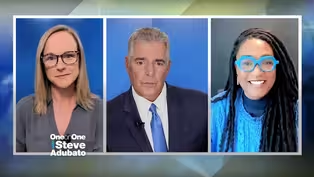
Authenticity & Its Connection to Business & Entrepreneurship
Video has Closed Captions
Clip: S2024 Ep2669 | 12m 9s | Authenticity & Its Connection to Business & Entrepreneurship (12m 9s)
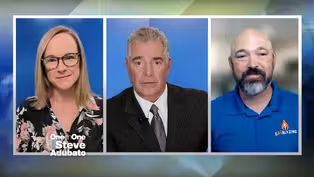
Trust, Leadership, and Building Collaborative Teams
Video has Closed Captions
Clip: S2024 Ep2669 | 14m 17s | Trust, Leadership, and Building Collaborative Teams (14m 17s)
Providing Support for PBS.org
Learn Moreabout PBS online sponsorship
- News and Public Affairs

Top journalists deliver compelling original analysis of the hour's headlines.

- News and Public Affairs

FRONTLINE is investigative journalism that questions, explains and changes our world.












Support for PBS provided by:
One-on-One is a local public television program presented by NJ PBS