
Ryland Barton (3/13/2024)
Clip: Season 2 Episode 205 | 7m 46sVideo has Closed Captions
Mid-Week Political Check-In (3/13/24)
Mid-Week Political Check-In (3/13/24)
Problems playing video? | Closed Captioning Feedback
Problems playing video? | Closed Captioning Feedback
Kentucky Edition is a local public television program presented by KET
Ryland Barton (3/13/2024)
Clip: Season 2 Episode 205 | 7m 46sVideo has Closed Captions
Mid-Week Political Check-In (3/13/24)
Problems playing video? | Closed Captioning Feedback
How to Watch Kentucky Edition
Kentucky Edition is available to stream on pbs.org and the free PBS App, available on iPhone, Apple TV, Android TV, Android smartphones, Amazon Fire TV, Amazon Fire Tablet, Roku, Samsung Smart TV, and Vizio.
Providing Support for PBS.org
Learn Moreabout PBS online sponsorshipTime now for a midweek check in of some major political developments in Kentucky so far this week with Rylan Barton, who is the senior editor.
One of them with NPR State's team.
Good to see you.
Good to see you, Renee.
So let's start by talking about a bicameral, bi partizan effort by some members of the Kentucky federal delegation to deal with no knock warrants.
We know that today is actually the day four years ago that Breonna Taylor was killed in her Louisville apartment, a byproduct of a no knock warrant.
Tell us what these two gentlemen in Congress want to do to change this from ever happening again.
Yeah.
So this is a proposal from Democratic Congressman Morgan McCarthy and Republican Senator Rand Paul that would it would it would seek to ban no knock warrants from being issued across the country.
And this would apply to local no knock warrants with how they'd attempt to do this nationally is by tying federal funding to local law enforcement agencies to whether those local law enforcement agencies have been or their local governments have.
And no knock warrants.
Rand Paul actually proposed a version of this bill back in 2020.
It didn't go anywhere at that time.
The problem with it was a bipartisan effort then.
But they're hoping that this time around that they can get a little bit more bipartisan support.
And there's not a lot of things that are passing out of Congress these days.
So it's it's really hard to imagine what exactly can get the interest of both chambers to pass anything at this point.
But if it's going to happen, it seems like something that is bipartisan has better chances.
And this is something that has the support of it, Mother as well.
They had a press conference about it earlier this week and renew your efforts to try to get it passed this year.
Yeah, well, we'll see how that goes.
So going now to Frankfort, there's a lot of activity.
We are ten days and counting.
Today is day 50, actually.
And so time as the sand is easing out of the hourglass, as we like to say, there was a controversial measure and Frankfort, a lot of them are.
But this stirred up open records and open government advocates about access to public records.
And the sponsor of the bill says he's just trying to close a loophole in the law that hasn't addressed how business can be conducted through electronic communications.
Tell us about this.
Yeah, so this is this bill has been pared down a little bit since earlier in the legislative session when a lot of open government advocates for saying that, you know, this would totally eviscerate the state's open records law.
Now, they're not totally happy with it yet.
They say that there's still a loophole in this provision pertaining to documents that would be part of public work that's included a lot of non, say, public email accounts or public devices that those devices that that information still wouldn't be, you know, pursuant to the Open Records Act.
Granted, this this bill attempts to deal with that by saying, well, public officials aren't allowed to use they're required to use their official machines for or official business.
But they say that's not enough.
There's not enough penalties.
There's no guarantee that officials are going to do that.
And we've seen that time and time again.
Officials do plenty of public work on their on their personal devices.
And this is something that we saw last year with the debacle over Louisville's little school system of rolling out its new bussing program.
There was reporting that it depended on communication between people on cell phones showing to show some of the the problems that took place at that point.
So open government advocates are still worried that this would severely walk back.
Kentucky's Open records laws right now.
But it passed out of the House.
So it's it's advancing.
But there are also some Republicans, though, that joined Democrats in opposition to the bill.
And it doesn't just apply to officials.
But I mean, he said hundreds of thousands, the sponsor, hundreds of thousands of Kentuckians, this could apply to active employees and board members.
Right.
And they would have to have a government issued email address.
So that would I think a lot would have to happen if this bill were to become law.
Right.
Disruptive legislative hearings.
So this is interesting how this was prompted.
And there is a bill that is getting some traction in the General Assembly that would address and criminalize disruptive, disrupting legislative hearings.
What's all this about?
Yeah, this is this is something that happens every year.
There are usually disruptions of some legislative processes, whether there are what lawmakers would consider disruptions, which are really false, protesting what's going on in the legislature.
And a lot of times what that looks like is really packing committee hearings when they're when controversial pieces of legislation are being heard.
So this would create criminal penalties for, you know, first and second offenses for a misdemeanor charges for folks who disrupt legislative proceedings.
I they will say there are already laws on the books that allow people to be punished, charged or disrupting legislative proceedings.
We saw this last year when there's some boss who interrupted the House chambers during debate over Senate Bill 150, the anti-trans bill, and they were charged.
And people have been convicted for or disrupting that.
But these lawmakers want a specific charge related to disrupting a legislative hearing would expand what those instances could be.
And it's still unclear exactly how this would be applied yet.
But I think some you know, some advocates, some people who regularly come to Frankfort are worried that this would change how the public is able to interact and also voice their displeasure with what is going on in Frankfort.
And finally, in just about a minute remaining, the Kentucky Safer Act House Bill five had a pretty robust hearing on Tuesday night and a lot of scrutiny.
And now there are two Senate rewrites of that bill.
Where is this likely headed?
Yeah, so this is advancing through the legislature.
So Senate Judiciary Chair Whitney Westerfield issued his own.
So that's the two version of this bill that would walk back some of the some of the, you know, tough on crime positions here or at least require a little bit more studying of them, especially things that were not related to violent crimes.
There's a more of a more robust a more fine version of this from Senator John Schickel.
I would preserve a lot of what's already in the bill going forward.
It looks like Westerfield said that it seemed like there wasn't enough support for his.
We will get another vote on this.
Going to be a little bit more discussion, hopefully on Thursday, where lawmakers will hash this out.
But no matter what, if one of these versions passes, the House and the Senate will have to come to an agreement on a final version of this.
We are kind of getting down to the last nine more days in the legislative session.
So there's a lot of work that will come up with the final version of this bill.
It's a really sweeping bill that would do everything from, you know, increasing penalties for certain crimes to criminalizing homelessness and allowing the expanding states expand your ground laws.
So there's a lot of discussion on that.
Well, we'll keep our eye on it all.
You're exactly right.
Nine more days left and there was a change made to the legislative calendar, too, that would allow them some working days and to be in committee to help hash out the budget as well.
So a little adjustment to give them some time to make it all happen before April 15th.
Thank you so much, Raelyn, for your insight.
We always appreciate it.
Thanks, Renee.
Video has Closed Captions
Clip: S2 Ep205 | 1m 8s | Kentucky's Attorney General wants the state to rethink Ibogaine. (1m 8s)
Video has Closed Captions
Clip: S2 Ep205 | 2m 33s | Appalshop is giving people more ways to hear stories of eastern Kentucky and Appalachia. (2m 33s)

Video has Closed Captions
Clip: S2 Ep205 | 1m 57s | Kentucky's family resource and youth service centers thank lawmakers for their support. (1m 57s)
Video has Closed Captions
Clip: S2 Ep205 | 3m 12s | Robust debate in Frankfort over a constitutional amendment on school choice. (3m 12s)

Video has Closed Captions
Clip: S2 Ep205 | 4m 28s | The Senate unveils its state budget plan, with some changes to the House version. (4m 28s)
Video has Closed Captions
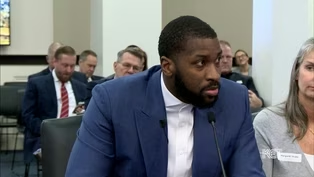
Clip: S2 Ep205 | 1m 30s | Michael Kidd-Gilchrist voices support for bill expanding insurance for stuttering. (1m 30s)
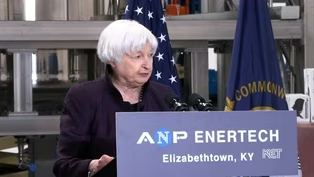
U.S Secretary of Treasury Janet Yellen in Kentucky
Video has Closed Captions
Clip: S2 Ep205 | 1m 28s | U.S. Treasury Secretary Janet Yellen help cut the ribbon on $50 million plant in Kentucky. (1m 28s)
Providing Support for PBS.org
Learn Moreabout PBS online sponsorship
- News and Public Affairs

Top journalists deliver compelling original analysis of the hour's headlines.

- News and Public Affairs

FRONTLINE is investigative journalism that questions, explains and changes our world.












Support for PBS provided by:
Kentucky Edition is a local public television program presented by KET