A Shot of AG
S02 E03: Rock Katschnig| Farming
Season 2 Episode 3 | 26m 46sVideo has Closed Captions
Rock Katschnig began his farming career when a death in the family determined his future.
Rock Katschnig, a grain farmer around Prophetstown, Illinois, began farming at a very early age when a death in the family determined his future. This year marks Rock’s 45th crop and 42nd wedding anniversary. With those numbers comes great friendships, networking, memories, life lessons and wisdom.
Problems playing video? | Closed Captioning Feedback
Problems playing video? | Closed Captioning Feedback
A Shot of AG is a local public television program presented by WTVP
A Shot of AG
S02 E03: Rock Katschnig| Farming
Season 2 Episode 3 | 26m 46sVideo has Closed Captions
Rock Katschnig, a grain farmer around Prophetstown, Illinois, began farming at a very early age when a death in the family determined his future. This year marks Rock’s 45th crop and 42nd wedding anniversary. With those numbers comes great friendships, networking, memories, life lessons and wisdom.
Problems playing video? | Closed Captioning Feedback
How to Watch A Shot of AG
A Shot of AG is available to stream on pbs.org and the free PBS App, available on iPhone, Apple TV, Android TV, Android smartphones, Amazon Fire TV, Amazon Fire Tablet, Roku, Samsung Smart TV, and Vizio.
Providing Support for PBS.org
Learn Moreabout PBS online sponsorship(upbeat rock music) - Welcome to "A Shot Of AG."
My name is Rob Sharkey, I'm your host.
I'm a fifth generation farmer from just outside of Bradford, Illinois.
I started a podcast which led into an XM show, which led into me getting a national television show, which led into me sitting here today.
But today is not about me.
Today is about Rock Katschnig.
How you doing Rock?
- Pretty good, Rob, what a fantastic opportunity to be here with you today.
- Yeah, when we were deciding to do this and we were talking about local people in agriculture that have made agriculture better, that have made the world better, I mean, literally, Emily and I had you on that very, very short list of people that we wanted to have in here.
So I'm thrilled you made the drive down from Hooppole.
- Well kind of fun to get away, especially on a Friday afternoon.
And it was so nice to meet you and Emily here a period of time ago, and it's always fun meeting new people and especially with an ag-related type theme.
So, yep, we've had a lot of fun already and look forward to a lot more years.
- Tell people where Hooppole is.
- Hooppole is nine miles north of Interstate 80 at Annawan, Illinois.
A little small town, 250 people.
Lifelong resident, been there for 60, almost 66 years, few days away from 66 years.
- I wasn't a big fan of Annawan when I was in high school.
(Rock chuckles) They talked about the big Belgium guys.
Your football team was huge.
- Yeah, yeah, Annawan was very dedicated in sports, some really good athletic programs, excellent curriculum.
And four of our daughters graduated from Annawan, Illinois in great programmer.
- My sympathies.
(both softly laugh) Rock, you have planted corn, you have planted soybeans this year.
It is your 45th crop.
- That's correct.
- That's pretty impressive.
- It sure doesn't seem like that many, but- - Doesn't it?
- When we do the math, no.
We do the math, I'm afraid it is.
- Okay, the way you got started though, I mean, obviously we've got the race cars here.
Your love of agriculture, is it parallel to the love of racing?
Is it higher or lower?
- Well, I guess it'd depend on the era.
My original game plan, if we back up clear to the early, early '70s, my older brother was going to take over the family farm and I would probably have pursued a career in racing.
It was my absolute love, still is, but after some unfortunate things happened to our family, when my brother was killed in a car accident when I was 16 years old and then a year and a half later, my dad died when I was 17 years old, my focus changed from the automotive career to back to the family farm.
So I went to Western Illinois University.
I got a degree in Ag sciences and Alpha Gamma Rho- - Whoa, whoa, whoa, whoa, whoa, whoa, whoa.
People I don't think necessarily all the time understand the family logistics in agriculture, right?
Your older brother was, he was gonna be the one that takes over the farm.
- Correct.
- I mean, that can be a very contentious situation with your family.
I mean, and it sounds like you were okay with it, right?
He was gonna be the one.
- Well, he was 13 years older than me.
I was 16, he was 29, and, anyway, he was I guess more involved with it that time, at 16 years old.
So at that point in time, there probably wasn't room for two of us on our family operation, even though dad had put together 1100 acres in 1971.
- Which in 1971 was a big farm.
- It was a big farm and Dad had hired help for raising a lot of cattle, a lot of hogs, and 4020 was the big tractor.
And a 495A was the planter, we had two- - Which is not necessarily a big tractor.
- No, no.
- Back then it was.
But no, I would say it was more like a garden tractor now.
- That's right, that's right, chore tracker to mow roads with.
But he had two 495A planters, just machinery that's a fraction of the size that we have today.
- With your brother passing away, and then your dad passed away a year and a half later?
- Correct, correct.
- Was that, do you think looking back, it was just so hard on your dad that- - Yes, absolutely, absolutely.
The stress of losing the older son, it was, and then keeping the livestock operation going, the farming operation going.
It was undoubtedly the stress that resulted in what took place.
- Between your brother and your dad passing away, did you know then that you were going to be coming back to the farm?
- I did, the family farm meant so much that, yeah, I knew I wanted to keep it going.
So that's when I knew I needed to get an education, find out about agriculture.
We rented the farms out to some friends and relatives for a short period of time.
- Did you know when you were doing that, that you were giving up on this dream of racing?
- I guess it just kinda got put on the back shelf for a period of time.
- Okay, are you okay with that?
- Oh, it was for the better.
Life would have been totally different, pursuing a career in the racing world.
Not as stable as hometown, relatives, friends, family.
Family, a big focus was on family and raising a family on the farm.
- Which might not have been so high of a priority.
- Not at all, not at all.
- Okay, so you go away to school and this is after you'd lost your dad, you get involved in Alpha Gamma Rho.
- [Rock] Correct.
- [Rob] Which is the big Ag fraternity, right?
- Ag fraternity, ag fraternity.
The first quarter, not quarter, yes, correct, quarter.
Fall quarter, freshman year, pledged Alpha Gamma Rho.
- What school again?
- Western Illinois University.
- Oh, yeah, okay.
- Yeah, boy, there was some more added stress, at that point in time with joining a fraternity.
But after the pledge period was over, I had 48 brothers in that fraternity house and the comradery and the friendship with those brothers is without a doubt the reason that I got a degree and finished four years of school, - You probably needed that.
- Yes, and I had a professor, Dr. Loren K. Robinson, our advisor to our house.
He said, "This world isn't about what you know, "it's who you know."
I never forgot those words.
- Which, if you don't know Rock, I would say that probably sums you up more than anything.
There's probably somehow this is getting streamed to, I don't know, Cambodia, and there's somebody probably in like the smallest of places watching this on their phone and go, "Oh, that's Rock."
Everybody knows you.
We walked into the studio, and there's a guy, he's like, "I had to be here when I heard you were coming."
You know everybody.
- Well...
It's a big old world and it's always fun meeting new people.
I learned the importance of introducing yourself through Alpha Gamma Rho and gaining new friends every day.
So yeah, it's always a lot of fun.
You can't have too many friends.
- Yeah, well, yeah, friends, true friends, not the ones that ask for money, right?
It's impressive and I think with you, the people that haven't had a chance to meet you, you have an ability to start a conversation.
You have the ability to listen to people and you have the ability to know when to interject.
And this is totally off agriculture.
This, if people can master that stuff, they can, they can have a whole lot of friends.
They can have people that remember you.
It truly is a gift.
I don't know if you realize it or not, but it truly is a gift.
- I have to give a lot of credit to the Illinois Farm Bureau and the ALOT program.
I really enjoyed the ALOT program.
I went through that in 2008.
Your skills with television, media, presentations, I really learned a lot from the ALOT program with the Illinois Farm Bureau.
I was a director for Henry County Farm Bureau at that time.
My son-in-law is now a rep for our township, Yorktown Township, but that was a great experience also, was the Illinois Farm Bureau.
- Okay, let's switch back.
You went to college, you go back to farming in the early '80s.
Timing wasn't necessarily your friend there, was it?
- Oh, not at all, not at all.
I started out with some really marginal equipment.
And it seemed like we did more welding and fixing than farming.
(Rob softly chuckling) So, decided to update to some newer John Deere equipment and along came 19% interest.
So if you had $100,000 worth of farm machinery, you were paying $19,000 to have it sitting there in your shed.
- Which $100,000 probably was pretty easy to do back then, as far as machinery.
- Well, in the fall of 1980, I bought a brand new John Deere 4440.
That was our big tractor at that time.
- It's a great, great tractor.
- And that tractor costs $30,000 brand new.
- That was it?
- And $30,000 right on the money, and today, if that tractor's in good shape, it'll bring more than that today.
- Oh, absolutely, yeah.
Okay, so you upgrade, right?
You did what you're supposed to do.
You go back to the farm and you upgrade, you're getting ready for the future.
You get hit with this interest, plus the '80s just were not good for making money.
- And then, to compound matters even more, our little small local community went through a bank failure.
- [Rob] Oh, okay.
- Oh my goodness.
- I don't think people nowadays know what that means.
- Well, there were insufficient funds at the bank to cover the notes.
The federal deposit insurance corporation came in, locked the doors, the bank took everything over and it was a very tough time for our little community, and a lot of people.
So we restructured with a new lender that came in, and it took quite a few years to dig ourself out of that hole.
- But you did.
- We did.
- Okay, that had to be a lot of sleepless- were you married to Marla at this point?
- Yes, yes, we were married in '79, July 21st, 1979.
So we were married, just starting to have, start our family.
It was a very stressful time.
Not only trying to farm about a 1000 acres at that time, but also with a livestock herd, with a cow herd.
But those old cows paid a lot of bills.
- [Rob] Did they?
- Yeah, we had a lot of marginal ground, so we had pasture for the cows and calves, and then we went to even finishing the calves because we were somewhat close to the slaughterhouse.
So they paid a lot of bills.
- When you look at back then, and I remember when we interviewed you for the podcast, you talked about buying a baler and that's where you lived.
You lived in that tractor cab and you ran that baler and you did what you had to do.
You look at agriculture today, the workforce today, do you think, obviously you're gonna have people that are willing to do that, but what do you think about the work ethic?
Is it different?
- It is 1000% different.
I guess when you really get your back up against the wall and you have to dig yourself out, you do what you have to do and had the opportunity to do custom round baling and make some good money, if you were willing to put the hours in.
Wore out two Vermeer round balers and was on my third John Deere round baler, and I said, "That's it, we're gonna quit the road show."
I don't know how many sets of tractor tires we didn't replace.
We were running all over Northern Henry County.
First cutting was some really good, fast money.
Third cutting, you might bounce all afternoon for 15 bales, but I said you had to take the good with the bad.
- Yeah, gotta average it out.
It's tough, I mean, here you are, you have 45 crops and, finding someone to help, right?
If you had the project, whatever, you tear down the building in the back 40 or whatever, finding that neighborhood kid to help, it's not like it used to be.
- No, there's some out there.
We're very fortunate right now.
We have a really nice young man that's helping us when he, he just graduated from high school, and he's a great worker, he's really willing to learn.
So we attack some of those projects when we know we have help like that.
- Let's switch gears.
That's supposed to be a joke for the race cars.
- Coming to a pit road.
- Let's go back to races, tell me about these cars.
- The first car is a Dirt Late Model replica.
Wayne Brown ran that car on some local dirt tracks and he was a teacher at our Annawan High School there and helped him with some sponsorship dollars.
Really great guy.
- [Rob] Yeah, you've got it right there on the side, The K Ranch.
- The K Ranch, Prophetstown, Illinois, yep.
(Rob softly laughs) The No.
7 Brandt car, Justin Allgaier drives the No.
7 car.
State of Illinois, Springfield, Riverton, Illinois.
Great young man, formed a friendship there with his team.
Rick Brandt is the main sponsor on the car.
The car is actually owned by JR Motorsports, Dale Earnhardt Jr., and have become very good friends with that team.
It's really opened a lot of doors at racetracks.
Also really close with another Xfinity team.
So back in the '90s, and late '90s, we threw some sponsorship money at the Xfinity series.
That was a lot of fun, and that really opened a lot of doors.
That was one fun thing about stock car racing.
Stock car racing is just like, the comradery, the friendship, it's just like a traveling circus, or it's just like showing livestock at the ferry, you might say.
Everyone knows everyone, people help everyone.
Not everyone, but they'll help other teams.
It was great, the people you met in the infield and the garage in NASCAR.
- That's where I got to know you.
I don't even remember how it got set up, but my oldest son and I, we went to a race with you and you got us into the inside track area.
And that's where I realized that everybody in the Western civilization knows who you are.
But it was so much fun, it was such an incredible rush.
I don't have a background with racing.
I didn't know much about it.
But man, when those cars got up and going in that first pass where they rolled past you, whew.
- There, a lot of people look at it, just cars going around in a circle.
There are so many variables in the setup of that race car.
And to know all the different details is what, it makes the competition so exciting, in the handling, and the performance, and of a race car that to lead and win a race.
- Well, and it was so cool 'cause you got us up right above where there it, what, the pit stop, right?
- Right, right, We were- (crosstalk drowns out Rob) on the war wagon, on pit road for Justin's team.
and looking right down at the car when they come in to pit for four tires and fuel.
- Which is unbelievable how fast they do it.
It's a pressure cooker because I mean, if someone makes a mistake, they're gonna hear about it.
It's, yeah, I'm glad farming is not like that.
- Well, when it comes to planting or harvesting, I try to compare our game with the game of racing.
After every race, the crew chief, they televise, they record the whole event, and they look back, they play it back, "How could we been a couple of seconds faster here, "a couple seconds faster there?"
And I try to compare farming in the same way.
If we would have done it this way, we may have picked up another 15 acres today.
We might've picked up another 30 acres today if we wouldn't have done this.
You have to make your best decision for that point in time and go with it.
- You told me that day that with racing, if you can go just a little bit faster, if you'd just spend a little bit more money, and that is like farming.
- It certainly is, it only takes a little bit more money to go a little faster.
- You almost seem like you've kind of lived two different worlds.
You got this farming world and you got this racing world.
Has that just kinda been a nice balance for you?
- It was a really fun getaway on the weekends.
The sport's totally changed now with the COVID situation we've gone through and kind of lost some connections with a lot of teams since attendance is so limited in the garage in infield area.
But hopefully that'll all resume and friends I have are just, we're as close as ever.
So it might resume.
- Yeah, that was probably one of the most fun days my son and I had together, was going to that.
- Glad you enjoyed that.
Thanks to Brandt and the Brandt family and Carl Barnhart, they are just top shelf for hospitality and friendship and, the offer, the position, or the opportunities we've had with them.
- Yeah, truly, I mean, they didn't end up sponsoring the podcast.
That's okay, it's all right.
No, it was, it was an incredibly fun day, and yeah, for someone that, they didn't know me for anything, but I was with you and they treated me with family.
- That's the way they are.
- It was fantastic.
- Where do you think agriculture's going?
- That's a really good question.
The price of machinery, the price of repairs, cost of parts.
We want to stay productive and efficient.
Everyone who wants to run new equipment, well, to be able to afford new equipment, you have to stretch it over so many acres.
Gosh, what's the next step?
There was a point in time where three or 4,000 acres was a big farm.
That's not the case anymore.
Now the next step is 15, 20, 30, 40,000 acres.
I don't know, when you get to that level, you have to have some really dedicated employees, which is tough to find that labor force out there, it's so seasonal.
We ask a 12, 14 hours a day, spring, not much going on in the summer, again in the fall harvest when the sun's shining and you have to roll.
And then, kinda slack during the winter.
So agriculture is just a different game.
You have to find somebody that's really in, and really dedicated.
- Yeah, I think like in a lot of situations, you have to find something for, if you're gonna have it as a full-time employee, what you kinda need in a lot of situations, you have to have something for them to do through those winter months- - Right, right, right.
- And then, when things aren't as busy.
Everybody's kind of relaxed during the winter as far as that, but yeah, it's tough to come up with projects.
- A really big part of the occupation is hauling, trucking, CDL, you need someone that's capable of driving trucks, whether it be a flatbed or hauling grain, or a dump trailer, whatever, you need someone with experience and comfortable with expensive equipment.
Gosh, with the equipment we have today, in a minutes time, you can have a 10,000 to $20,000 repair bill in the blink of an eye.
- Oh, yeah, trust me, trust me, I know.
Well that and it's, I remember when I first started seeding beans and I had a 16-row planter with no CCS.
So I'm putting bags in each planter.
And I did that all by myself, all day.
Just pounded it out.
This year, I was getting down to the end and I probably had to throw in 40 bags, 'cause I didn't want to open another probox, I called my son.
I was like, "Come help me putt these bags."
- That's right.
- So it is different.
Maybe that's just me getting older though.
- Yeah, we used to do a lot of custom planting also back in when we were drilling with a 750 John Deere drill, 7 1/2-inch spacing.
That drill held 44 bags.
And a young man who's almost like my son recalled, we're planting beans for a guy one time, and he thought, "Boy," he'd have these beans in a real safe place, he put them in a pickup truck with a topper box on it.
- [Rob] Okay.
- And we had to dig all those beans- - Oh, no.
- Out from the pickup before we got them up on top of the drill to put them in the drill.
- I still use mine.
- Do ya?
- The Y750, yeah, on a couple of smaller fields that have some weed issues.
It's a good drill.
I don't want to use it any more than that, but.
- I have one sitting in the shed, I need to sell it.
I need to start clearing out some corners, making more room in sheds.
- Well, what's the future look like for you, Rock?
- Well, we have a son-in-law that is year seven in our operation, married our third daughter.
We have four daughters.
He's really good with the technology part of this game.
That was a very weak part for me.
So he's great with it, with the GPS, the auto-steer and the information that we have available to us is just mind boggling what we have out there, so he's great with that.
So he is spraying as we speak right now.
- We get towards the end of the show and ask people their social media.
So what's your Instagram account?
(Rock loudly laughing) What's your TikTok?
You don't have a Tiktok?
- Uh-uh.
- Twitter?
- Uh-uh.
- Facebook's about it.
Facebook and my trusty phone.
- And your trusty phone, which is always ringing 'cause everybody knows you.
- My trusty phone that I almost ran over with a forklift this morning.
- [Rob] Why would you do that?
- It fell out of my pocket.
- You've got one of those OtterBoxes though, right?
- Yes, yes, yes.
But I put it in my pocket, but I didn't clip it.
I just slipped it in the pocket.
So when I bent over to move some bags, it fell out of my pocket.
See, that's a funny thing you could get it on the TikTok and tell people the story about how you almost ran your phone, you would just have a million followers in a week.
- Well, I like vests with pockets.
I've learned the importance of that.
I've lost my billfold twice.
- We're talking about you getting on TikTok.
We aren't talking about vests.
- Well, I lost my billfold twice, once at an 80-acre field and once in the timber.
- Any money?
- Yes, but I found it both times.
- How did you find your wallet?
- I got in a four wheeler and retraced my entire path (Rob softly laughing) and I found a $20 bill that the Batwing mower cut in three pieces and I found all three pieces.
- And you taped it together?
- I taped it together.
- I think you just reaffirmed every stereotype of a farmer from Hooppole, Illinois.
All right, go follow Rock on TikTok.
Rock, it's amazing to talk to you.
You and Marla are fantastic, and your four daughters.
It's incredible, I value our friendship, I really do.
I was so glad when you said you were able to come on the show, and I wanted to share- - I feel like Ed McMahon today.
Johnny Carson.
- Hey oh!
Rock Katschnig, everybody.
Everybody else, we'll catch you next week.
(intense rock music)
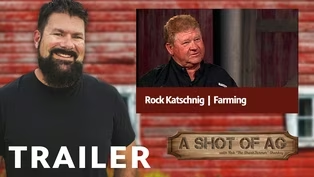
S02 E03: Rock Katschnig| Farming | Trailer
Preview: S2 Ep3 | 20s | Rock Katschnig began his farming career when a death in the family determined his future. (20s)
Providing Support for PBS.org
Learn Moreabout PBS online sponsorship
- News and Public Affairs

Top journalists deliver compelling original analysis of the hour's headlines.

- News and Public Affairs

FRONTLINE is investigative journalism that questions, explains and changes our world.












Support for PBS provided by:
A Shot of AG is a local public television program presented by WTVP