A Shot of AG
S02 E07: Eric Hodel | Midwest Food Bank
Season 2 Episode 7 | 26m 46sVideo has Closed Captions
Eric Hodel, CFO of Midwest Food Bank, talks about the mission of this amazing organization
Eric Hodel is a farmer from Woodford County and the COO/CFO of Midwest Food Bank, a nonprofit organization with 12 locations in the U.S. and other countries. MFB distributes food and shares the love of Christ with programs like Hope Packs for hungry students to take home on the weekends and disaster relief in the form of nutritional meals called Tender Mercies.
Problems playing video? | Closed Captioning Feedback
Problems playing video? | Closed Captioning Feedback
A Shot of AG is a local public television program presented by WTVP
A Shot of AG
S02 E07: Eric Hodel | Midwest Food Bank
Season 2 Episode 7 | 26m 46sVideo has Closed Captions
Eric Hodel is a farmer from Woodford County and the COO/CFO of Midwest Food Bank, a nonprofit organization with 12 locations in the U.S. and other countries. MFB distributes food and shares the love of Christ with programs like Hope Packs for hungry students to take home on the weekends and disaster relief in the form of nutritional meals called Tender Mercies.
Problems playing video? | Closed Captioning Feedback
How to Watch A Shot of AG
A Shot of AG is available to stream on pbs.org and the free PBS App, available on iPhone, Apple TV, Android TV, Android smartphones, Amazon Fire TV, Amazon Fire Tablet, Roku, Samsung Smart TV, and Vizio.
Providing Support for PBS.org
Learn Moreabout PBS online sponsorship(upbeat music) - Welcome to a shot of Ag.
I'm your host, Rob Sharkey.
I'm a fifth generation farmer from just outside of Bradford, Illinois.
I started a podcast which led me to getting on XM Radio, which led me to getting a national television show, which led me to write here.
But today is not about me.
Today is about Eric Huddle.
How are you doing Eric?
- I'm doing great.
Thanks.
- It's good to have you here.
- I'm excited to be here.
- I'm a little concerned.
You know, when the guests looks better than I do.
(Eric laughing) - So.
- Thanks.
- I don't know if you could do something about that.
- You're being generous.
- Not really (laughs).
(Eric laughs) Now you are the COO and the CFO of the Midwest Food Bank.
You're kind of overachieving there.
Aren't you?
- Yeah (laughs).
(Rob laughs) I'm on a great team.
I have a great team and a great organization that I'm able to be a part of.
- Like, we're gonna learn all about the Midwest Food Bank but let's learn a little bit about you first.
Originally you grew up on a farm kid.
- Yeah.
- Right.
- I was fortunate to be raised on a farm outside Metamora, Illinois.
So Woodford County and I grew up on a farm, went to engineering school, hired into Caterpillar and was blessed to have 20 years working for Caterpillar.
- Why an engineer?
- I think I liked solving problems and for me engineering was about...
I loved math and I liked solving problems.
(Rob laughs) I know.
So... - He's one of those (laughs).
- (laughs) so that's yeah, it was just great.
I mean, it was really exciting.
I love school.
And like I said, I worked for Caterpillar and was engineering and marketing and business management and had just a really wonderful career, but had had halftime change, kind of had God calling me to a second half of my career and that involvement with food bank and farming.
- Okay, that had to be...
Yes, you say you were calling, but still, I mean, it had to be a little something because you know, 20 years and with CAT.
CAT's a great company.
It's a lot of security.
It had to be somewhat risky to say, "All right, I'm gonna go ahead and transition to this next phase.
- It was a faith and a family decision.
- Mm-hmm.
- And it wasn't a financial decision, but every time I kept coming back and I would process why not to make the change?
Why not to make that transition.
It was all my own self.
- Mm-hmm.
- When I thought about transitioning to the food bank and transitioning to farming, it was to help the community.
It was to help people that were in need.
It was to be and spend time with my family.
So when I really kinda took myself out of the decision, it was pretty clear and I felt very peaceful about making that transition.
- How many kids you have.
- Three.
- Three kids.
- Blessed with a beautiful wife and three kids.
- How long have you been married?
- (indistinct), you gonna put me on the spot.
(Eric laughs) Oh, men.
I wanna say 24 years.
because I think there's a milestone coming up.
- Okay.
What would your wife say?
- (laughs) I don't know.
(Eric laughs) I think she would say for sure, 23 or 24 years.
- So, how old were your kids generally when you were making this decision?
Because it sounds like, you know, going back and spending more time with a family.
What's part of it?
- Yeah.
So they... like when they were in their formidable years, we were living in different cities and moving and taking on different jobs with Caterpillar.
And that was great.
That really kind of bonded and jelled our team.
- Mm-hmm.
- And then through just kind of a series of moves, we ended up back in Peoria.
We ended up back in Metamora.
We ended up back close to the family farm, and I think we kind of underestimated kind of how those roots would really kind of just shoot up.
And so Ethan was a...
I think he was a junior in high school.
- Okay - And my daughter was a freshman in high school.
My son was in Junior High.
And so it has been nice because a bit less travel, a bit less moving and a family change.
So that was high school years.
We've really been able to kind of have some stability as a family.
- Did you plan to come back to the farm though?
- I didn't.
That wasn't really on my radar.
- Mm-hmm.
- I kinda served my brother who I'm very close with.
He was involved in helping my dad a whole lot more than I was.
- Mm-hmm.
- And I thought that he kinda wanted to take on that role, but when the farm succession planning happened, he was very satisfied with his job as a high school administrator and he was doing a great job.
- Mm-hmm.
- And he kind of left the door open for me and we talked about it as a family and it kinda fell to me that if that was something I wanted to take over... And I'd like.
For me, farming, isn't just kinda driving a tractor.
I like the capital investment.
I like the planning aspect of it.
The risk management.
- I hate that part of that.
(Eric laughs) - I like to get an attractor and push the button, and then you're on the phone for the rest of the time.
Yeah.
That's a lot of fun.
- Yeah.
I enjoy that but I also like the other pieces of the farm and... - Well, a lot had to change in 20 years.
All right.
- It did.
I mean, I was...
When I came back to the farm, I really didn't know how to drive the tractors.
- Yeah.
- Like how we get on a tractor and I'd be like fumbling around tryna... - That's right, they drive themselves.
(Eric laughs) - (indistinct).
- Yeah, now they do, now it's...
I love setting up a field planning and rolling through it and pulled out my notebook and plant in the next field and making crop sales.
- Mm-hmm.
- And I like that mobile office aspect.
That's (indistinct) some of the funnest days as you putting seed in the ground and- - yeah.
- you get another stuff done.
- Okay.
I could talk about this all day, but your other job.
- Yes.
COO and CFO of Midwest Food Bank.
How did that come about?
- Yeah.
So in 2003, the kids are family who are also farmers.
- Mm-hmm.
- They saw a need to serve the community and food pantries.
There were six food pantries in McLean County that were looking for more food for their shelves to serve people.
- Mm-hmm.
And so the Keizer family got together and they said, "Hey, we've got trucks, we've got sheds, we can... We think we can help."
And they're obviously a very generous and helpful family and cared about their community.
And so the Midwest Food Bank started in 2003 out of a family barn in McLean County, just outside Bloomington.
So from those kinda humble beginnings, it just continued to grow.
And before long, they were in a warehouse in town.
Then another division in Peoria had started, a division Indianapolis started.
And so they had just seen growth throughout their locations and also growth in terms of the food that they were distributing out of their facilities.
And it got to a point where, again, through kinda entrepreneurial startup, it got to the point where you kind of have to have a little bit of structure to manage that size of an organization.
- Yeah, because it's a food bank.
- Correct.
- There's a difference a food pantry, is kinda what I think maybe a lot of people think of when you go to the church or go to the senior center.
And if you need some extra food, that's where you can get it.
You're different though.
You say you're like the level above?
- Yeah.
I refer to it as wholesale, right?
So.
- Okay.
- Food pantries are retail.
They're serving the families.
They're serving the individuals.
- Mm-hmm.
- The food bank, like Midwest Food Bank is the wholesaler that is supplying the food to the pantries.
So we don't give the food to an individual in need.
We give it to 2000 different food pantries or agencies or churches or soup kitchens.
- Yeah.
- And they're the ones that serve the people that are in need.
- You heard the joke about the food bank.
- Have it but I think I'm going to.
- There's no accounting for taste.
- (laughs) Okay.
- Bank accounting.
- Okay.
All right.
- Food.
- Okay.
I got it.
It took me a little bit.
That's probably why I haven't heard it.
- I thought it was funny.
- Okay.
- Well, we'll move on (laughs).
(Eric laughs) - Overall, I mean, the kids are family.
What they started unbelievably charitable, you know, wanting to do more, but at some point, like you said, it becomes almost like a business because you've got such a big successful monster of a food bank.
That's where you come in.
Right.
So you have to be the one that is making sure all the gears are moving in sync.
- Yeah, that's correct.
I mean, I try to oversee or give guidance to all of our food banks and Midwest Food Bank has 10 locations throughout the US and two internationally.
And so I try to provide enough common process, enough freedom within the framework that they're able to each kinda serve at their state, but then all of the financials, all of the numbers, all of the HR policies, our branding, our communication kinda pulling it together to look like one, you know - Mm-hmm.
- Professional well-run organization , which it is.
- And that's probably what people don't see, right?
They see the good stuff, right.
They see you getting food to people that need it, right.
You're fighting hunger and all that good stuff.
They probably don't understand the process, all the things that went behind the scenes to actually make that happen.
- Yeah.
I mean use the word accounting.
Like we do have to account for- - In a joke.
- In a joke.
- Yeah.
- And you know, the difference between a non-profit and a business is not in terms of how you have to track it's the terms of having to pay taxes.
- Mm-hmm.
- So when we're distributing $380 million of food, we have to account for that.
We have to track it coming in.
We have to track it going out.
We have to have good robust accounting numbers- - Mm-hmm.
- for our auditors to come in.
And then the differences of the nonprofit is we don't have to pay tax, but it still has to be accounted for.
- Now, Midwest Food Banks.
Do you charge the food pantries?
- We don't.
That's a model that was put in place by the Keizers and we've been able to hold to that.
And so we do not have a service fee or a charge to the pantries.
We try to raise private financial donors - Mm-hmm.
- or get grant dollars to be able to support the organizational costs.
So that's about 12 or $13 million that we raise and are blessed with people donating to the food bank.
- Mm-hmm.
- And from that financial donation, we're able to pay our electricity, put fuel in our trucks, purchase the equipment, pay our employees.
So that $13 million of donations every year then turns into $380 million of food that we are distributing out our door at no cost.
- Okay.
So take me through it in a nutshell.
- Yap.
- How does a family that needs food... How do they get?
I mean, take me from the process where the food is made or donated to where they end up in the family's hands.
- Yeah.
So it can come...
The source of the food can come from a couple areas.
- Mm-hmm.
- It could be a food manufacturer like Kellogg's or Del Monte.
And they may have an overrun of a product, or they may have a can that gets dented.
And so those food companies or distributor of food, when they have access or what would be waste - Mm-hmm.
they donate that to Midwest Food Bank.
And so we go get that with our truck and trailers.
We bring it into our facilities, we store it, we organize it, we refrigerate it, or we freeze it depending on the product.
And then our agencies come to Midwest Food Bank and they pick that, those items up, they take them back to their pantry and then individuals or families come to the pantry and they take the food that they need to feed their family.
- All right.
I mean, that sounds so simple - Yeah - when you say it like that.
But I can only imagine just the logistics of it has to be overwhelming.
- Yeah.
It is but it's... like in that, you know, in that supply chain, - Mm-hmm.
- everybody does their part.
And like, it's just a blessing to see how generous people are throughout the whole supply chain.
- Yeah.
- You have companies that they have propel water or bottled water, whatever the item is.
And they're willing to bless Midwest Food Bank and they trust us to be good stewards of that food.
And so they do their part and they give us the food and we have volunteers and we have staff that make sure that it gets put and safely stored.
- Mm-hmm.
- And then you've got the pantries and they have volunteers and they're reaching out.
And so throughout the entire supply chain, you have people that are doing their part and they're caring for each other.
And that's how you get an individual or a family that has fallen on hard times and is maybe a little bit short in terms of their financials.
They can pay their electrical bill.
They can pay their rent, but they don't quite have enough money left for their food, groceries.
- Mm-hmm.
- And they're able to get that food on the table for their family.
- Let's talk about the volunteers, my wife and kids.
- Yeah.
- Have done this thing.
And then she told me when you go in there, you watch a video and then to get all hair netted up or whatever.
(Eric laughs) and you're making the packages, you're putting it all together.
She said it is like the most well-oiled machine that you can imagine because you walk into this massive warehouse, but even, you know, a kid that's younger than 10 is able to help because of how well you haven't structured.
- Yeah.
We are... First of all, the volunteers are the lifeblood of our organization.
- Mm-hmm.
- We just have a tremendous amount of volunteers across the US that come every day to the food bank and help.
And we try to make that experience positive for them, but also applicable for all ages.
- Mm-hmm.
- So if it's a young child putting stickers on a label, or if it's an... We have a lot of senior citizens, again, they're not really maybe wanting to stand or to lift, or but they're at a table and they're putting stickers on this bag.
This bag here is an example of our hand packaged, Tender Mercies.
And some of them we run off of just a regular print decal and others we actually leave blank so that we can have a purpose for somebody to put a sticker on.
And you would say, "Hey, that's inefficient.
Like why wouldn't you just print all the bags?"
- Mm-hmm.
- But part of the food bank's mission is to make sure that people have a place to go and find purpose.
And so we provide that opportunity for a volunteer to be able to do what they can.
- Mm-hmm.
That's probably one of the more underrated things that society is actually has almost forgotten.
The sense of purpose that a person needs - Yeah.
- in order to succeed and actually wanna get out of bed.
I mean, I think it's great that you do that, but you mentioned was Tender Mercies.
- Correct.
- Explain what that is.
- Yeah, Tender Mercies is a meal that Midwest Food Bank produces.
- Mm-hmm.
- And it has rice and beans and protein, and it's chicken flavored.
- Mm-hmm.
_ And it also has minerals and vitamins all in it.
So it's a single serving package.
This is a single serving meal.
This one has instant rice.
- Mm-hmm.
- So it's even more easy for somebody to just take it and add water and have a nutritious meal.
And so it's a balance of having that, you know, tasty chicken flavored, seasoned meal, but then also the nutritional and in really getting that good quality food and protein into their body.
- Okay.
I'm gonna admit something here, right.
because again, it doesn't make me sound good, but I want you to explain it to me.
In the town where I live in, they were doing the deal where they were sending the kids home with a meal pack over the weekend.
- Yeah.
- Right.
And I was like, "Well, that's kind of almost...
I mean, why can't the parents feed those kids?
And in my mind, it's almost kind of annoying that they're doing that.
Now.
I've heard the explanation that has changed my mind, but I wanna hear your take on it.
- Yeah, so, you know, unfortunately maybe the household that you and I grew up in isn't applicable, or isn't the same for other kids.
- Mm-hmm.
- And so for us, we maybe have a hard time expanding our mind to think that parents wouldn't care enough to plan ahead, to work hard, to sacrifice, and to somehow find means to put food on the table.
But I think the reality is, is there are kids that are raised in an environment that they don't have that adult supervision or adult caring.
- Mm-hmm.
- And so Midwest Food Banks has a Hope Pack, which is kind of a weekend meal kit for those students.
You know, when they come to the school, our school system is great and it identifies those kids and it gets (indistinct) on free or reduced lunch.
And so that gives them that nutrition.
It gives them that food source during the week, but on the weekends they are kinda left fending for themselves.
- Yeah.
- And so that whole pack that they go home with on the weekend is a way to help that person.
That really probably can't quite, I don't know, offend is the right word, but can't quite, you know, do what they need to on their own.
To get food and it makes it a bit easier for them.
And the nice part is our school system sees that need.
And a lot of cases they do it very positively and very discreetly where it's a backpack or it's the students not walking home with a box of food and feeling like they're different.
They just go home with a backpack and the food's in there.
- Well, and the person that changed my mind on that, you know, they explained, well, if these kids barely eat anything on the weekend, their Monday shot at school (Eric laughs) and maybe their Tuesday morning, a shot before their body can re reregulate and get back to where they can learn.
- Yep.
- You have to have a charitable heart to do what you do.
- I don't know that I would say.
I don't wanna really make it about me.
I would say the good of the organization.
- I'm good at my show.
- Yeah.
(Rob laughs) - I would say I've been blessed with really great parents.
- Mm-hmm.
and excellent grandparents.
And I think they've taught me and instilled in me to think of others.
- Mm-hmm.
- And so I give a lot of credit to how my values were instilled in me.
And I've encountered great people throughout my life.
And so I think coming to Midwest Food Bank, working with the Keizers, and working with the organization has just continued to kind of bring that out.
And again, we have a great team that everybody, you know, really cares about serving and helping others.
- Like when people wanna help other people.
I think one of the biggest fears is they don't wanna be taken advantage of, right?
Off, I'm gonna give that person, you know, a buck off the street and then I see them getting into a nicer car than I drive, or if people are picking stuff up at the food pantry and they actually have an attitude that the food isn't as good as they can get.
There are some people, it holds some people back.
What advice do you give people that are struggling with that?
I wanna help, but man, I just...
I don't wanna get taken advantage of.
- Yeah, that's a great question.
I think, like a lot of situations, I think you gotta be careful not to be judgmental or not to underestimate the baggage that people bring with them.
- Mm-hmm.
- And so I think to be generous and to err on the side of grace and generosity and not, you know I would say you trying to select to determine who gets this or who doesn't get this, There's probably a greater risk that somebody that really needs it doesn't get served versus somebody that maybe took advantage of the system.
And so if that happens, okay, fine.
But just know that you're doing enough, that definitely the people that are in need were able to get served.
Can you remember that first moment?
So when you started this, can you remember that moment you go, wow.
I I'm actually, I'm doing a lot of good here.
- I think I'm reminded by it every day.
You know, I really...
It's just, you know, I've, I'm fortunate that I'm able to go see the different divisions and I'm out.
And I see the great work that's happening in Texas.
I see the volunteers that are working in Arizona.
And so for me, that's just really rewarding.
- Mm-hmm.
- to see regardless a geographic or situation people serving and doing it with joy in their heart.
And so I'm just thankful to be able to see that everyday and I'm blessed.
- So you're a nice guy, whether you wanna admit it or not, you're one of those nice guys.
- Yeah.
- (laughs).
How many locations?
- We have 10.
10 locations in the US, Florida, Georgia, Pennsylvania, Connecticut, Indiana, Illinois, Texas and Arizona.
A couple of locations are in Illinois and then we're in Haiti and Kenya.
- How did that come about?
- You know, again, it's people seeing a need and rather just sitting on it, moving into action.
And so both Haiti and Kenya were people, board members that were traveling out of country - Mm-hmm.
- and they saw a need and they said, "Hey, you know, we can help."
And it's exciting.
- If people want to find out more volunteer, where do they go?
- The best place for information is www.midwestfoodbank.org.
And if you go to our website, you can navigate to any of our locations.
You can learn more about our programs, but midwestfoodbank.org.
- Well, I'm just going off what I think Emily used to tell me.
Is not like you don't show up at your door and say, "I'm here to volunteer."
Right.
There's a process and a waiting.
Yeah.
I mean, we do prefer that you sign up and we have a volunteer sign up form or call the front desk and ask about what opportunities are (indistinct).
We'll never turn anybody away that wants to help, but definitely for groups or for just getting plugged into the volunteer opportunity, going to our website, going to the volunteer opportunity page or calling the front desk at that location are two good things to do.
- What's the best way?
I mean, if you could wave a wand, right.
And have like a person do the best thing for you.
Is it the volunteering?
Is it the monetary donations?
Is it food donations?
What do you think is the... What do you think is the most impactful for your organization?
- I think the most impactful - would be just to share.
- Mm-hmm.
- Tell people about Midwest Food Bank, because the more people that they tell and the more people that know what Midwest Food Bank is doing, then hopefully those people will volunteer.
Hopefully, they will donate.
Hopefully, they will pray for the organization.
So we definitely, we need the volunteers to help with the work and then we need the financial donations to kind of cover our overhead costs.
- Yeah.
- But definitely the more people that know about it, I think the better it is for the food bank.
- Yeah.
- Is this any good?
- It is.
I've had it.
I've had it several times.
Yeah.
It's really good.
- We could add to and if you put a chunk of that Velveeta in there (indistinct), - We actually have recipes that have like little kickers that go with it.
- Really.
- So yeah.
So I'm not a cook.
So I couldn't tell you any of the things to do.
This is about the limit of my cooking.
Add hot water and you're off and going.
- But this is instant, right.
- Yes.
- So this is easy.
Like for those packs going home on the weekend.
- Yeah that's something that maybe a younger kid could do.
- Instant meal.
Yep.
- Okay.
And even the rice in there is free cooked - Is free cooked, ready to go.
So they're just... How do you prepare that?
A microwave, as a oven, what is it?
- Yeah.
You add water and you microwave it and you're off and running.
- But that sounds like a lot of work.
- And heat it up.
Yeah (laughs).
- (laughs) would you do it all again?
- Yeah.
I mean, I'm a no regrets kinda person.
I'm gonna keep moving forward.
And so the experience I had growing up on a farm and working hard, really prepared me for college and for Caterpillar.
The experience I had at Caterpillar, the leaders I learned from, the ability to move around with my family wouldn't trade it.
And now to work with Midwest Food Bank and to work with my dad on our family farm, absolutely privileged to be able to do both, yeah.
So very thankful.
- It does.
It sounds like an incredible, almost two lives- - Yeah - that you've lived and your servant's heart and your charitable heart definitely, comes through.
So I'm glad that I made you uncomfortable about making this interview about you (laughs).
So Eric Huddle, thank you so very much for being on the show and everybody else.
We'll catch you next week.
(upbeat music)
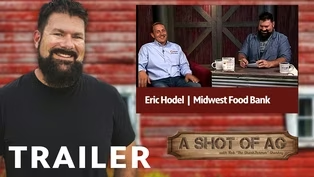
S02 E07: Eric Hodel | Midwest Food Bank | Trailer
Preview: S2 Ep7 | 20s | Eric Hodel, CFO of Midwest Food Bank, talks about the mission of this amazing organization (20s)
Providing Support for PBS.org
Learn Moreabout PBS online sponsorship
- News and Public Affairs

Top journalists deliver compelling original analysis of the hour's headlines.

- News and Public Affairs

FRONTLINE is investigative journalism that questions, explains and changes our world.












Support for PBS provided by:
A Shot of AG is a local public television program presented by WTVP