A Shot of AG
S02 E10: Kirk Liefer | Farmer
Season 2 Episode 10 | 26m 46sVideo has Closed Captions
The Liefers have farmed in Red Bud for generations; they’ve now opened Lieferbrau Brewery.
Kirk Liefer and his family have farmed in Red Bud Illinois for generations and have never been afraid to diversify their farm. Opening the Lieferbrau Brewery has required dedication and skills from many family members as they worked together to perfect their brew, draw a crowd that will keep coming back and work through the struggles of COVID guidelines.
Problems playing video? | Closed Captioning Feedback
Problems playing video? | Closed Captioning Feedback
A Shot of AG is a local public television program presented by WTVP
A Shot of AG
S02 E10: Kirk Liefer | Farmer
Season 2 Episode 10 | 26m 46sVideo has Closed Captions
Kirk Liefer and his family have farmed in Red Bud Illinois for generations and have never been afraid to diversify their farm. Opening the Lieferbrau Brewery has required dedication and skills from many family members as they worked together to perfect their brew, draw a crowd that will keep coming back and work through the struggles of COVID guidelines.
Problems playing video? | Closed Captioning Feedback
How to Watch A Shot of AG
A Shot of AG is available to stream on pbs.org and the free PBS App, available on iPhone, Apple TV, Android TV, Android smartphones, Amazon Fire TV, Amazon Fire Tablet, Roku, Samsung Smart TV, and Vizio.
Providing Support for PBS.org
Learn Moreabout PBS online sponsorship(guitar riff) - Welcome to A Shot of AG!
I'm your host, Rob Sharkey.
I'm a farmer from just outside of Bradford, Illinois.
I started a podcast, which led into an XM radio show, which led into a national television show, which led to me being right here today.
But today is not about me.
Today is about Kirk Liefer.
How are you doing, Kirk?
- Good to see ya, Rob.
- It's good to have you here.
- I'm excited.
- Are you?
- Yeah, I love seeing you.
(laughter) - Red Bud, Illinois.
Where is that?
- So, we're about an hour South of St. Louis, 20 miles south of Bellville, in Southern Illinois in Randolph county.
- Okay, that's where you're from originally?
- Originally born in that area.
- You're a farmer.
- Farmer.
Raise corn, soybeans, and wheat, and also grow some seed beans for Pioneer.
- Okay, and you were a farm kid.
So I mean, you, you're the stereotype, right?
That you grew up on a farm and then you, you went off to college.
Southern, right?
- Yep.
- Oof.
- Best school in the state.
- I went there, so I know you're not telling the truth.
(laughter) - It's a fine school it was a lot of fun.
- Yeah.
I had a good time.
- Yeah.
It's kind of the underrated school in the state, I think so.
I think because of back in the partying days, everybody kind of wrote it off.
- Right.
- When did you graduate there?
- Graduated in '99.
I went to (indistinct) college for two years, graduated there in 97 and then went to Southern in the next two years, and then graduated in '99.
- So, you would not have been there during any of the riots?
- No, probably right after.
- Okay.
You know, somewhere there is a, it's like the world's wildest videos or whatever.
- Correct.
- It was an old cass- like the VHS.
And if you could find that there was a scene on there where they're having the riots at Southern and it's a line of cops, and then you've got the crowd.
And then on this side of the cops is some yahoo going like this to the crowd, waving them on.
- That was you?
- That was me.
- Oh man, I just missed it then.
- I was so, so, so happy when I saw that.
(laughter) Okay.
So did you know that you always wanted a farm?
- Yeah, I grew up with grandpa and dad, being with grandpa every day, dad every day and just knew from an early age, that's what I wanted to do.
It was pretty, pretty steadfast in my mind.
That I wanted to be in ag.
- Siblings?
- Yeah, Got a younger brother, Kent.
A younger sister, Cara.
And then my youngest brother is Christopher.
- So this is where it gets kind of touchy sometimes in ag.
Right?
- Correct.
- When you have siblings, you have a farm, is it a big enough for one kid to come back?
All the kids?
I mean, how did you guys navigate that?
- Well, you know, there's a lot of farms Rob that, you know, have difficulties managing several members of the family and that's something that we've been fortunate with.
Being able to control, and it's been not too bad for us.
And it's kind of worked out well that whenever grandpa passed on, it was dad and I, and then as the farm grew, we had opportunities that kind of allowed siblings to come back and have roles that they wanted.
- Okay.
Is there anything else you ever wanted to do?
- No.
And I see that in my youngest son, Cade now.
He has got farming on the brain so bad.
That's all he wants to do.
He farms at home, wants to farm with me.
And I'm pretty sure that's how I was growing up as well.
- See, now that's a pressure on you now, right?
- Right.
Because it's, you're the farmer and now you have to make it into a position.
I go through this too, and it does.
It actually worries me more than like the, the success of, of the farm that it's like "Hey if the kids want to come back.." Because I was lucky enough to have that.
I want to give that to them.
- Yeah it's something that I think about every day.
And I'm pretty sure grandpa probably started things for dad, dad for me, and it's been my goal to continue what we're building now.
To have opportunities for the kids in the future.
- Okay, what's the ground like around Red Bud?
- It's not what it's like here.
(laughs) - Yeah.
- Rolling.
- It's pretty nice here.
- Trees.
Yeah, we, we've got a wide variety of ground we farm.
- You do have some good ground though, right?
- Yeah, We've got some good ground.
We got a little bit of everything.
Creek bottoms, river bottoms, Grandma's got rocks, some pretty good grounds.
We've got a good, good collection of everything that our county offers.
- So when you are, when you're, when you're picking a field, right, when you're harvesting a field the, the combine can map all that out.
So a lot of times you have like the square or the rectangle of the field, and then it will show you, you know, if that's a good crop over here or different colors or whatever.
I've seen, Kirk's, I've seen your maps, yours look like Picasso did it.
- Yes.
- There's no square fields.
You're farming all like this.
- I don't know how you stay awake in your fields.
- It's tough sometimes.
(laughs) - Yeah.
- By tough.
I mean, fantastic.
- But you have, you have to just basically navigate what you have for grounds.
- Correct.
- Which is not always going to be the nice, straight line.
- I don't know any better.
So that's, that's.
- You have some straight fields, Right?
- We've got some, but even the straight field has probably got a drainage ditch in them, or some waterways.
So we never get that full effect of just driving straight from one end to the other.
- Okay - It's very rare.
- My sympathies.
- They're taken.
- Corn, soybeans, wheat.
At one time though, your farm did have livestock.
- Yeah.
I mean we had livestock when grandpa was around, had some cattle.
And then had hogs whenever dad and I were around.
And probably about 2004 is when we got out of the hogs and really had to make a decision, in which, which way we were going to go.
- [Rob] Mmhm.
- Getting out of hogs was tough, because dad had done it his whole life.
- [Rob] Yeah.
- But at that point in time, as you know, hog industry was changing and we really needed to focus on something we knew and could do the best we could.
And, uh, but when that happened, we lost some of the diversification that we had.
So ever since then, we've been trying to gain some of that back.
- [Rob] Did you care?
About losing the hogs?
- Well, they made us money for a few years there, but once we got rid of them, no, I didn't care.
- That's the way that ours was too.
We got out in 2008.
My dad was the same way.
It was rough for him.
I wanted to get out of them.
So it was a case where I, you know, kinda, I didn't just share exactly my, what I was thinking about.
Cause I would like want it to scream.
Yes.
Get rid of these stupid things.
Let's go to row crop.
Was that the same way with you?
- Yeah I mean, those mornings when you get up at 4:30, 5 o'clock to load hogs, you know, you're just thinking, why are we, why are we doing this?
But we had a good stretcher.
Cause 99 had happened when we had eight cent hogs.
And a lot of guys got out.
So we went and rented a bunch of buildings and had a five-year stretch of, of profitability.
And then it was just time to be done.
- We really are lazy aren't we?
- (laughs)Compared to our grandparents and parents probably, probably so.
- There's a lot of people that think we get up at 4:30 every morning for fun.
- Right.
- And milk the chickens and stuff.
- Right, right.
No - Doesn't happen.
I mean, if I could, I'd sleep in til nine.
(both laugh) You talk about diversity.
All right.
Let's, let's talk about getting into the brewery business.
How, how did that all come out?
- So, you know, one of my goals coming out of school was to be able to grow the operation, to bring siblings back, - [Rob] Mmhm.
- and have the family involved.
I know some people don't look at that as trying to have the family involved, but it was important to me and family is important to us.
First time that happened was in 2012, we got the opportunity to have a Pioneer Seed dealership, and that allowed my brother to come back and take full charge of that.
- Okay.
So, what that means right?
Is when I need seed corn to put it in the ground to make a crop, it's very specific.
It comes in a bag and there's dealers.
So a farmer dealer like your family, so you're out there selling seed corn for yourselves, for your neighbors And that it's, it's a side hustle for a lot of farms.
- Correct, so we're supplying seeds to local farmers for corn, beans, alfalfa and wheat.
- Okay.
So now was that just his deal?
Or is that kind of a family deal?
- So, he is the manager in charge of that, it's his company.
And he helps us whenever he's not on Pioneer time.
So he's, whenever there's customers, meeetings, he's gone and takes care of that.
And when he's caught up, he helps us.
Which is a lot in the Spring and the Fall.
And it actually compliments what we're doing quite well.
- You know, what's funny is there was a survey done, I think it was by the Farm Bureau, at one point, where they found out that a lot of people think that Pioneer, DeKalb, that these are huge farms, that because they see those signs everywhere.
So they see a Pioneer sign by a field, they think this is some Pioneer farm that's farming everything.
- Yeah.
And it's, it's not that at all.
Basically Ken is a representative for the company that allows us to go out and try to help farming operations be more profitable.
- Okay.
So back to the brewery thing.
How did this come about?
- So my youngest brother, Christopher, graduated college in I think '14 somewhere in there and came back to the farm.
Had a business degree.
Liked farming but it really wasn't his passion.
So he had worked at a local winery for probably seven, eight years.
Helping them make wine, bottle wine, and just the process of the making of the alcohol, making the wine, was something he was extremely interested in.
He started a brewing homebrew in our, in our farm shop and had some really- - [Rob] Is that illegal?
- Well, we did it.
(Rob laughs) - It was very good.
- Welcome to agriculture everybody.
- And it, and it turned out that he had some really good batches and we started exploring things for a couple of years and never could find the right spot.
2017, my aunt and uncle had a building they purchased in Red Bud and asked if we would like to be part of the renovation and, and do the brewery.
- And okay, your, your last name is Liefer, Liefer, Lieferbrau.
- It actually has got a pretty important meaning, Liefer in German means to deliver.
Brau means beer.
So it's our job to deliver beer.
I think it's just meant to be.
- I think you're just making that up.
- That's not.
- I mean, I'm going to Google this.
- You should Google it.
- I mean, seriously, if you're lying to me, we're going to put a little disclaimer.
- No.
- It's going to be "Kirk Liefer, not telling the truth" - Have a disclaimer that says "he was correct".
- Guess, guess we'll find out won't we.
(laughs) That's pretty cool.
It does, it seems like it's almost meant to be.
- It was, We really researched a lot of names and as a group of us and just kept coming back to using our name and couldn't have worked out any better.
- So how do you do it?
You guys are farmers, right?
This is, this is what you do.
And now you've, you're doing a brewery.
You have to do research on what people like, what names or you know, what taste, all this stuff.
How do you even start that?
- So we were very, very fortunate, Sharkey.
We've got eight members, siblings and spouses.
That each bring a unique skillset to the, to the, to the brewery.
And that alone helped us to, to do what we do.
We've got people who are really good with numbers, people who are good with PR, people who are good at brewing and just all those minds kind of collaborating together, made this work.
It wouldn't have worked without that kind of situation.
- Yeah, there is a lot of brain power in your family.
I like your brothers.
I like your wife.
- Appreciate that.
- We'll just move on from there, won't we.
(both laugh) This had to be intimidating though.
- It was, and the first year was tough.
Just learning everything.
You're learning what people want.
You're learning a new system.
You're just not having your friends come over and have beers on you.
You're going to charge them.
You know, there's just a whole idea of having events and things that was new to us.
But, we've, we've, I don't want to say mastered, but we figured it out and we're comfortable with it.
And it's, it's going well.
- How's the red tape of not just selling alcohol, but producing alcohol.
- It's tough.
And that's something my sister deals with, you know, there's a lot of taxes.
- I like your sister too!
- Yeah.
(laughs) A lot of taxes is a lot of laws and rules we gotta follow.
And you know, those are some of the things that sometimes are frustrating for a guy like me, who likes to get to goin and make a move.
- And likes to break the law.
(laughs) - Yeah, right, obviously.
So, you know, that was a little bit tough, but we've got the hang of it.
We're we're doing it right.
And feel confident that we're following all the rule the rules and laws that we should be.
- One time, I was complaining about farming to my dad and he says, "yeah, dealing with mother nature is not fun, but just be happy that you're not dealing with human nature" - Well, we're there.
- You've got to deal with both.
- Yes, and uh you know, we do a lot of events.
A lot of, we get asked to do weddings and different things and you do get to get - Ah!
Emotions are high!
- Yeah, you get to figure that all out and try to work with the customer.
Customer's always right.
- Ohh, come on Kirk!
- Trying to make things the best for everybody.
- Really?
Did you just say that with a straight face?
- Yeah, I said it.
(Rob laughs) - There's gotta be times you just want to strangle people.
- So Stephanie's department is a lot of PR stuff and she's a very good, mild-mannered woman who deals with it well.
- Okay.
Because not only you've got people that are annoying, you got people that are drinking too.
Which seems to turn up the annoying.
- Correct.
Luckily, you know, we close early, so we let them get, you know, having fun, then they go to the next spot and they can, you know, get crazy.
- Uh huh, do you ever, do you carry like that little Irish club?
The whatever they call it, the head bopper.
- No, we haven't had no problems yet, believe it or not.
- Huh..
Okay.
I don't believe it but (laughs) - We, We're a fine establishment Ron!
- I Know you are!
I've been there.
It is an amazing place.
It is literally if I didn't know you, I would sit there and like, this place is awesome.
It just, it's a very good atmosphere.
We went there when the weather was nice.
So you had the back open.
It was fantastic, but I I'm impressed with, with what you guys have done.
- It's going well for us, and the whole idea is we wanted something inviting.
Something that felt like maybe you were in St. Louis, but you weren't, it's very family oriented.
A lot of the pictures you see on the wall, all the pictures you see in the wall are all from family.
And it's just about family, farming and working together.
- So you, and your family, are very well known in the area.
Is that kind of tough?
'cause you got people showing up that, you consider friends.
and it's like, "do I give em a drink or do we give em a check?"
- You know everybody, and uhm Red Bud is a very small, tight knit community, who support their local businesses very well.
And you know, it's as important for us to have a brewery that is something we can extend on to our family.
But it's also just as important for us to be a part of Red Bud.
And Red Bud has changed, so dramatically, the last 20 years.
And we feel kind of honored to be in the, I guess the hotspot of downtown there.
Helping to bring people in because if, if people are coming to town to see us, then they're eating there and vice versa.
And it's good for everybody.
It's good for the community.
And it's, it's been awesome.
- I paid.
when I went.
- I think I bought you a couple of drinks.
Maybe.
- No, no, I paid - I think I bought Emily drinks.
'Cause I like your wife too.
- That, that might've been true.
That might've been true.
There's parts of that night I don't remember.
- It was a good night!
(Ron laughs) - When people come in, do they get a taste of agriculture?
- Yeah.
- Do they get a taste of farming?
- Yeah, and we try, I guess, you know, part of my role is to try and go around and talk to people.
Give them some, - Oh, you're that guy?
- I'm that guy.
- The host or the, what did you call it?
The MC?
- I'm the host.
That's why I'm here talking to you.
- Okay.
(laughs) What do you tell said people?
- I just tell them about the history that the pictures in the wall are of our, of our grandparents, our great grandparents, the heritage of our farm.
And we're fortunate, seven of the eight partners have a farming background.
So there's pictures from, you know, the 1800's of family members on their farm.
And that's just a very special thing to us that we can give them a little bit of what ag is about.
Give them a little bit idea of what a family working together can be about, and to make something unique for the community.
And we get a lot of people from St. Louis and the Metro East that come just to be part of the on the ambiance of the building.
- So, when you have people that aren't involved in agriculture right, 'cause we're farmers, we're always sensitive about what people think.
I mean, do you get people in there that say, "oh yeah, you guys are poisoning the world with your GMO's and all this stuff."
Are they actually wanting to know about what you do as a profession?
- I'd say 99% of the time, that's want to know about what you do with your profession.
And you know, they can ask questions and you know, we've been, we've been trained up to answer these questions, right?
In all of our past things that we've been a part of in life.
So.. - Don't skip ahead, man.
I mean I've got a list here - Okay, I'm just trying to help you.
- This is what Kirk does!
He tries to skip ahead.
I'm trying to be professional on that and let you get a chance to talk about your brewery.
- Uh huh.
- Can we continue?
- We can continue.
(laughter) - You are a good a face for that because I don't know why, but people seem to like you, and when you talk to them, they actually listen to you.
- I think most people do.
Maybe that's not my family, right?
But maybe the outsiders.
- Well, the, the thing you have going for you is the people that are coming here for the first time don't know who you are.
- That's a bonus.
- That's a huge bonus for you - That's a huge bonus, I agree with you.
(laughter) - All right, you brought it up.
Training as a farmer, right?
Because we do get asked questions and sometimes we don't know how to ask them.
Sometimes we get angry that people don't understand because we are doing such a better job than what, you know, our ancestors, not that they knew any better, but we're doing such a better job for the environment that then we get frustrated when people say that we're, we're not good for it.
- Right.
It's tough.
Isn't it?
- It's it's, that's what we're here to do.
We did go through a training program, it was a two year deal.
And did you learn anything from that?
- Yeah.
I mean, I've been involved for a lot of years and stuff.
You know, dad grew up being involved.
Grandpa grew up being involved.
Stephanie's dad grew up being involved in, you know, I always thought that if you had the ability and the time to lend your time and thoughts to some organizations that are beneficial, it was something we need to do.
And when we were in ag leadership, you know, that was just a, another piece of the puzzle.
And I learned, I learned a lot, but I learned more from meeting guys like you and the rest of our class, some of the best friends I have in the world are people I've met through these, these learning opportunities that we've had.
And that's priceless in my mind.
- Gets you off the farm, a little more worldly.
It used to be a, what I call it, growing up in the system.
As a farm kid would start out in 4H.
Then he would move to FFA.
Then he moved to like the farm bureau, young farmers, and then the farm bureau and then the commodity groups.
And it was a whole system, right.
Then social media came in because the whole time there we were being taught, well, you have to change people's minds that farmers are great people.
Social media came on and we realized that people basically are wrapped up in their own lives.
They think farming is cool in that, but it's, we were focusing in on the 1% that was really hammering us.
- Correct.
- Like you said, the 99% - That's tough, you know, whenever, like you had mentioned a minute ago, we feel we're doing the best job we can.
And I think we are, and to get that kind of criticism that we're not, it's tough.
And some of that, sometimes those one percenters have the, have the loudest voice and that's tough to, you know, but we can, we can prove to them and do the best we can to, you know, try to portray to them what we're doing.
- But this helps.
Right?
- Yeah.
- Because when they, when they see sometimes the field of corn, when they're driving by, they can think of you.
It's a scary thought.
- I know.
That's a good thought.
- Do you think it's important for a farmer to travel?
- Yeah.
I mean, a lot of people want to complain how bad we have it here in the United States.
And we've traveled the world.
You probably more than I have.
But I think when you get outside your comfort zone, get outside your normal routine and you see how good we have it here in this country.
It makes you, it gives you a different appreciation.
We have our struggles, but this is still the best place to live in the world.
- Yeah, in that program, we were in, we went on a trip.
The trip was to Japan and the trip was to Panama.
- Close.
They're close in the map.
If you look.
- Apparently, the people that were in charge of setting the trip up, didn't have an understanding of how the planet was set up because it was, it was horrible.
But anyway, it was a good transition because I mean, Japan's about as modern as you can get, - We saw two different worlds.
- Yeah.
And Panama is not, that that country is struggling.
- To go from one country that's clean, respectful uhh to a place that is dirty and poor.
- When we left their government, we all said this, this place is crooked.
- Yeah.
It's just that it's trips like that though, that give you appreciation and some knowledge in your head to understand how the world goes around.
- Okay, let's talk about something serious, all right.
Let's talk about your mom and the pies that she makes.
Now tell me when, tell me when to stop.
So if this is, this is the table, how high is your moms the pie that she makes.
- Close.
- 'Bout like that?
- Yeah.
- It's uh, what, what are they?
- It was a coconut creme and a lemon meringue, I think it was.
- The thing was, yeah, it was about that tall.
Is that how you grew up?
- Yeah.
- How are you Not 800 pounds?
- We die from the inside out.
We don't uh, yeah.
Right.
A lot of people ask that.
- Your mom's an amazing cook.
- Yeah, she is very good.
Yeah.
We're uh, that's something she loves though.
She loves to entertain.
We all love to entertain.
And when we had the class out there at our place, you know, people think that's a lot of work, but we love to entertain.
And we love to see all you guys have a good time and be our guests.
- You do have a very nice shop that you can transition into a place where you can have a meeting, have people out there.
Do you use that quite a bit?
- Yeah.
That's, when we built that, we didn't realize what that was going to do for us.
In hindsight, if we would've known all the events and stuff, stuff we have there, we would have probably done some things a little bit differently, but it's been a good tool for us.
- You have an ice machine.
- Yes.
- I'm jealous.
- Yes, we do.
- I looked into that, but we can't make ice.
Cause our water's too rusty.
- That's a problem.
- It is.
- Ice machines are a phenomenal.
- Yeah.
In our house, we make the ice out of the Culligan water.
And then we refer to that as the good ice.
You were complaining about your ground compared to ours, but at least you have good ice.
- I'd take your ground over good water.
- Well, we all have our little struggles.
Now, if people want to find more about your brewery.
- So Stephanie does a lot on Facebook, just look for Lieferbrau Brewery and then Instagram, same thing.
And that's where she's posting stuff about events and things that we do.
- What's it like working with a wife that is so much smarter, so much more talented than you?
- Well, it makes my life easier.
- Does it?
I'm glad you can at least recognize it.
- Oh, I recognize it.
Yes.
- How is it working with family?
- It's good.
I mean, there's ups and downs, but we work at it to get along.
We work at it too to make it work.
And like I said earlier, it works that we have got roles for everybody.
We're not a bunch of people trying to do the same job.
So we can all do our thing, and we make sure we get together and we get over our differences and it's tough, but we do it.
- And you can all kind of call on each other, right?
Like if the brewery needs help, if the farm needs help.
- Correct.
- Is it nice that every, everybody has a role, but can you pull people off?
- That's right.
You know, whenever Kent needs something at Pioneer, we go and take some of our crew and help him.
And he helps us a lot.
Vice versa.
If a guy can't do something at the brewery, we always got somebody to call.
It works out really good.
- Yeah.
Not every farm has that luxury of the family being able to get together.
Yeah.
- Yeah.
It's tough.
I, I've got friends, you know, and, and people that, you know, compliment us on the fact that we can get along.
Cause sometimes it's tough.
- Out of all the family members you work with, which one do you like the least?
- (laughs) Oh boy, I'm not answering that.
- Okay.
Refuses to answer.. - Yeah, make a note.
- So now it's going to be Kirk Liefer:Difficult guest.
- Maybe you should ask them.
- Oh I think I already know the answer to that.
It's, this is so cool.
What you guys have done.
I love it because this helps my farm because people are going to your brewery.
They're having an amazing experience and they're getting to know about ag.
So Kirk Liefer from Red Bud, Illinois, thank you and your family for everything that you're doing.
And to everybody else, we'll catch you next week.
(outro theme)
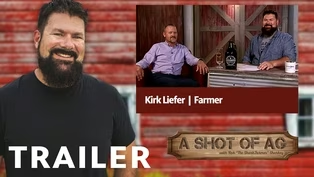
E10: S02 E10: Kirk Liefer | Farmer | Trailer
Preview: S2 Ep10 | 20s | The Liefers have farmed in Red Bud for generations; they’ve now opened Lieferbrau Brewery. (20s)
Providing Support for PBS.org
Learn Moreabout PBS online sponsorship
- News and Public Affairs

Top journalists deliver compelling original analysis of the hour's headlines.

- News and Public Affairs

FRONTLINE is investigative journalism that questions, explains and changes our world.












Support for PBS provided by:
A Shot of AG is a local public television program presented by WTVP