A Shot of AG
S02 E11: Sharon Gramm | RiverFront Market
Season 2 Episode 11 | 26m 46sVideo has Closed Captions
Sharon Gramm spotlights the Peoria RiverFront Farmers’ Market.
Sharon Gramm has worked for years to attract local people down to the Peoria RiverFront Farmers’ Market to enjoy fresh produce and products from local farmers, artists and food vendors. She sees it as a fantastic way to connect consumers to where their food comes from and how it’s produced.
Problems playing video? | Closed Captioning Feedback
Problems playing video? | Closed Captioning Feedback
A Shot of AG is a local public television program presented by WTVP
A Shot of AG
S02 E11: Sharon Gramm | RiverFront Market
Season 2 Episode 11 | 26m 46sVideo has Closed Captions
Sharon Gramm has worked for years to attract local people down to the Peoria RiverFront Farmers’ Market to enjoy fresh produce and products from local farmers, artists and food vendors. She sees it as a fantastic way to connect consumers to where their food comes from and how it’s produced.
Problems playing video? | Closed Captioning Feedback
How to Watch A Shot of AG
A Shot of AG is available to stream on pbs.org and the free PBS App, available on iPhone, Apple TV, Android TV, Android smartphones, Amazon Fire TV, Amazon Fire Tablet, Roku, Samsung Smart TV, and Vizio.
Providing Support for PBS.org
Learn Moreabout PBS online sponsorship(upbeat rock music) - Welcome to A Shot of Ag.
My name is Rob Sharkey.
I'm a farmer from just outside of Bradford, Illinois.
I started a podcast which led into an XM Radio show which led into a national television show which led into me being right here today.
But today is not about me.
Today is about Sharon Graham.
How ya doin', Sharon?
- Good, how are you?
- I'm doing pretty good.
You're from Peoria.
- I'm actually from Metamora but I work in Peoria and have worked in Peoria for the last 16 years.
- Okay, you would've thought PBS would've- - That's okay.
- Were you born there?
- I was born in Metamora, yes.
- [Rob] Okay, and you chose to stay there.
- I did.
- [Rob] That says a lot about ya.
(Rob laughing) - I know.
- What is your official title?
- My official title is Director of the Peoria River Front Association and my side title is Manager of the Peoria River Front Market.
- All right, so it's like a job within a job.
- Yes.
- Which one's harder?
- I would say they're both equally hard.
We actually do divide them separately in budgets and things like that so we do consider the market a separate operation completely.
- Gotcha, so farmer's market.
- Yes.
- It's what everybody thinks they're gonna stop and you've got a bunch of farmers out there and they're selling corn and turnips and beets and stuff that nobody really eats.
Tell us what your market is.
- Okay, we are actually a farmers and art market and we open mid-May.
We go through the end of September.
We're open every Saturday morning, eight to noon and we are downtown on the River Front so we have a beautiful location.
We're right next to the River Station building.
And it is a farmers market and we focus on our farmers that bring a great variety of produce throughout the entire season, but then also we also have art vendors.
Everything must be grown, made, or created by the person that's selling it so we are a producers-only market and we consider ourselves local and by local, we mean everything must be made or grown within the State of Illinois.
- Okay, so I get the farmers stuff, if they grew it.
I didn't realize that was the same with the artists down there.
- Yes, so everything has to be handmade by the person that's selling it, or significantly altered from its original state.
So yeah, that's our rules.
(both laughing) - You get caught up in the definition.
- Yes.
- I suppose that's pretty important, really.
- Right, and we really focus on local for the market.
We say within the State of Illinois.
Our farthest vendor comes from Calhoun County when she brings peaches every week during peach season.
- [Rob] That's quite a ways down south.
- That's our farthest distance vendor.
Most of the vendors are within 30-40 miles of Peoria and they come each week, and then the art and craft vendors as well.
So we have candles, wood-turned items, glass items, pottery.
A good variety of nice quality artwork.
- It's an event when you go down to it.
- It is an event.
- You would go down to it even if you didn't want to buy food.
- Right, so it's interesting, the people who are interested in the fresh vegetables and fresh fruit, they come early because sometimes, the farmers do sell out so if you wanna get your choice of the best produce, it's best to come early.
We allow the vendors to start selling at eight.
- [Rob] That's not bad.
- No.
- That's not like farmer-early.
- No, it's not farmer-early.
It's city-early, I guess.
You can start selling at eight, and then as the morning goes along, we get some more browsers that come through and shop the art and craft items.
We have omelets.
We have Bloody Marys and mimosas served at Martini's.
- Oh okay, all right.
- We have live music.
It is an event.
You can spend 15 minutes there.
You can spend a couple hours there.
And we have people that do both.
- All right, we'll get to the Bloody Marys but let's talk about you.
- Okay.
- How did you get into this?
- I have a friend who I used to work with and she was married to the president of the board of the River Front Association, Curt Hubert.
He owns a lot of the buildings downtown.
And so she found out about the opening and recommended me and so I went and interviewed and that's how I got involved.
- Do you have any background in any of this?
- I was in banking prior to this.
Marketing for a bank.
- Okay.
(Rob laughing) - And some event planning, so I do consider this job an event planner position much more than a gardening or farming position.
It's event planning.
We have balloons and face paining.
I feel like it's my job to bring people to the market and to promote it on social media and things like that, and then it's the farmers' jobs to bring the produce and bring the great food and sell what they've been working so hard to grow.
- I can tell you this as a farmer.
I think it would be a mistake to have a farm-oriented person in your position because it's all about getting the people there.
If you have the best produce in the world, you don't find it if they had any cotton candy, but if you can't get people to buy it there, and that's where you're gonna know people a lot better than the farmers do.
- I do feel that that's my position is trying to get people there, to highlight the farmers.
And social media has been really good.
It's a free place to promote those farmers that come and I try to highlight them and highlight what they're doing during the week to bring their produce there.
Not this past Saturday but the Saturday before, we had a rainy day and it's really disappointing to have the farmers work so hard all week to bring the produce in, and then you have a rainy Saturday and we have about half the people show up to buy from them.
But it is always impressive with the number of people that come out and shop in the rain as well.
- You met my wife, right?
- I did meet your wife.
- When people meet my wife, when they leave her, they know every show that we're doing, the time that it's on, the website and all this.
Are you the same way with the farmers market?
- Yeah.
(Rob laughing) - I'm the organization behind the market and the farmers are the hard workers.
We have people that bring baked goods and cheesecake and tamales.
- [Rob] Tamales?
- Panenderia Ortiz Bakery brings tamales as well as some other Mexican baked goods.
- Really?
- Yeah.
So they're there every week.
- And they would have to produce that to do that.
- Yes, they make it.
They have a bakery on Monroe Street in Peoria and they make everything at their bakery and then they bring it down and sell it.
We also have Swanee's Pretzels.
So we have several ready-to-eat food vendors but then we also have a lot of baked goods and stuff that's packaged to take home, breads and cookies and things like that.
We have honey.
We have popcorn.
All kinds of good stuff.
- [Rob] Everything here.
- Yeah.
- The peppers, do you know what kind these are?
- I don't know what.
They're purple peppers.
- They smell really good.
Purple peppery.
You got the corn.
You know I'm a farmer and I grow corn for a living.
I don't grow sweet corn 'cause it's a pain and I can go and pay whoever grew this really a lot less than it's worth and you can eat as much corn as you wanted.
- We have several vendors that specialize in sweet corn and so there's a great selection.
This is the height of the season right now with the sweet corn and the peaches and the green beans and lots of tomatoes.
- [Rob] Pickles?
- Yeah.
- Oh now I've messed everything up.
Was this in there a specific way?
- No, it's fine.
Just don't squash the peaches.
- I wouldn't, I'll leave that alone.
(Sharon and Rob laughing) Okay, so how many people are visiting this market on a good weekend?
- On a good weekend, we have four-to-5,000 people so it's a big event.
- [Rob] Four-to-5,000 people.
And how many vendors?
- At our max, this past weekend we had 94 vendors so we've gone anywhere from in the middle of May, we started at about 65.
We've grown to 95.
And then as fall comes in, we'll kind of go down a little bit more and probably be down to 70-75 vendors.
- Do you have a bread-and-butter customer person that's coming?
Do you have a stereotype of a customer?
- We really don't.
We're a very diverse market so we have young people, old people.
We've got the Instagrammers who are out there taking pictures of the coffee.
We have a coffee vendor.
We've got the young and old and families.
It's just a very diverse market and I really can't say that there's a typical.
I would say there's more women than men.
- [Rob] So good people-watching?
- Great people-watching.
- Tube tops.
It's like the State Fair.
- Yeah, there are probably some tube tops out there.
(Sharon and Rob laughing) - And I've been, and it's been a while and I think we went more towards the winter, but yeah, there was just an incredibly diverse crowd.
It wasn't you think maybe they're more affluent or maybe the people that were looking for a deal.
It was everybody.
- Right, we do have high-income customers.
We have lower-income customers.
We have a great Link program at the bank.
Not the bank, at the market.
I'm going back to my banking.
We have a Link program that allows people to use their Link card and we give them tokens to be spent at the vendors.
Rather than going to Walmart or a big grocery store, they can come down and support the local vendors using their monthly Link dollars as well, so that's been a good addition.
- [Rob] They're tokens?
- They're wooden tokens and they're worth a dollar a piece so when you swipe your card and you take 25 or $30 off of your card, we will actually match up to $15, and then that matching $15 has to be spent on fruits and vegetables.
So it's a really win-win situation.
The farmers love it because the money's going directly to them.
- [Rob] Added business.
- Added business.
It helps out the community and then that money stays here locally.
- Plus, if you're buying food, especially if you're kids, this stuff is better than Doritos.
- Right.
- And do you like Doritos?
- I like Doritos too.
But this is healthier.
- In general, you'd much rather have the kids of Peoria eating stuff like this.
- And as a producers-only market, you can talk to the person that grew the sweet corn, that picked the peaches, so I think that's really nice too.
If you have any questions, we have a farm from East Peoria, Down River Farm, and they bring a lot of unusual things, so they're right there telling you how to cook it, what to use it in, that type of thing.
We have a mushroom vendor that brings mushrooms and he has recipe cards he'll hand out and tell you how to cook them.
- [Rob] That's smart.
- It's really good to go with your kids and show them how to learn how to cook this food as well.
- Farmers like these because what we do, people have a lotta questions about it, and the farmers at the farmers market seems to be like our frontline of defense when it comes to communicating what we do because they're the ones that are talking to the general public.
When I sell my corn, it goes off on a semi and I don't know where it goes.
And then when somebody asks me, "Are you poisoning the world?"
I just get all defensive in that.
But the farmer that work there and the producers that work there, they know how to talk to people.
- Right, they do.
They work really hard and so they're proud of what they bring down there, and they want people to buy it and if you don't know how to use a certain item, they're happy to share it with you.
If they use organic practices or what type of farming they do, they're willing to answer any questions.
- I suppose there's people that haven't gone there too much that are maybe almost a little intimidated because they're going to a farmers market and they don't know what this is.
They don't know what that is.
What's your advice to 'em?
- I think just go up and ask.
The farmers are all so friendly.
They are willing to share and they want to share.
That's why they're doing this type of farming, is they want to be out there with the public and they want the public to know what they're doing as well, so it shouldn't be intimidating.
The farmers are all very, very nice and all of the vendors are very nice.
If there's potters or glassblowers, they're all very proud of the work that they're doing.
- [Rob] Glassblowers?
- We do have some glassblowers.
- Do you have sword swallowers?
- We do not have sword swallowers, no.
I'll have to work on that.
- Maybe you should look into it.
I'm just sayin'.
- Hadn't thought of that one yet.
- Okay, I like what you say here.
"We consider ourselves a business incubator."
What do you mean by that?
- This is something that we've kind of learned as we've come along in the last 18 years is that we've had a number of businesses start at the market and they've got a great idea.
Harreld Webster with Tripple Dipple's, for example, he knew he wanted to open a cheesecake business and he started down at the River Front Market.
- Society wants him to open a cheesecake business.
- Yes!
So one of the first places that he started, he's worked really hard at this, is the River Front Market.
And Four30 Scones started at markets as well so these businesses can go and meet the public and try out their product before they open a brick and mortar.
We really take pride in giving different businesses exposure and helping them move onto their goals of the brick and mortar place.
- Especially because you take a look at some of these companies that have become successful probably wouldn't have done it, maybe wouldn't have done it without that market and without you running it the way so hey, that's a big pat on the back.
- I don't wanna take credit for them.
- I'm giving you credit for that, whether you want it or not.
- They do work really hard, but it is a good opportunity.
It's a good place for them to showcase their products that their offering and with bringing four-to-5,000 people.
And markets are hard work.
We're open for 19 weeks a season.
Sometimes we're open for 20.
Some of these vendors do multiple markets in different cities, so it's a lot of setting up and tearing down and I give these businesses a lotta credit for coming every week.
- You seem like a very nice person which is confusing to me 'cause I am not.
I have been a chairman of a farm market's committee when I was President of the County Farm Bureau, so this was in Princeton.
Those meetings, they were difficult.
They say the term herding cats because all the people that make each a different one are fiercely independent entrepreneurs, and now you're trying to get them together at a common goal and you've got somebody upset that the tent spike of their neighbor is two inches over on their line and stuff like this.
How do you do that and have such a wonderful disposition?
(Sharon laughing) - Sometimes, I don't know if all the vendors would agree about that wonderful disposition at seven o'clock in the morning sometimes.
I guess I'm a rule follower, so we have our rules and regulations.
- [Rob] Do you have a look?
- I do have a look.
I didn't know I had a look until some of the vendors pointed that out to me, but apparently I do have a look.
- I kinda wanna see the look.
- I don't know what it is.
I'm not gonna do the look but I've had vendors ask if I'm upset with them and I'm not upset.
- [Rob] Because of the look.
- I'm just busy.
My busiest time is from 5:30 in the morning til eight o'clock.
I'm certainly busy throughout the morning but once the vendors are set and everything's ready to go, then I'm good to go.
But yes, I must have a look but I am a rule follower and I do expect all the vendors to follow the rules and then everything goes smoothly.
- If people just do what I tell them to do, we'll get along just fine.
- Right.
- And then you get on the other side, the people that buy this and they're like, "There's a bug in this."
"How can you be selling something" "that there was a bug in this?"
You gotta deal with the customer side and the vendor side.
That's gotta be a hard juggling act.
- It's difficult sometimes.
This year, knock on wood, it's been a nice year.
People are happy to be able to come out to the market.
They're happy to be able to have something to do.
Last year during COVID, we were open all 20 weeks of the season last year.
- [Rob] You were?
- We were one of the few events in Peoria that was able to stay open.
We worked very closely with Peoria County Health Department who was a great partner with us last year and not everybody liked the rules that we set, but as I told the vendors and the customers, this is what we have to do in order to be able to be open.
Nobody wanted the market to close.
So last year was successful but this year has been much better as far as crowds and people coming out.
And I think for the most part, people are very appreciative to have this in Peoria.
- Do you know much it advanced now?
I gotta figure it's gotta be so hard.
You're going into a market every weekend.
At what point do you know do you have to wear a mask?
At what point do you know does everybody have to be six feet apart?
How's that work?
- So we dealt with that a lot last year.
We did require social distancing.
We had a lot of chalk marks on the pavement.
- How'd that work?
(Rob laughing) - We all did the best we could.
We did require all the vendors to wear masks.
We encouraged all the customers to wear masks.
This year, since we're an outdoor event, we have not required masks.
Certainly, people are welcome to wear them if they're more comfortable.
But last year was definitely more challenging in other ways but we made it through then.
Like I said, people seem to be coming out and they seem to be intentionally buying local, which is really good to see because a lot of people have pushed that message for a long time and it's really good to see that people are following through with that and keeping their dollars local.
- We interview a lotta people on Ag and since COVID, the direct sale has just skyrocketed.
People that have raised cows their entire life are now going direct to consumer because it was that little bit of scare in the grocery store when they went to buy hamburger or whatever and it wasn't there.
All of a sudden, people got interested in where their food comes from, which you're perfect for that.
- A lot of our farmers, we have Grandma and Grandpa's Farm, Garden Spot Produce, Down River Farm.
I'm sure there are others I'm just not thinking of right now.
But they do CSA baskets, community-supported agriculture, so they will sell directly to customers a seasonal basket so you might get a summer basket or a fall basket and it's filled with whatever they produced that week and you pick up a basket every week and so basically, you're buying a share in the produce for the season and then you get whatever's available at the time and I think that's a really good program as well.
Some of the boxes are picked up at the market.
We really don't have anything to do with that but I just think it's a really good program.
- Yeah, well it gets people down there.
- And I think more people went out to the farms last year too to buy directly from the farms.
They might've had little bit more time to go do that.
But it's nice to see where your food is actually coming from.
- Tell me about your T-shirt.
- Okay, so we've always had a T-shirt every year for the River Front Market, and the last four or five years, we've had- - Is that you?
- That is not me.
We're trying to highlight women farmers this year.
- They do pretty good.
- Women farmers work very hard.
Dee Ingles with Smiley Graphics, which is right down here in the Warehouse District, she designed this year's T-shirt.
They're a vendor at the market.
And years before, we had Kiera from Kiera's Flowers, she designed a T-shirt for us.
So over the last four or five years, they've kind of become a thing where people get a T-shirt every year.
- [Rob] They're collectors.
- They're collectors, yeah.
- Do they come in crop tops?
- They do not.
Tank tops, we have tank tops.
- Maybe something you could consider?
- So T-shirts are a fun way.
The proceeds benefit the market so it's a good way to support the market as well.
- Do you enjoy what you do?
- I do.
Sometimes, it's a love-hate relationship, I say but I really do.
We've become, I feel, like the market vendors are a little family down there and you get to know people and that's my favorite part of the job is getting to know the vendors and the farmers.
- It sounds a little hokey but as a farmer, I feel good that I'm creating something that helps feed people.
You're kinda doing the same.
Have you ever thought about that?
(Sharon laughing) - I have.
I think it's a very interesting job.
There's a lotta things behind the scene and there's a lot of things that have grown over the past 16 years from what we were 16 years ago, whether it's been a natural progression or whether it's things that we've added.
Adding the ready-to-eat foods, the omelets, and the tamales and pretzels, that brings more people down.
So we've made a lot of changes.
Added the Link program.
We've added the T-shirts.
The live music has always been a part of it.
So yeah, I do feel good about bringing people down.
I feel really good when we have a good crowd and I feel really good when vendors say that they've had record sales for the week, and we've had a couple of those this year where many vendors have said they've had record sales for the 10 or 15 years that they've been there, and that's really good to see.
- Well, you should feel good 'cause you're the one behind it.
So if people want to find out more about this online, where do they go?
- We do have a website, which is visitdowntownpeoria.com so that kinda ties back into the other part of the Peoria River Front Association.
The River Front Association is a business owners association for downtown businesses, so the market was originally created to bring people downtown to support these businesses or to support the area that these businesses are in.
If you go to peoriariverfront.com and click on the Market logo, that's where our rules and regulations and applications and things are.
But probably our biggest place for information is social media on Instagram @peoriariverfrontmarket and Facebook @peoriariverfrontmarket.
And we've done some highlights of some of our farmers this summer and some of our vendors and just putting lots of pictures up there.
We let people know when the peaches are coming, when the sweet corn's coming, that type of thing.
So if you're on social media, those are probably the best places to find out information.
- Instagram has probably changed some of it.
- Someone started the Instagram account, a young girl who worked for me years ago, and then I kind of let it go and we focused on Facebook so this is the first year we've really gone back to Instagram, and it's been good to see.
- You need a TikTok.
- Yeah, but I can't dance very well.
- We'll be the judge of that.
(Sharon and Rob laughing) - TikTok may be next, I don't know.
- We didn't get into the Bloody Marys and the mimosas.
You can have alcohol down there?
- Martini's is open.
They have that nice covered canopy beer garden area and they serve Bloody Marys and mimosas, which is right next to the omelet station.
And so you can shop the market, buy all your produce, and then come back and have a beverage.
You can walk around the market.
You have to keep it within the market boundaries but you are able to walk around with your drink as well.
- I think there's a premium to be made.
Make a Bloody Mary and have all this stuff on top of it.
- That's a good idea.
- You'd have to have a bucket, wouldn't you?
I think it's very cool what you're doing, and I love that you can tell by talking to you that you have a passion for this and it's good to see because you'd think after 16 years, a lot of herding cats and that, that you can still see the good that you're doing through this.
- I always say there's a time for new blood to come in and new ideas and so I'm not sure when that will be, but when the time comes, I think it'll be good to hand it off to somebody and they can take it over and grow it some more.
- Okay, well Sharon Graham from the River Front Market, thank you for all that you do.
- Thank you very much.
- As a farmer, I wanna thank you for what you do and getting this in front of people, so thank you very much.
And to everyone else, we hope you catch us next week.
(upbeat rock music)
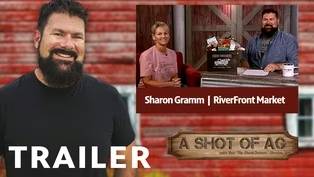
S02 E11: Sharon Gramm | RiverFront Market | Trailer
Preview: S2 Ep11 | 20s | Sharon Gramm spotlights the Peoria RiverFront Farmers’ Market. (20s)
Providing Support for PBS.org
Learn Moreabout PBS online sponsorship
- News and Public Affairs

Top journalists deliver compelling original analysis of the hour's headlines.

- News and Public Affairs

FRONTLINE is investigative journalism that questions, explains and changes our world.












Support for PBS provided by:
A Shot of AG is a local public television program presented by WTVP