A Shot of AG
S02 E15: Larry Schaer | Farmer / Stroke Camps
Season 2 Episode 15 | 26m 46sVideo has Closed Captions
Larry Schaer talks about Life on a Produce Farm and his Retreat and Refresh Stroke Camps.
Farmer Larry Schaer talks about life on his produce farm in Spring Bay IL. His family runs a “U-Pick” strawberry patch and Schaer’s Farm Market. Like many other farmers Larry had an off the farm job working in Human Resources. He teamed up with United Stroke Alliance to create Retreat and Refresh Stroke Camps to provide support to those caring for family members who have suffered a stroke.
Problems playing video? | Closed Captioning Feedback
Problems playing video? | Closed Captioning Feedback
A Shot of AG is a local public television program presented by WTVP
A Shot of AG
S02 E15: Larry Schaer | Farmer / Stroke Camps
Season 2 Episode 15 | 26m 46sVideo has Closed Captions
Farmer Larry Schaer talks about life on his produce farm in Spring Bay IL. His family runs a “U-Pick” strawberry patch and Schaer’s Farm Market. Like many other farmers Larry had an off the farm job working in Human Resources. He teamed up with United Stroke Alliance to create Retreat and Refresh Stroke Camps to provide support to those caring for family members who have suffered a stroke.
Problems playing video? | Closed Captioning Feedback
How to Watch A Shot of AG
A Shot of AG is available to stream on pbs.org and the free PBS App, available on iPhone, Apple TV, Android TV, Android smartphones, Amazon Fire TV, Amazon Fire Tablet, Roku, Samsung Smart TV, and Vizio.
Providing Support for PBS.org
Learn Moreabout PBS online sponsorship(high energy rock music) - Welcome to A Shot of AG!
My name is Rob Sharkey.
I'm a fifth-generation farmer from just outside of Bradford, Illinois.
I started a podcast which led to an XM radio show, which led to a national television show, which led to me being right here today.
But today is not about me.
Today is about Larry.
Sure.
How are you doing Larry?
- I'm doing well.
Thank you.
- Good.
You're from Spring Bay.
- Spring bay, long time... forever.
(laughs) - That's where you grew up?
- That's where I was born and grew up.
Yep.
All my life.
Except for some time in the military, yeah.
- I'm not going to ask you how many years?
- 72.
- 72?
- Well, 73, closer.
- I don't know.
(both laugh) - 73 years, yeah, 73 years old.
- 73 is like the new 55.
- I don't know.
Some days it feels more like 85.
(both laugh) - Oh, very, very interesting.
Almost kind of hard to describe you because you've got so many facets, but you're farmer?
- Yep.
I was born and raised on a farm.
My mom and dad basically raised three kids.
We all started there and, not having a college education, they were very adamant about the three of us kids having a college education.
So at a very early age, we started raising produce for our college education.
- [Rob] Okay.
I bet you hated that as a kid.
- No, I liked it.
- You liked it?
- Oh yeah.
It was cool.
And you know, we started when I was five and it was like, we sold cantaloupe along the highway.
It's like a lemonade stand.
And it's like, from that point on, that was, well, when I was four years old.
So that was 60 some years ago.
- [Rob] I've done things like that with my kids and to raise money for their college.
And it ended up costing me a lot of money.
(Larry laughs) Did you guys actually make money on it?
- Yeah.
- Or it was just something to keep you busy?
- No, no, we actually... the money that we made from our produce and selling produce put us through college.
- [Rob] Where'd you go to school?
- Bradley.
I went to Bradley.
My brother went to Bradley, and my sister went to ISU.
- [Rob] Okay.
So what did you study?
- Psychology, actually.
- Okay.
This is going to be a fun interview.
(both laugh) - Sort of the life of oxymorons, I guess, you know.
- Why psychology?
- Well, I don't know.
I've always had an interest in people, and my brother went in to human resources, and I thought that was of interest.
And so I went into human resources, but my degree was in psychology, and I got through that.
And then I was drafted into the military, so... - [Rob] Can you hypnotize people?
- Oh no, no.
- Did you want to?
- No, not really.
It was more of understanding people and how they behave, and, there for a while, I was just interested in going to the store with my wife when we were first married and just watching people because I find them quite interesting and fascinating what they do and how they do it sometimes.
- [Rob] People watching.
- People watching, yeah.
- [Rob] My wife and I do that.
We talk about what they were.
- Yeah, yeah, yeah.
You wouldn't get too much out of me on what to wear other than plaid shirt and jeans, you know?
(laughs) - Okay.
(both laugh) - You were drafted?
- Yup.
Drafted in the military.
Yeah.
So...
Spent a couple of years in Fort Riley, Kansas, working in a dental clinic, working on kids and spouses.
- [Rob] What?
- So yeah.
- [Rob] You're a psychology major.
- Oh, yeah.
Well, if you understand the wisdom of the military, it's like, "Well, he worked with people, so he must be a good dental assistant."
(laughs) So that was the connection.
- Kind of explains a lot.
- Yeah, that's right.
That's exactly right.
For two years we did that.
So I was like... You know, I viewed that as my time served, and I would do it again, too, so... - [Rob] People don't understand that, myself included, because I was younger than that age, but they don't understand what drafted means.
- Right.
- I mean, you talked to the young people today, they think "military something", you sign up for willingly.
You didn't have that choice.
- No, no.
And during that time, of course, that was during the sixties, and that was a... a decade to remember and to live through.
And it's like, when they had the lottery, and that's another concept that most don't understand.
You know, a lottery, they basically have 365 marvels and dates on them, and they pulled them out of a jelly bowl, basically.
And that was the sequence of which you were drafted.
So my number was 90... 97.
So I was drafted in the first three months of the draft.
And the further along you went, you know, when you got up to 250, 260, the chances of being drafted were quite unlikely.
- Okay.
- So if you were like 1,3, 200, you can assume that you were going to be drafted or if you enlisted or whatever.
So I decided to just go ahead and see what happens.
And I ended up as a dental assistant.
- [Rob] There's a lot worse jobs.
- Oh yeah.
- Yeah.
- Of course.
If you were looking to some people's mouth, you might want to reconsider that.
[Rob laughs] - 72 Or 73, I don't know.
Years old, right?
- Yeah.
- Looking back, which decade is the most memorable?
- Probably the sixties.
- [Rob] Yeah.
It doesn't surprise me.
- Yeah.
I mean, the getting through college, because that time, basically, you know, if you finished college, you basically probably were not going to end up in the military because they had plenty of people that were not going to college that got drafted, but the numbers ran low.
So they started drafting people in a different way.
And that's how I got drafted.
So, it was an experience.
- You think the twenties that we're in now might give the sixties a run for their money?
- I don't know.
[Rob Laughs] Definitely turbulent times, you know, from all the stuff that was going on, but not to say that's true for now, too, so... - [Rob] Yeah.
So you've always farmed?
- Always farmed, yeah.
- But that wasn't always...
It wasn't just that as a job, correct?
- Correct.
- Yeah.
- Yeah, it was always a sideline, so to speak 'cause... unless you have a large farm, as you know, today, you can't do it full-time You just can't make enough money with the expenses and stuff.
So it's always been sort of a secondary hobby.
My wife calls it a hobby.
She's from Chicago, so she doesn't understand it at all, of the why we would spend money on a hundred thousand dollars on a tractor when our house only costs 80.
[both laugh] So it was like, you know, she's been with me for 50 years.
So she's finally understood why.
- [Rob] 50 Years?
- Yeah.
- [Rob] Congratulations.
She must be a saint.
- Pretty much, yeah.
Pretty much.
[Rob Laughs] - I don't think people realize outside of agriculture that the majority of farmers don't just farm.
- Right.
- They have a secondary job just for the reasons that you said.
- Mostly family farms.
I mean, family farms, basically, they've got to have other sources of income with their truck drivers.
I mean, a lot of them now have their own semis, and, you know, they do trucking and things like that in the off season.
But what was it now in Illinois, you got to have a couple thousand acres to really consider full-time farming.
It's gotta be up there.
- [Rob] I don't know - Yeah.
- It depends on if you have a radio show or not.
[both laugh] - Yeah, yeah.
That would be true.
That would be true, so... - Okay, the riverfront market.
- Right.
- The farmer's market they have down in Peoria.
How long have you and your family been involved in with with that?
- We started that when I came out of a group called "Up with People", in 1976.
- [Rob] Up with People?
- Up with People - [Rob] Is that like "Menudo"?
- That, I don't know what that is, but Up with People is a nonprofit educational corporation, and we did musical shows around the world.
And my wife and I were cast directors and we traveled for three years.
Cast directors with a cast of 50 people doing public shows, performances, half-time entertainment, Super Bowl.
- [Rob] Did you sing?
- Sort of, yes.
(laughs) Yes.
I did.
To answer that, yes.
- Do you feel like singing now?
- No, absolutely not.
(Rob laughs) Absolutely not.
I would not want to hurt your...
I know you have a good following.
I wouldn't want to jeopardize that.
- [Rob] No, we don't.
- But it was pretty cool experience, and they still exist today.
But it was just a good communication.
The students lived in host families as we traveled around the country and around the world.
And it was a good educational experience.
And you could take college courses as you're traveling.
And my wife and I were the directors, and we had some pretty great experiences.
- [Rob] Does sounds like it.
- Yeah.
- That sounds like a lot of fun.
- Well, we were able to be in the halftime entertainment for 1976's Super Bowl.
- [Rob] You're kidding me!
- No, I was one of the performers in 76's Super Bowl.
- [Rob] So, could you see yourself on TV?
- No.
What they clipped, they didn't show me obviously, (laughs) because there was 220 other people too, so... - I would've made sure they saw me.
I don't know what I would have... fell down or something like that.
- It was like this...
It was the first year that they really did something other than marching bands.
And from that point on, they did either three or four half times for super bowls.
- [Rob] What year did you say that was?
- 76?
- Where was it?
- That was in Florida.
It was Sugar Bowl.
- Do you remember who won?
- Yeah, Dallas.
[Rob grunts] Against Pittsburgh.
- I lame you for that.
- Yeah.
[Rob laughs] It was interesting.
It was interesting, obviously, from a perspective of watching 80,000 people on a wall, a wall of 80,000 people when you're down on... on the grounds basically, And looking up is just rows and rows and thousands and thousands of people.
- [Rob] Not many people get this experience that.
- Well, not many, I guess.
And now it's more professional entertainment obviously.
- Yeah.
- So... - Tell me about your midlife crisis.
- Well, I think I was one of the early ones, because at age 35... - [Rob] 35?
- I decided to start my own business called Resource Management Services, so...
It's like, well, what do I got to fail?
What do you got to lose?
To start something that I would enjoy doing.
- [Rob] What is it?
- Resource Management Services was a company designed to help small, medium-sized businesses with their human resource issues.
Outplacement, training, performance issues, writing policies and programs that normally small, medium-sized businesses would not have a personnel department.
Then I functioned for them for that, so... - [Rob] Gotcha.
And this was probably, I mean, at that point, you couldn't just like smack people for not working.
- Yeah.
- So they had policies like you... - There is a whole area of sexual harassment training that we did for people, organizations... - [Rob] How do you know all that?
How did you learn that stuff?
- Read a lot and just a lot of trainings and stuff.
- A lot of it's legal though, right?
- Yeah, but most of it was more educational, to get people to understand why, you know, the purpose of, you know, having environments that were supportive of non-discrimination, etcetera.
And it's like, yeah, That was during the Thomas, you know, hearing and stuff like that too.
- [Rob] Clarence Thomas?
- Yeah.
It was an interesting era.
- Not as interesting as the sixties, so... - Well, that was hard to beat, basically.
Hard to beat.
- You're hard to interview because you have so much to talk about.
Tell me about how you got involved with people with strokes.
- Well, when I had Resource Management Services, I needed an administrative assistant and I hired this... young lady.
Her name was Mary Lee Nunley, and she became my administrative assistant, and we worked together for several years.
And it's seldom that you find people that you function day one, as sort of hand in glove in a sense of how you work well together.
Like you and your wife probably, right?
- I just do what she says.
- Oh, okay.
(laughs) Well, our relationship was such...
It was really great.
And we worked well together, and I sold that company in 95, and went on to start a couple of other businesses.
And then her husband had a stroke in 2001, and I asked her what she was doing.
And she says, "I started these camps for people that have had strokes."
I thought, "well, that's interesting."
And it's like, well, how'd you come up with that?
Well, being a caregiver for a stroke survivor, you quickly understand what it is that you need and what you need from other people to help support you through that effort.
And so she says, "I'm starting these camps."
I said, "Oh, that's interesting.
Why don't I sell my eldercare company, and we'll create a national network of retreats and camps for people with strokes?"
- [Rob] Whoa, okay!
This is the business that you started?
- Yeah.
- And you just decided you were willing to sell that... - Yeah.
- To go into helping people with strokes.
- Right, right.
- There there's three key factors.
- [Rob] Whoa, whoa, whoa!
No, skip over that.
(both laugh) I mean, that's what you built.
- Yeah, well... - How hard... was that a hard decision?
- No, no.
I don't think so.
Because the three factors where she started a camp, and the next year she had to do two camps.
The next year she had to do four camps.
She had no budget.
She had no staff.
There was no such organization.
She was just doing that on her own.
- [Rob] Yeah.
- And I said, "Okay, you double something without any advertising, without any money.
That says something."
That you've got a movement, that just needs to be directed.
So I said, "Let's create a national network of camps and retreats that did not exist, that does not exist, other than through retreat and refresh stroke camp."
So we started working with hospitals, with their patients, and we've completed 265 camps in 25 states since we started.
- [Rob] That's incredible.
- Yeah, so... - I have built businesses.
Some made it, some didn't.
- Yeah.
- I know what it means.
- Yeah, yeah.
- I know what it personally means to have that.
And just to sell that...
So it's very...
It's incredible that you did that, but it's almost hard to imagine your mindset.
Just how unselfish of an action that was.
- Well, the need is there.
I mean, if you think about stroke survivors and the experience and the rehab they go through, half of them may experience depression within their first year because they become so isolated and disconnected from friends, from their jobs, from their whole life.
And it's like having a camp and retreat where you bring others together that have mutual experiences really create comradery that changes their lives.
- [Rob] Yeah.
- And that's what people see.
- [Rob] You know what I'm writing down, Larry?
"Larry does not take compliments well."
(both laugh) - Well...
It's being a farmer, right?
- That's correct.
Alright.
Strokes almost get a secondary... You know, everybody knows all about heart attacks.
And then tell me about like what we have here.
- Okay.
Retreat and refresh stroke camp was started with the idea of doing these camps, but the idea became stronger and stronger.
the more we went across the country.
And we needed something bigger, so we created a parent company called United Stroke Alliance.
And one of the first things we needed to do was to create an acronym to get people to understand and remember the signs of stroke.
Because most people don't know.
- [Rob] No.
I don't.
- And it's not like a heart attack.
A heart attack, you hurt.
- Yeah.
- You know, your heart hurts, your arm hurts, whatever... Stroke is not like that.
So that's easy for people to not recognize that they don't know the signs.
And each minute you're having a stroke, you'll lose 2 million brain cells.
Lost, gone!
- Each minute?
- Each minute.
Two million brain cells.
- [Rob] Sounds like a lot.
- Well, if you don't have many, you're in trouble.
(laughs) So our purpose was education of educating the public, the communities that we're in on the signs of stroke.
And our Board came up with this acronym called "Be Faster".
And it represents the signs of a stroke.
"B" being balanced, as, you know, if a person gets into a situation where they fall, not steady, that's a possible sign.
- [Rob] Yeah.
- Yeah.
"E", you know, for eyes.
Blurry vision, double vision, could be a sign of a stroke.
"F" is for face, where face droops, one side.
Possible.
- That's what people think of, right?
- Yeah, and the original term back with the University of Cincinnati back in... years ago, the head "F.A.S.T", F, A, S, T, which stood for "face", "arms", "speech" and "time."
But we expanded it because people didn't understand that that was an emergency.
So people might even recognize that, "Yes, I'm having a sign, but I'll go to the doctor tomorrow."
Well, you know how many minutes there are between today and tomorrow and how much damage the brain goes through at 2 million brain cells per minute?
So we had the tag on emergency response, the ER part, to get people to understand.
You don't wait till tomorrow.
You call it as an emergency right now because they have medications.
They have interventions now that can actually fix the problem, so to speak, especially if you have a clot.
There's two different types of stroke.
One's a bleed, like you have a hose and it breaks.
Okay?
That's a bleed.
And then you have a clot if it's not set, and they have a drug called TPA that dissolves that.
But it has to be administered within three, four hours of the first onset of the sign of a stroke.
- So if I'm having a stroke, I'm not necessarily in pain?
- No.
- I didn't know that.
I figured something would hurt.
- No, nothing hurts.
I mean, your arm goes to sleep or your speech gets a little impaired, you know?
It's like...
So sometimes you don't know that you're having a stroke, but somebody else will recognize.
It's like, "Oh, he's slurring his words."
So he's either intoxicated or he's having a stroke.
And it's like... but you, it's like thinking, "Oh, I'm fine."
You know?
So it almost takes another person.
It's almost like CPR.
Somebody else has to recognize and help you to recognize you're having a stroke, and we need to go to the hospital right now.
- Hmm.
So this is... Help me wrap my head around it.
You..
This is your business now?
- Yeah, I'm the director of a nonprofit, yeah.
- We have a board of directors and staff and things like that, yeah.
- Okay.
And the name of it?
- United Stroke Alliance.
- Okay.
You've done a lot of things.
- Yeah, yeah.
I would agree with that.
(laughs) - I mean, you're talking to a young person, right?
Just starting out life.
Do you encourage them to do that or do you...?
Because a lot of people think, "Oh, I'm going to get a job and we'll just stay there forever."
- You have to... What you do, you have to enjoy.
And it's like, "I like working."
And it's like, "Well, it's not work if you enjoy what you're doing."
So people say, "When are you going to retire?"
Well, I don't know if I want to retire 'cause I enjoy what I'm doing now.
So it's like, "Well, if I enjoy why I quit?"
You know?
- So, as soon as like, when people retire, that's when they get really busy.
- Well maybe I'm retired and don't know.
(both laugh) - The family still going with the farm though?
- Oh yeah, yeah.
I have two daughters, but they don't live close here.
One lives in Montana and one lives in Wisconsin.
So I've got a couple of high school kids that help me out.
And there's...
They're my 18 because we raised a lot of produce: watermelons and cantaloupe and sweet corn and tomatoes and, you know, it takes hours and hours and hours and hours to keep that stuff going.
And we have our own market along the highway that we're getting ready for the fall season with pumpkins and all that kind of stuff, too.
- [Rob] Do you know where people can find you, like social media or internet?
- Yeah.
We have our own Facebook, you know, Schaer's Country Market.
- Yeah.
And "Schaer's" as is S, C, H, A, E, R. - Schaer's Farm Market, Spring Bay Road, yeah.
- How about for the Stroke Alliance?
- Yeah.
We're located out in Pilgrim Park Area there, so... - [Rob] People will to stop by.
- Well... - [Rob] They can probably Google you, too.
- Yeah, we have our own website, you know, unitedstrokealliance.org, Stroke Camp, so... We got thousands and thousands of pictures of people at camp, and so we've got a lot of amazing stories.
- [Rob] Doctors come too, right?
- Yeah, I mean, 'cause we work with the hospitals, like for example, I and, here, Alissa...
They've been a sponsor of Stroke Camp for years and years and years.
And you know, their doctors and nurses are the volunteers that come out and to give the caregivers a break, you know, because caregiving is 24/7.
- [Rob] Is it like the weekend camps?
I mean, you guys are not out in tents and stuff, are you?
- No, no.
We try to find almost like resort-type camps or church camps.
We really will want to set up a weekend for the survivors and caregivers and use volunteers to give the caregivers a break.
And it's like, you hear caregivers walking away.
It's like, "I can do this for another year."
Because it's such an intense, ongoing, caring role they have where their spouse or child or parent or whatever, you know, so... - You built a business, you sold your business to start this business.
Would you do it again?
- I'm running out of time.
I don't know how many... (laughs) - No, I mean, would you make that same decision?
- Oh, yes, yes, yes.
I mean, the stories that you hear, the lives that you've changed...
The result of what we've been able to do with camps is incredible, so...
It's been good.
- You're one of the good ones, Larry.
- Don't...
I try to keep a low profile.
- Larry does not take compliments well.
[Larry Laughs] - No, I'm really happy that you came on the show because my wife, she found you at the farmer's market and she wouldn't let let go until you said you would come on.
A person like you does not seek attention, does not seek the accolades that you deserve.
So I really, really appreciate everything.
- Appreciate the opportunity to come and share.
- [Rob] Yeah.
- And like I said, if anything else, people, don't remember me, remember this.
- [Rob] Okay.
We're going to work on compliments though, right?
- Yup.
Well, yeah, it's a work in progress.
[Rob laughs] - Larry, all right, thank you so much.
Really, really appreciate it.
And everybody else, we hope you catch us next time.
(high intensity music)
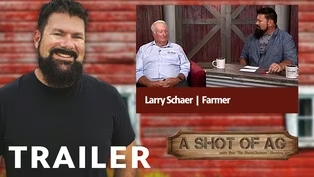
S02 E15: Larry Schaer | Farmer / Stroke Camps | Trailer
Preview: S2 Ep15 | 20s | Larry Schaer talks about Life on a Produce Farm and his Retreat and Refresh Stroke Camps. (20s)
Providing Support for PBS.org
Learn Moreabout PBS online sponsorship
- News and Public Affairs

Top journalists deliver compelling original analysis of the hour's headlines.

- News and Public Affairs

FRONTLINE is investigative journalism that questions, explains and changes our world.












Support for PBS provided by:
A Shot of AG is a local public television program presented by WTVP