A Shot of AG
S02 E17: Joe Zumwalt | Farmer / Philanthropic Family
Season 2 Episode 17 | 26m 46sVideo has Closed Captions
Joe Zumwalt and his family have a rich history of farming and giving back.
Joe Zumwalt farms along the river and levy system around Warsaw, Illinois. Almost every acre of their land has been in the family for 84 years and they have a rich history of giving back. He tells stories of how his great uncle James McMurry bought land during the Depression, then allowed farmers to buy it back and keep farming. He says every farm is a family farm by blood, sweat or turmoil.
Problems playing video? | Closed Captioning Feedback
Problems playing video? | Closed Captioning Feedback
A Shot of AG is a local public television program presented by WTVP
A Shot of AG
S02 E17: Joe Zumwalt | Farmer / Philanthropic Family
Season 2 Episode 17 | 26m 46sVideo has Closed Captions
Joe Zumwalt farms along the river and levy system around Warsaw, Illinois. Almost every acre of their land has been in the family for 84 years and they have a rich history of giving back. He tells stories of how his great uncle James McMurry bought land during the Depression, then allowed farmers to buy it back and keep farming. He says every farm is a family farm by blood, sweat or turmoil.
Problems playing video? | Closed Captioning Feedback
How to Watch A Shot of AG
A Shot of AG is available to stream on pbs.org and the free PBS App, available on iPhone, Apple TV, Android TV, Android smartphones, Amazon Fire TV, Amazon Fire Tablet, Roku, Samsung Smart TV, and Vizio.
Providing Support for PBS.org
Learn Moreabout PBS online sponsorship- (upbeat Rock music) - [Rob] Welcome to A Shot Of Ag.
My name is Rob Sharkey.
I'm a fifth generation farmer from just outside of Bradford, Illinois.
I started a podcast which led into an XM radio show, which led to a national television show, which led to me being here today.
But today is not about me.
Today is about Joe Zumwalt.
- How are you doing Joe?
- Really well.
I'm very glad to be here with you, Rob.
It's a pleasure to be sitting here with you.
- Thanks for making the trip up.
You're from Warsaw, Illinois, which is down here in Hancock county.
- That's right.
Where, if you think of the state of Illinois and go as far west, as you can go put a dot on it, right on the Mississippi river.
That's where we are.
- On the hump?
- Kind of on the hump.
If Illinois had a gut.
That would be it over there.
- That's the furthest west.
- That's the furthest west.
- And that's where you're at?
- That's where I'm at.
- And that's where you were raised, right?
That's where you always been.
- Yep.
I've been there my entire life.
Didn't went to school at Western and McComb graduated there.
So basically stayed in Western, Illinois, my, my young and now adult life.
- Okay, but now you're up here in Peoria.
- Yeah.
For a good cause here.
- It's about two hour drive?
- It is.
It is.
There's some good country.
- I mean, if you weren't you, how long would it take some because you got a heavy foot.
- Yeah, a little bit, not as heavy as some, but probably more like two and a half, three hours, plus- - It's pretty heavy.
- Yeah, just a little, - But, you are a farmer down there?
- I am.
Yep.
Corn soybeans also grew up on a cattle on the Arabian horse farm.
My parents raised cattle and Arabians.
- I didn't know that.
- yeah.
- Arabian horses?
- Arabian, when I was probably in high school, we had 80 Arabian horses.
- What do you, what do you do with them?
- Well, my brother said that we had an Arabian horse dairy, and they that really didn't catch on though so - Can you milk them?
- No, actually not, but that's a joke we tell a lot of people but a - But it's never, never funny.
- And you don't get a whole lot either.
You know, very small quantities.
- I don't know if you're joking now or not.
( laughing ) - Well it's real good for you.
- Well there.
( laughing ) - Okay, we're moving on.
Arabian horses are, you're growing.
You're growing corn and soybeans.
You get into the wheat down there?
- We have a little bit, I have some friends down south.
- Why?
- I don't know either.
Why do you want to get a combine out in July?
- I know it.
- It's hot and the air conditioning never works.
It never.
It gets warm.
Yeah.
- But you, you were a farm kid.
- Yup.
Yeah.
Very much so.
I mean, grew up like a lot of other farmers, in involved in FFA and you know, cleaning horse stalls and bailing hay and- - The Arabian milking horses.
- That's right.
That's right.
( laughs ) - So I always call it like the system.
Right.
It's a, the farm kids grew up in the system, they start in 4 age and they go to FFA and then they go to young farmers and they go farm bureaus.
And then they go to like some commodity group or whatever.
- Right.
- And then they die.
- Well.
I'm on my way out then because I've kind of done that progression.
I hope not.
But, but you are kind of right.
I think farm kids are raised in a culture where you're encouraged to get involved and you have to be involved so you can speak out for our lifestyle and our livelihood.
And I think farm kids and especially growing up through FFA, you learn public speaking, you're in contests, you're developing friendships.
They're going to national conventions and, and learning that traveling is interesting.
And seeing other parts of the farm community around the country.
- Do you do the whole public speaking thing in FFA?
- I did.
- You're a good speaker.
You are, you, you are our easy button, literally.
And we've done this so many times.
Like when we have a guest back out on us, we, we literally, he says, we're down to Joe.
We call Joe because we know we can call you like literally at the last minute and you can still just hold a conversation with ya.
- Well, there's always something to talk about.
And usually it doesn't take much for us to, you know, sit and have a conversation.
- Oh, we've had some guests that don't like to converse.
- I, I've heard a few of those episodes.
Those podcasts.
There's a few you might not want to tune in to.
I don't know.
( laughs ) - So how long have you been farming on your own?
- Yep.
I started my own farming career, I guess in the fall of 1999.
So I've been farming myself for 22 years.
- Man you're really old.
I didn't realize how old you are.
- I'm getting older.
( whistles ) I'd like to think I'm still on the young end of things, but we square baled hay yesterday.
And my back is feeling it this morning.
So I'm not sure how old I am really.
- You're suppose to hire like kids to do that.
- You find me some kids who want a square bale hay anymore.
I'll be glad to hire them.
- Well you gotta pay them man.
- This is true.
- Is this what you've always wanted to do.
- Yeah, definitely.
I growing up, I don't think I ever had any desire to do anything else, but be in production agriculture.
I think if I had any other things I might've liked to have done, it would be to have a little bit of time before I came right out of college and went right into my own production side.
But that was available to me and I did, but I always would have loved to have gone out and done the wheat harvest or, or been a part of that for a couple summers.
But I always knew that farming was in my blood and, and that's what I love to do.
And the only thing I really know to do and know to do well I guess.
- So when you get out west, we're talking like Texas and Kansas, right?
There you got the wheat harvest and you got these big custom unit deals, right?
So you go and you, they start in Texas and they cut wheat all the way up until Canada.
- Canada.
- Basically.
And that's what a lot of young people do is they go out there and it's just, you're right in the combine.
You're it's long hours, but it's fun.
And yeah, I've always thought the same thing too.
- I mean, what kid, I mean, when you think about it, funnest things you do are running that combine or running up self-propelled sprayer.
And so to think if you can do that all summer long, I mean, that just not, it's hard work.
Those people that do that commit long hours, you know, for months going from Texas to Canada, but always interested me, but I've never regretted going right into production agriculture.
It's it was a lifelong desire as a kid.
And it's continued to today.
I mean, I couldn't imagine being in any other career or lifestyle.
- I wish I would've done it.
I- I'm like you.
I went right from college back to the farm.
I wish I would have a couple of years.
- Right.
- But here you're that young, you're like two years is a lifetime.
- Right.
Right.
And you think, man, I don't want to be away from the farm that long.
And I was thought that all during college, that's why I stayed closer to home.
Cause I wanted to be involved in the farm while I was going to school.
- When I was growing up, you know, even when I started working for my dad.
He always ran the combine because he was the boss.
Right.
I'm the boss.
Now I bought the combine.
I never get a running.
- I'm saying, I know who gets to run your combine.
- No, not even Emily gets to run it.
- Oh okay.
Yeah, because I don't know.
It seems like now it's different.
You're out doing other stuff and putting out fires here, there and the other.
And you've, you're paying someone to, to run a combine.
And that was a fun thing you wanted to do.
- It is.
No, I'm lucky in that regard in our operation, I can sit in the combine and you know, when you put your headset on and you got Bluetooth in the combine, you can coordinate a lot of things.
So I'm lucky in that I get to run the combine the majority of the time.
So I guess I'm, you know, I'm either lucky or I'm selfish.
- Are you saying you're a better farmer than I am?
- Maybe just more organized.
- You can only be good at so many things Rob.
- More organized?
All right, Joe, it's time for some good questions.
The, the farm has been in your family for, it's kind of an interesting story, how a lot of the, the ground was acquired.
So tell me about that.
- Yup.
I kind of reflect back here to a book that I brought here to use as our reference point.
- It looks old.
I almost don't want to even touch it.
- I'd say it's probably, - I don't want to break stuff.
- It was given to my grandfather in 1943.
And it is a book it's entitled 'The Man from Missouri.'
And it is about my great, great uncle James McMurray.
Who was a 1 of about 10 children in a small town.
And in North East, Missouri around colony Rutledge Goran area, which was a thriving area and like I said.
A lot of families back then had lots of children, maybe 8 or 10 children, you know?
So it came from the farm- - They didn't have the internet.
- They didn't have the internet.
This is true.
If they wanted to find out something, they had to read it.
And yeah, we didn't have instant messaging or social media.
What would you do if it was 60 years ago Rob?
- That's why you have a lot of kids.
- So this man had a lot of humble beginnings and luckily he was a real driven individual and had some ability, his most probably notable deal was that he started Acme steel company.
And back in those days - They got sued by that coyote?
- Yeah.
They're the ones who make dynamite and always blowing stuff up.
- I was a big fan of that.
- I had to Google what Acme stands for.
It's a, it's a, what do you call it?
When the letters - Acronym - An acronym and it's more organized, you'd know that if I could have my phone, I could Google it here and figure that out.
But, one thing he was known for, he was one of the inventors and there were lots of people invented this, but the bands like your tie lumber together with those steel bands.
- Oh yeah.
- He invented a type of that in that day.
And that's kind of how the steel company took off.
So we're talking in the depression area and era, and through that steel company, he made some money and he invested it in ground and a large portion of what we still farm or have today is what he purchased in the thirties.
So majority of that ground has been in our family farm known as Hancock lane company for 84 years.
And as I was preparing for your show here and just thinking about something, I, I really thought that was incredible because what he did that was the depression era of farmers were getting well evicted off their land because they couldn't pay pennies in taxes.
And so he'd purchased the ground and then a lot of cases leave those tenant farmers on that ground to farm.
And then once they got back on their feet, say in the later 30s or early 40s, a lot of that ground was sold back to those farmers.
- Can you imagine what that meant to them?
- Yeah.
Maintain their lifestyle, their livelihood.
And there's still some of those families that bought that were able to get that ground back.
Their ancestors still farm down there today in several situations.
- That's cool.
- It is really a neat story and he was just a successful businessman.
And, but from real humble beginnings and the name McMurray is familiar.
If you're from Illinois, you might recognize what was the name?
McMurray college in Jacksonville.
And as a result of some of his wealth, he donated money back to that college and they ended up changing the name to McMurray college.
Unfortunately here in the last year, they they've closed and it's no longer but - Oh they're gone?
- They're gone.
- Oh I didn't know that.
- Their sold off sold, had a say, auctions, auction pieces of it off.
And so that's unfortunate, but there's a nice legacy there.
- Do you know how, he probably had pretty good, you don't get a college named after you if you donated a 100 bucks?
- No, I don't think so.
I, I couldn't even tell you because I've been curious over the years, what donated, but there were several dorms named after him.
And even when they had the sale of the college, they had several portraits of him and I purchased one of them anyway.
And brought back in is now hanging in our public library in Warsaw.
- So, that's your great uncle.
- It'd be my great, great uncle.
- Great, great uncle.
So now who do we have here?
- Yep.
This is actually my grandfather, who was for about 50 years of his life, the manager of Hancock land company.
And he, to me was also the man from Missouri because he was born and raised in Missouri as well.
Came into Illinois and managed this farm, this farm ground that my great great uncle purchased.
- He's got a dog.
- That's chip, actually that's chip.
- Chip the dog?
- Chip chip the dog, actually it's - Chip the sequel.
- Yes, we won't say what happened to chip 1.
You know, sometimes pets get injured on farms, but that's at least chip 2.
There might've been a chip 3.
- Do you remember grizzly Adams?
- Just a little.
- His, the, his friend mad Jack.
His borough was number 7.
( laughs ) So maybe you could just, instead of chip 1 and chip 2, just number them.
- Well, yeah, that's.
Well, that's kind of like the show mutual of Omaha's wild kingdom always had that, that older guy who was sitting in the nice studio.
- Marlin, Perkins.
- Yeah.
He was the same guy forever, but there was like 7 different gyms.
And after he wrestled an alligator, there was a new gym.
The next week.
- Yeah.
Jim was expendable.
- I think he was.
- Jim was wearing, what was it?
Red and star Trek.
Whoever wore red.
- Goner, next episode.
- What are we talking about?
So I liked that you're proud of your family's history because sometimes people, they almost shy away from that because they're so caught up on being their own person.
You are very successful in your farming operation.
You're very good farmer, but I love that you respect the past that got you there.
- Yeah.
That's, that's the big part of it.
I mean, it's a lot about being a family farm, but the land that we have in Hancock land company is what ties our family together in a lot of ways.
I mean, when we're together or if that is the reason to get together, to meet and discuss the farm, it just creates another link for the family.
But it goes back to the roots.
I mean, a lot of what we have, luckily we have because of the dedication and the progressive thinking that my ancestors had there, I mean, to have that land and, and I've been lucky enough to have a wonderful farming career, thanks to my ancestors for it.
- Yeah.
There's times in agriculture where the, the farm kinda gets called out.
And I think people don't quite understand, oh, that's a corporate farm or whatever.
A lot of times my farmers in a corporation, but we've sure looked at it just for the reasons of taxes.
- Sure.
- But it's family owned.
It's just, our family is kind of the same, like here.
- It really is I mean, it's definitely grown.
So back in the day when my great great uncle started this at the peak, there were 36 tenant farmers.
So crop share is what he was doing.
It was 36.
Now we're down to 2, now, but it's still a family and no matter.
So obviously we've gotten bigger and total acres, but it's still very much a family.
And what I was just thinking about here, because I think family farms get such a bad rap because you might have 10 or 15 family members and you may farm a lot of acres, but it stall, you're still in the family.
And, and the other kind of idea on that too, is something that we were talking about beforehand here.
It's just not always does family mean blood.
I mean, even on a lot of these corporate farms, you have to have a family nature to do what we do.
I mean, you're coordinating, you're working in equipment, you're working with livestock and, and those people you're working with are every bit, you know, family as well.
- Yeah.
I could kind of see you as the cousin we don't talk about.
- The black sheep of the family.
- Yes, exactly.
You and I, I don't even know when we met, but we, we definitely learned a lot more about each other when we were going through Illinois Ag leadership.
Which is, it's a two year program where you, it's kind of like a master's degree for farming as our friend says.
And then yeah.
And then we went to international travel.
We went to Japan and Panama because whoever planned the trip didn't own a globe.
- Yes.
- Yeah.
- Oh, that was an odd choice, but it was a was it was incredible trip, but yeah, we were a little confused by that at the time, but yeah, well aware that.
- That there was 30 people that were involved at that.
And it's, I, you know, you and I were maybe towards the top of the age wise, so maybe we didn't get as much out of it as some of the younger people, but the other people, the comradery I think is definitely was worth doing.
- Oh, absolutely.
If you're not familiar with it, I mean, it brings together people from both sides of agriculture, farming, agribusiness, puts you mix them together in a blender.
And after two years, just as we were talking a little bit ago, it's just another family in my opinion.
And we saw that just this last weekend, you know, had a, a dear member of that family of that ag leadership family that was in a tragic accident.
And it's been four years since our class graduated, but I was counting up, I believe 26 of the 30 members were able to get together within a couple of weeks notice and to honor this person.
And I just think that was fantastic.
And to me, that's just another Testament to family and the family that we have in agriculture.
- Yeah.
Yeah.
I was holding up fine until I saw the classmates and how they were hurt and that's when I was like, ah, I gotta, I gotta walk behind the shed for a second.
Cause a dust flew my eye.
- Is that what that was?
- That's what it was.
- Oh, I see.
- It's hard, it's hard to lose someone that close there and someone has to see the family being affected by that and everything.
But what we do as a profession is very dangerous.
- Yeah.
Yup.
Well, a number of our class or our class was unusual, you know, and that a number of them were in production.
Ag are actively farming.
A lot of other classes don't have as many production Ag members.
They have more agribusiness members, as you know, and we were real lucky to have a lot of farmers.
And as we were in this event, you know, honoring the life of our friend and looking at each other, knowing that the risks that we take every day on pieces of equipment or with livestock and think it could have been any one of us and we just need to have a little more attention and respect for the safety we need to take in our career.
- I think back I, I, a 100 times I've done things that I, that could have killed me and not really thought about it until it was either in this situation or that, or, or situations that would have cost me a finger or a limb and all that.
It's when are we going to learn.
- Right.
Well, look at a lot of the old farmers, you know, that whole era they're missing parts, you know, and some of the equipment that you had to use was so crude back then, it's amazing that they had arms and legs.
I mean, when he came out at the end of a fall or something, so that stuff was just looks like something you'd see in a horror movie.
- In fact, they use a lot of it in horror movies.
It's bad.
You, you kind of unique you farm by the river, its own set of challenges, isn't it?
- It is.
So if you're familiar with the Illinois, obviously the Western border is the Mississippi river and we are in an area that is prone to flooding.
We have a levy that protects us, like a lot of areas along the Western edge and through the Illinois river valley and the Mississippi river valley.
But we flooded in 1993 and in 2008.
And if you've ever not seen a flood event like this, it's a little different.
We always hear in the news or on the weather channel about these flash flooding events, you know, you get 12 inches of rain and the Creek comes up, flash flood.
Our events are a little bit different.
Yeah, you have to have the rain, but when the levee protects you to a point and if the river gets too high, the levee breaks, it's almost like an, it's kind of like a controlled flood, but it's obviously not controlled your levy broke.
So you have time to get your equipment, things like that out, but it's just devastating.
And the loss of a crop and the blood, sweat, and tears that you've put in to that crop.
And it's a, it's a trying time because you have a number of people coming around volunteering to try to save property and livestock and, and do what you can, but it can be a real trying time in 93' and 2008 were very trying and very, very difficult financially to, to get through.
- Yeah, you've got federal crop insurance, which at best covers, not even all your expenses.
Is there flood insurance for crops?
- There is a well, not necessarily for crops, but for whatever infrastructure is in that bottle, it may be a grain bin, a machine shed, a house.
And the more times you flood the fewer and fewer of those things are, I mean, just by nature.
- But you can't assure of your corn and your soybeans, they get ruined.
- Not especially for flood.
No, that's just covered through your federal crop insurance.
- That's one heck of a hit.
- It.
- I mean, I don't know how you survive that to, to actually forego a year.
Not only that, but I mean the cost of it that's, that's it huge hit.
- It's a huge hit.
And when you take a year, say is 2008 and think, remember back to what commodity prices were in 2008.
- They're always bad.
- Actually.
They were quite good.
And as we were going into the summer, we were making sales.
So a lot of people had to buy back corn to cover their sales then.
- That's tough.
- It was.
Yeah, it was.
But on the other hand though, too, when you farm in the river bottoms, the drought years are pretty, pretty generous to us.
You have a little give and take.
- All right, so you're, you're an old guy now, young people coming up wanting to farm, what do you tell them?
- Find some good mentors and it's worth the effort it's going to take to get into it.
Yeah.
I don't know.
As a young person, it'd be almost impossible to come in.
If you didn't have some real farmers that were eager to bring new farmers in, you know, but there is opportunity out there.
I mean, look at the average age of farmers right now.
- Old.
We're actually the young guys.
- We are.
- That's crazy.
- I mean, I hate to say it, but when we go to farm bureau meetings, a lot of times there's, you know, there is a lot of gray hair in the room that just tells me that we need to get more people our age, more and more involved.
You know, we're the ones who need to be speaking out and getting more involved.
- You know what's funny is I'm doing the XM show.
Emily gets these guests that I wanted.
And it's like, first-generation farmers, people that are coming back from not even doing anything they're selling direct to the, the customer.
- Yep.
- You know, we're almost getting obsolete, right?
our thinking these new, these new people coming in are killing it.
- Yeah.
This com single commodity minded thing is not the direction.
A lot of things are going in, and that's how new people can get into it.
Especially, you know, the consumers in urban areas love to buy products.
So they can come out to the farm and pick their own eggs out of the chicken coop or go out and pick your apples or your pumpkins, things like that is providing an opportunity for a new generation of farms to come into production.
Ag.
- I don't like it.
I don't like change.
I don't know what we're going to do about.
- But what you've seem to adhere to change pretty well.
- I don't like it.
- Well now I know what Emily does.
She just.
- Are you on social media anywhere?
- Very little.
I mean, I'm on Facebook.
I am on Snapchat, but I, I, I like to follow other people rather than.
- I don't think we're Snapchat buddies.
- Yeah.
I can see you on the map every once in a while.
I see when you drive through Hancock county and don't call.
- Really?
- Yeah.
- I you're, Somebody might need to show me how to set some things differently.
I didn't know.
That was a thing that's fine.
A little worrisome.
- I'm the least of your worries.
You can find out who else is watching you.
- What about your farms?
You got like a website or something?
- No, we do not.
Okay.
No, you just gonna have to come to Hancock county and coo around, and I'll give you a personal tour rather than a social media tour.
- Okay.
Are you afraid of jumping into the modern society?
- I just know that there's plenty of people like you, who are well versed at it.
- I don't like it though.
- Man.
You're talking about all these things.
You don't like change, social, better not tell your followers that you're not into this.
- Our, our fathers grandfathers didn't have what you and I have though, is the group chats where we can talk to farmers in the state, in the country.
They're invaluable really.
- Well yet.
We have a great example of that.
We were just talking earlier, you know, about the ag leadership group, our first trip of that two year program, we go to Washington DC for two weeks.
One of the members of our, of our class said, have you guys ever heard of this WhatsApp thing?
And we were just putting it on our phone so that way we could keep track each other around DC, you know?
And that's something that has made us, I think, tighter than a lot of classes and a lot of groups that go through that because we have that constant connection.
- It's daily, all the time.
- We're constantly making fun of somebody.
Usually, you know, certain brands of combines or.
- I guess I haven't seen the making fun of it.
Is that, you talking about me?
- Oh, well maybe.
- I know I can find a Gleaners.
That's what you wanted to say.
- It is.
I didn't know if I could say, be brand specific, specific on air.
- I guess we'll find out.
Joe ZumWalt, from Warsaw and Hancock county.
I tell you what Joe, you're always, you're always a thrill to talk thrill.
- Can you spell it?
- I don't know if that's the right word.
It's always okay to talk to you.
You're sufficient to talk to at times.
- And I'm going to leave it at that.
I'm mediocre.
- But you are, you are a benefit to agriculture because of the way you represent.
And like I said, because of the way that you appreciate the past, but embrace what we have now.
So Joe Zumwall, thank you very much.
And everybody else.
We hope you catch us next time.
( intense music )
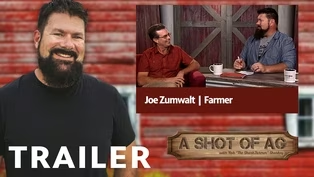
S02 E17: Joe Zumwalt | Farmer/Philanthropic Family | Trailer
Preview: S2 Ep17 | 20s | Joe Zumwalt and his family have a rich history of farming and giving back. (20s)
Providing Support for PBS.org
Learn Moreabout PBS online sponsorship
- News and Public Affairs

Top journalists deliver compelling original analysis of the hour's headlines.

- News and Public Affairs

FRONTLINE is investigative journalism that questions, explains and changes our world.












Support for PBS provided by:
A Shot of AG is a local public television program presented by WTVP