LA64
Sabine Parish
2/3/2026 | 26m 47sVideo has Closed Captions
Sabine Parish opens onto a rugged stretch of land shaped by frontier history and borderland culture.
Sabine Parish opens onto a rugged stretch of Louisiana shaped by frontier history and borderland culture. The journey includes the Free State Festival, fishing at Toledo Bend, and roadside stops in former logging towns. Along the way, stories of Indigenous roots, outlaw legends, and local resilience define a region that remains proudly independent and rich in character.
Problems playing video? | Closed Captioning Feedback
Problems playing video? | Closed Captioning Feedback
LA64 is a local public television program presented by LPB
LA64
Sabine Parish
2/3/2026 | 26m 47sVideo has Closed Captions
Sabine Parish opens onto a rugged stretch of Louisiana shaped by frontier history and borderland culture. The journey includes the Free State Festival, fishing at Toledo Bend, and roadside stops in former logging towns. Along the way, stories of Indigenous roots, outlaw legends, and local resilience define a region that remains proudly independent and rich in character.
Problems playing video? | Closed Captioning Feedback
How to Watch LA64
LA64 is available to stream on pbs.org and the free PBS App, available on iPhone, Apple TV, Android TV, Android smartphones, Amazon Fire TV, Amazon Fire Tablet, Roku, Samsung Smart TV, and Vizio.
Keep Exploring
Related to This Episode
Providing Support for PBS.org
Learn Moreabout PBS online sponsorshipSupport for Le 64 is provided by.
Office of the Lieutenant Governor, Billy Nungesser.
Keep Louisiana Beautiful and the Louisiana Office of Tourism.
In this episode of LA 64, we hit the road in Sabine Parish, once an outlaw borderland.
Now a heritage rich landscape shaped by indigenous roots, frontier law and sawmill towns will trace the legacy of no man's land and explore the South's largest man made lake.
Plus, sample Louisiana's road trip staple gas station eats de la Chasse.
I'm Karen LeBlanc, a travel journalist and Louisiana native.
Join me on LA 60 for a journey through all 64 parishes exploring Louisiana's last travel pass and.
Sabine Parish sits on Louisiana's western edge, bordering Texas.
Our road trip starts in fluorine.
We'll travel north to Fisher and then on to Marty and Julie.
The parish gets its name from the Sabine River, which runs 600 miles through Texas and Louisiana before reaching the Gulf of Mexico.
Sabine Parish was Louisiana's version of the Wild West, where explorers, settlers, tribes, and outlaws shaped Louisiana's western frontier.
I timed my visit during the Sabine Free State Festival, an annual event in Florien, that celebrates the region's origins as no man's land step into the Sabine Saloon.
The year 1806 land is lawless, and a rowdy bunch of outlaws have gathered for a high noon shootout.
From 1806 to 1821.
Spain and the United States could not agree on a border between Texas, then Spanish territory, and Louisiana, so they created a buffer zone with no formal government, no law enforcement, and no Texas.
This boundary dispute created a 17 year frontier free for all.
Known as no man's Land.
It was a 34 mile wide strip of land east of the Sabine River that attracted outlaws and settlers.
Without oral storytelling, those would be lost for generations.
So I'm really, glad that our ancestors decided in 1980 that this was something that really needed to be promoted and tied, because it's something that, you know, we we wouldn't know about, it's left out of the history books.
Laws of this one served as the capital of Spanish Texas, connected to western Louisiana by El Camino Real.
The 2580 mile Kings Road that stretched from Mexico City to Natchitoches through no man's land soldiers, missionaries, indigenous families, and early settlers all traveled this route, which today follows much of highway six and is marked as the El Camino Real National Historic Trail.
It was a true cultural crossroads where Caddo, Choctaw, and Apache peoples met French, Spanish, and Anglo settlers, each shaping the region's identity.
My ancestors came back in Spanish.
So for those who does intermarried into the Choctaw and Apache Indians, there were taken refuge for those who dash.
I'm a member of the Choctaw tribe, and I'm standing up for veterans for the last 250 years.
The Shebeen Free State Festival kicks off with a parade, a wagon train and a bevy of local beauty queens rolling down the road.
It feels like stepping into a living frontier town where the air fills with the scent of cane sirup bubbling, meat smoking, and, of course, gunsmoke.
Artisans craft fiddles, ceramics, spin yarn and demonstrate the skills passed down through generations.
Well, I'm good and thirsty.
I want to you saloon.
Pour me a stiff on.
What are you serving?
Ice cold sarsaparilla.
All right.
Bottoms up.
Oh, you can duck into the Sabine Saloon for the festival's famous root beer before heading back outside to catch the Wild West shootout.
A reenactment staged several times throughout the weekend that draws a crowd.
No, not helping me at all.
You got it.
How are you?
You know I need my help.
Come on.
I don't.
Know what.
To bring law and order to no man's land.
Fort Jessup was established in 1822.
And the soldiers here patrolled the area, arresting bad actors, breaking the law.
And they put him in jail here on the property.
Oh, wait, there weren't any laws.
People doing bad things.
People who were coming here.
Purposely because they know it's confusing and they know it's.
Very hard for the area to be police.
So they're like, we're going.
To come and commit crime.
Because we're probably going to get away with it.
And then you have people who are coming.
Here who think, oh, we're moving here to start a better life.
One of the fort's most famous commanders was Zachary Taylor, who later became the 12th president of the United States.
At our height, we had over.
1500 soldiers permanently stationed here.
Today, Fort Jessup is a state park.
It occupies 22 acres.
All of the original structures, except for the kitchen, were destroyed in a fire.
You can still smell the smoke from the last meal.
Cook?
Yes you can.
We actually still.
Can use this.
As we said earlier, it's fully functional.
We do cooking programs for some of our reenactments.
A replica of the fort's officer quarters houses a museum that chronicles life at Fort Jessup and the surrounding community.
The fort closed in 1846 with the United States annexation of Texas, negating the military's mission to patrol no man's land.
But the late 1800s, Sabine Parish was blanketed with old growth longleaf pine.
This attracted the timber industry, which attracted the railroads, and along the track, sawmills and logging camps sprung up, and eventually settlement.
Based at about ten miles apart, which was just about the time that the steam locomotives needed to stop and fill up with water.
I'm taking you to The Old Many Train Depot, which is now a museum for a tiny train ride through history.
Right now, you facing the, depot?
Where we at right now?
And this is the layout of the town of Many.
Well, I got to tell you, as a visitor, this really helps me get the lay of the land.
And it puts into perspective the impact that the railroad had in shaping all of these towns and communities in the parish.
The restored train depot also chronicles the region's roots as no man's land, And Many's history.
Dating back to 1843, when it was founded and named for Colonel James B Many.
Many is the parish seat, and its main street is in the midst of a reinvention, with historic storefronts of locally owned businesses.
The restored Sabine theater has a busy event calendar, is a community center, and the town proudly proclaims home of the Tigers, referring to Many High's football team with several state championship wins.
As I walking through these rolling hills, I'm actually traveling over the Sabine Uplift, an ancient dome of sedimentary rock pushed upward over millions of years.
Erosion shaped it into soft ridges 300 to 500ft high.
These roads reveal one of Louisiana's most scenic drives.
El Camino Real, a designated Louisiana Scenic Byway, follows U.S.
highway six across northern Sabine Parish and the Natchitoches.
Meanwhile, U.S.
Highway 171 cuts North-South through Many, Florien and Zwolle, another former sawmill town where the train depot also serves as a museum.
Hi.
Hi.
Hello.
Welcome to the Zwolle Museum on the bend.
Martha Henderson, my tour guide, is a lifelong resident of Zwolle.
We start at the original ticket office of the 1898 depot.
Okay.
This room, this area is dedicated to the timber and the logging.
That was the first thing going on back in those days.
It was virgin timber.
And these are some samples of the brands on the log.
When they got to their destination, that's how they knew who they belonged to and who to pay.
But we're very proud of the logging industry here.
The museum also documents the hundreds of homes displaced by the creation of Toledo Bend Lake.
These are all the homes that were lost and went under the water.
And in a lot of cases, it tells you the history.
I'll tell you that.
Who owned it?
How much they got for it?
Around the parish, painted bass sculptures, local art.
Celebrate Toledo Bends, world class fishing.
Many is considered the heart of Toledo Bend Lake, as we are the parish seat and the largest community on the lake.
In this parish.
There's a lot of sporting activities on the water.
There's scuba diving in the lake, there's, bass tournaments and really good fishing.
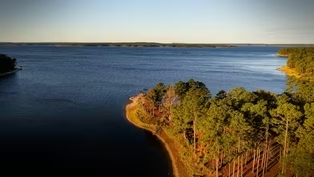
Toledo Bend Reservoir, the largest manmade lake in the south, opened in 1969 after the Sabine River was dammed.
It now anchors a network of parks, golf and fishing resorts, marinas and scenic overlooks, including two Louisiana state parks.
The lake transformed this once hilly, sparsely populated corner of western Louisiana into a major destination for boaters and anglers.
I. Well, hello there.
Karen.
Hi, Pete.
Come right in.
Ha ha ha ha ha ha ha ha!
My pleasure.
So you are, "The memory keeper," folks say around here.
Ha ha ha ha ha ha ha!
Well, you live long enough.
You get to be the one.
This was originally my ballroom home.
I was brave.
Born here in this house.
Pete Abington turned his childhood home into his business office.
The walls tell his life story filled with photos of politicians that he helped elect.
Sports memorabilia and mementos from his pivotal role promoting the construction of Toledo Bend Lake to lake.
Now, in the last 25 years, it's just gotten real popular.
But I was on the ground crew when it was just a dream.
Highway six crosses the Toledo Bend Reservoir into Texas, offering sweeping views of the spillway.
The reservoir stretches roughly 65 miles along the Sabine River, straddling both states.
Its creation required flooding vast tracts of forest, farmland, river bottom communities, and tribal lands.
Now they get it passed.
We had to get the governor get behind it.
And the governor was Jimmy Davis.
And and that was a masterstroke there because they got a big old gallon jug of Sabine River water.
And Jimmy Davis met a delegation from him, which I wasn't there then.
I was doing some ill, but he met them there on the bank in Mississippi.
And when they hand it to him, it said on the front of that gallon jug, a glass built to lead a Ben lake.
So we had the governor committed one last bill to let them in Lake.
Very clever product.
Oh, yeah.
And then it had to go for the Senate and the House, and they approved it.
And they but they did it all figured out how it was going to be financed.
And it was financed through the Confederate Memorial Fund.
And there was some money set aside for the Confederacy that we could get.
And we could use it to build this lake.
And they laugh about it, and they weren't for billing that late and this early one for the water taking it home or the graveyard.
But, It was it was uncomfortable for them because they were to be bought out by the state and have to move.
I stated two state parks, both sat on the banks of the reservoir.
South Toledo Bend State Park, near Many, sits on bluffs overlooking the lake's southern reaches.
I stayed in one of 19 cabins with water views and amenities that rival many vacation home rentals.
In the mornings, I sit here in my cabin, screened in porch, and take in the peaceful waterfront view.
You can hear the leaves rustling and it is a beautiful time in surveying.
Parrish.
It's early November and the leaves are changing colors.
You can see all of that around you because the cabins are nestled in these wooded areas on the waterfront, and you can hear the birds chirping and see the waterfowl.
It's just a glorious way to greet the day.
I head out to explore the park's hiking trails.
The state park is a bald eagle nesting ground, and along some of the nature trails, perhaps you'll spot a bald eagle.
And the reason for this is because the park is around the Toledo Bend Reservoir, and the Eagles love to hunt the fish in the reservoir.
Let's go check it out.
Bring your binoculars.
The park visitor center offers this panoramic view of the Toledo Bend Reservoir.
It's windy today, so if you look out in the water, you can see the white caps.
North Toledo Bend State Park sits near the town of South Wally, and it's a prime spot for bass fishing.
The state park spans 900 acres, offering camping, hiking, swimming, boating, fishing, and water sports.
It is a cool, crisp morning here at North Toledo Bend State Park, so I made a fire in my fire pit, which is right outside my cabin.
And these cabins are adorable.
There are log cabins.
They have so much character because it's cool outside.
I think today I'm not going out of the water, so no kayaking, no canoeing for me.
But I am going to take a hike, get some exercise.
Along my hike on the Dogwood Nature Trail, I spotted Bigfoot.
Actually, it's a replica.
But seriously, Bigfoot folklore is big in these parts.
Every year, Bigfoot believers gather nearby at Wildwood Resort in South Wally for an annual Bigfoot Symposium to swap sightings and share theories about the hairy being.
After my hike, I sat down with my new friend Cheech LaRue, whom I first met at the Choctaw Apache Powwow and Barb to talk about what Toledo band really cost this community.
His ancestors lived for generations in the river bottom along the Sabine River, only to lose their homes, their land, and pieces of their identity when the bottom lands were flooded to create the reservoir.
My name is Kenneth Laroux.
That's my real name.
Everybody down here calls me Cooch Laroux I'm, Actually, I'm an elder with the Choctaw Apache tribe of Ebarb.
We, we've been living here forever.
I was born here, right behind us.
The lake that is my home.
My original home is underwater today, and, some of you guys might have faced that before.
Too.
I lived on the river bottom with generations of his extended family who survived off the land as trappers and raised hogs and cattle.
His family was one of hundreds forced to sell their land to the state at $50 an acre.
There was no to go with the government at that time.
They came in and they said, your land is worth this much, and they paid you.
That was the end of the negotiations.
So me and Toledo, we okay.
But I still hate that it disrupted people all up and down the Sabine River, because it was a very, very great place to be.
307 00:19:55,260 --> 00:19:59,765 Today, the village of Ebarb, an unincorporated area near Zwolle, is home to a concentration of Choctaw Apache tribe members and their tribal headquarters.
While attending the Sabine Free State Festival, in Florienm I stayed at the historic Dover House, a three bedroom Airbnb that's more like a living museum that invites you to make yourself at home.
Welcome to the Dover House.
Come on in.
Let me show you around.
Owner Louise Thaxton restored the home that once belonged to flooring businessman Joe Dover, who built it in 1928.
His family photos the home's original furnishings, floors and fixtures.
Connect me to Floridians past.
Joe Dover.
He was in a lot of businesses and he brought it was, gas to the parish.
In fact, the Dover House was the first house in Sabine Parish to have gas run into the home.
So that was he was very forward thinking.
Those are the original doors, and many of these are original windows.
So the home is like a portal to life, as it was for a well-to-do family over 100 years ago, living in Paris.
Exactly.
The home sits across the railroad tracks from the Free State Park in Florin, where the festival is held.
The interpretive park has several recreated frontier town buildings that are open to the public.
Gas station eats are a culinary claim to fame in Sabine Parish, and as strange as it sounds.
I discovered some of the best food is cooked up at gas station convenience stores.
Curtis Grocery store on Toledo Bend Lake sells fishing bait, provisions, and popular plate lunches in its diner.
Keeping with the spirit of the region and the local food way.
I ordered the Toledo Bend damn fries and Curtis Grocery specialty.
There are catfish.
This is a signature recipe with made to order cornmeal, and the red meat is cut from it and so is the fat.
So this is de la chasse.
During Louisiana's timber boom, the town of Fisher was happenin.
It was founded in 1899 by the Louisiana Longleaf Lumber Company, and everyone in the town shopped at this general store.
Today, it's still in operation.
It's called the Old Mill Store, and it's an antiques mall.
If you are passing through Fisher, you gotta stop and shop.
Let's go check it out.
And.
What?
Hello there.
May scale.
Well.
Hi.
How are you today?
So tell me about the old mill store.
I came to shop.
What am I going to find?
Well, you're going to find everything from A to Z. From the cradle to the bear.
Cradle to the dead.
Right.
That's all.
It is.
You heard Gale.
You can shop for an entire life span.
Objects of nostalgia, collectibles, quilts, vintage kitchenware and clothing.
It's a treasure hunt that takes time and patience to reap the rewards of that special find.
So Gale is going to show me around her town of Fisher.
Oh, you're looking at it.
This is the main district, right?
Kind of like the main street?
Yes.
The hardest.
Yep.
This is the old mill store.
So everybody come to shop.
The Old Mills store is part of a cluster of whitewashed wooden buildings listed on the National Register of Historic Places.
An ensemble that includes the old opera house, post office, church and city hall all stand beside the railroad that once carried lumber out of this sawmill village.
Remember today as one of the last sawmill towns from Louisiana's golden age of timbering?
What's it like living in Fisher?
Oh, it's so peaceful.
I wouldn't trade it for anything.
I love living here.
Here's my takeaway from my time in Sabine Parish.
This place devised every cliche about Louisiana.
Its landscape looks unlike any other part of the state.
It's world class bass fishing unfolds on one of the nation's largest recreational lakes and its cultural mix indigenous, Spanish, Anglo and French reveals a different Louisiana altogether, one worth experiencing, exploring and remembering.
Hey.
New.
And.
Support for LA 64 is provided by office of the Lieutenant Governor Billy Nungesser.
Keep Louisiana Beautiful and the Louisiana Office of Tourism.
And, by the way, a national heritage area, the Saint Landry Parish Tourist Commission, Northwestern State University, and by the Foundation for Excellence in Louisiana Public Broadcasting.
And viewers like you.
Thank you.
Video has Closed Captions
Preview: 2/3/2026 | 20s | Every parish has a personality, and Sabine Parish reveals itself one mile at a time. (20s)
Providing Support for PBS.org
Learn Moreabout PBS online sponsorship













Support for PBS provided by:
LA64 is a local public television program presented by LPB