
Sacajawea of the Salmon River Valley
Season 9 Episode 4 | 26m 46sVideo has Closed Captions
Idaho Experience explores Sacajawea through the eyes of Shoshone-Bannock tribal members.
“Sacajawea of the Salmon River Valley” explores the history of Sacajawea through the eyes of Shoshone-Bannock tribal members. Randy’L Teton, who modeled for the U.S. Sacajawea dollar coin, guides us to historic places in the region while sharing stories of Sacajawea’s positive impact on the success of the Corps of Discovery as they traveled the West.
Problems playing video? | Closed Captioning Feedback
Problems playing video? | Closed Captioning Feedback
Idaho Experience is a local public television program presented by IdahoPTV
MAJOR FUNDING FOR IDAHO EXPERIENCE IS PROVIDED BY THE ESTATE OF DARRELL ARTHUR KAMMER, IN SUPPORT OF INDEPENDENT MEDIA THAT CONNECTS COMMUNITIES AND EXPANDS UNDERSTANDING. ADDITIONAL FUNDING WAS PROVIDED BY…THE...
Sacajawea of the Salmon River Valley
Season 9 Episode 4 | 26m 46sVideo has Closed Captions
“Sacajawea of the Salmon River Valley” explores the history of Sacajawea through the eyes of Shoshone-Bannock tribal members. Randy’L Teton, who modeled for the U.S. Sacajawea dollar coin, guides us to historic places in the region while sharing stories of Sacajawea’s positive impact on the success of the Corps of Discovery as they traveled the West.
Problems playing video? | Closed Captioning Feedback
How to Watch Idaho Experience
Idaho Experience is available to stream on pbs.org and the free PBS App, available on iPhone, Apple TV, Android TV, Android smartphones, Amazon Fire TV, Amazon Fire Tablet, Roku, Samsung Smart TV, and Vizio.
Providing Support for PBS.org
Learn Moreabout PBS online sponsorshipAnnouncer: Major funding for Idaho Experience is provided by the estate of Darrell Arthur Kammer in support of independent media that connects communities and expands understanding.
Additional funding was provided by the James and Barbara Cimino Foundation Anne Voillequé and Louise Nelson Judy and Steve Meyer, and from the Corporation for Public Broadcasting and contributions to the Friends of Idaho Public Television and viewers like you.
Thank you.
[Music] Randy’L Teton: I'm standing here at the Continental Divide, what is known as the Lemhi Pass.
Okay.
I just got back from Salmon.
So the emotions, they're still there.
And these past few days have been amazing.
Okay, I'm not going to cry.
Behind me is Idaho.
In front of me is Montana.
These established roads were built over the Indian trails that my people, the Agai Deka, the Shoshone people created to hunt in Montana the mighty buffalo.
I'm getting emotional because Salmon, Idaho is the birthplace of Sacajawea.
To witness and to be there on the landscape, I can feel her presence.
I can feel the presence of our people.
We are here at the highest elevation of the Lewis and Clark expedition.
We call this beautiful area Wee-yah-vee.
Try not to cry here.
I'm sharing with you all a personal feeling that I had when I was on top of the Continental Divide.
Sacajawea was able to recognize this area that was close to her home.
She showed Lewis and Clark and the expedition these Indian trails.
I just can't believe it, that Sacajawea and her baby, in her moccasins climbed up and down sharp rocks.
It just makes me feel more close to Sacajawea and her journey and what she did.
So I'm here today to share that with all of you.
Narrator: She may be the most famous woman in American history.
By some counts, there are more statues of Sacajawea than any other American woman.
Schools and parks, peaks and rivers are named for her.
Yet for all her fame, there’s very little we really know about her.
No one drew her face or recorded her words.
But we know the important part.
This teenage mother survived incredible hardship to become a witness and interpreter and contributor to one of the most consequential chapters in American history.
Randy’L: And I feel that the information that we have about Sacajawea is enough.
I think all we need to know is that she's from Idaho, She's Shoshone and she did the best job that she knew how to at such a young age.
And for me to be part of recognizing her and keeping her stories alive, I feel honored, I feel humbled, I feel, you know, that she's with me.
When she was only about 14 years old, she had been captured by Indians in Montana, where her people were out hunting buffalo in the 1800s.
Leo Ariwite: If you think about it, this is where the birth of this country is.
Because if Lewis and Clark never got the horses, they would have never made it to the Pacific Ocean.
Narrator: The Salmon and Lemhi River Valley is critical to the story of Sacajawea.
Our guide to her story, as her people know it today, is Randy’L Teton.
Randy’L: In our culture, we like to introduce ourselves in our in our language.
So, Tzah-dahveh, ne Nani hah Randy’L Hedow Teton.
Ne Sosoni Banait.
Hello.
My name is Randy’L He-dow Teton.
I am Shoshone-Bannock from Fort Hall, Idaho, and I'm the official Sacajawea, model for the U.S.
dollar coin.
Narrator: The Salmon River Valley is where Sacajawea was raised, where she connected the Lewis and Clark Expedition to her Shoshone relatives, and where she is remembered and celebrated today with a 71-acre park.
Randy’L: The Sacajawea Interpretive Center here in Salmon is doing a really good job in making sure that her story, her people’s story is still being shared.
But knowing that this valley was once covered with her people fishing in the waters that just gives me chills.
Suzy Avey: So the mission of the Sacajawea Interpretive, Cultural and Educational Center is to tell the story of Sacajawea her people, the Agai Deka, Shoshone-Bannock and the Lewis and Clark expedition.
One thing we get asked here at the Sacajawea Center is, “Oh, so she was born right here, right?” And we have to say, “No, you know, it's she's from this valley.
She was born in this valley.” We just represent a space in her people's homelands, and this was a space that was picked out by elders.
This is where we're going to have Sacajawea and her people represented.
Narrator: The City of Salmon broke ground on the Sacajawea Center in 2001 to honor Sacajawea and the Agai Deka, Shoshone history.
Todd Nelson: They wintered here, they were deeply connected and and I know why.
It's, it's a, it's a magical place.
The connection that we could to make to the rest of the world through the Center is, is wonderful.
To be able to celebrate her, and her people and how things were back then is quite nice.
It introduces people to our community and, and puts forth a wonderful side of us to the outside world.
Narrator: The Center grew out of efforts by the George family, descendants of Sacajawea, and was completed during the 200th anniversary of the Lewis and Clark Expedition.
Suzy: So I work with the Shoshone-Bannock, LCPD department on a lot of projects.
They've been really helpful.
I also work with some of the Agai Deka families who are from here and lived here and grew up here, the George family, the Ariwite family, some of the Tendoy family as well.
And they all played for me a huge role in helping us tell an accurate story, as well as bringing indigenous culture and history into Salmon.
Randy’L: These would be our summer homes which we called gahni.
And basically we would cover them with a lighter skin such as antelope or deer.
But for shading, this was perfect.
And our doorways were always faced towards the east.
So you have these both facing the east.
Suzy: These are the homelands and continue to remain the homelands of the Agai Deka, Shoshone-Bannock people, and that even though we live here now, that these are still their homelands, and to make sure that we're honoring that.
This community, doesn't always get to see and doesn't get to interact with that history in that culture that to me, makes Salmon what it is.
Narrator: The Agai Deka, which means the Salmon Eaters in the Shoshone language, returned to Salmon every year for the Agai Deka gathering.
Voices: One, two, three.
Narrator: The celebration and traditional salmon feed is a chance for the descendants of the original inhabitants to honor their connection to the valley.
Willow Abrahamson: Oh.
It's hot.
Cooking and serving food and feeding your people is a part of our lifeways.
It's a part of our prayer to our future generations.
It's a way that we give and we share with more than one another.
And so no matter how much work and effort, it's it's about the love.
And at the end of the day, just as with anybody in the world who does things out of love, it just feels good and it's a blessing.
Woman: Hey guys.
Hey.
Narrator: A run-walk up Agency Creek to Lemhi Pass recalls the forced removal of their people.
The 12-mile trek starts at Tendoy School, named for Sacajawea’s nephew.
Chief Tendoy was the last leader of the Agai Deka in the Lemhi Valley and is buried nearby.
What do we know of Sacajawea’s life in the valley?
Well, let's start with her name.
Randy’L: So Sacajawea’s name, it’s not Sakakawea, not Sacagawea.
She is known to our people as Sacajawea.
I wanted to clarify that because throughout the Lewis and Clark journals, her name is misspelled And when she was taken by the Mandan-Hidatsas, they said Sakakawea.
So that's where we got Sakakawea.
That's the Mandan- Hidatsa version when she was enslaved with them.
Narrator: Sacajawea was born near Salmon in the late 1700s, but was taken from her people as a young girl.
While her family was buffalo hunting in Montana, she was kidnaped in a raid.
She was with the Mandan-Hidatsa in present-day North Dakota when she met Lewis and Clark.
Sacajawea was pregnant.
She'd been sold or given to the French fur trapper Toussaint Charbonneau.
Lewis and Clark hired Charbonneau as their interpreter, and recognized that Sacajawea would be valuable in communicating with the Shoshone people and negotiating for horses.
With the assistance of Captain Lewis, Jean Baptiste was born on February 11th, 1805.
His full head of hair earned him the nickname Pomp, derived from the Shoshone word bumby for head.
On the journey west, we know that Sacajawea was brave.
She saved invaluable expedition journals and other supplies when their small boat almost capsized.
And we know from those very journals how valuable she was as a guide.
Voice of M. Lewis: August 8, 1805.
The Indian woman recognized the point of a high plain to our right, which, she informed us, was not very distant from the summer retreat of her nation.
This hill, she says, her nation calls the Beaver's Head from a conceived resemblance of its figure to the head of that animal.
Meriwether Lewis.
Narrator: And we know the Shoshone recognized Sacajawea even after her years of captivity, which allowed her to play her pivotal role as diplomat and interpreter, assuring the expedition got the food and horses it needed to continue to the Pacific.
M. Lewis: August 17, 1805.
Captain Clark arrived with the interpreter Charbonneau and the Indian woman, who proved to be a sister of the Chief Cameahwait.
The meeting of those people was really affecting.
Meriwether Lewis.
Randy’L: And she goes over there and gives him the biggest hug, and he just couldn't believe, “You're alive.
You're okay.” They are going to meet her son for the first time, so I can't imagine the feelings and the emotions that she was feeling in her head, and her heart.
And so throughout the journey, you'll notice in Lewis and Clark's journals, they mention the contributions that she has made, you know, from pointing out food sources that they could eat when they were dwindling down on their food resources, medicines that the men needed.
She knew the right plants to boil, make tea, to give them.
I know that she also probably helped them out with making them moccasins.
I know that she ended up teaching them how to make snares to catch rabbits and squirrels, small game.
So her contributions are invaluable.
And it's all evidence in the Lewis and Clark journals.
Voice of W. Clark: July 13, 1806 The Indian woman who has been of great service to me as a pilot through this country, recommends a gap in the mountain more south, which I shall cross.
William Clark.
Randy’L: And I think that's what we need to remember in honor of this young girl, Sacajawea.
Is that she was quiet, but she had so much knowledge.
She was such a force.
She brought a light to the men with her son.
[Sacajawea Laughing] Randy’L: It gave everybody a little bit of a boost every day to to witness Jean Baptiste growing up in front of their eyes.
Narrator: There was an unexpected advantage of having Sacajawea and baby Pomp along.
W. Clark: October 13, 1805.
The wife of Charbonneau, our interpreter we find, reconciles all the Indians as to our friendly intentions.
A woman with a party of men is a token of peace.
William Clark.
Narrator: Sacajawea and Randy’L's life intersected in 1999.
Randy’L was going to college in New Mexico when Santa Fe artist Glenna Goodacre was looking for a model as she designed a dollar coin for a competition sponsored by the U.S.
mint.
Randy’L: She was in search of finding someone that is of the same descent, same bloodlines, same tribe as Sacajawea.
Narrator: Glenna's design with Randy L's image won the competition and the coin was issued in 2000.
Randy’L: I feel that I was at the right place at the right time.
And I just feel very honored to represent Sacajawea.
And I'm so happy that this coin represents not only Sacajawea, but Jean Baptiste, because he's the youngest member of the Corps of Discovery expedition, and she's also the only woman on the expedition.
So what I did is I served for two years, traveling with the United States Mint team, campaigning, marketing, basically being the face of the new coin.
Narrator: That intensive experience sparked a desire for Randy’L to learn everything she could about Sacajawea, and it fueled what she calls her mission to ensure Sacajawea’s story is known to the world.
Randy’L: I knew she was from Salmon, Idaho.
I knew that she had a very rough life.
And if you can imagine being taken away from your family at ten-years old and enslaved by another tribe, the Mandan-Hidatsa from North Dakota, and not understanding the language, not understanding their way of life, their culture, you know, I, I sometimes have to step back and just remember, you know, she was a human, a young human.
Narrator: In 2024, Randy’L published a book about Sacajawea’s life.
Randy’L: I really wanted to tell Sacajawea’s story from a Shoshone perspective.
So all those stories that were shared with me the oral traditions of what we know of Sacajawea, plus adding to what I found to be true based on Lewis and Clark's journals.
That’s why I wanted to tell a story about Sacajawea.
This famous Native American woman, who's from Idaho, like me.
Suzy: You know, one of the things with the Lewis and Clark Expedition, I find, is that we can often get tied up in that, “Well, if it's not in the journals, it didn't happen.” And that's just to me, not true.
We're leaving out oral traditions and oral histories, which are just as important and just as relevant as the written record.
Narrator: Leo Ariwite grew up listening to stories about his people.
He emphasizes those oral traditions with his family and tells his children not to write stories down, but to remember and share them orally.
Leo: So that tradition goes on.
And so to this day, I teach my kids oral history and, they understand it.
And so that's why I always stress people, if you want to learn something from our people, listen.
Narrator: Most of the Agai Deka were forced to the reservation in Fort Hall in eastern Idaho in 1907.
Leo: Well, this place is important because this is the last settlement or the last village of the Shoshone people, and basically the descendants of Sacajawea.
Narrator: Leo's family was one of the last of the Shoshone in Salmon, living in what was known as Indian Camp until he moved to Blackfoot.
Leo: We left in, 72.
And I fought tooth and nail with my parents.
I didn't want to leave.
I even went as far as asking my friends if I could stay with them.
Narrator: Leo was close to his grandmother, who shared her family knowledge.
Leo: and her name was Hattie.
So I became like grandma's boy because I was always around her.
Growing up here, that's who raised me.
And she ended up telling me about who are people were and where we come from.
And so I eventually just started understanding where my roots came from.
And so I’m passing that on down to my own kids.
And I told them, “Don’t write it down.
Just listen to what I tell you.
And if you have a question, ask.” And I keep telling them, “I'm teaching you how we do things orally because it's how I was taught.” Narrator: He learned that Sacajawea’s birthplace is not where the Bureau of Land Management sign and monument are located on 17 Mile Road, southeast of Salmon.
She was born in a grove of cottonwoods near the Lemhi River, near what is now Baker.
Leo: These stands of willows back here is basically where the Indian women would come to have their kids when they were in labor and getting ready to birth.
And menfolk aren't allowed into this area.
Narrator: Leo's family also believes that Sacajawea met her uncle, not her brother, when she returned with Lewis and Clark.
And that Sacajawea lived out her old age in Fort Washakie, Wyoming.
Leo: According to the written history, Sacajawea died in South Dakota somewhere.
But she didn't.
She came home.
My mom's dad's uncle, Archie Nappo, when he was young, he says he saw her come home.
They come home into the valley.
Back home.
And so when she realized that her her direct relatives were no longer here, and learned that they went to, Fort Washakie, that's where she went.
And she died an old lady over there.
Narrator: What happened to Sacajawea after the expedition remains a great mystery.
She had a daughter, Lisette, who is thought to have died very young.
Some Agai Deka do believe that Sacajawea had died in her 20s, but others believe that Sacajawea left Charbonneau and returned west.
As hard as it would have been to be on her own in the early 1800s, we know from the Lewis and Clark journals that Charbonneau could be violent and unreliable.
Randy’L: She gets pregnant, loses her daughter.
We don't really know exactly what happened to her after that.
So we have to be careful of the information that we're reading.
And as a Shoshone, I will go ahead and pick that she lived to be an elderly woman, and she's buried, in Wyoming.
Narrator: The journals reveal the leader's ambivalence toward Charbonneau, but Clark especially admired Sacajawea and liked baby Pomp.
Captain Clark essentially adopted the boy and paid for his education, which allowed the young man to later travel in Europe and learn multiple languages.
Randy’L: I think that that Sacajawea having that experience and that support from both Lewis and Clark at the time of the birth of of her first child created a connection to to them.
She trusted these two men, even though they were not tribal.
She trusted them.
She felt that they were good people.
She felt safe, unlike what was happening in her own home, that we can imagine what was going on.
Narrator: Jean Baptiste lived until age 61.
A mountain man, interpreter, guide, clerk and miner.
He became sick while traveling from California to Montana in 1866.
He's buried in the lonely desert where he died near the Idaho-Oregon border.
Randy’L: I would love to find out more about Jean Baptiste, and I think that's a missing link that needs to be talked more about in relation to the Lewis and Clark expedition.
Narrator: Today, Sacajawea is celebrated as a hero.
But in her time she was largely forgotten.
She really wasn't famous until nearly 100 years later, when the American suffrage movement embraced her as an icon and a role model.
An American woman who'd had a vote in the expedition's decision on where to spend the winter of 1805-06.
Suzy: You know, I would say she's brave.
She's practical.
She is, you know, creative in a sense of how she's surviving this entire expedition.
One of the things I love is how many people we get in the interpretive center who are just, even though we don't know much about her life, are just in awe of her.
You know, “She's been my hero since I was five years old.” She's just this figure that people can, I think, in a sense, see themselves in.
A woman who's just asked to do this, to be a part of this, journey.
And she does it, and she does it to me with bravery and grace.
Randy’L: When you look at her contributions that she did in in the 1800s and then nearly 200 years later, you have this beautiful coin in her honor.
You know, that is a significant historical move of recognizing not only a female, but a Native American on a United States coin, which is the first in the United States history.
And I'm just so thrilled to be part of that historical change.
[Music] Announcer: Major funding for Idaho Experience is provided by the estate of Darrell Arthur Kammer in support of independent media that connects communities and expands understanding.
Additional funding was provided by the James and Barbara Cimino Foundation, Anne Voillequé and Louise Nelson Judy and Steve Meyer and from the Corporation for Public Broadcasting and contributions to the Friends of Idaho Public Television and viewers like you.
Thank you.
[Music]
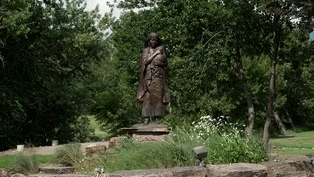
Introduction to "Sacajawea of the Salmon River Valley"
Video has Closed Captions
Clip: S9 Ep4 | 2m 28s | Idaho Experience explores Sacajawea through the eyes of Shoshone-Bannock tribal members. (2m 28s)
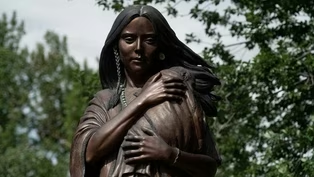
Preview of "Sacajawea of the Salmon River Valley"
Preview: S9 Ep4 | 30s | Idaho Experience explores Sacajawea through the eyes of Shoshone-Bannock tribal members. (30s)
Providing Support for PBS.org
Learn Moreabout PBS online sponsorship












Support for PBS provided by:
Idaho Experience is a local public television program presented by IdahoPTV
MAJOR FUNDING FOR IDAHO EXPERIENCE IS PROVIDED BY THE ESTATE OF DARRELL ARTHUR KAMMER, IN SUPPORT OF INDEPENDENT MEDIA THAT CONNECTS COMMUNITIES AND EXPANDS UNDERSTANDING. ADDITIONAL FUNDING WAS PROVIDED BY…THE...