
Struggle and Success – Sacramento’s LGBTQ+ Communities
Season 28 Episode 21 | 26m 46sVideo has Closed Captions
Explore the struggle for equality and dignity for Sacramento's LGBTQ+ communities.
Explore the historical and ongoing struggle for equality and dignity in Sacramento’s LGBTQ+ communities through regional perspectives and events. Meet local trailblazers and discover the historic events that led to the creation of Sacramento’s LGBT Community Center.
Problems playing video? | Closed Captioning Feedback
Problems playing video? | Closed Captioning Feedback
ViewFinder is a local public television program presented by KVIE
The ViewFinder series is sponsored by SAFE Credit Union.
Struggle and Success – Sacramento’s LGBTQ+ Communities
Season 28 Episode 21 | 26m 46sVideo has Closed Captions
Explore the historical and ongoing struggle for equality and dignity in Sacramento’s LGBTQ+ communities through regional perspectives and events. Meet local trailblazers and discover the historic events that led to the creation of Sacramento’s LGBT Community Center.
Problems playing video? | Closed Captioning Feedback
How to Watch ViewFinder
ViewFinder is available to stream on pbs.org and the free PBS App, available on iPhone, Apple TV, Android TV, Android smartphones, Amazon Fire TV, Amazon Fire Tablet, Roku, Samsung Smart TV, and Vizio.
Providing Support for PBS.org
Learn Moreabout PBS online sponsorshipComing up...
Explore the struggle for equality and dignity in Sacramento's LGBTQ+ community.
We'll hear from local trailblazers...
I have a lot of hope because I see the next generations who are going to fight for those freedoms.
I mean, I'm going to count on them.
We can't go back.
We have to go forward.
Discover how their struggles have paved the way for the next generation... We're here to scream, to shout, to resist all the powers in this world that says we're nothing!
I can't just sit still while my community is being murdered.
So, advocacy is what I do.
It's my life.
I have to advocate for myself.
And witness what it is like from those who faced rejection, but persevered.
My own family doesn't accept me.
Who would want to go through that?
This isn't a choice.
This is me.
This is who I am.
We are people.
We belong to people.
Sacramento's LGBTQ+ scene today is lively and vibrant, teeming with bars, clubs, restaurants, galleries and a community center... all centered in a Midtown neighborhood called Lavender Heights.
Adorned in rainbows, Lavender Heights was championed by Sacramento's first openly gay city councilmember, Steve Hansen, bringing together the LGBTQ community in Sacramento and beyond.
Any man, woman, boy or girl that will practice homosexuality...
But the Capitol city has not always been such a welcoming home for the LGBTQ+ community.
Many people worked for decades, often in secret, to build up the networks that exist in Sacramento today.
I mean, in the seventies, being gay was not something you talked about openly.
My friends who were teachers were in constant fear of being fired from their jobs.
You know, people had to remain hidden.
And it was a hard... it was a hard way to be.
Gays and lesbians would go to their respective bar scenes, but were not very out, and for good reason, because there was not a lot of protection or security here.
Dennis Mangers is a former politician and lobbyist who has been called the "Gay Godfather" of Sacramento.
When same-sex marriage was legalized in 2008, Dennis and his partner, Michael Sestak, were the first couple in Sacramento to get married.
It's hard to say- hard to describe how we felt.
We felt somebody has recognized that we deserve to love one another, uh, as a same-sex couple, and we deserve to... to be married.
In the decades leading up to that pivotal moment, Dennis had been quietly building a powerful network in the Capitol of people who supported gay rights, starting in the 1980s.
And we met secretly in my office, monthly, about how we could advise legislators to introduce and support legislation that would be beneficial, uh, to our community.
Around 1982, 83, our first AIDS patients started surfacing here in Sacramento, and we had to do a fairly quick pivot.
While the epicenter of the AIDS epidemic was largely happening in cities like San Francisco and New York, Sacramento was not spared.
An organization called CARES was created in Sacramento, turning a former bank in Midtown into a one-stop clinic for HIV patients, where they could get prescriptions, doctor's appointments, testing, and counseling.
Nearby, a Victorian mansion was turned into a hospice house with more than a dozen beds.
It was called the Hope House, and it provided a refuge for the mostly young gay men who were dying of AIDS.
They would be moved there.
And then, we would provide them with services.
And we were so glad that we were able to give some of these kids estranged from their families and churches and schools and, now, afflicted with a... a disease that was going to shorten their life.
As Dennis and many others were building political and fundraising networks, another Sacramento trailblazer was creating a similar network for lesbian professionals.
Rosemary Metrailer was a lawyer, specializing in civil and gay rights.
She started an all-woman firm in downtown Sacramento in the 1980s.
Soon, her phone was ringing off the hook.
We often had people call us and say, "Gosh, do you know a lesbian dentist or a lesbian teacher or a principal or insurance person or real estate?"
And finally, I decided that I would try to get everybody together.
She created the Sacramento Area Career Women's Network, which soon drew hundreds of people from all over Northern California for social networking events and dances.
To this day, I run into people who say, "We met each other at SACWN 30 years ago, and we never have forgotten that, and thank SACWN for that."
It was this reputation as a lesbian leader that drew Rosemary into a legal battle against one of the most prominent fundamentalist preachers of the time... Jerry Falwell.
And today, the theme is the second coming of Jesus Christ.
He had a program called the Old-Time Gospel Hour, where he sold all kinds of trinkets.
Your Bible and two gold-plated Jesus First pins will be sent to you immediately.
He became very successful at that.
He was charismatic.
You know, he talked big.
He preached big.
But he preached a lot of hate.
Jerry Falwell's sermons often targeted the liberal Metropolitan Community Church.
A Sacramento gay activist named Jerry Sloan was a minister with the local Metropolitan Community Church, and also had a personal connection to Jerry Falwell.
Jerry and I went to a Baptist Bible college in Springfield, Missouri together in 1955.
So, we knew one another quite well.
He was here in... in 19- in- on July 13th, 1984.
He was invited to appear on a... on a local talk show called Look Who's Talking on channel three, KCRA.
The producers knew that I had gone to school with him and I was gay, and so, they invited me to be in the audience.
Hi Jerry.
You made a statement, uh, concerning the Metropolitan Community Churches, in which you said they were "brute beasts," "part of a vile and satanic system."
-I never said that.
-Well, you certainly did.
I've got a tape of it.
-Well, I'd like to hear the tape Play it right now and I'll acknowledge it.
-I don't have it in my possession.
-Of course you don't, 'cause it doesn't exist.
-You also said that there would be rejoicing in heaven when they would be annihilated.
-That is an absolute lie, Jerry.
-That is not a lie!
-I'll give you $5,000- I'm saying this on television- if you can produce that tape.
-Hallelujah!
I went to Rosie then, knowing that she was a... a... a lesbian lawyer, went to her and said, "Write him and tell him to send us the $5,000 back by return mail."
And I got back to Jerry, and I said, "You're on.
You know, I think we can do this."
Rosemary and Jerry Sloan waited until Jerry Falwell returned to California, then served him with a lawsuit.
Their case went before the Sacramento Municipal Court in 1985.
After hearing from attorneys from both sides, the judge spent hours listening to all of the particular tapes involved.
We had to bring in a television set, a video player, get it all set up in the courtroom.
And we made our arguments.
This is an oral contract.
It's the same as if you tell the kid next door, "If you mow my lawn, I'll give you five bucks."
All the judge had to do was look at the tapes, see that I had said- I quoted him accurately, and that, uh, he should rule in my favor.
Look at the Metropolitan Community Church today, the gay church, because they are spoken of here in Jude as being brute beasts.
But thank God this vile and satanic system will one day be utterly annihilated, and there will be a celebration in Heaven.
And the... the court agreed that we had, in fact, earned the $5,000 and ordered Falwell to pay not only the $5,000, but interest at the legal interest rate.
Jerry Falwell's attorney appealed and lost again, bringing the total amount of the judgment to nearly $9,000.
We, uh, went over to Grady's Copy Shop and they made a copy of that check that was about this big.
And Jerry took that huge check and, um, part of the proceeds from that judgment and helped to found the Lambda Center.
And that huge check, for many years, was hanging in the... the Jerry Falwell Memorial bathroom there, at the Lambda Center.
Well, it just felt so triumphant and so- well, just really satisfying to win this case, because we were making somebody be accountable for their cruel words.
What an amazing symbol that was, to know Jerry Falwell is somewhere stewing over the fact that 5,000 bucks of, no doubt, money given by little old ladies somewhere in- around the country to him, but he had to devote it to the service of the people he'd been attacking.
Jerry Sloan's decision to use the money to help create the Lambda Community Center was a personal one.
I think I was probably 18 before I even knew what the word "queer" meant.
And again, in those days, there were no community centers.
There was no place to go except the... the gay bar to learn anything about being gay.
Jerry Sloan died in 2021, but his legacy lives on at the Lambda Center.
It's now called the Sacramento LGBT Community Center.
The mission of the center is to create a region where LGBTQ people thrive.
David Heitstuman has transformed the Sacramento LGBT Community Center with services that mirror the needs of the community.
California, by far, has the highest percentage of homeless folks in the country.
California also has the highest percentage of LGBTQ youth who are experiencing homelessness.
Since the last Point-in-Time count in 2019, we've seen a 19% increase in homelessness for transitional-age youth.
The primary reason that they become homeless is because they were rejected by family.
In 2019, the center began opening shelters to unhoused LGBTQ+ youth between the ages of 18 to 24.
We focus a lot about mental health struggles and ways that we can tackle those struggles.
With a need so great, the center is calling on the community to step up.
The newest program is the Host Home Program, where young people are placed in homes in the community for four to six months.
Kai Meyers is one of the many LGBTQ youth who have sought refuge at the community center for help after spending a year without a place to call home.
My own family doesn't accept me.
Who would want that?
Who would want to go through that?
I just feel like if you actually tried to live in someone else's shoes, you'd realize this isn't a choice.
This is me.
This is who I am.
After 90 days in the center's transitional housing, his case manager thought he should consider the Host Home Program.
So, I was kind of worried because I didn't want to feel like already, like, a burden, or like I'm making anything harder on them.
And my case manager was like, "Honestly, like, this house seems perfect for you.
And the only thing that's stopping you is that you haven't asked."
And I asked.
I just feel like... it's a no-brainer.
Like, why wouldn't I choose to help a young person have a better life if I have the opportunity to do so?
We saw his progression, that he was making strides.
And if we can, you know, be more of help to that, then why wouldn't we want to help a young man go through that?
And that's the main thing, is to help him out.
I just feel... welcome.
And these are adults that- we have different views.
We're Christian, we lean conservative- more on political issues- but the narrative in this day and age is, like, if you're a Christian and you're transgender, you don't mix.
You don't like each other.
And it's sad to me that that's the narrative that's out there.
We're all just human beings trying to find our way and support each other.
And so, I just think this narrative of hate and- it's... it's so toxic.
But I also feel like when you really get together, you find out you have so much more in common.
We should barbeque for Father's Day unless you've got other plans.
The one thing that Jeanne always says is that it just feels right.
Kai definitely blended into our family really easily.
And part of that is just Kai's demeanor.
You know, he is respectful.
He's helpful.
He helps cook.
Love that.
I'm not going to complain about that.
We spend a lot of time having dinners together, and that's something that I actually really enjoy.
This is a family where we sit down, and we'll play, like, charades.
Now that Kai doesn't have to worry about where he's going to spend the night, where he's going to get his next meal, I feel that Kai is able to kind of look at the future.
Kai landed a job and he is taking up new hobbies.
I feel like I can focus on myself and, like, the values and morals that matter to me.
I feel like I'm more of an individual.
Although the Host Home Program has ended, Kai continues to live with the Boyer family.
He doesn't get to escape that easy, so- [Laughs] I don't know what having a sibling is like and this is, like, the closest that I could imagine it being like.
He just literally feels like my brother.
It's been a good journey.
When I first moved in, I remember when I would fall asleep at night, I would fall asleep smiling because I felt happy to be here.
I just thought, "What if we had said no?"
It's just kind of the moment where you knew, like, it was the right thing to do.
The muppets?
Kermit!
This whole experience has re-taught me what it's like to have community and love and connections, to be vulnerable, I guess.
This just feels like genuine love.
Kai was meant to be a part of this family, period.
I love you guys.
I feel like you've given me a platform and a space to actually grow.
And I feel like you guys want me to be as happy as I can be, and you guys believe in me, and I'm not sure if I actually could put into words how much that means to me.
I am a queer, Black, trans woman in my heart.
That's who I am.
That's how I was born.
Most of my life, I've faced rejection... people laughing at me, people not understanding me, people intimidated by, um, something that they don't understand.
I'm a lover of people first.
Behind that is my activism, the fighting for other folks.
There is growing concern in this country and fear about deadly attacks against transgender Americans, particularly trans women of color.
I can't just sit still when my community is being murdered and attacked.
So, advocacy is what I do.
It's not work to me.
It's... it's my life.
I have to advocate for myself.
I have a strength that's coming from within.
I think that's the basis of who I am.
And so, if you care about humanity, if you care about the folks at the bottom, normally, some type of fight is involved in that.
I had to fight all my life.
I was surviving since I came out of the womb.
I was exhibiting the characteristics of someone who walks this journey of a trans person, um, at five years old.
I was not like the other boys, and I was more attracted to the feminine things, um, Barbie dolls, playing with other girls.
And I felt like I identified with the other girls more so than the other boys.
It wasn't accepted, but I was who I was.
I couldn't hide it.
Um, it was no surprise that I was going to come out as a trans person to my family.
It was just a chaotic environment that I grew up in, constant chaos.
I had a parent, um, that thought that I was something that was broken.
She rejected me as a trans child.
There was a lot of abuse, um, in my household.
Um, beat with broomsticks, um, called "faggot" all the time.
My mom is deeply religious, so I spent a lot of times in prayer lines trying to pray the gay demon out of me.
So, home wasn't safe.
The only safe space I had- and I know it may sound, um, crazy to some people, um- was the streets.
The streets were safer than my house.
At just 13 years old, Ebony ran away from home and began living on the streets of Hollywood.
And got involved in sex work and went through the rut that a lot of trans people go through- jails, institution, drugs and surviving on the street.
That was my constant rut for many years.
Until one fateful day in fall of 2001.
It was my last bout in jail.
I went back to Santa Monica Boulevard and I saw the same stuff, and I was just tired.
And right there on the... on Santa Monica Boulevard, I got on my knees and I said, "God help me."
And it felt like the universe just stopped.
And right then and there, no kidding, um, a church bus stopped right in front of me and opened and said, "Are you ready to go to church?"
I felt like that was divine intervention.
It turned out the bus was part of a ministry for transgender people.
It drove around L.A. inviting and transporting people on the streets to church.
I went to the altar that night and I cried out 22 years of hurt and pain.
And that was the catalyst, I believe, to who I am today.
That began my healing process.
Ebony eventually stopped doing drugs and prostitution.
She moved from L.A. and settled down in Sacramento.
I have gotten a lot of healing from this city.
This city has, um, rebuilt me.
It was in Sacramento where Ebony transformed into an activist, leader, and the role model she is today.
You're hear to scream, to shout, to resist all the powers in this world that says we're nothing!
[Crowd cheers] She became even more emboldened to fight when various transgender rights were being taken away.
The Trump administration has rescinded key protections for transgender students in public schools.
He will ban transgender people from serving in the military in any capacity.
Several LGBTQ rights groups immediately condemned this change.
...Every Black Life Matters Protest... Over the years, she has organized numerous marches and protests throughout Sacramento, including the Black Women's March in 2017.
With the Women's March, a lot of Black women didn't see themselves reflected in that march, and they didn't really see Black trans folks reflected in that march.
My community here in Sacramento said, "Hey, we need to organize our own space and stake our claim as people that have been suppressed and oppressed, saying that we're here and that we matter."
And so, that's what we did.
We changed the narrative.
I don't want to yell at y'all.
I want to say thank you, first, before I start yelling.
[Laughs] Of her many accomplishments over the years, one she is most proud of is commemorating the death of Chyna Gibson, a transgender woman of color.
She was a performer that was known throughout the United States, um, but she was based here in Sacramento.
And she was deeply loved by the LGBT community.
Um, so, it was a great loss when she was murdered.
Chyna Gibson was in New Orleans over the weekend, visiting family and attending Mardi Gras.
Saturday night, Gibson was gunned down in a strip mall parking lot.
Witnesses heard ten gunshots.
Sadly, Chyna Gibson's story isn't, like, a singular story.
There's a lot of Black trans women being murdered.
I took Chyna with me in my heart, and I said, "We have to do something to memorialize her here in Sacramento."
Ebony commissioned a mural in honor of Chyna Gibson.
It's a unifying message.
It's the message that we belong to people.
It humanizes our experience.
When I look across this room and I see all these warriors rising up to say, "We stand for trans lives," I'm filled with incredible emotions.
Today, Ebony continues to thrive as a prominent advocate and role model for Sacramento's LGBTQ+ community.
She is currently the executive director of California Transcends, an organization advocating on behalf of Black transgender people, and she has received numerous awards and recognition for her activism over the years.
Ebony, your tireless dedication to the fight for equal rights and racial justice makes California a better place.
Congratulations, Ebony.
[Cheers and applause] Internally, I'm living my truth.
And the beautiful thing about human experiences is that we, um, all have our own truth and that we are different.
We are different representations of humanity.
And so, why wouldn't, uh, humanity show up as a big, Black trans person?
My hope for the succeeding generations is that they learn to live in the fullness of who they are, that they're in an environment in which they can rise to their absolute fullest potential.
Our diversity is part of what makes us strong.
And so, if we have to fight to preserve our diversity, just as we fight to preserve our democracy or our religion or whatever it is that's important to us as human beings, that's worth fighting for.
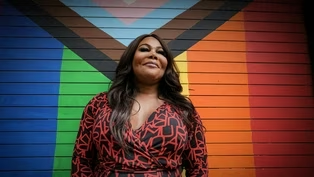
Sacramento’s LGBTQ+ Communities Preview
Preview: S28 Ep21 | 30s | Explore the struggle for equality and dignity for Sacramento's LGBTQ+ community. (30s)
Providing Support for PBS.org
Learn Moreabout PBS online sponsorship












Support for PBS provided by:
ViewFinder is a local public television program presented by KVIE
The ViewFinder series is sponsored by SAFE Credit Union.