
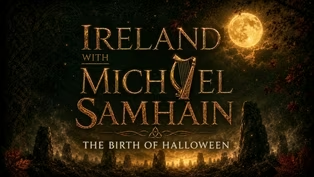
SAMHAIN: THE BIRTH OF HALLOWEEN
Special | 56m 46sVideo has Closed Captions
Michael Londra explores Samhain, Ireland’s ancient roots of Halloween and folklore.
Michael Londra, host of the popular travel series Ireland with Michael, embarks on a spine-tingling journey through Ireland to uncover Samhain, the ancient Celtic festival behind Halloween. Blending rich history, haunting folklore, and modern traditions, the film reveals how this ancient celebration evolved into a holiday now observed in many parts of the world.
Problems playing video? | Closed Captioning Feedback
Problems playing video? | Closed Captioning Feedback
SAMHAIN: THE BIRTH OF HALLOWEEN is a local public television program presented by Detroit PBS
SAMHAIN: THE BIRTH OF HALLOWEEN
Special | 56m 46sVideo has Closed Captions
Michael Londra, host of the popular travel series Ireland with Michael, embarks on a spine-tingling journey through Ireland to uncover Samhain, the ancient Celtic festival behind Halloween. Blending rich history, haunting folklore, and modern traditions, the film reveals how this ancient celebration evolved into a holiday now observed in many parts of the world.
Problems playing video? | Closed Captioning Feedback
Where to Watch SAMHAIN: THE BIRTH OF HALLOWEEN
SAMHAIN: THE BIRTH OF HALLOWEEN is available to stream on pbs.org and the PBS app.
(water splashing) (bird noises) CHILD: Tonight we speak to those through the veil.
The lines between worlds are thin and frail.
As the sun goes down far to the west, my ancestors watch over me as I rest.
They keep me safe and without fear on the night of Samhain, the witches' new year.
♪ (doorbell rings) (door opens) CHILD: Trick or treat!
Thank you!
(kids talk excitedly) MICHAEL: Before Halloween there was Samhain, the night when the veil between worlds grew thinnest, a time when the living and the dead walked closer than ever.
♪ (water rushing) Here in the heart of Ireland, from an ancient portal to the other world, the oldest stories of Halloween emerged.
We're peeling back the layers of history and myth to understand what Samhain truly is, how it evolved into Halloween and the effect a culture that walks side by side with its spirits had on our literature, our art and our music.
This is a land where spirits don't just linger in legend.
They wander the lanes still, especially the mischievous púca, a shape-shifting sídhe or fairy who are said to be most active at this time of year.
In fact I can attest to their wiles, one of them may have already taken a liking to me.
I'm currently in a sling thanks to the mysterious re-emergence of an old injury on our very first day and I've been told it's best not to question the other world's sense of humor.
This is Ireland with Michael: Samhain, The Birth of Halloween.
(blowing) ♪ ♪ ♪ ANNOUNCER: Samhain, The Birth of Halloween is made possible by... MAN: You dropped your hat!
Hey!
Stop!
You dropped it!
♪ Sorry.
♪ You must be joking.
♪ I think you dropped this.
MAN 2: Thank you.
MAN: Yeah, no bother.
ANNOUNCER: Since 1932, CIE Tours has welcomed travelers to discover Ireland's rolling green landscapes, cherished traditions and Irish hospitality, creating memories that last a lifetime.
CIE Tours, where every journey becomes a story.
(windchimes) VOICE (quoting William Butler Years): Fairies, come take me out of this dull world, for I would ride with you upon the wind, run on the top of the disheveled tide, and dance upon the mountains like a flame.
♪ MICHAEL: We begin our time here at Kilronan Castle, a Gothic Revival estate steeped in history and legend.
In the quiet of the off-season, the stone walls seem to whisper stories of kings, of warriors and perhaps even the supernatural.
It's the perfect place to pause, reflect and prepare for the journey ahead.
♪ DR.
O'CONOR: What's curious about the house to me, the thing that always strikes me is the breakfast room looks directly on Sí Mhór, the little mountain above Leitrim Village about six or seven miles away with its three passage graves.
Of course, Sí Mhór is the famous Sí Mhór, Sí Bheag, Sí Mhór of O'Carolan, you know the great composer.
♪ That actually references fairy lore and folklore of the area because the whole idea behind Sí Bheag Sí Mhór is this continual war between the fairies who live in the hill of Sí Bheag which lies closer to Keshcarrigan, and Sí Mhór.
MICHAEL: Nearby, not so far away, we have indeed the entrance to the underworld.
DR.
O'CONOR: Yeah.
MICHAEL: And whether you call them the sídhe or ghosts or the púca, people have a reverence still for the other world.
DR.
O'CONOR: I certainly know some very old people who believe fully in fairies, but in a way it would be wrong to say that your average middle-aged elderly Irish farmer today absolutely believes in the sídhe or in a fairy.
But to a certain extent the embers of fairy lore are still there.
For example, nobody would destroy a ringfort.
The lone tree which is associated with the sídhe within a field, usually a hawthorn tree, sometimes a holly tree, is never touched right to the stake.
Farmers will tell you so many stories about bad luck if a ringfort or a lone tree was actually, a lone bush was actually cut down or destroyed.
You know, the digger broke down, the tractor broke down, worse even, the person may have died.
Apart from the fact as a professional archaeologist, you know, you want to preserve monuments, so it's nice to have that association between the sídhe and archaeological monuments to ensure their preservation.
But at the same time, you know, there is, I do have a certain romantic bent, and it is nice to think that there's something a little different out there.
♪ VOICE (quoting Irish myth): Beasts, monsters and terrifying creatures regularly emerge from Oweynagat, especially around Samhain, when the veil between worlds is thin.
(dripping) ♪ MICHAEL: From Kilronan Castle we travel to Rathcroghan, a major archaeological site with over 240 monuments including Oweynagat, the Cave of Cats.
♪ (sheep bleat) To understand what put Rathcroghan at the heart of ancient Ireland we turn to Daniel Curley of the Rathcroghan Visitor Centre.
DANIEL: The cave at Rathcroghan is a place that's only open to the other world according to our stories at that one auspicious time at Samhain, where we see all this manifestation of creatures changing the world into winter is taking place.
So the other world really, it's not a wholly sinister place, it's a place a lot more complex than that.
But it's how our ancestors understood their place within the Irish environment, the mortal environment, and how certain things are out of their control really in a certain respect.
So in our case at the cave at Oweynagat they talk about a whole litany of warriors that are tested by creatures that emerge from the cave or that indeed that these famous warriors go into the cave to be tested.
And the best way for us to read that is the possibility that the cave might in its truest form, in its real life youth, might have served as a place where rites of passage, where youths on the verge of adulthood might have been sent into in order to face their fears.
♪ SIOBHÁN: And in that place of darkness, it's sensory deprivation like.
So when there's sensory deprivation, when you're not looking, when there's no light and there's no sound, you're feeling.
So it's a feeling place.
So the invitation is to come into the feeling place.
Now this is where so many people, we don't want to go there because what's waiting for us?
DANIEL: To be reborn in a sense because they're going into Mother Earth to face the goddess of war who resides in the cave.
So they're going in to face the goddess of battle, going in as a child or an adolescent and then to be reborn and having proven themselves and brought themselves to the next level of responsibility in a way.
MICHAEL: Here at Rathcroghan, druids would light their fires in a careful ritual.
They'd extinguish all the old flames, plunging their familiar home into hushed darkness.
Then, return the light, relit from a sacred source, all this symbolizing the death of the old year and the birth of the new.
SIOBHÁN: Our calendar is 13 moons.
There's 13 moons in a year, 28 days in a cycle.
An in breath and an out breath.
A waxing and a waning Moon.
Like this is our cycle.
Like this is the woman's cycle.
This is the cycle of nature.
This is the biodynamic calendar.
Like that is the Celtic calendar.
DANIEL: Communal fires really are an opportunity for the society, for the human society to fight back.
To kind of bring light, keep light in the time of darkness encroaching upon us.
So that idea of being safe around that fire, that brightness offering the bit of solace and the bit of hope when things have gone more sinister, gone more darkened and more uncertain, that's where the bonfire tradition kind of really looms largest.
In terms of the name of it, bonfire seems to take its origins from the concept of bones and the burning of bones is something that would have been useful from, again, an agricultural point of view as a fertilizer and the driving out of the minerals that are in the bone material, but also the noises and the lighting of it gives a certain spectacular nature to it as well.
VOICE: This was the arrangement of the house.
Seven partitions in it.
Seven beds from the fire to the wall in the house.
All around there was a fronting of bronze on each bed, carved red yew all covered with fair varied ornament.
MICHAEL: Rathcroghan's history spans an incredible 5,500 years, including being known as the mythic seat of the kings of Connacht.
DANIEL: So in the Iron Age, which is what we have the best evidence for, for Rathcroghan, so about 2,000 years ago.
We've got a very dispersed society, so we're not living in towns, we have no towns, so a place like Rathcroghan is not a population hub, it's what I would describe as an empty capital.
It's a place that's very busy for brief points in the year, so Rathcroghan serves then really as a focal point, a kind of a lightning rod for people to gather, to celebrate, for fairs and assemblies, for opportunities to engage in all of the type of activities that a society without towns needed.
With marrying off branches of families, declaring war, suing for peace, law making, even down to crowning kings and burying the important dead.
A place that's awash with activity at brief points of the year and those points of the year would be of our seasonal changes.
SIOBHÁN: That is divided into eight and they correlate to the directions and those eight fire festivals happen at turning points.
From Lughnasadh you travel in August, from Lughnasadh you travel down to the equinox, the autumn equinox, from the autumn equinox you come to Samhain.
DANIEL: In modern Irish you talk about it as Oíche Shamhna, so Halloween night, and that as we know now today is a global festival.
MADELINE: The colors of orange and black that are associated with Halloween comes from the light part of the year, which stopped at Halloween, into the dark part of the year.
SIOBHÁN: It's a kind of a, they say a threshold, threshold points, like when something ends and something else starts, there's sort of a, you could call it a limbo, the liminal space between two worlds, like, you know.
MADELINE: The veil between the other world and this world was gossamer-thin, and its souls could pass through, and they may have wanted to come through for, maybe for revenge, maybe for unfinished business, maybe just to see their loved ones, and maybe just out of mischief, but they would come through that gossamer veil into the dark part of the year.
SIOBHÁN: So you're at the very end of the summer, you're saying goodbye to everything, all the, you know, no more harvesting, the land is stopping, it's not giving anymore now.
The harvest is done, if it's not in, leave it in the bush for the animals, because there's no look for eating it after, you know.
DANIEL: You're looking at the end of a cycle, and you're looking at the end of a period of brightness and entering into a period of darkness.
So your winter and your spring months are the time when you're going to be indoors more often.
You're disengaging from a lot of the agricultural activity that would have been more prominent in the summer and in the autumn.
And as such, it's time to take stock.
It's time to keep warm.
It's time to keep stores available as much as possible.
SIOBHÁN: The rituals are basically like, they're like a signpost for your psyche.
You know, you're like, "We're doing this now lads."
You're making, you're announcing, like, you know, because your mind is like an unruly monkey that needs a little bit of structure.
And the rituals give it that structure or these ceremonies.
DANIEL: So from the point of view of the spiritual nature or the understanding of how the world worked, Samhain marked that very, very deliberate break from the bright side to the dark side of the year.
SIOBHÁN: It's the in- between space, you know, where nobody in particular has full jurisdiction.
DANIEL: What survives to us in the early medieval stories, they talk about that last night between autumn and winter being charged with a whole series of different creatures and beings and monsters that will roam the earth and in effect change the world from a time of plenty into a time of dormancy, really.
MICHAEL: On this night, the Celtic New Year, communities gathered, ritual was performed, and cycles of life and death were honored.
But they still had as impishly a good time as we have today.
♪ DANIEL: For people that might be more familiar with more modern concepts, think of like nearly like a large scale music festival or even such important seasonal affairs such as the likes of Mardi Gras or the like the Carnaval, that idea of celebration before potentially austerity.
♪ (crows cawing) CHILD: When the clock strikes midnight, beware the fright, for ghosts and goblins come out tonight.
♪ (crows cawing) MICHAEL: Now, to understand how these ancient practices shaped what we call Halloween, we turn to historian Nathan Mannion.
He traces how the fires of Celtic New Year came to influence our celebrations today.
NATHAN: So while these spirits had an opportunity to come into our world, they needed to be deterred in some fashion.
So how was that done?
People would dress up, try to blend in, so to speak.
They'd want to look a little bit like those otherworldly beings that were making their way here, to confuse them, to keep them from taking them and their souls to the underworld.
But they'd also carve things like lanterns as well as deterrents.
So things like the jack-o'-lantern tradition originated there as well.
MADELINE: Well of course the Irish being an agricultural people, the turnip was in season and they would take the turnip, they would carve as frightening a face as they could and they would put a candle inside.
And this was to ward off the evil spirits, to ward off the fairies.
NATHAN: There's a lot of strong folk beliefs and traditions around it.
So the turnip was also known as the jack-o'-lantern.
And that name has a very interesting origin as well.
So Jack is a figure in Irish folklore who was meant to be a little bit of a churl, a bit of a reprobate, a bit of a rogue.
And he reputedly was a blacksmith.
But one making his way through the countryside one night came across a corpse and he realized that it was actually the Devil.
The Devil had come to take his soul and to bring him to Hell.
But Jack, being Irish and being a bit of a rogue, tried to deploy a little bit of trickery to prevent that from happening.
So he convinced the Devil to pop into a local pub and let him have one last drink before he made his way down to Hell which he agreed to.
They had their drink.
Then Jack, of course, realized, "Oh, I have no way of paying for this."
He was penniless.
So he asked the Devil to turn into a silver coin that he could use to pay the barman and then turn back in and make their way down afterwards, which the Devil, admiring the nefariousness of this approach, agreed to.
But Jack, instead of paying for the drinks, pocketed the coin.
He was carrying a crucifix in his pocket as well, which prevented the Devil from turning back.
And so they had to strike a bargain.
So Jack said, "I'll let you go if you give me ten more years and let me get on with my life."
Time rolled by, ten years on, the Devil comes again.
Jack is still trying to worm his way out of it.
This time he asks the Devil to climb up a tree and grab him an apple, so he can have one last meal before he makes his way to the underworlds, which for some reason he agrees to again.
But while he's up in the tree, Jack plants a bunch of crucifixes around the base, preventing the Devil from coming back down, and this time he decides to strike a bargain for the remainder of his life, not just ten years.
So with no other option, the Devil again agrees and Jack is spared.
Eventually his life comes to its natural end.
He makes his way to Heaven.
He's supposed to be hoping to make his way through, but of course he's led a terrible life.
He's been a rogue, a trickster.
So the gates of Heaven are closed to him.
He turns to Hell turns up at the gate and the Devil says, "Well look, a promise is a promise.
I'm not letting you in here."
So instead, feeling a little bit sorry for him now that he's this soul trapped between two worlds, he gives him an ember from Hell a coal, which he puts inside a turnip.
And that lantern is supposedly what people see in marshlands and bogs and dark nights all around Ireland.
It's Jack, basically in purgatory, trapped between two worlds, trying to wander the Earth for all of eternity.
MADELINE: And of course when it went to the New World, then pumpkins were a lot easier to carve.
NATHAN: If you're looking for something effective, a deterrent, something brighter, something more substantial, it makes sense to try and use the biggest thing you can get, which in this case was the pumpkin.
MICHAEL: So let's dive a little further back.
I want to talk about the Cailleach, the witch.
NATHAN: Yes, yes, so witchcraft in Ireland is actually relatively uncommon.
There are very few tales of witches in Ireland.
MICHAEL: The most infamous example of them all, however, must be Alice Kyteler of Kilkenny.
NATHAN: That's my hometown, so I've grown up around witchcraft, you could say.
MICHAEL: It was here in 1324 that the first witch was condemned in Europe.
Alice Kyteler was born in her family's expansive house, now an inn, the only child of Flemish merchants.
Alice's first strike in the eyes of the church was being a woman.
Her second was being a money lender.
And her third was the suspicious death of her four husbands.
After her fourth husband's death, his children and those of the last three got together and brought a charge of poisoning.
In those days, it went that a charge of heresy meant that her substantial fortune would go to the church.
The local bishop got interested and brought her to court.
Though she fought it, Alice was eventually forced to flee the country.
Fortune would not be so kind to her maidservant Petronilla de Meath, who, after being forced to confess to a crime of witchcraft, implicating her mistress along with herself, was burned at the stake.
This tragedy is a blueprint for much of what we associate with witches.
Alice Kyteler was said to fly on a wooden beam and commune with a demonic familiar who took the form of a black cat.
Nowadays, Petronilla, the maid who died, is honored as the namesake of one of Kilkenny's finer dining establishments.
Just as the ritual fires of Samhain were a bridge between worlds, so too was the human voice.
In Ireland, the voice has always carried memory, warning and magic.
Keening, chants and traditional sean-nós style of singing were ways to honor the dead, call spirits and mark the turning of the year.
♪ Hell above and Heaven below ♪ ♪ All the trees are gone ♪ ♪ The rain has such a lovely sound ♪ ♪ To those who are six feet underground ♪ ♪ The leaves will bury every year ♪ ♪ And no one knows I'm gone ♪ ♪ Leave me golden, tell me dark ♪ ♪ Hide from Graveyard John ♪ ♪ The Moon is full here every night ♪ ♪ And I can bathe here in his light ♪ ♪ The leaves will bury every year ♪ ♪ And no one knows I'm gone ♪ ♪ Hell above and Heaven below ♪ ♪ All the trees are gone ♪ ♪ The rain has such a lovely sound ♪ ♪ To those who are six feet underground ♪ ♪ The leaves will bury every year ♪ ♪ And no one knows I'm gone ♪ (birds calling) VOICE (quoting Lady Jane Wilde): As the leannán sídhe was the acknowledged spirit of life, the bean sídhe was the spirit of death, the most weird and awful of all the fairy powers.
MICHAEL: I wonder, have you picked up the same kind of stories that I picked up about our reverence for the underworld?
The sídhe, the púca, the bean sídhe.
SHAUNA: We were terrified of the bean sídhe, absolutely terrified.
MICHAEL: Who were you most scared of when you were growing up?
MADELINE: We were told about, you know, if you go to a certain place at night, then this woman will appear and you'll know who she is because she has long, straggly grey hair and she screeches.
It's like a whole regiment of cats.
And don't stay out, come straight home.
SHAUNA: And I remember a friend of mine, Aiden O'Donnell, from Dunkineely, telling me a story about the bean sídhe.
Aiden did not wake up ever, he was the eldest.
His brother woke up very, very upset because he could hear this.
And Mary, his mother, came in and she could hear it, but Aiden couldn't hear anything.
They went down.
They said it sounded like a crying coming towards them, but then the next they would be down at the shore, then it would be at the back of the house, back up into their face.
And the next day, their next-door neighbor who lived behind them, died.
And that's what the bean sídhe is apparently alerting you to, is that someone close to you is going to die.
♪ MICHAEL: Lough Eske Castle rises in dramatic Gothic style with turrets, pointed arches and intricate stonework that feel almost haunted in the evening light.
In 1939 the castle caught fire, burning out the interior and rendering the structure derelict for the next 70 years.
From fire, however, came renewal, when the inside was not so much restored as reimagined into the luxury hotel you see today.
♪ (fire crackling) Its dark architecture seems perfectly at home with Halloween, echoing the local tales of spirits in the Otherworld, including the legendary Lough Eske Monster said to lurk in the waters nearby.
A more recent phenomenon, Eskie serves as a good reminder that not all Irish frights go back to the days of yore, nor do we ever take ourselves all too seriously.
♪ VOICE (quoting William Butler Yeats): The púca has many shapes- is now a horse, now an ass, now a bull, now a goat, now an eagle.
MICHAEL: After a night among the shadows and stories of Lough Eske it's time to follow the trail of fire forward through time, from the misty waters of Donegal to the rolling hills of Meath.
Centuries after the ancient fires of Samhain lit the hilltops, the legacy of those flames survive here at the Hill of Ward near Trim and Athboy.
Once a sacred site where early Celts gathered to mark the turning of the seasons, today it hosts the Púca Festival, a celebration of the shapeshifting spirits, mischief and magic that have haunted Irish folklore for generations.
♪ ♪ Amid the mischief and music of the Púca Festival, it's easy to forget why costumes became part of the season.
Centuries ago people dressed to blend in with the spirits, to hide from wandering souls and mischievous púcaí.
Today the masks and outfits are playful, but the root of the tradition remains a little disguise to survive the night.
VOICE (quoting Lady Jane Wilde): There are several modes in which the evil eye can act, some much more deadly than others.
MICHAEL: Leaving flickering flames and mischief at the Púca Festival, our journey through time turns to a different kind of protection.
One carved in stone in the superstitious centuries of the Middle Ages.
Kilkea Castle, with its centuries of history, hides this curious relic above its gatehouse.
Okay, Jack, I brought you around here because I wanted to ask you about that up there.
What is it?
JACK: So, that is the Evil Eye Stone of Kilkea Castle.
It's a stone that was put on by the FitzGerald family, who, this was their family home for over 700 years.
But it was also a defensive castle, so one of the defensive techniques they had was the Evil Eye Stone.
And whilst it's a very grotesque image that has been placed here just over the archway where you would walk into the main courtyard, the idea was that if anyone was coming to the castle to attack it or its people or its lands, that they would look at this stone and it would draw any evilness or badness out of them.
So it was quite a mystical or magical stone that they believed in back then and still to this day it's something that fascinates our guests when they come to Kilkea Castle.
MICHAEL: There's nothing like a bit of magic.
(birds calling) As if an evil eye stone weren't enough protection for guests at Kilkea Castle, they also offer the protection of the magic of its resident wizard.
JACK: So there was Gerald FitzGerald, which was one of the famous FitzGerald Dynasty who lived here for over 700 years.
He was known to have practiced black magic and alchemy here at the castle.
And there's many stories about him that go back many, many years.
MICHAEL: So when I'm wandering the halls tonight, I better not run into anybody called Gerald FitzGerald.
JACK: No, well, there's only one time of the year that we've heard that he comes back, which is on the seventh day of the seventh month of every seventh year.
And it's known that he rides through the castle grounds and through the Curragh locally on his horse every seven years.
MICHAEL: I was just looking there on your lapel.
There's a little monkey that seems to be on everything that I look at.
Tell me about the monkey.
JACK: The FitzGeralds, again the earls of Kildare, they kept a range of exotic animals including falcons, monkeys, they had a couple of dogs as well.
But there was a story that a fire broke out here at Kilkea Castle many years ago and Gerald FitzGerald, who was the second earl of Kildare, was a baby at the time and he was in his nursery.
And when the fire broke out, the servants couldn't get back into the castle to rescue the baby.
And the story goes that the monkey appeared out of the flames with the baby FitzGerald in its arms.
And ever since then, the FitzGeralds adorned it into their coat of arms and we wear it on our lapels and put it on all of our collateral around the hotel as well.
So it's a lovely story that goes way back, but it's the one that stays with us every day.
MICHAEL: While roaming the grounds, I'm definitely hoping not to run into the menagerie of supernatural beings about.
The castle's gamekeeper may have some answers to where some of these myths and stories come from.
JOHN: Well, the barn owls exist nearly all over the world.
So in some places they're called grass owls because they hunt over grassland.
But they have extremely soft feathers.
They don't make a sound when they fly.
And for that reason, they've often been mistaken for a ghost.
When this big white shape would pass over your head.
MICHAEL: Oh.
JOHN: Especially if you're walking along a lonely country Irish road, coming back from the pub in the early hours in the morning, this owl will fly over your head, screech and frighten the life out of you.
MICHAEL: Okay, so I can see how maybe people would think they're hearing a bean sídhe, maybe.
JOHN: Well, the Irish name for this owl is the screecher in the graveyard, which is a very descriptive name.
MICHAEL: From the ancient stones of Kilkea to the walls of Derry, time marches onwards, and so do the celebrations.
Here, Halloween has grown into one of the largest festivals in Europe, drawing visitors from all over the world.
♪ What began as fires and folklore has become parades, music and tales of hauntings.
But bean sídhes, púca and spirits of the night are never far away.
Mingling with the crowd of festival goers are the echoes of these stories past.
♪ CHARLENE: Michael!
MICHAEL: Charlene!
CHARLENE: How are you?
MICHAEL: How are you?
When in Derry, there's no better guide than Charlene McCrossan, whose family has been sharing Derry's ghostly history for generations.
CHARLENE: You're checking out our city's skeleton.
MICHAEL: I am.
I mean, it's pretty kind of spooky itself.
CHARLENE: I know, and this is our city coat of arms.
So, all the time, for hundreds of years, in our city coat of arms, we have had Walter de Burgh.
Poor Walter starved in a dungeon in the 13th century over a war over land.
And we celebrate this story in our city coat of arms.
So you are in no better place for Halloween this year.
MICHAEL: I have to tell you, I've been taking Halloween a bit too seriously lately.
CHARLENE: Right.
MICHAEL: So it's time to have a bit of fun.
CHARLENE: Oh, yeah, of course, well we have all the spooky fun in Derry.
MICHAEL: Alright show me around.
CHARLENE: Brilliant!
♪ MICHAEL: Charlene, first stop on our spooky tour.
Alright tell me where we are.
CHARLENE: So we are within the grounds of St Columb's Cathedral.
This is the oldest building within the walled city completed in 1633.
Now behind me we have what is called Siege Heroes Mound.
There was a siege here in the city in 1689.
7,000 people roughly sadly lost their lives.
It is said that up to 5,000 bodies of those who died during the siege are buried here.
MICHAEL: No wonder it's a mound.
CHARLENE: I know, like built as a hill because there's that many bodies within it.
MICHAEL: Do you know why they buried them here?
Is it because it's within the wall of the... CHARLENE: Within the wall, this is also where William of Orange, his army were within the walls at that time, so this is where a lot of the main situation was.
There were cannonball being fired in and out of the walled city at that time and a lot of the people unfortunately who passed during the siege it was due to disease and starvation because they were eating everything from cats, rats, dogs, mice, anything they could get their hands on.
MICHAEL: Uh, okay, to continue on our theme, let's head to the next stop.
CHARLENE: We will indeed.
♪ MICHAEL: I know where I am now.
I'm familiar where this part of Derry is.
CHARLENE: It is.
It's so familiar here, isn't it?
So we're overlooking the Bogside.
We have the hills of Donegal in the distance, but we do have, of course, a very spooky story attached to here.
And this one is actually quite recent as compared to the stories related to the siege.
And it's about St Columba's Long Tower Catholic chapel.
You see it over there?
MICHAEL: Okay.
Yeah.
CHARLENE: So there was a landslide of the graveyard of that chapel.
And would you believe that the coffins, the bones, were all out where the flyover is today, all over the street.
And that actually happened just a hundred years ago.
♪ MICHAEL: Charlene, this is about as picturesque a church as I've seen in a long time.
CHARLENE: It's gorgeous.
MICHAEL: Don't tell me there's a spooky story attached to this.
CHARLENE: There are spooky stories all throughout the city, I'm sorry to tell you.
But this is St Augustine's church, what we lovingly call the Wee Church on the Walls.
Now as you know, in Ireland we're very religious, but also with being very religious comes a lot of superstitions.
People were very superstitious in years gone by and when they were buried, old burial methods, people who were superstitious were buried with a string attached around their finger.
The string led up above the grave.
At the end of the string there was a bell in case they were accidentally buried alive.
So who knows we might hear some bells ringing here today.
MICHAEL: I hope not.
CHARLENE: I know, hopefully not.
(laughing) ♪ VOICE: There is a place in the parish of Errigal in Londonderry called Slaghtaverty.
The laght or sepulcher monument of the Abhartach or dwarf.
This dwarf was a magician.
MADELINE: Well, Abhartach comes from dwarf and Abhartach was a- he was shapeshifter.
MICHAEL: Madeline McCully has spent a lifetime collecting tales from ancient myths to chilling ghost stories.
She gives new voice to Derry's eeriest legends, including the legend of the Abhartach, a tyrant that refused to die.
He may remind you of another literary figure.
MADELINE: He was born and he had all of the awful attributes that anybody should have.
And apparently he would go around and he would drink the blood of animals.
And apparently then he began to lure young women with sweet music and became a handsome young man.
And once he would be near them then he would obviously take them and kill them and take their blood.
And they tried to get rid of him, the local people in the area, and they could not get rid of him.
And they sent for a neighboring chieftain who apparently was very brave, Catháin, and he came and he did kill him.
And they buried him, but within three days he rose again and he became even more bloodthirsty than before.
So Catháin consulted with a druid and the druid said, "You will not kill him in that way.
He will keep coming back.
You must use a spear made from yew wood and you must put it through his heart and then bury him upside down so that he's facing Hell and he will not be able to rise."
He prepared and he went with his faithful hound.
Abhartach was out drinking the blood of a young woman that night, came home before the dawn and of course Catháin was waiting and he stabbed him in the heart with a stake.
And he buried him, this time according to the druid, upside down facing Hell and he covered it with a huge stone.
And the druid had said, "Around it you must put thorn trees because he cannot go beyond the circle of thorntrees."
Well, there's one thorntree that still is there, but it is actually over the huge stone.
MICHAEL: Well, guess what, Madeline?
I'm going to go out to see it today.
MADELINE: Oh, well, I'm glad I'm not going with you.
♪ MICHAEL: Well, against my better judgment, here I am standing on what's said to be the site of Abhartach's third and final burial.
Head down with a stone over him, a stake of yew still plunged through his heart, a tyrant who wouldn't stay dead.
The fact is, all that protection only contains him.
He's said to live still, lying in wait just beneath my feet.
Honestly, I'm not sure if I'm brave enough to stay until sundown, and doubly so on this night when the veil is thinnest.
So let's get going before old Dracula's terrible thirst grows too great.
♪ Back in the city, night falls and Derry transforms.
The city's ancient streets and walls, already awash in centuries of stories, come alive with color, music and spectacle.
Thousands gather to celebrate Halloween, blending old legends with new traditions, costumes, parades and performances.
From the eerie whispers of the past to the laughter of today, it's a city where history and modern celebration collide.
And nowhere else in the world does Halloween feel quite like this.
♪ VOICE (quoting Bram Stoker): The last I saw of Count Dracula was his kissing his hand to me with a red light of triumph in his eyes and with a smile that Judas in Hell might be proud of.
♪ MICHAEL: Nineteenth-century Dublin was alive with writers who haunted the city as Halloween was evolving into the form we know it today.
Sheridan Le Fanu, who penned Carmilla, the first vampire novella; Oscar Wilde, whose portrait of Dorian Gray still warns of the corrupting allure of decadence; and, of course, Bram Stoker himself, father of Dracula.
Their work echoes the legends of Ireland's past and the anxieties of their present.
It was here, Marsh's Library, where their likes came to prowl the stacks, hunting for inspiration and expanding the rich canon of Irish storytelling.
♪ AMY: We are very lucky to have our reader register, so records of everyone who read in the library, going back to 1828.
So when you came to the library, because you know the librarians didn't know that they could trust you, you had to sign the register, give your address and then you also had to be recommended.
So here if you look on the 4th of July 1866, a very auspicious day for American audiences, we have Abraham Stoker as he was still signing himself there.
It's a beautiful hand, very clear.
19th century hands are not always the easiest to read but his is very lovely.
It helps as well that there had been, well it helps that sounds terrible, but there had been some thefts in the library a couple of years beforehand and what this meant was that the librarians were really very strict about both getting people to sign the reader register but also noting down what they had read so this is there's a particular window in the library's history where we know exactly the books that people read when they came into the library.
So over here we have kind of a companion to this and here you can see on the first day that Stoker came in which was the 4th of July, we have him here Mr.
Stoker and he was reading some pamphlets and then he came in seven times over the next year and there's a list of everything he looked at.
So we have books we have atlases we have literature we have books on witchcraft and astrology lots of very exciting things and they're all noted down which is a real really exceptional and to have that information is really fantastic.
MICHAEL: So can we take a look at- a closer look at those books?
AMY: MM-hmm.
I think you'll be surprised with some of the references in them as well.
So here this is one of the volumes of a very well-known 17th century compendium of travel literature called Purchas His Pilgrimage.
And here you can see there is a map of Transylvania and on the next page a description of Transylvania in the 16th century.
It's an area that was particularly interesting to, or that Europeans were particularly interested in, in the 16th and 17th century because it's more or less on the border between the Ottoman Empire and Europe.
So it's an area of real struggle between the Habsburgs and the Ottomans and it's sort of very important as part of Europe's identity and part of the borders of Europe.
So Bram Stoker seems to have been... I don't want to make it seem like, "Oh, he saw this and thought, oh, I know I'll set my novel 30 years after being in Marsh's Library in Transylvania."
But it's interesting to think that these are certainly books that he would have read.
And another one, another travel book by a man called Peter Heylyn, his Cosmographie, also from the early 17th century.
I can just grab that for you there.
This has a list of all of the voivodes or sort of kings of Transylvania.
And it also mentions the area of Wallachia, which is very of great interest to in Dracula.
And if you look at this section here, it talks about Muhammad, so the Ottomans, putting into power the brother of a man called Wladis, who was called Dracala.
So an actual reference to the historic character anyway called Dracala.
MICHAEL: So, you know, he moved in literary society, we know that, and I'd love to kind of explore the contemporary influences that he had.
I know, for example, that he was friends with Oscar Wilde's family.
AMY: Yes, so he knew Oscar Wilde's parents, William and Speranza, and Oscar Wilde's mother, Speranza, wrote a book called Ancient Legends, which was all about Irish folklore and Celtic myths, because this is very much a time in Ireland that kind of Celtic revival is beginning.
So this was after he was in Marsh's before he moved to London.
So there's definitely, he's being exposed to these sort of these myths, these legends, Irish folklore.
There's also the fact that when he was growing up, he's known to have been bedridden for the first few years of his life and that his mother told him stories and she seems to have been very affected by a cholera epidemic when she was young and you know was telling stories of people who basically no one would go anywhere near somebody during a cholera epidemic because it was so easy to catch it was so contagious that people essentially had to lie down in graves that had been built for them or had that had been dug for them excuse me and just sort of wait to die which definitely has that kind of almost link to the living dead.
Returning from the grave so... I think again all of these ideas it's hard to pin down exactly one person, one literary reference, but all writers accumulate these ideas over years and just seeing that there are definitely early, earlier references, earlier things that he's reading that might well have had some kind of influence on his writing.
VOICE (quoting James Joyce): These barmbracks seemed uncut, but if you went closer you would see that they had been cut into long, thick, even slices and were ready to be handed round at tea.
♪ MICHAEL: From the fires of Rathcroghan to the Gothic streets of Dublin, Ireland has never stopped speaking to the unseen.
Perhaps that's why Halloween feels like coming home, and it doesn't get much closer to home for me than barmbrack.
It's a true Irish tradition with no corollary in America.
CATHERINE: Barmbrack, bairín breac.
MICHAEL: And there's one woman in the world beside my mother that I trust to make it.
Catherine Fulvio, I have for the past week talked about every Halloween tradition that there is.
The final element, however, is my favorite element, and that's the food.
Can you tell me about barmbrack?
CATHERINE: It comes from the Irish language.
Bairín means little bread, and breac is speckled.
So it's a fruitcake, but don't panic, it is not the kind of fruitcake you have to re-wrap and give to the neighbors because you don't want it.
This is a light, moist fruitcake, and that's the way I grew up.
I'm showing you my Auntie Trina's recipe today.
MICHAEL: Lovely.
CATHERINE: So it's a family hand-me-down.
So the first thing we need to do is we need to cook out the fruit.
This is just a mix of raisins and sultanas.
MICHAEL: I was wondering.
CATHERINE: Yeah.
So they go in.
So in they go.
And then you need to get some water in to cook out the fruit.
MICHAEL: Yes.
CATHERINE: We go in with a bit of sugar.
Just a little bit of sugar.
MICHAEL: Okay.
Always a plus.
CATHERINE: There we go.
And it's only a tiny bit of butter.
MICHAEL: My favorite part.
CATHERINE: And this is it when it's all cooled down, you see?
MICHAEL: Oh, great.
CATHERINE: And then this is... MICHAEL: So the fruit, it soaks it all in.
CATHERINE: Yeah.
So, barmbrack, it's a fruit cake.
MICHAEL: Okay.
CATHERINE: But what makes this a Halloween cake, Michael, is you have to wrap up little trinkets.
MICHAEL: This reminds me of the king cake which they make in New Orleans.
CATHERINE: Yes, because you hide it in the cake.
You probably know all of this anyway.
MICHAEL: Yeah, I mean, I think it changes the stick.
I can't remember what it means.
CATHERINE: So the stick means you're going to have a tough life.
Some of it's miserable, right?
But it's fun.
MICHAEL: It is.
CATHERINE: Because the whole idea was this cake told your future.
Uh, where is that?
This- the rag means you're going to be poor.
MICHAEL: I remember.
CATHERINE: Let's get on to positive things.
The ring, you're going to get married soon!
MICHAEL: Yes!
Finally!
CATHERINE: Yay!
However, if you get the pea, you won't be married within the first year.
MICHAEL: I remember.
CATHERINE: And the coin, which is the one, I guess for me, we grew up with the coin and the ring.
The coin meant you were going to have good fortune.
So you start then to make your cake.
You have your fruit that's cooled down.
And this is self-raising flour.
This is just a bit of mixed spice, which I just love the smell of.
MICHAEL: Oh, very good.
CATHERINE: So the next thing now we need are the eggs and the fruit.
We're on the home stretch.
MICHAEL: Yeah, oh great, it's that easy.
CATHERINE: It's that easy.
So we give this a little stir up.
And then all this goes in here, you see.
MICHAEL: Now Catherine, I should point out that normally I'd be of great assistance to you in the kitchen because I'm a wonderful baker, but today I'm going to be blaming my dodgy shoulder, so I can't be of assistance at all, whatsoever in fact.
CATHERINE: And I'm telling you, I'm so disappointed for you, because I know you'd love to do something like this.
MICHAEL: In truth, I'm totally telling you lies.
I couldn't bake to save my life.
CATHERINE: Really?
MICHAEL: But I'm learning here, I'm learning.
CATHERINE: Well you see now, I'm just mixing this in.
Like, honestly, my grandmother was an expert at making this and my mum and our Halloween growing up in our farmhouse was never complete unless there was a barmbrack on the table.
MICHAEL: Same here.
CATHERINE: You know, it's just... MICHAEL: Barmbrack and a big slab of butter to go with it.
CATHERINE: Michael, the next thing is we need to wrap up a trinket.
So I'm going to go with the coin because we want something positive.
MICHAEL: Sure.
CATHERINE: And we want to think that we need good fortune moving forward.
So this is just, you always wrap it up in baking parchment so you can find it again.
MICHAEL: Of course.
CATHERINE: Yeah, do you know what I'll do?
I'll put the recipe up on our website for you.
MICHAEL: Oh do.
CATHERINE: So that people will- MICHAEL: What is your website by the way?
CATHERINE: We have recipes up there.
I have my own website as well, CatherineFulvio.com And we have so many delicious recipes.
MICHAEL: So tell me about the cooking school here, because I feel I'm, in the past 10 minutes, I've learned so much.
I figure that I might learn some more if I come and take one of your longer classes.
What can you do here in Ballyknocken?
CATHERINE: We do a huge amount.
We do weekend classes for anybody who wants to sign up, all hands on.
You know, we have a gorgeous class called Guinness is Good for You, where you make Guinness soda bread, beef and Guinness, Guinness sticky toffee pudding, like Guinness and everything.
MICHAEL: Fantastic.
CATHERINE: And it's so delicious.
So now, there you go.
There's your cake done.
However, we must.
MICHAEL: Oh.
CATHERINE: So you've got to pick a spot.
Do you want me to put it in for you or do you want to put it in?
MICHAEL: Ah, no.
I better not touch it because I'll jinx it.
You put it where you want.
CATHERINE: You pick a spot.
MICHAEL: Grand.
CATHERINE: So Michael, this is it.
Here's the one I made earlier.
MICHAEL: My favorite part.
The eating.
CATHERINE: Shall I cut it for you?
MICHAEL: Please.
Now, we want to get the ring or the coin.
CATHERINE: Coin, yes.
MICHAEL: Okay.
Well, you, I don't know.
I wouldn't mind now, a ring.
CATHERINE: Would you?
MICHAEL: No, no, CATHERINE: I'll go for the coin.
MICHAEL: Alright, let's go for the money.
CATHERINE: We'll go for the cash.
Let's have a look now here, Michael, and see.
Oh, oh my goodness, we've got something already.
MICHAEL: Not the first.
CATHERINE: Honest to God, we've got something already, Michael.
Can you believe that?
Look at that.
MICHAEL: Catherine, you're lucky.
CATHERINE: Look at that.
MICHAEL: Oh, there it is.
CATHERINE: There it is.
MICHAEL: Catherine, you're in the money.
CATHERINE: Look at... I'm in the money?
So are you, Michael.
There's two of us in it.
MICHAEL: You made it.
CATHERINE: Let's have a look here.
MICHAEL: We'll split it, will we?
CATHERINE: We'll split it.
Look at that.
So this was the joy, you remember this growing up, the joy of finding the slice of cake.
MICHAEL: You'd be thrilled.
CATHERINE: And it's wrapped up there and you'd pull it out and you'd be going, look what I got.
And you'd have your brothers and sisters- BOTH: Raging!
(laughing) ♪ MICHAEL: All right, let's cut to the chase.
CATHERINE: Yes.
MICHAEL: I want to taste this brack.
Now I love, like a lot of Irish people, a slab of butter on my brack.
I'm going to do this with one hand, but that's all I need and I am going to eat this.
CATHERINE: That is a slab.
MICHAEL: Okay don't judge me Catherine.
CATHERINE: I'm not judging.
MICHAEL: Oh, yeah.
Mm.
This is the taste of Halloween.
CATHERINE: Yeah, 100%.
♪ MICHAEL: Samhain was never just about fear.
It was about remembering.
The light that burns in the dark, the voice that carries through time and the stories that bring us close, even when the year dies and begins again.
MICHAEL: To learn more about everything you've seen here, go to IrelandWithMichael.com ANNOUNCER: Samhain, The Birth of Halloween, was made possible by... MAN: You dropped your hat!
Hey, stop it!
You dropped it!
♪ Sorry.
♪ You must be joking.
I think you dropped this.
MAN 2: Thank you.
MAN: Yeah, no bother.
ANNOUNCER: Since 1932, CIE Tours has welcomed travelers to discover Ireland's rolling green landscapes, cherished traditions and Irish hospitality, creating memories that last a lifetime.
CIE Tours, where every journey becomes a story.
♪ ♪ ♪ ♪
Promo | SAMHAIN: THE BIRTH OF HALLOWEEN
Michael Londra traces the spine-tingling origins of Halloween back to its ancient Irish roots. (30s)
Providing Support for PBS.org
Learn Moreabout PBS online sponsorship










Support for PBS provided by:
SAMHAIN: THE BIRTH OF HALLOWEEN is a local public television program presented by Detroit PBS