
Sanders Candy, Strohs Brewery, Minoru Yamasaki, Asbury Park
Season 6 Episode 21 | 26m 46sVideo has Closed Captions
This week's stories: Sanders Candy, Strohs, Brewery Minoru Yamasaki, Asbury Park Film
This week, One Detroit gets the scoop on the history of Sanders Candy. A DPTV documentary looks into the life and legacy of architect Minoru Yamasaki. Plus, Detroit filmmaker Ken Williams discusses his film “Asbury Park.”
Problems playing video? | Closed Captioning Feedback
Problems playing video? | Closed Captioning Feedback
One Detroit is a local public television program presented by Detroit PBS
Sanders Candy, Strohs Brewery, Minoru Yamasaki, Asbury Park
Season 6 Episode 21 | 26m 46sVideo has Closed Captions
This week, One Detroit gets the scoop on the history of Sanders Candy. A DPTV documentary looks into the life and legacy of architect Minoru Yamasaki. Plus, Detroit filmmaker Ken Williams discusses his film “Asbury Park.”
Problems playing video? | Closed Captioning Feedback
How to Watch One Detroit
One Detroit is available to stream on pbs.org and the free PBS App, available on iPhone, Apple TV, Android TV, Android smartphones, Amazon Fire TV, Amazon Fire Tablet, Roku, Samsung Smart TV, and Vizio.
Providing Support for PBS.org
Learn Moreabout PBS online sponsorship- Hi, I'm Satori Shakoor.
Here's what's coming up this week on One Detroit Arts and Culture.
The history behind one of the most iconic bakery and ice cream shops in Detroit, plus Detroit Designs the World, the impact of Minoru Yamasaki on Detroit's signature buildings, and Detroit filmmaker, Ken "Legend" Williams on his movie "Asbury Park."
It's all ahead, this week on One Detroit Arts and Culture.
- [Advertiser] From Delta Faucets to Behr Paint, Masco Corporation is proud to deliver products that enhance the way consumers all over the world experience and enjoy their living spaces.
Masco, serving Michigan Communities since 1929.
- [Advertiser] Support for this program is provided by, the Cynthia & Edsel Ford Fund for Journalism at Detroit Public TV, The Kresge Foundation.
- [Announcer] The DTE Foundation is a proud sponsor of Detroit Public TV, among the State's largest foundations, committed to Michigan focused giving, we support organizations that are doing exceptional work in our state.
Visit DTEFoundation.com to learn more.
- [Announcer] Business Leaders for Michigan, dedicated to making Michigan a top 10 state for jobs, personal income, and a healthy economy, Nissan Foundation, and Viewers Like You.
(upbeat music) - Hi and welcome to One Detroit Arts and Culture, I'm Satori Shakoor.
Thanks for joining me here at The Gallery at Brewery Park.
This gallery was created in 2021, when Eric Walters, Brewery Park's director of procurement reached out to abstract expressionist Amanda Koss, to create an exhibition for the building.
We're so excited to showcase this facility as a new place for artists to exhibit their works for free in the city.
Let's get into the show.
Coming up, we'll explore the design legacy of Minoru Yamasaki, right here in Detroit and his influence around the world.
Then "Asbury Park" by Detroit filmmaker, Ken "Legend" Williams.
He tells Steven Henderson, how the movie explores mental illness and police brutality, and it was all filmed right here in Detroit.
But today, we're starting with dessert.
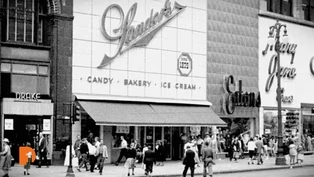
Detroit's Sanders Bakery and Ice Cream Shop is more than just a well known place for great sweets.
This segment from our documentary, "Detroit Remember When: Made in the Motor City," covers Sanders Bakery and ice cream shop's history, and the influence it had on the workforce and culture in Detroit.
(melodious music) - If we acted up in Montgomery Wards, while my mom was shopping, we didn't get across the street to Sanders.
- And Sanders was a real big deal with my parents, and once in a while, if you're really good, you could go to one.
- Sanders.
Well, it's always... For me it's Sanders not Saunders.
- Sanders or Saunders, it doesn't matter, because a cake is a cake.
- [Narrator] Detroit's premier cake and candy maker had stores and lunch counters all over Metro Detroit, reaching its peak in the 1960s.
- Mom worked a... One of the jobs she had was at Sanders Bakery, on Woodward Avenue and Highland Park.
The biggest treat we would have would be to go pick her up from work and we'd get there early, they had this double chocolate cake that was to die for.
- I remember skipping high school at Notre Dame High School, don't tell the priest that, but I did, 'cause I'd walk over to Eastland Mall and go to the Sanders and get the chocolate malts, which were so fantastic over there.
They're still fantastic today but then, it just seemed better when you skip school to do it.
- [Narrator] And to think a guy named Fred, started it all 140 years ago.
- His real name is Fred Sanders Schmidt.
He didn't wanna be a baker, 'cause his father was a great baker and he didn't wanna compete with him.
- [Narrator] The story really begins in Chicago where Fred, born in Germany grew up.
As a young man, he traveled back to Europe to train as a master confectioner.
- When he came back, he started his first store in Chicago, under Fred Sanders, so, not to compete with his father.
- [Narrator] After the great fire of 1871, Fred came east and Chicago's loss was Detroit's gain.
- He was very successful very quick.
In fact, he was way ahead of his time.
And some say he created the ice cream soda.
He was one of the larger confectioners in the Midwest.
- [Narrator] His pavilion of sweets opened up on Woodward Avenue and became an instant Detroit landmark.
His candy making machines were powered by motors that were made by Thomas Edison, and repaired by a young fellow named Henry Ford.
Let's say he ran a finely tuned organization.
- Sanders used to have a school.
So, if you worked in one of their ice cream parlors, they had 60 ice cream parlors at one time in the Metro Detroit area, you had to go through a school.
- [Narrator] The school actually showed legions of Detroit women, the proper do's and don'ts of good customer service.
- They were literally sent home, if they weren't dressed appropriately.
And they have the uniforms they had to wear.
- [Narrator] And the lunch counter became a Detroit tradition.
- My big, big, big day was to go downtown with my friends and go to Sanders, and stand behind people's chairs, three people deep, while you waited for your seat.
- You looked down the line and see, who was closest to being finished then you stand behind him, and you keep looking at him telling much basically hurry up and eat.
- Can you imagine trying to sit there and eat your lunch or your sundae, while people were standing behind you, but you just ignored them.
- [Narrator] In 1913, Fred created his most iconic concoction, the Bumpy Cake.
- He wanted to pay homage to his father before he died.
His father was a great baker, he was a great confectioner, so, what he did is combine the two with a ganache over a Devil's Food cake with buttercream, and that's how the Bumpy Cake was started.
- [Narrator] We can even give Fred's company credit for Sweetest Day here in Detroit.
- It became kind of a chocolate and gift card, kind of a holiday, which is very similar to Valentine's day, but at a different time of year.
- [Narrator] Sweetest Day, remains an October tradition, big right here in Detroit and in Cleveland, where it started 90 years ago.
Today, some of Detroit's favorite confections are making a comeback.
Morley Chocolates, is rejuvenating Fred's product line and opening up stores all over again.
They've also brought back The Great Debate.
- Half of the people, including my in-laws do not...
They say Saunders.
- You say Sanders, I say Saunders.
So, I would say it was a family thing.
You said it the way your parents did.
- And believe me it was Saunders, not Sanders.
- It's actually Saunders I'm sure, but I say Sanders, 'cause of my folks are from Tennessee.
(laughs) - You know, to us either is right.
As long as you are talking about Sanders/Saunders, and you're a fan, we love it.
- You can find out more about Sanders, just go to our website at OneDetroitpbs.org.
Let's stay on the treat train and talk about beer.
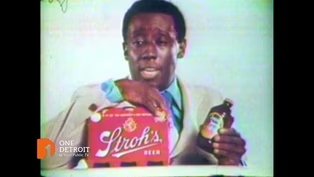
Our documentary Detroit Remember When: Made in the Motor City, gives us some insight into the Detroit beer scene.
(upbeat music) - When you go up with your friend, do you ever drink beer?
- Pop Please.
- Come on son, be honest with me, do you drink beer?
- Of course I drink beer pop, I'm 29 years old.
- [Narrator] If you are of a certain age and you lived in Detroit, you know about America's only fire brewed beer.
- Pop, pop, listen to me, I drink Stroh's, honest.
- Son, your mother and I, we only want what's best for you.
- Hey Caesar, what's with this fire brewing business?
- I don't know man, wait a minute.
Hey Sam.
- Huh?
- Fire brew, what is it?
- Hey Nick, your drink is Stroh's, fire brewers, what is it?
- What?
- I'm not doing this because Stroh's is America's only fire brewed beer, what do I know from fire brewing?
- Their beer was not made in electric kettles, it had a flame underneath it man.
(chuckles) And that made it special.
- And I'm not doing it because... - [Narrator] According Stroh's, fire brewing mellowed the beer, made it smoother.
- I'm doing it because I love the taste.
And besides I'm getting a lot of bread to admit it.
- [Narrator] It dates all the way back to 1909, when Julius Stroh was touring breweries in Germany.
- [Julius Stroh] So, we tasted and tested and compared.
- The styles of beer that he liked particularly, turned out to be fire brewed.
They were brewed in kettles heated with a direct flame.
- [Narrator] The Stroh family, had already been making beer in Detroit for half a century, when the fire brewing process started.
- So, my great, great grandfather arrived here with $200 in 1849.
Well, that was enough to get started.
- [Narrator] Bernard Stroh came with a wave of Germans to the Midwest, political refugees of the German Revolution of 1848.
- Bernard started the business in 1850, just east of Downtown Detroit of Gratiot Avenue.
By the 1860s, he built a great big new brewery and he was the largest brewer in Michigan by then.
- [Narrator] When Prohibition hit Michigan in 1917, Stroh's actually survived by making other things.
- We made soda pop, ginger ale, we had our own line of orange soda, Cola, and all sorts of things.
And then ice cream.
- [Narrator] Stroh's made a malt extract, supposedly for cooking and as a nutritional supplement, but (chuckles) well, we all know it was really for people who wanted to make their own illegal brew in the basement.
Few brewers actually survived Prohibition, the depression and then the war after that, but the postwar boom was really pretty good to those who did.
- [John Stroh III] Pfeiffer got very big, Goebel very big, Altes got very big.
- [Narrator] By the late 1950s, the big brand in Detroit was Goebel, Joe Bell to some.
- That was the spoof on it.
Perhaps we lived in where PBRs and that was called Joe Bell.
- Joe Bell.
I've heard of JCPenney, but not Joe Bell.
- It's football once again with Goebel 22.
- [Narrator] How's this, Van Patrick was at the mic for Goebel when the Detroit Lions won their last NFL championship, back in 1957.
- [Van Patrick] Lions 28, Chicago 10.
- [Narrator] Back then, Van Patrick was also the voice of the Detroit Tigers.
- And one of his famous expressions, "Hell huge the pitch, it's a long one Ole, it's foul by a Goebel Beer case."
- [Narrator] When Stroh's became the official beer of the Tigers, Van Patrick was suddenly out.
Replaced by an announcer from Baltimore, some guy named Ernie Harwell.
The great brewery strike of 1958, hurt the Detroit beer business so badly, it really never recovered.
Beer from St. Louis and Milwaukee suddenly moved right in.
- Pabst became the biggest selling brand in Michigan, as a consequence of that strike.
In order for us to grow, we had to expand outside Michigan.
- Goebel went bankrupt.
Acquired by Stroh's, Pfeiffer moved out of state while Stroh's hired New York Ad man, Bill Bernbach.
Bernbach had created the iconic Volkswagen Beetle campaign, "Think Small", but in the late 60s, Stroh's was thinking big.
- Stroh's brings you this eight pack to remind you of how fast our beer disappears.
- [Narrator] The advertising worked.
- Oh Yank, what about some of that Stroh's Beer, what you've been talking about?
- [Narrator] Stroh's quickly became a national brand, buying other beers and breweries along the way.
- Pick it up mate, we don't want the Blokes to know we've been here.
- [Narrator] But the costs, they were just too high.
The Stroh Brewery on Gratiot, shut down in 1985.
♪ So here's a toast ♪ The first era of Detroit made beer had come to a close.
♪ From one beloved to another, Stroh's ♪ - When it comes to art and culture in Detroit, design is at the top of the list.
Around the city and into the suburbs, you can find the landmarks from Albert Khan to Eero Saarinen, to Minoru Yamasaki.
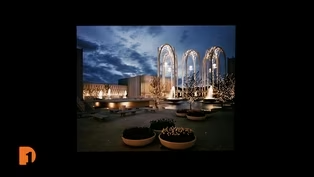
Yamasaki designed the World Trade Center and also left his mark here in Detroit.
Here's a closer look from our Detroit Public Television documentary, "Detroit Designs the World."
(upbeat music) - We remember Yamasaki today as the designer of the World's Trade Center in New York, the Twin Towers that unfortunately were lost on 911.
Beyond that he was a leader in what we call Mid-Century Modernism, which took the basic efficiency of modernism, glass and steel and clean lines and kind of infused it with some warmth and beauty that we associate more with something like, The Arts and Crafts Movement.
Yama, what we say, softened and humanized modernism in some really important ways.
- So many modernists had struggled for so long before the 50s, to try to create and convince people of a modern architecture that didn't rely on the past, that was of the 20th century, and didn't need to use arches and other elements from the history.
- [Yamasaki] We will succeed in creating the first modern, technological, humane, prosperous civilization.
- Inspired by his travels, he was incorporating, sure elements of Italian Renaissance architecture and French Gothic architecture.
He was using Islamic arches, and he was using the notion of the screened window from Islamic architecture.
He used a lot of elements from Japanese architecture.
So, he didn't limit himself to the Western history, like some modernists tried to.
He really was a pioneer global architect.
The problem was that in the mid fifties, modernism was still very strong and still very influenced towards rejecting that historical past.
- At the end of World War II, the Detroit firm of Smith, Hinchman & Grylls was looking for a new chief designer and heard about this young Minoru Yamasaki in New York and hired him to come to Detroit.
And I think like a lot of people who come from far away from Detroit, he probably thought he'd be here for a couple years and move on, and instead he spent the rest of his life here.
Well, Yamasaki started out with Smith, Hinchman doing the first modernist building in Detroit, the Federal Reserve Building in Downtown Detroit that was highly praised and much imitated.
- [Narrator] As early as 1948, he was really pushing the envelope for these sleek lines and large glass windows, and the Annex is a beautiful example of that.
People walk by every day and don't even really notice that that is one of the most famous architects in the world.
- [John] He got his reputation fairly quickly here.
He did schools everywhere, and then he became Wayne State University's almost in-house architect.
He did their McGregor Conference Center on the campus, which is one of his very best buildings, and by that time his reputation was growing and he started doing buildings around America and around the world.
- [Dr. Dale] McGregor is really, I think in the architectural world considered to be his masterpiece.
It's one of the first buildings he designed after his world tour.
And it goes farther, I think, than any other work that he did, in terms of incorporating disparate elements and disparate influences from around the world.
(upbeat music) For instance, it has elements of a Greek temple to it, it has elements of a Gothic cathedral, it has a little bit of those Islamic screens that I mentioned.
Pools outside the building, it's very Japanese sort of atmosphere.
And he kind of brings all these different ideas together.
And in the other work that he does after this, he never seems to reach out to as many different kind of influences as he did at McGregor.
Post McGregor, I think is just well done in terms of the details and the proportions and the relationship between the inside and the outside.
- In the '50s, Yama began to work on project for the Michigan Consolidated Gas Company, which needed a new headquarters, and he created what is now known as One Woodward, a skyscraper.
- It was his first skyscraper.
People don't realize this, but it wasn't even completed at the time that he was hired to do the World Trade Center, which was gonna be the world's tallest buildings, and here, he had just a couple of tall building designs under his belt.
But one of the things that's evident even in that building, his first skyscraper, is that he's looking for a different way to do it.
The typical way of designing skyscrapers back then and constructing them was, you use a steel frame and you build it up as many stories as you need, and then you cover it with some sort of skin, which at that point was a lot of glass and maybe a little bit of metal.
And he felt like that was becoming too kind of commercial and packaged, and he wanted to find a different kind of expression.
One thing that Yamasaki was always trying to do in his public buildings, is to bring the public in, to have them feel comfortable, to have the buildings be beautiful.
I think one of the other criticisms that struck me as I researched his work was the number of times that he used the word beauty in the '50s and '60s when other architects weren't.
- When I think about at what Yamasaki gave to architecture, besides a lot of great buildings that are still there and will be there like McGregor, at the same time the notion that any important public building needs to have some outdoor space for users.
A Plaza, landscaping, green ways, bike paths, a sculpture garden, anything like that.
That is so part of our architectural and planning DNA now, that you can't conceive of an important building that would ignore that stuff.
And you don't necessarily think that that's what Yamasaki gave us, but in fact, that is what he gave us.
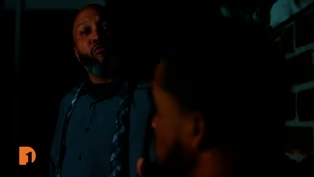
- Named after real street here in Detroit, the movie "Asbury Park", was created by local filmmaker, Ken "Legend" Williams.
It tells a story, of four Detroit kids growing into adulthood, exploring challenges of mental illness and police brutality.
Steven Henderson talked with Williams on American Black Journal.
- Let me ask you a question.
What's the first thought that goes to your mind when the police rolls up on you?
(car engine roars) (police siren) - What you want, huh?
- Yeah, slow down... (suspenseful music) - Hope I don't get a ticket.
- Hope that I make it home alive.
- Quite frankly, I was in fear for my life.
The suspect was not compliant with our orders and was just obstructing our investigation.
- I'm so sick with going to funerals early.
- The Civil Rights Act, only resulted because of a nation of African-Americans coming together and taking a stand.
(click of gun safety released) - You people think it's okay to break the law.
- Those of us who are from Detroit or live in the area know that "Asbury Park" is a street on the west side.
Is now the title of your film, but it's also where you're from, is that right?
- Yes.
I grew up on Asbury Park Street, right off S Dittmar.
- So, talk about the inspiration for this film.
The street that you grew up on, the experiences that you had there.
- The biggest thing behind this film is survival.
You know, like I said, each of the kids, they have their own different things that they're going through and dealing with.
And I thought it would be interesting to see this from a kids' perspective.
You know, there are so many things that are going on in the world right now, with police brutality, mental health awareness, you know, just a lot of different things.
And as adults, we have a hard time grasping our heads around it and dealing with it.
So, to be able to see this from a kid's perspective, I think is necessary.
- In how?
You know, because I'm a parent and I know, as I watch the news and see the things that are going on, I know how I'm trying to deal with it and gravitate to it, and I think just as a community, we just have to do a better job of actually checking to see what's going on with our kids to see how they're dealing with it, to see what they think about it.
Because I think, if we did that, I think we'll really be blown away by some of the responses that we'd get.
Because they're not stupid, they see what's going on.
- Talk about the differences between what maybe you experienced as a kid growing up in that area and what your characters in the movie experience, is there a big difference or?
- To be honest, it's a direct reflection of what I experienced as a kid.
I grew up in a single parent home.
My father left when I was six years old.
And when that happened, I was no longer able to be a six year old.
I had to start moving...
I always, you know, the running joke is, when I was six, I was actually 16.
Because the level of responsibility shifted, and I was no longer able to be a carefree kid to just sit back and say, "Hey, you know, everything is okay."
There were certain things that I did to try to protect the house.
I was the kid who, I'd pull out the toolbox and something needed to get fixed.
You know, I'm doing that now.
I'm checking the windows at night and looking out to make sure that my mom is protected and things like that.
So, I took on a much older persona that I actually was due to my circumstances.
And the reality is that's not uncommon.
The drug dealing and the shooting, like, yeah, that happens, but I feel like this portion of it is often missed.
Everybody is often trying to be tough and things like this, but what's often missing in those film is the vulnerability.
I think one of my biggest motivations behind this film, is my youngest son.
I looked at him one day and I laughed, and I was like, "Man, you're like really a 10 year old."
'Cause when I was 10, I had responsibilities, I had... You know what I mean?
It was just a totally different animal.
And to see him just be carefree, I wasn't able to carefree as a kid.
- So, I wonder what message you think people who aren't from Detroit and who may not know anything about Asbury Park, the street, might take away from this.
So, I'm always curious about how we project to everybody else from the city.
- "Asbury Park" isn't even necessarily a Detroit story, it actually takes place in the fictitious world of the inner city.
Because while it is relevant in Detroit, it's also relevant in Baltimore and St. Louis and just all over the country.
But I think oftentimes, like when you're going through things, because you're dealing with it in the real time, you don't stop and think, hey, somebody's dealing with it over here or someone's dealing with it over there.
So, for me, like I said, is much bigger.
And honestly, my goal and my hope is that people that are not from that environment, will take a look and start asking questions, because I feel like that's how you evoke change.
- Here, it's just a fight to breathe.
- Well, that's it this week for One Detroit Arts and Cultures.
Thank you so much for joining.
I'd like to express my gratitude to The Gallery at Brewery Park, for letting us film here.
See you next week and take care.
- [Announcer] You can find more at oneDetroitPBS.org or subscribe to our social media channels and sign up for our one Detroit Newsletter.
- [Advertiser] From Delta Faucets to Behr Paint, Masco Corporation is proud to deliver products that enhance the way consumers all over the world experience and enjoy their living spaces.
Masco, serving Michigan Communities since 1929.
- [Announcer] Support for this program is provided by the Cynthia & Edsel Ford Fund for Journalism at Detroit Public TV, The Kresge Foundation.
- [Announcer] The DTE Foundation is a proud sponsor of Detroit Public TV among the state's largest foundations, committed to Michigan focused giving, we support organizations that are doing exceptional work in our state.
Visit DTEFoundation.com to learn more.
- [Announcer] Business Leaders For Michigan, dedicated to making Michigan a top 10 state for jobs, personal income, and a healthy economy, Nissan Foundation, and Viewers Like You.
(upbeat music)
Video has Closed Captions
Clip: S6 Ep21 | 5m 33s | Asbury Park | Episode 621/Segment 4 (5m 33s)
History of Sanders Chocolate & Ice Cream Shoppe
Video has Closed Captions
Clip: S6 Ep21 | 4m 49s | Learn about the history of Sanders Chocolate & Ice Cream Shoppe, a Detroit institution. (4m 49s)
Video has Closed Captions
Clip: S6 Ep21 | 5m 53s | Minoru Yamasaki | Episode 621/Segment 3 (5m 53s)
Video has Closed Captions
Clip: S6 Ep21 | 5m 18s | Strohs Brewery | Episode 621/Segment 2 (5m 18s)
Providing Support for PBS.org
Learn Moreabout PBS online sponsorship
- News and Public Affairs

Top journalists deliver compelling original analysis of the hour's headlines.

- News and Public Affairs

FRONTLINE is investigative journalism that questions, explains and changes our world.












Support for PBS provided by:
One Detroit is a local public television program presented by Detroit PBS