
Sandy Baruah/Leaders at the MPC
Season 5 Episode 22 | 26m 46sVideo has Closed Captions
Sandy Baruah/Leaders at the MPC | Episode 522
A talk with CEO of the Detroit Regional Chamber Sandy Baruah about the importance of Michigan’s leaders coming back together at the Mackinac Policy Conference after two years, thoughts about gathering with Michigan leaders at the Mackinac Policy conference, and a look at an art exhibition. Episode 522
Problems playing video? | Closed Captioning Feedback
Problems playing video? | Closed Captioning Feedback
One Detroit is a local public television program presented by Detroit PBS
Sandy Baruah/Leaders at the MPC
Season 5 Episode 22 | 26m 46sVideo has Closed Captions
A talk with CEO of the Detroit Regional Chamber Sandy Baruah about the importance of Michigan’s leaders coming back together at the Mackinac Policy Conference after two years, thoughts about gathering with Michigan leaders at the Mackinac Policy conference, and a look at an art exhibition. Episode 522
Problems playing video? | Closed Captioning Feedback
How to Watch One Detroit
One Detroit is available to stream on pbs.org and the free PBS App, available on iPhone, Apple TV, Android TV, Android smartphones, Amazon Fire TV, Amazon Fire Tablet, Roku, Samsung Smart TV, and Vizio.
Providing Support for PBS.org
Learn Moreabout PBS online sponsorship- Hi, I'm Christy McDonald and here's what's coming up this week on One Detroit.
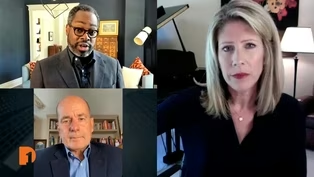
Nolan Finley, and Stephen Henderson joined me to catch up on the biggest issues Michigan is facing as we head toward state leaders meeting on Mackinac for the first time in two years.
Plus Detroit Regional Chamber CEO, Sandy Baruah on Conference safety and agenda, and then head to Cranbrook for an exhibit celebrating art alumni from around the world.
It's all coming up on One Detroit.
- From Delta faucets to Behr paint.
Masco corporation is proud to deliver products that enhance the way consumers all over the world experience and enjoy their living spaces.
Masco, serving Michigan communities since 1929.
- Support for this program provided by the Cynthia and Edsel Ford Fund for Journalism at Detroit Public TV, the Kresge Foundation, Community Foundation for Southeast Michigan.
- The DTE Foundation is a proud sponsor of Detroit Public TV Among the state's largest foundations, committed to Michigan focused giving.
We support organizations that are doing exceptional work in our state.
Visit DTEfoundation.com to learn more.
- Business leaders for Michigan dedicated to making Michigan a top 10 state for jobs, personal income, and to help the economy.
Also brought to you by and viewers like you.
(upbeat music playing) - Hi there and welcome to One Detroit, I'm Christy McDonald.
Happy to have you with me this week.
Kids are back in school.
There are questions surrounding the federal vaccine mandate and regional leaders are getting ready to meet face-to-face for the first time in a year and a half, up on Mackinac Island.
Coming up, I talk with Sandy Baruah, from the Detroit Regional Chamber about the focus of the conference, the safety of the gathering and why it is so important now.
Then our One Detroit contributors, Nolan Finley of the Detroit News, and Stephen Henderson of American Black Journal outline the biggest issues we're facing now as a state.
Plus, we head out to Cranbrook, for a dynamic exhibition that spotlights the contributions of Cranbrook alumni to the world of Art and Design.
It is all coming up.
And we are starting off with the annual gathering on Mackinac Island.
The last time we all got together, it was the Spring of 2019.
We were talking about fixing the roads and No Fault Auto Insurance Reform.
The issues we face now as a state, while still in a pandemic are centering around work and economic investment and community health.
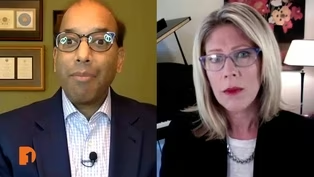
I spoke with Detroit Regional Chamber CEO, Sandy Baruah.
- I think before we can even get to what the agenda of what we're going to be talking about up there.
Let's just go ahead and talk about the fact that we're gathering for the first time since 2019.
What were some of the safety concerns and logistics that you guys had to put in place to make sure that this, this could even go?
- Well, first of all, our ethos was we really need to decide, is did we want to do the conference or not?
And then we realized that, you know, with COVID with all the changes that have occurred in our economy and our society with all the federal, you know, money issues with all the political polarization, we felt that really now, more than ever, was the time that we needed to bring Michigan's leaders together for a common and civil conversation.
So once we decided that, yes, we needed to move forward, then we needed to decide how are we going to do this?
And it was never an option for us not to do it in the safest way possible.
So we're looking at, COVID really not as a pandemic anymore, but an endemic.
When you think about it as a pandemic, that means that, oh, one day it's going to be here.
And one day it's going to be gone.
We think COVID is going to be with us for quite some time.
We need to learn to live with it as an endemic.
And we said, vaccinations, absolutely.
We are, we are requiring vaccinations.
We were using a third party technology partner to verify those vaccinations.
We have reduced our capacity, not just at the conference overall, but each one of our meeting rooms.
we're moving more things outside.
And my favorite thing, Christy, is that we're going to have red, yellow, and green bands that you wear on your wrist.
Red band means hey, happy to see you, but don't touch me right now.
A yellow band means, Hey, I'll give you the fist bump.
And you know, the green band says, Hey, I'll give you a kiss.
- I, you know, I think that's interesting, to be able to kind of give people a heads up as, as they approach.
you know, we haven't all been together in the same space.
Why do you think it's so important for us to get back to some kind of face-to-face conversation when people have really gotten comfortable?
You and I are talking on Zoom right now.
- Yeah.
But we all know that Zoom or Teams or any electronic communications, is not the same as being in person.
You miss the nuance, you miss the conversation before the conversation or the conversation after the conversation.
There's really no way to replicate that on Zoom.
We're seeing that in our children's learning that they're missing a lot by doing a remote learning, because there frankly hasn't been any other option.
So having people together physically is important.
And again, you know, we need to ensure that we're doing doing this right.
- So let's go ahead and talk about the recovery really of the state in the conversations that are going to be happening up on Mackinac.
The future of work, our community health.
What are the pillars of the conference that are really going to focus on those conversations?
- Well, Wright Lassiter, our Chair, the CEO of the Henry Ford Health System, really sent this overall pillar of re-imagining a healthy Michigan.
And that includes re-imagining our economy in a post COVID environment.
It means w what is it?
What, what do our communities need to be healthy?
And our people need to be healthy, not just physically healthy from a medical standpoint, but, but emotionally healthy, you know, financially healthy.
And then of course, you know, what do we need to do to advance racial equity and economic equity in our communities across the state?
So those are the three pillars that you're going to see under this broader theme of re-imagining a healthy Michigan.
- Look, you're talking to CEOs and business leaders all the time, Sandy, what are they saying to you about concerns about filling jobs, productivity, and getting back on track here economically in Michigan?
- Well, it is a tale of two cities right now.
I mean, the economy generally is doing well, actually Michigan's economy is doing better than most other states.
I think we're kind of in the top 15, top 10 in terms of our economic performance, compared to most of, most of the nation, primarily thanks to the strength, to the manufacturing sector globally.
But at the same time, employers can't find employees.
There was a talent shortage before COVID began and has only been exacerbated since.
I mean, you can drive by any street, where there are businesses, and I guarantee you there'll be help wanted signs.
And that's not just at restaurants.
That's in professional services firms, that's in manufacturing plants.
Everyone has the same problem.
That is our number one issue right now as employers.
- Another thing that you guys are going to be talking about up there and that we always end up coming around to, is politics and the civility of getting things done.
And you said at the top of our conversation, that there really has been an erosion of that in this last year and a half, especially.
What do you anticipate in terms of conversations up at Mackinac about, Hey, what are we doing to finally step back?
Because we now have a very large chance, where we are in the state of Michigan, the influx of billions of dollars, big decisions that have to be made that can really project into the future, what the state of Michigan is going to be like.
What is the appetite to have those civil conversations and action moving forward, Sandy?
- Usually when America has been in crisis safe, you know, post nine 11, or the effort that it took us to propel ourselves to victory in world war II, we have been over on the, we the people side of the continuum, we've been very collective unified in our actions.
With COVID, we somehow went all the way to the other side.
We were kind of pegged over on this independent, you know, live free or die.
And we're losing this kind of collective collectivism that we normally have in our nation to get through big challenges.
And so, you know, our event has a unique role in, in Michigan, which is that our event, the conference, because of the civility theme that we've always had, brings people together in a way that lowers the temperature and allows people with disparate views to have those conversations.
And so we hope that that theme of civility will kind of win the day.
At least for a while.
- There are a lot of side conversations off the agenda, as well with some politics mixed in.
So I caught up with our One Detroit contributors, Nolan Finley of the Detroit News and Stephen Henderson of American Black Journal.
- All right.
So we are heading up to Mackinac next week and, and talking to a lot of people, that we really haven't been face-to-face, in front of, in a very, very long time.
But I think before we jump in on what the, the biggest topics are going to be up there, our biggest discussion, I want each one of you to give us a sense from your perspective where we kind of stand as a state right now, when it comes to jobs, growth and recovery, and coming out of this.
Nolan, let me start with you.
- I think we're posed for a pretty strong recovery.
If we can get our workforce in shape.
We don't have enough people reemerging into the workforce to sustain growth.
I mean, we nationally, we're running at five, six percent growth.
That should be boom times for Michigan.
And yet we see the auto makers struggling because they can't get chips.
And we see other businesses struggling because they can't get employees.
- So, I mean, I think there, there, I agree with almost everything that Nolan said there, incredibly (chattering) I would add to that, My concern about cities like Detroit, where before the pandemic, we were on the precipice of this incredible comeback in downtown, I'm not just talking about the center of the city here with job growth and new restaurants and, and really a critical mass of people, at all hours of the day and night.
Something I haven't seen in Detroit since I was a pretty little kid, but Nolan and I, for instance, we're, we're downtown this week for lunch in a place that, that should have been packed and wasn't.
When you walk the streets downtown, you know, there's still this emptiness and there is this big picture question about how much will people return to work.
And so what happens to all of this office space, all these buildings that were redone and populated that may not have the kind of density that they did before.
- I'm not quite sure we're going to see five days a week again, and people all in the same kind of space.
And then if you have companies that are going to start hemorrhaging saying, you know what, we're going to let this lease go.
You know what?
We're going to totally move this.
That's a massive blow to the tax space, Nolan.
- That's right.
We can't happy talk this as people have been trying to do.
And we've got to face up to the reality that if people don't come back to work in those offices, they're not likely to return to those apartments in the great numbers.
And they're not likely to return to the restaurants and, and bars and other entertainment venues.
- So let me ask you this, Stephen, what do you want to hear from Mike Duggan?
And what should he say to people up on Mackinac, when he's got business leaders, you know, philanthropy up there?
What should he say?
- No, I think he's got to start focusing on some of the reality, which is that we're going to have to adapt to all of this and that we're going to have to do things a little differently, and we're going to have to grow Detroit, perhaps in a different way.
The other thing that, that, that I think we ought to know though, is that, you know, the mayor is walking around now with about $800 million dollars in his pocket, which is an incredible sum.
And it is an incredible advantage that I can't remember any mayor having, but certainly a mayor who looks like he's about to start his third term.
He's going to be able to do a lot more than he has been able to do in the immediate past.
And so that gives him some opportunity, I think, to, to, to have some real clout in that conversation.
- You know, talking about the 800 million, it let's talk about the billions likely coming here now, to Michigan and, and let's, let's look at it, statewide Nolan, are we starting to make the right decisions?
Or do we have a good enough political consensus that to make the right decisions about where to spend this kind of once in a generation money that is going to be coming to Michigan for recovery?
- I don't think we have a clue.
We haven't seen that decision-making really get started yet.
I was talking to one of our county leaders this week and asked about the money his county was getting, and didn't yet even have a clue how to spend it.
They're getting so much money that they didn't expect.
They didn't plan for.
They didn't identify needs for, and you hear that in community after community.
Yeah, we got this money.
We really don't know what we, what we're going to do with it.
And I think there's gotta be a consensus that this money is not coming every year.
You're not going to get it next year.
You've got to spend for the next two to three years.
How are you going to spend it in a way that improves your community, improves your state for the longterm?
How, how are, what investments are you going to make that will pay off in years to come, when that money disappears from your annual budget?
- Stephen, what do you think?
Cause, I mean, these are decisions that you do have to look out for the long-term and say, how, how can we leverage this with what we have going on today?
And I'm thinking about infrastructure.
I'm thinking about all the different kinds of things that say, you know, what, if we've got this pile of money, this is where we need to put it.
Education also is on my mind as well.
- Yeah.
I mean, you, you, you can't build it into the budget as though it's going to be there every year.
And so you've got to spend it in a way that has an impact in, in the longterm, but that the spending only happens upfront.
And so there are certain kinds of things that government in particular can do.
If you can get some of that going, if you can leverage some of that money to get other money for, for, for infrastructure, given that it's the, the price tag there is way more than anyone is getting in this, in the stimulus.
Those are the kinds of things that, that will make a difference.
You know, in the schools, in the school system, in Detroit.
- I also like to see Washington take some of the strings off if Michigan and in these counties and these communities that are struggling could use some of that money to pay down their long-term legacy costs, their long-term pension debt, to put in creative financing for their healthcare, Like Oakland county did a few years ago.
You could really make a difference in the long-term financial health of these places.
- Let me ask you guys, one of the one things that you're looking forward to hearing or seeing up at Mackinac.
Stephen, let me start with you.
- I mean, again, I'm just going to be happy to see everybody in one place again, after a really long time away from that.
you know, I think this talk about the future, and what it looks like in the short term and what it looks like in the long term.
Normally we're doing this in the spring instead of the fall.
We haven't done it in a year and a half, but it's an odd time in the pandemic because it's not behind us the way we thought it would be.
I'm really eager to see how, how people are planning for the unplannable or the unforeseen in the, in the short term and the longterm.
- Nolan, what about you?
- Well, a business community runs on relationships and we haven't been able to do much relationship building over the last couple of years.
So it would be, this is a good opportunity for people to reconnect, to re-establish connections with other people They might, they might be able to collaborate with, to have creative collisions.
It's just good to have people back face to face, talking to each other.
- You can watch all of our coverage of the Mackinac Policy Conference at onedetroitpbs.org, and we will have an hour special next Thursday, right here on One Detroit.
All right, turning now to an important art exhibition at Cranbrook.
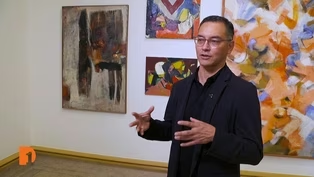
And this is the last chance to see it this week, it's called With Eyes Opened, and it is a collection of works from the students of Cranbrook who went on to make a major impact worldwide over the last 90 years.
Cranbrook's story remains a key part of America's history of design.
Artists training there keep emerging and are recognized nationally.
And some are working right here in Detroit.
Bill Kubota has the story.
- [Bill] Banglatown, East Side, Detroit over by Hamtramck, Artist Chris Schanck has a studio here.
He's been working in the city for the past decade.
- You can't blame a student for wanting to go to the west or east coast seeking, seeking more opportunity.
But I had spent 14 years in New York.
I had a decent understanding of how the cosmopolitan city worked and, and a good grasp of art history.
What I needed was time alone to grow.
- Schanck came to Michigan to the Cranbrook Academy of Art, which led to this works made from styrofoam foil.
And that team to make them.
- The point of going to Cranbrook is to develop your own point of view.
That's the goal.
Our olive oil process was something I invented at Cranbrook through just a series of rapid iterations.
The best advice I got there from a colleague was, just try a lot things.
- The Art and Design world knows Cranbrook's impact.
You'll find it around here.
The GM Tech Center in Warren, the spirit of Detroit downtown.
90 years on the Cranbrook Academy's got an exhibition.
- Cranbrook was a real incubator, and it was an attractor for people across the country.
Curator Andrew Blauvelt put the show together.
- With Eyes Opened is actually a phrase that Eero Saarinen used in an unpublished manuscript that he wrote at the end of his life, reflecting on all the things that he had done at Cranbrook.
- Finnish architect Eero Saarinen, designed the Bloomfield Hills Campus, starting the Academy in the early 1930s, a radical new approach, Blauvelt says.
- Yeah, it's radical in the sense that this was the first time that someone articulated that you should have a practicing artist be in charge of the, of the program.
Before that it would have been a professor.
And in the United States, there was a lot of what we call maybe Art Theory, like principles of art making.
- So, here more doing than hearing people talk, Cranbrook recruited some leading artists like Carl Millis from Sweden, his figures surround the Orpheus Fountain A fountain without a centerpiece.
And here the tiny model of what was supposed to go there.
- It's part of the Cranbrook mythology that Saarinen, who is the master architect, thought that the figure was too big and too much, which I would personally agree with at that scale.
- The full-sized sculpture ended up in Stockholm, Sweden.
Cranbrook's influence kept traveling far and wide.
This painting by Jose Hoya who came here in the late 1950s.
- He's considered a living treasure as an artist and has such an impactful career in bringing Modernism to the Philippines.
- Here's Wook-Kyung Choi from Korea.
- Now she's considered one of the pivotal figures for helping introduce Western Abstraction back into Korean culture.
- Frank Okada, a Japanese American from Seattle.
- He helps introduce the idea of Abstract Expressionism into the Pacific Northwest.
- Cranbrook Art.
You can also see it at the TCF Center.
Alum, Sonya Clark's Healing Memorial, a participatory tapestry for those lost to the pandemic.
- The Beaded Prayer is a locket or an amulet that has a message in the inside it's sealed shut.
And it has at least one bead on the outside.
- Clark's work at the exhibition, a Confederate flag, threads meticulously extracted.
- I think for Sonia, for the artists, it's definitely a question of social justice.
And so her artwork is often dedicated to those projects, where she's trying to advance those kinds of issues and causes.
- Then there's design of the mid-century kind.
Ruth Adler Schnee wanted to be an architect, off limits to women at that time.
So she excelled at fabrics.
- She was basically developing a new industry.
So, her with, along with a few guys, actually in a and another woman really developed the whole modern era of textile design.
- Schnee and others like Florence Knoll of Knoll Furniture Fame, would help define modern interior design Harry Bertoia, Cass tech grad.
He studied here creating chairs from wire.
At Cranbrook, Charles and Ray Eames learned to bend wood.
With the war on, they made a leg splint into a work of art.
Then came the chairs that permeated post-war America.
- Thank you, Ray.
All right, Charles, let's start with the first one right here.
- The molded plywood chairs are a result of a, in a way letting the mass production technique show through in the result.
- The traditional, what we call the Cranbrook cannon, has been the figures of like Charles and Ray Eames and Florence Knoll, and Harry Bertoia, all of these figures from mid century.
And they all did a really amazing things, but that's not the complete story.
- Ken Isaacs led the school's design department in the fifties.
In the seventies, he'd make his celebrated super chair, when Watergate and an oil crisis were going on.
- So he was one of the pioneers in what we call DIY Furniture Design, or do it yourself furniture.
So we think he's a really important figure that has been kind of forgotten about, but happily we have his archive now at Cranbrook.
In 1984, somebody who also studied here at the Academy, in the 1950s, Niels Diffrient, has a totally different other approach to his design.
He is the one of the fathers of ergonomics.
- Niels Diffrient, another Cass Tech grad, his lounge chair created with the dawn of the personal computer.
Later he created his own line of fancy office chairs.
Diffrient died in 2013, Isaacs in 2016, the next wave of designers carry on, but not so much with mass production in mind.
- Jack Craig, who has this piece here, this is from his thesis project done here at Cranbrook.
So again, experimenting with materials, not unlike the Eame's experimenting with wood to bend it.
He's experimenting with PVC pipe.
- Every time I decide to make a table or a chair, I have to, you know, chop it up like this.
This will be a chair someday.
I'm going to these giant plumbing supply places that only deal with municipalities and giant contractors.
And I show up asking for one pipe.
I was more into the idea of what you get through this natural process, but what you get out of it is, it's very industrial design looking curvatures.
- Jack Craig's work keeps evolving.
- So slowly I cinch, you know, the pipe around these irregular features.
- He made an abandoned tool and dye shop in Detroit's lower east side, his studio after finishing at Cranbrook.
- I was not really that introduced to the city during my time.
I do wish there was a stronger relationship and I hope that's changing.
- Craig's connected to his neighborhood like fellow alum, Chris Schanck - I got to know my neighbors and eventually my work required assistance.
So my first assistants were my neighbors who lived adjacently across the street.
And that's how I got to know my community.
That's how I got to be a part of the community.
- Schanck's work too, featured in the Cranbrook Exhibition, amongst all those other pieces.
- The influence of Eame's is strong.
I mean, the ghosts are there and you feel the inspiration and the pressure.
Cranbrook is a school of making, you know, theory and practice, heavy on the practice.
- And for more on the Exhibit, you can just head to onefetroitpbs.org and remember One Detroit Arts and Culture starts with all new shows, September 27th, Mondays at 7:30 PM.
And that is going to do it for us this week.
Remember One Detroit from Mackinac Island is coming up next Thursday and at onedetroitpbs.org Have a great weekend.
I'll see you next week and take care.
(dramatic music playing) (bells clanging) (upbeat music playing) (upbeat music continues) You can find more at onedetroitpbs.org or subscribe to our social media channels and sign up for our One Detroit Newsletter.
- From Delta faucets to Behr paint, Masco corporation is proud to deliver products that enhance the way consumers all over the world experience and enjoy their living spaces.
Masco serving Michigan communities since 1929.
- Support for this program provided by the Cynthia and Edsel Ford Fund for Journalism at Detroit Public TV.
The Kresge Foundation, Community Foundation for Southeast Michigan.
- The DTE Foundation is a proud sponsor of Detroit Public TV among the state's largest foundations, committed to Michigan focused giving.
We support organizations that are doing exceptional work in our state visit DTEfoundation.com to learn more.
- Business Leaders for Michigan, dedicated to making Michigan a top 10 state for jobs, personal income, and to help the economy.
Also brought to you by and viewers like you.
Video has Closed Captions
Clip: S5 Ep22 | 7m 32s | Leaders at the MPC | Episode 522/Segment 2 (7m 32s)
Video has Closed Captions
Clip: S5 Ep22 | 5m 59s | Sandy Baruah | Episode 522/Segment 1 (5m 59s)
Video has Closed Captions
Clip: S5 Ep22 | 7m 39s | With Eyes Opened | Episode 522/Segment 3 (7m 39s)
Providing Support for PBS.org
Learn Moreabout PBS online sponsorship
- News and Public Affairs

Top journalists deliver compelling original analysis of the hour's headlines.

- News and Public Affairs

FRONTLINE is investigative journalism that questions, explains and changes our world.












Support for PBS provided by:
One Detroit is a local public television program presented by Detroit PBS