
Santo Tomas & Villa Torél
Season 15 Episode 4 | 24m 47sVideo has Closed Captions
In this episode we tour Santo Tomás.
In this episode we tour Santo Tomás. This is the oldest winery in Ensenada, and an integral part of the history of the city. We also meet the winemaker, tour the fields and have a complete sensorial experience. Then we savor Michelin-recognized cuisine at their on-site restaurant, Villa Torél, where history, hospitality, and flavor come together beautifully.
Problems playing video? | Closed Captioning Feedback
Problems playing video? | Closed Captioning Feedback
Crossing South is a local public television program presented by KPBS
Santo Tomas & Villa Torél
Season 15 Episode 4 | 24m 47sVideo has Closed Captions
In this episode we tour Santo Tomás. This is the oldest winery in Ensenada, and an integral part of the history of the city. We also meet the winemaker, tour the fields and have a complete sensorial experience. Then we savor Michelin-recognized cuisine at their on-site restaurant, Villa Torél, where history, hospitality, and flavor come together beautifully.
Problems playing video? | Closed Captioning Feedback
Where to Watch Crossing South
Crossing South is available to stream on pbs.org and the PBS app.
Providing Support for PBS.org
Learn Moreabout PBS online sponsorshipJorge Meraz: Hey folks, on this episode of "Crossing South," we dive into Mexico's wine legacy at Bodegas de Santo Tomas, exploring their wine museum, meeting the winemaker, and trying the serious flavor at Villa Torel Restaurant.
It's all coming to you now.
♪♪♪ Jorge: Folks, I am in Ensenada.
The region is considered the most important winemaking region in all of Mexico here in Baja.
Now, the oldest wine making facility, the oldest winery in Baja, is the one I'm at right now.
It's Santo Tomas, and the sherpa that's gonna tell us all about it is standing right next to me.
It's Francisco.
How are you doing, Francisco?
Francisco Cervantes: Welcome.
Thank you for being here.
Jorge: You're the expert on all things Santo Tomas, right?
Francisco: We'll see right now.
Jorge: We'll see.
"Crossing South," folks.
Don't go anywhere.
Let's get to know Santo Tomas.
Francisco: All right, let's go.
Jorge: Okay, Francisco, so, oldest winery in Baja in the region, what does that mean?
When was it founded?
Francisco: We were founded in 1888, 137 years ago.
Jorge: Wow, what has been the history of this place?
I mean, the fact that it's still operating under Santo Tomas, amazing.
Francisco: Yeah, well, the history of Santo Tomas is so important to Ensenada because it has grown alongside with the city itself, so they're pretty much sisters one from another.
Even before Ensenada was established as a city, Santo Tomas was already here and when it was founded as a actual town in 1882, we were established only 4 years apart from that.
As a fun fact, this building that we're standing in right now used to be house of former president Abelardo Rodriguez back in the '30s.
This was also his personal bank.
This is why we have this vault that was built back in the '30s and this is now the access to our underground cellar.
Jorge: Oh really, you kept it?
Oh wow, it's heavy.
Whoa, does any Bill Gates or Elon Musk, do they have a vault like this?
It's all digital now, but look at this, man.
Francisco: This original structure was made in 1915.
Back in the day, this is where we used to have the fermentation tanks for our sparkling wine when this place was the actual winery.
But now this is just a collection of the wine that we have here.
So this is the indigenous people that lived in the land before the arrival of the Spanish people, the ancestors to what we know as Kumiai, Paipai, Kiliwa, and Cucapa.
And what some people don't realize is that even nowadays the descendants of the family still work in the agricultural part here in California, yeah.
Right here, this is what Ensenada looked like when Bodegas de Santo Tomas became a company.
Jorge: Wow, so that is the main drag of Ensenada.
Francisco: That is correct, yes.
So Francisco Andonaegui and Miguel Ormart became the first legal owners of Bodegas de Santo Tomas in 1888.
They were the ones who signed the very first document.
So in the 1930s, Abelardo Rodriguez, who was president of Mexico, became the owner of Bodegas de Santo Tomas.
Jorge: Whoa, one of the owners.
Francisco: Yes, he lived in Mexico City where he met Stefano Perobinello, who became the very first oenologist here in Mexico.
As an oenologist where you're making wine with a lot more purpose, a lot more study behind, you pass from having the type of wine that the missionaries taught us how to make to this type of wine that we know today.
He also introduces new varietals to Mexico, Italian varieties such as barbera, the nebbiolo, the chiantis, all of those.
Jorge: I love nebbiolo.
It's my favorite, so.
Francisco: This is where we were right here.
If you recognize this house.
We call this place La Casona, which is the old house of Abelardo Rodriguez, considered the very first Bank of Ensenada today.
Jorge: So where we started used to be Abelardo Rodriguez's house.
That's where the vault is.
Francisco: That's correct.
Jorge: And we are here in this building right now.
Francisco: We are, yes.
Jorge: You see, to me, this looks like a mad scientist trying to kill Superman, preparing some stuff, you know, like ready kryptonite, you know, this?
Jorge: Put the bottle in.
Fasten it and then... You notice that, the Mexican way?
That is current Santo Tomas inventory, right?
This is what you go to a showroom, you go to a store, this is what you can buy right now.
Francisco: Our most recent bottles are right here.
Jorge: Okay, I'll be taking two of those, please.
Francisco: Yeah, and at the very top we have the different lines that we have here and what they-- Jorge: You did say "Yes," right?
Right, continue, please continue.
[laughs] Jorge: So which is the mole wine, which is the mole wine?
Francisco: For mole, I would definitely recommend Artinta Mexico right here, which is a blend of Barbera and Merlot.
Jorge: See, I was testing you and you passed.
You passed.
Good job, Francisco.
Good job.
Francisco: So in this region because we have the type of climate that's ideal for olive trees, we started planting olive trees surrounding the vineyard.
Jorge: A hedge surrounding to protect the vineyards, wow, that's smart.
Francisco: So that we started producing our extra virgin olive oil.
We're also one of the first ones to do mono varietal type to separate each of the varieties to do a different profile of aroma, texture, intensity, and aftertaste for each one of the olive oils too.
So in the '80s, Don Antonio Cosio Ariño became the owner of Bodegas de Santo Tomas.
He hired as an oenologist Mr.
Hugo D'Acosta, who's known as the father of Mexican wine.
Jorge: Really?
Why is that?
Why does he have that distinction?
Francisco: So he's made sure to bring Mexican wine outside of Mexico.
So that's mainly why he's the father of Mexican wine so he's the creator of our premium wine Duetto which was originally launched as a collaboration with the United States, so it's the very first binational wine that used a grape from the US and a grape from Mexico to come up with this duet.
This here, we call it Agora.
This is a place where they do-- Jorge: Did you say agora?
Francisco: Agora, yes.
Jorge: Like in the Greek cities?
Oh wow, okay, so what type of events are you holding here in your agora, this warehouse?
Francisco: Really in the entire place we hold a lot of events.
We celebrate about 70 different types of festivals all throughout the year and that's not even mentioning what the quinceañeras, the weddings, and all that stuff.
Jorge: Francisco, well, you did a really good job.
Thank you for being our tour guide today.
And there's more "Crossing South" coming your way, folks.
We're gonna actually go now, location, to the actual winery.
We're gonna taste their stuff, so don't go anywhere.
More "Crossing South" coming your way.
Jorge: We find ourselves on the actual vineyard of Santo Tomas and we have my friend here David, right?
David Najera: Hi, nice to meet you.
Jorge: Nice to meet you, David.
You're the oenologist or what do you call 'em?
David: Yes, I'm the winemaker of the Bodegas de Santo Tomas.
Jorge: As a winemaker, what have you found?
How have you found this place?
David: In my first harvest, I noticed a lot of the different-- the differences between all the varieties and all the type of wines that we can make from each vineyard.
Jorge: From each one?
David: Yeah, in San Vicente that it's the vineyard we make pretty cool wines, white wines.
In the center we have the red wines and here in San Antonio we make the top-level wine really of the-- Jorge: The altitude helps you with that?
David: A little bit more, but it's also the soil, the weather, the all the place.
My winemaking career, I made it in Argentina in Mendoza with a well-known French family of five generations called El Lurton, and this year, well, Santo Tomas called me back to Mexico and I began my national experience making wine here.
Jorge: Compared to Baja, like the culture, the type of variety of grapes, what can you say-- now you from a perspective coming from Argentina and seeing how they're--they may have been for a long period of time very purist and just focusing on one type of grape maybe.
David: I think that it's very difficult to compare between varieties because isn't even the same place, neither the same gastronomic culture.
Also, the culture of the people, it's totally different.
So I think that we here in Baja we have like another opportunity than can we have in an Argentinian conditions talking about wine.
Jorge: So David, what type of plant is this?
David: This plant is from Cabernet Sauvignon.
This is the variety of that we have planted here in San Antonio.
Jorge: Just by looking at it, you can tell that it's a Cabernet Sauvignon plant?
Francisco: Yeah, there's a science called ampelography that with the form and the shape of the leaves you can know what varieties.
Jorge: That's fantastic.
So you're like a living app where you point, you know, you-- [laughs] ♪♪♪ David: Another thing interesting here is that the age of the plants.
This vineyard in particular, we have one of the most youngest plants in all the three vineyards.
These plants have more or less 20 years, more or less.
Jorge: And that's young?
David: And that's young in comparison of one grenache that we have in San Vicente that has more or less 80 years old.
Jorge: Eighty years old?
David: Eighty years old.
Jorge: Wow.
Diego Ruiz: And yeah, in this place we have different experiences such as wine tasting and this tour where we try to show you the roots, literally, of this winery.
We have an immersive and sensorial tour where we-- Jorge: Immersive and sensorial tour?
David: Exactly.
Jorge: Okay, so with that you piqued my interest.
[both laugh] Jorge: So the description wasn't just hyperbole, it's definitely immersive.
They're projecting a map right onto the wine fermentation tanks, animations, drawings, photographs, and video.
It's actually pretty clever.
You're surrounded by multimedia related to the history and operation of the winery.
Definitely a little bit of imagineering at work here.
Jorge: Whoa, I thought this was projected.
It's painted.
What's your name?
Carol Villarino: Carol.
Jorge: Carol, nice to meet you, Carol.
Carol, is this the immersive room?
Carol: Yeah, well, all the tour is immersive.
This is a vine of grenache, okay?
It was like, 68 years old, yes, before the-- Jorge: This is the root system, huh?
Carol, it's got me, it's got me.
Just kidding.
Carol: Here we have the three different soils, okay, for each valley.
This is like a clay and if--you can touch it because this is a sensorial experience too, okay?
Jorge: So this one is located where?
Here?
Carol: No, at the south of Ensenada like 2 hours.
Jorge: Oh, there's a lot of mineral content on this one?
Oh, nice.
And that also affects the wine, right?
Carol: Yes, the profile of the-- of your wine.
Jorge: Isn't that amazing?
So literally, from like, one hill or one valley to another, the wine could have a completely different personality?
Carol: Exactly, yes.
Jorge: Man, you guys have big doors, right?
The Stars Room.
Carol: Yes, la sala de las estrellas.
Jorge: Oh, really?
Carol: Are you ready?
Jorge: I am ready.
Carol: Perfect, we're going to turn off the lights, okay?
Jorge: Very good.
♪♪♪ ♪♪♪ Jorge: Thank you for a lovely tour.
Thank you very much.
Carol: You're welcome.
Jorge: Okay, so we've seen the history of Santo Tomas, a storied location, winemaker, important cultural aspect of Baja.
But among the things that it has obviously enjoying the location, its wines, the produce available in the region, the current culinary movement, well, food was not gonna be missing in a place like this.
Jorge: Fernanda, talk to me about the style of cooking you guys are shooting for here at Villa Torel because I thought it was part of Santo Tomas.
I now come to realize you guys are completely independent.
So what is the style of food you guys are going for here?
Fernanda: Yeah, so we do proximity kitchen, everything that's nearby like the Pacific Ocean and some farmers and fishermen and we all work with all the community to make food together and put all the menu together.
Jorge: Farmers, fishermen, you work with anyone who's working in the environment, resources that are local.
Fernanda: Yeah, we do organic vegetables and we do the, like, the trace everything that we bought we trace it.
Jorge: You mean when it comes to animals, you know exactly how they're born, what they eat, everything?
What about the flavor styles?
What style is that?
What are you shooting for?
Fernanda: Yeah, so Chef Alfredo has traveled around the world.
All the menu, it's inspired by his journey.
He loves like Lebanese type of food and from the Spanish cuisine, the rice and he's from Mexico City so that's kind of a mixture.
Jorge: Got you, so Mexican heritage and all of his travels have inspired the cuisine.
So we're getting to taste a world tour of a globetrotter and what he's experienced, right?
That's fine, that's good.
This one is a bluefin tuna raw fish.
The way they prepared this, they call it like, a kombu jime, which is like a Japanese kombu technique where they cure it with seaweed.
It has like this kimchi rhubarb radish.
This is like a celery cousin.
It's got some garlic, black garlic mayo below.
Oh my goodness.
This is so fresh.
This is so good.
Like, I'm ruined if it's not as fresh as it is in Baja.
I'm just ruined.
I can't have it anymore.
This is their crab potato salad.
I mean, just looking at it, it doesn't look great, you know.
You see here potato chips, you've got your kale, it's got a garlic aioli.
The top meat is spider crab meat.
And she brought it with this red Fresno sauce which is the pepper that's a cousin of the jalapeño but apparently it's spicier.
Just put a little potato chip-- in fact, let's dunk the potato chip in the Fresno.
Man, she said this is gonna be spicy, so we'll see.
Not an impactful flavor.
It's good, but nothing like blow your socks off.
We're gonna do the mixture now because that's what she said.
The chef said that we should do that, so they literally said do it, it'll make sense once you do.
Mm, maybe that's what she said, it makes sense once you do it, you know, everything has a purpose.
The crisps add a little bit of a seasoning to it.
The flavor becomes a little bit more impactful.
So I understand why.
Jorge: What else can you tell me about this place because I see everyone, the staff, is super-friendly.
You've been super-helpful and friendly, so you guys seem happy to work here.
Can you tell me anything about your, you know, mission, your company mission?
Fernanda: Yeah, we are so happy to be part of the hospitality industry and not just--it's not just about food.
It's about making everyone feel special and feel at home.
So, everyone that works here feel that like they're in their home and all the customers too.
So, the--Chef Alfredo and Denise want everyone to feel like they're in their home, visiting, so that's why everyone is so happy here because we're all part of Villa Torel that it's their home.
Jorge: You can tell.
You can tell when a place has unhappy employees, when a place where everyone does perfunctory work, and out here everyone seems to be generally on the spot, ready to serve happily, and that comes across for sure.
It's part of the experience.
So let's move now to this one which is their tomato tartare.
This apparently is made with heirloom tomatoes.
It's got a cambujimen.
It's got the freekeh green grain.
This cream that you see on top, it's a labneh milk.
It looks great.
Oh, is it, mm, oh my goodness.
Oh this is so good.
You know what it feels like?
This has zero protein and it feels like it does.
It feels like you're eating some sort of fish.
This is a fried eggplant dish.
It's first of all it's got, you know, smoked fish, mayo, laminated olive oil, it's got a chimichurri on top.
It's called a baba ghanoush.
It's like a roasted eggplant blended.
This right here is the labneh, like the creamy cheese milk substance, and you can see dry fish all on top, sprinkled.
Mm, the flavor is so interesting.
It's almost like flavors you've never had before.
It almost tastes like creamy beans.
Okay, guys, this is what I'm talking about.
Look at this roasted carrot dish.
This broth, this reduction, is made out of duck bones.
And then this cream right here, this is a citrus cream.
I can't believe they're just bringing you a carrot, right?
Like, I'm going to a restaurant, you know, to eat food, and they bring you a carrot, so this better be a dang good carrot.
I'll just say that.
Look at that.
Won't you look at that?
Okay, folks.
Wow, oh my goodness, this is definitely one of the favorites.
It's a contender.
Folks, it's a contender, mm.
Jorge: Has the restaurant won any kind of awards because right now Baja seems to be on the radar for many culinary international awards.
Have you guys won anything?
Fernanda: Yeah, we do.
We do have the Bib Gourmand by the Michelin Company, the Michelin Stars, with the Latin America 50 Best Restaurants.
Jorge: Oh, you've been featured on that too.
Fernanda: Since 2022.
Jorge: Really?
Among the best restaurants in Latin America.
Look at that.
Fernanda: We've all been working very hard.
Jorge: Hey, hard work is paying off, right?
Okay, now they've brought their duck dish right here.
It's a layered dish, so it's got the reduction, a bone reduction, on top.
This is the duck breast, basically.
It's got also a thigh and the vegetation that you see around, the farm where these ducks are raised, where they live, this is the type of food that they eat.
Oh, that is very good.
Mmm.
The--was--it's very--it's almost like a pork belly texture.
It's incredibly tender and juicy.
Let's try the leg here.
This has literally been cooked in fat.
Fantastic.
Let's try-- 2 for 2 so far.
Let's see if they had--if they get the hat trick.
They do.
It's a very good dish, folks.
So this is a seasonal dish.
This is their lobster risotto, can you believe that?
I mean, look at this.
It's got butter, it's got lemon zest, the sauce is made of multiple cheeses, and it's got a risotto underneath there.
Let's just try the risotto with the cream sauce, okay.
Oh my God.
Oh my God, that's good.
Let's try it with lobster, folks.
Let's get some of that lemon zest.
I don't need to say it, but I mean just in case I did, this is a winner.
I understand that you were a bakery chef.
Fernanda: Yeah, I'm a pastry chef and-- Jorge: Pastry chef, yeah.
Do you have any influence in the desserts that we have here today?
Fernanda: Yeah, I do.
I've made it with Denise, like guidance, and her French heritage.
We've made the dessert menu, yeah.
Jorge: Well, I have to tell you I'm a dessert snob and a dessert connoisseur, so I'll tell you what I think of your desserts.
Fernanda: Okay, I hope you like them.
[both laugh] I know you're gonna like them.
Jorge: Okay, okay, I like that.
I like that.
Fernanda: Confidence.
Jorge: Yes, I like that in my chefs.
I like that in my mechanics and my doctors and my chefs.
[both laugh] ♪♪♪ Jorge: You know that desserts are my Achilles' heel and I'm almost like a dessert snob and proud of it, so let's see if this date and almond tart with ice cream, a la mode, let's see how it stacks up.
Oh my God.
Apparently this type of little pastry, it's a financier.
There's peach on top.
And then they've got the labneh on top--on the side.
And what you see there, that substance on top of the labneh, the creamy cheese, that's olive oil and salt.
Wow, what a combination.
I've never had a dessert like that.
What a unique and delicious taste.
Jorge: This is where we close.
This tart, it's a salted caramel pistachio chocolate tart.
This just looks like it's going to be amazing.
Let's get some of that caramel goodness.
Oh my goodness.
Baja's got game in the dessert business.
These guys know how to play ball.
We hope you enjoyed the show, folks.
Take care.
We'll see you next time "Crossing South."
I'm just gonna try this pistachio alone, see how-- Jorge: So after exploring the legacy behind Bodegas de Santo Tomas, meeting the hands shaping Baja's wine future, and experiencing the bold flavors of Villa Torel, we leave Valle de Guadalupe with a deeper taste of the passion driving Mexico's wine country.
We wait until the road calls us again, the next time we get to cross south.
[laughs] ♪♪♪ male announcer: Like to know more about the places you've just seen?
Maps, videos, podcasts, and more at CrossingSouth.com.
We also do Facebook, Instagram, and YouTube.
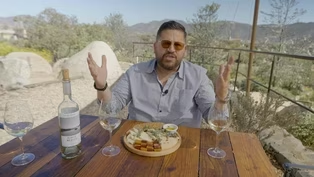
Santo Tomas & Villa Torél Preview
Video has Closed Captions
Preview: S15 Ep4 | 30s | In this episode we tour Santo Tomás and savor Michelin-recognized cuisine at their restaurant. (30s)
Providing Support for PBS.org
Learn Moreabout PBS online sponsorship













Support for PBS provided by:
Crossing South is a local public television program presented by KPBS