
Sarida Scott of The Skillman Foundation discusses philanthropy at the Detroit Policy Conference
Clip: Season 54 Episode 10 | 7m 23sVideo has Closed Captions
A discussion about the importance of philanthropy in fostering economic development in Detroit.
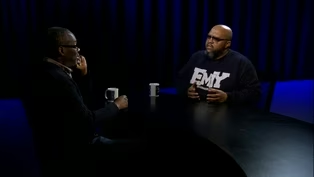
Philanthropy plays a crucial role in growing a city’s economic ecosystem. Host Stephen Henderson sat down with Sarida Scott, vice president of program at The Skillman Foundation, at this year’s Detroit Policy Conference hosted by the Detroit Regional Chamber. They talked about the importance of philanthropy in fostering economic development and connecting with the new leadership in Detroit.
Problems playing video? | Closed Captioning Feedback
Problems playing video? | Closed Captioning Feedback
American Black Journal is a local public television program presented by Detroit PBS
Sarida Scott of The Skillman Foundation discusses philanthropy at the Detroit Policy Conference
Clip: Season 54 Episode 10 | 7m 23sVideo has Closed Captions
Philanthropy plays a crucial role in growing a city’s economic ecosystem. Host Stephen Henderson sat down with Sarida Scott, vice president of program at The Skillman Foundation, at this year’s Detroit Policy Conference hosted by the Detroit Regional Chamber. They talked about the importance of philanthropy in fostering economic development and connecting with the new leadership in Detroit.
Problems playing video? | Closed Captioning Feedback
How to Watch American Black Journal
American Black Journal is available to stream on pbs.org and the free PBS App, available on iPhone, Apple TV, Android TV, Android smartphones, Amazon Fire TV, Amazon Fire Tablet, Roku, Samsung Smart TV, LG TV, and Vizio.
Providing Support for PBS.org
Learn Moreabout PBS online sponsorshipas opposed to a White American mother.
- Philanthropy plays a crucial role in growing a city's economic ecosystem.
I had a chance to speak with Sarida Scott, who's Vice President of Program at the Skillman Foundation at this year's Detroit Policy Conference hosted by the Detroit Regional Chamber.
We talked about the importance of philanthropy in fostering economic development and interacting with the new leadership here in Detroit.
Philanthropy plays this incredible role in Detroit that it doesn't play in other communities.
What do you think it needs to be playing right now with all the transition that we're seeing?
- This is a really critical time.
- Yeah.
- And this is a moment where we talk a lot about the need to connect.
I really see philanthropy playing that role of connecting.
One of the things that I always say is like the philanthropy superpower is the convening power.
We can bring people together.
- Yeah, yeah.
- And we really need this now in this moment.
- Yeah.
So, at Skillman, you guys are focused on youth education.
Tell us what you're up to now, given how different things are than they were just a year ago.
I mean, it's amazing to think of all the things that have changed, and all the problems that have surfaced or gotten worse in that time.
- In this moment though, we're really focused on education, as we say, People Powered.
So, listening to those who are most impacted by the education system, students, educators, the community to help us in, you know, driving the solutions, identifying the solutions, it's also a part of the bridging.
I mean, for as much as we want to do in the city, and as much as we invest, no one entity can impact and change the education system.
- Yeah.
- And it's really this moment that we need to remind everyone that education touches everything.
And so, when we're here talking about business and economic development, it all goes back to education.
So, that's really a lot what we're trying to do, is remind people that we need to listen to those who are impacted by the system, they need to be brought in and be working on the solutions, And we need to be doing this all together.
- Yeah, I know that's work that you've been involved in for years and years long before you came to this role at Skillman.
I wonder if you can help people understand the things that you hear and see from those folks, from students, from parents, from educators, especially in Detroit, about how things are going, and what they need so that we can go faster and further.
- So, there's, I mean, there's so many challenges we know.
I mean, so we still, we talk a lot about the post-COVID, and the COVID generation, and the challenges.
So, we all know that mental health has been a lot of the issues that have been raised.
- Wow.
- We know that there is a concern about, what's AI?
And how does AI look for the, you know, the careers for the future, and how are we helping students be prepared for that?
And students are concerned about that.
We also know we're in this moment where we have, there's a lot of talk about the value of higher education, and is that still worth it for students?
So, there's so many things that they're grappling with.
And also just the rest of what's going on in the country.
- Right, right.
- I mean- - And it has an effect on young people that I think we don't stop and think about all the time.
- Yes, and we need to, because they are experiencing in such a different way, because it also then impacts the way they think about their future and what opportunities they have and what's possible.
So, there's so much that we need to do around helping them continue to think about the future.
Just as we were talking about the reminding ourselves, we will move out of this.
- Yeah, yeah.
- This will pass.
- Yeah, right, everything does at some point, right?
- Exactly.
- We just gotta survive that.
And that's always- (chuckling) - And also how are we setting things up so that we recognize that children can thrive in the future.
- Yeah, yeah.
So, I wanna talk a little about the transition that we're seeing politically here in Detroit right now.
We've got a new mayor, a lot of new council people.
Philanthropy worked very closely with the last two mayors, really, in terms of just trying to get things going in Detroit again.
Is there a different role philanthropy will be asked to play for this new administration, or is it just kind of making sure everything's still standing up and moving forward?
- Well, to start, philanthropy has already expressed support for the new administration.
- Yeah.
I mean, this historic time with Mayor Sheffield.
- Yeah, right.
- And we all wanna see her succeed because if she succeeds, the city succeeds, the region succeeds, the state succeeds.
It remains to be seen if there are some different roles that she might be interested or the administration might need.
But what is consistent, is that there is clearly an intent across the sector that we wanna be supportive and do what we can.
- Yeah.
Her focus on poverty, to me, is the thing that stands out the most.
I mean, we're only a couple weeks into her being mayor, she's still gotta, you know, get settled and figure out what she wants to do.
But she has, time and again, come back to this idea of government's role in solving poverty and moving people out of it.
She's got some innovative stuff already going on with RX Kids coming from Flint to Detroit that didn't get as much attention as I think it should have.
That's a huge step forward.
I wonder, for philanthropy, how it plugs into that part of the administration, which is very different from what we have seen from the past two mayors.
- Well, you know, there's so many, I mean, philanthropy supports different things, but for us, it's very exciting because, of course, all of these things impact children and youth.
- Yeah - We supported also RX Kids, which is wonderful.
- Uh-huh.
- She's also created a new youth director, which is an amazing role.
- Yeah, right, right.
- You know, youth affairs.
And so, we are really very much interested in seeing how we can support that.
So, I would hope that for most in philanthropy, supporting Detroiters, supporting residents on basic needs, it hinges on everything that we're interested in and that we want to see happen for the city to thrive.
- Yeah.
You know, it is interesting to me, I mean, obviously, the milestone that she represents is the first African-American woman, first woman in the mayor's office.
it already feels very different.
Partially because of the things that she notices, partially because of the things that she's keying on.
I'm not sure I expected it to be so starkly different from every other mayor we've had, but it's gotta be, you know, for philanthropy and for you as an African-American woman.
That's gotta be just the sweetest little note, I guess, in all of this.
- Well, I don't know if you remember the op-ed that Meredith Freeman and I wrote a few years back and we said, the next Mayor of Detroit- - Will be a Black woman, yes.
- Should be a black woman.
And we mentioned some of the things that women think about.
And she has shown that those are the things- - She's doing it.
- She's thinking about it.
You know, families and children, and so all of us thrive.
- And not just as ancillary concerns, but as the focus.
- Yes.
- She just has come right out of the gate saying, this is what I want to do, and this is what's important for this country.
- Yeah, I love it.
- Yeah, right.
- It's very exciting.
- All right, well, Sarida, it's always great to see you.
Thanks for sitting with us here.
- Always good to see you too, Stephen.
Thank you for having me.
Video has Closed Captions
Clip: S54 Ep10 | 12m 11s | Dr. Calvin Mann said he focuses on Black boys and their families because of challenges they face. (12m 11s)
Providing Support for PBS.org
Learn Moreabout PBS online sponsorship
- News and Public Affairs

Top journalists deliver compelling original analysis of the hour's headlines.

- News and Public Affairs

Today's top journalists discuss Washington's current political events and public affairs.












Support for PBS provided by:
American Black Journal is a local public television program presented by Detroit PBS