State of Affairs with Steve Adubato
Sarno; Slavin; Rodriguez and McBride
Season 4 Episode 32 | 28m 23sVideo has Closed Captions
John Sarno; Kevin Slavin; David Rodriguez and Christian McBride
John Sarno discusses what employers are doing to protect their employees during COVID and the financial challenges facing employers; Kevin Slavin talks about the collaborations among hospitals in NJ and the importance of strong leadership; David Rodriguez & Christian McBride talk about the arts the connection between social justice and NJPAC’s James Moody Jazz Festival.
Problems playing video? | Closed Captioning Feedback
Problems playing video? | Closed Captioning Feedback
State of Affairs with Steve Adubato is a local public television program presented by NJ PBS
State of Affairs with Steve Adubato
Sarno; Slavin; Rodriguez and McBride
Season 4 Episode 32 | 28m 23sVideo has Closed Captions
John Sarno discusses what employers are doing to protect their employees during COVID and the financial challenges facing employers; Kevin Slavin talks about the collaborations among hospitals in NJ and the importance of strong leadership; David Rodriguez & Christian McBride talk about the arts the connection between social justice and NJPAC’s James Moody Jazz Festival.
Problems playing video? | Closed Captioning Feedback
How to Watch State of Affairs with Steve Adubato
State of Affairs with Steve Adubato is available to stream on pbs.org and the free PBS App, available on iPhone, Apple TV, Android TV, Android smartphones, Amazon Fire TV, Amazon Fire Tablet, Roku, Samsung Smart TV, and Vizio.
Providing Support for PBS.org
Learn Moreabout PBS online sponsorship- [Narrator] Funding for this edition of State of Affairs with Steve Adubato has been provided by TD Bank.
Horizon Blue Cross Blue Shield of New Jersey.
The North Ward Center.
The Robert Wood Johnson Foundation.
The Healthcare Foundation of New Jersey.
ADP, always designing for people.
The Fidelco Group.
PSE&G, committed to providing safe, reliable energy now and in the future.
And by Rutgers University Newark.
An anchor institution that is both in Newark and of Newark.
Promotional support provided by NJ on Air.
And by ROI-NJ, informing and connecting businesses in New Jersey.
[INSPRATIONAL MUSIC] - Hi, this is Steve Adubato.
We are coming to you remotely, as you can obviously tell.
It's the 17th of November as we're taping this.
And we're joined by our good friend, John Sarno, President of the Employers Association of New Jersey.
Looking good, John, how are you doing?
- I'm doing well.
Good to be with you, Steve.
- So I said, we're taping on the 17th this will be seen after that.
What do we have to be thankful for in these very challenging times?
- Well, right now, at least from what my perspective is, is that we can be thankful that there's a lot of trust in the workplace, not in every workplace, but in, in the majority of workplaces.
I think we can be thankful that employers and employees are working together, by and large, on the same page.
And it's good to see.
I mean, I hate to say that it took a crisis to get people on the same page and to get people's attention, but I think we can be thankful for that.
- So John, let me try this because this will be seen later.
There are certain things that obviously things are changing by the minute with COVID 19, but there are certain best practices, or at least better practices.
What are the better slash best practices that employers really should be, must be implementing in the workplace to protect not just their company, but way more importantly, their people.
- Yeah.
So another thing to be thankful for in New Jersey is we have some great leadership, great leadership.
So, - You mean in government, John?
- We have an executive order.
- In government, with Governor Murphy?
- I think the Murphy administration is doing a great job.
I think his cabinet is doing a great job particularly the New Jersey Department of Health.
I have a tremendous amount of confidence in their work.
I meet regularly with them.
I get briefing so that I can then translate it to the EANJ members.
So, no, I have a tremendous amount of confidence in their work, particularly the Department of Health.
In any event, we start with the governor's executive order in terms of best practices, right?
And then we go back to establishing that trust with the employee.
So an example might be that an employee's spouse tests positive, right?
We need that employee to disclose that to the employer so that the employer can engage in those best practices.
That's not gonna happen unless there's a two-way street.
So then what happens?
Well, the employee might have to self isolate for two weeks.
The employer may request a, a negative test before they return.
Employees who were in close contact with employees, so that's the CDC guidance, they have to be notified, keeping in mind the integrity and the respect of the privacy of the employee who may have self isolated.
And then there's the obvious ongoing protocols of mask wearing, socially distancing, disinfecting, split shifts, allowing people to work from home who can work from home, and then finally, there's the Americans with Disabilities Act.
You have to be conscious that there may be employees because of their medical condition may not be able to wear a mask.
So we might have to reasonably accommodate that.
So that's kind of an overview of best practices right now.
- John, I often think about this, as I said, we're taping toward the end of 2020.
And since the 13th of March, all of our team, our terrific producers behind the scenes, our great production team other than Scarlyn who is our camera operator physically here with me, everyone else is remote.
And I'm not sure of this, but I'm hopeful, prayerful that we can continue to do what we're doing as we're doing it.
We don't know when we're gonna get back in the studio at NJTV or WNET.
But that being said, not everyone can work this way.
What about those organizations, what about those companies, what about those employers who really need their people in a physical space?
- Well, only 25% of our- - Here's what I'm trying to get at John.
I'm sorry.
Do you find any employers that are putting pressure on people to physically be in a workplace?
Many of whom don't wanna be there?
- Sure, I mean, listen, we've been with our members, you know, from the beginning through the entire pandemic.
And as you said, we're gonna go into this next year.
So, you know, we have a continuum, a continuum of situations and which includes some employees who are reluctant to come in.
So, listen, working from home is a privilege, all right.
Only 25% of us, only 25% of us can do that.
75% of the workers in New Jersey either are in close contact with customers and coworkers, or in somewhat close contact, right?
And then you have the essential, the essential employers and employees, healthcare worker, social service workers, food service workers.
So, sure, there's a lot of guidance on this.
There's a lot of workplace safety health protocols.
The bottom line is that no employee should choose between her health and safety and her job.
All right.
- And no employers should push that issue if that's what the employee believes.
- Well, it's, but it's objective, right?
I mean, so a lot of employees, they may live with a - Yes.
- older parents, for example, right?
And they may be reluctant to go to work, but they may be reluctant to even go food shopping.
So, I mean, in those situations unless there's some concrete reason why the employee doesn't want to come in, then they might have to choose between their job and staying home.
So the employee that resists or does not wanna go to work really needs some concrete reason, not just a subjective apprehension.
- A couple of things, John has touched on so many things.
And by the way, the Employers Association of Jersey, one of the many supporters of what we do particularly in our public policy programming.
Check out their website when you see it up there.
But I wanna make this clear.
This is very tough for employees, but also employers.
I wanna be really clear.
The other thing is, John made a great point.
I feel blessed, I feel fortunate.
I know our team does as well to be able to work remotely for the most part.
But remember what John said, 75%, again John, 75% cannot do this.
- Correct.
(Steve sighs) I mean, listen, you know, we have a service economy, right?
So, you know, that's physical.
- Yes.
- You know, robots, you know, don't do that and then you have essential production, manufacturing.
- Someone's delivers food to their homes.
- Someone delivers food to our home.
Someone delivers that package to your home.
Someone's out, these people are out there working and they have to be protected.
But the last question, before I let you go, John.
How tough is it for your members right now, financially to stay afloat?
- Well, the loans from the federal government has helped.
I have to tell you that EANJ members tend to be larger, right?
'Cause they're employers.
And they are operating and they're not the kind of small businesses that are really, you know, suffering on Main Street.
So I think thankfully, thankfully most of our mid-sized businesses, larger businesses are operating.
May not 100%, but they're more than floating right now, they're, I can't say that they're doing well.
We're still in a recession, but it's not dire.
- You know, as we end this segment, just to remind folks, as I said, right before Thanksgiving we're taping, it will be seen after.
The vaccine, everyone hopes and prays.
However, there are a lot of things- - Listen.
- We must, it sounds redundant, John, but we still have to keep wearing masks, socially distance, washing our hands.
Yeah, redundant, but for some need to be reminded on a regular basis, all of us.
Final words, go ahead, John, 20 seconds.
- Well, vaccine's gonna be rolled out over multiple months, well into next year.
So, you know, - That's right.
- the state's goal is ambitious, 70%.
Now, if we're not getting the 70%, we're gonna be wearing masks, socially distancing, the whole works for a very long time.
So, you know, the next big step then is vaccinations.
- John Sarno, President of the Employer's Association of Jersey.
Thank you, John, my friend.
Best to you, and your family and your members, all the best.
- Best to you, and your staff, and to your family.
Thanks very much.
- Thank you, I'm Steve Adubato and we will be right back.
(grand music) - [Announcer] To watch more State of Affairs with Steve Adubato, find us online and follow us on social media.
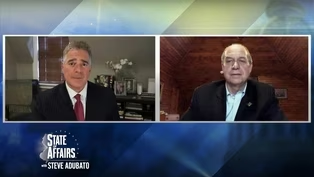
- We're now joined by Kevin Slavin, President and CEO of St. Joseph's Health.
And as we speak at the end of November, he is the chair of the New Jersey Hospital Association until February first, I think 2021.
Is that right, Kevin?
- That's correct Steve.
- Let's do this, biggest lessons you've learned about COVID and handling it from a healthcare perspective to date.
- Biggest lessons have been the incredible innovation, dedication shown by all frontline healthcare workers, but also the leadership of hospital systems throughout the state, as well as state government.
And being the chair of the Hospital Association, again, when this is seen after, you'll be the outgoing chair a little bit later in 2021, to what degree do you see collaboration among hospital and between the hospital presidents, for whom there's usually a lot of intense competition?
- Absolutely, we saw just a tremendous collaboration, competitors that put everything aside, put the competitive landscape aside during this pandemic, helped each other out, not just in the local competitive landscape and local markets, but throughout the state.
There was one instance on a weekend where CentraState John Gribbin's hospital was in need of surgical gowns.
And there was a hospital from the north who provided those.
And, do you think that- okay, let's assume the vaccine plays out, more and more people get it in 2021, Do you believe that that spirit of collaboration will continue, Kevin?
- I believe it will, because everyone across the state realizes that working together, the health care system was stronger and more resilient, whether it be on the allocation of personal protective equipment that we did early on in the process, all agreed on a formula that once there was an allotment that came out of the federal and state stockpile that we would share it according to that formula, having a common visitation policy, so there's not confusion in the community, why is one hospital having a visitation policy that's different than another?
And you know, it could go on and on, whether it be ventilators or therapeutic drugs.
So it really benefited the residents of the state.
- Let's talk leadership.
You're also on our sister program with Mary Gamba, Lessons in Leadership.
I wanna go back to this question of leadership.
I'm actually doing some work at Saint Joseph's with their Leadership Academy.
And let's just assume for a second, we're talking about frontline healthcare workers, physicians, nurses, respiratory therapists.
In your view, how much, how important is it, beyond the clinical expertise, Kevin Slavin, to be a great leader on the front lines during COVID?
- Well, it really made a huge difference.
Watching the emerging leaders step up, many of them step up and without specific direction, doing the right thing, innovating, coming to us saying, hey we think we want to try this, this could work.
We had the faith in them to do it, get them the resources, and many, many things happened because of that.
Today, I'm proud to say that our system director of emergency services at St Joseph's, Janine Lozan, is on the front page of Newsweek as the leading healthcare worker in the country.
- What's that do for an organization like St. Joseph's Health when that happens?
- It's a tremendous morale booster for everyone.
We all support Janine a hundred percent.
She's a rising star, the whole story of Dr. Jim Pruden, who was our first diagnosed COVID positive patient who went on to recover and go home and is now back on the job, every time he walks through the halls, it just boost the morale of the organization up another level.
- Let me try this, Kevin.
It's so interesting.
St. Joseph's Health has different hospitals.
One I know in Paterson, the main, I don't wanna say the main one, but really big one, key one.
- Largest.
- Yes.
Is it different dealing with COVID and a crisis like this in Paterson than would be say in Wayne or in another, quote, suburban community?
Is it different, and if so, how?
- Well, there were definitely differences, okay.
So the underserved population in Patterson, Latino, African-American, and other minorities obviously were hit much harder by this.
The high housing density in Paterson led to that.
In Wayne though, we see a much older, growing older population.
So they're also as vulnerable.
So we saw different populations being impacted, but to the same severe effect.
- Hospital presidents.
I talk to a lot of university presidents, as you know, and I always ask, how has their job changed?
And the answer is dramatically.
How do you believe the job of being a hospital president or hospital system president has changed significantly since March 13, 2020?
- I think we've all learned how to renew sense of speed.
Because we were forced to move extremely fast.
We didn't have the luxury of time, and we moved fast, we took risks.
We learned from our innovation centers that many of us have, and applied those techniques, and did it in real time.
And things by and large worked, they worked very well.
We took care of the population and the residents of the communities we serve.
And we learned to work at a faster rate of speed.
- Final question.
Early on in the pandemic I saw you shoulder to shoulder with the governor, Governor Murphy and Commissioner Percichilli of the Department of Health.
How important is it, the collaboration between government, particularly state government, and hospitals?
- That was very significant.
Early on, myself, Cathy Bennett, the president of the Hospital Association, we're part of the team that the governor put together, the response team.
We were at the rock, the the emergency preparedness center, many days, most weekends, working hand in hand with state government, being a support to state government.
We're asked to do many things to support those efforts, and the governor and Judy have done a tremendous job to take care of this state.
- Kevin Slavin is President and CEO of St. Joseph's Health.
Also, as we speak, the chair of the Hospital Association New Jersey.
Kevin we'll continue our conversation, because these issues are not going away anytime soon.
All the best to you and your team at St. Joseph's Health.
Thank you, Kevin.
- Thanks Steve.
- I'm Steve Adubato, we'll be right back.
(grand music) - [Announcer] To watch more State of Affairs with Steve Adubato, find us online and follow us on social media.
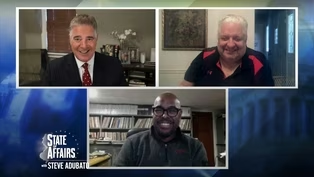
- We're now joined by two old friends.
They're still young, but they're old friends.
David Rodriguez, Executive Vice President, Executive Producer on NJPAC, and also Christian McBride, composer, jazz advisor in NJPAC, and the most extraordinary bassist you will ever find in the world!
Christian, is that the way you wanted me to say it?
I just wanna make sure.
(laughs) - Yes, that's exactly how I wrote it for you.
Thank you!
(laughs) - Hey, listen, so let's do this.
Every year, we do this, but we've never done it like this before.
We're all innovating.
The TD James Moody Jazz Festival, March 2021, David, put it into perspective.
What's it gonna look like, and why is it so important?
- Well, I mean, particularly during the pandemic, the ability to really reach out to our patrons, to our donors, to the young people who experience arts education throughout the year, finding those new ways to do it is a challenge, and I'm even going to say an opportunity.
There's a lot of jazz programs that we've done where more people have tuned in than ever before.
So we're excited that we can still make that connection, and with TD Jazz, what this does more is rather than having a condensed, two-week period, it extends the series throughout the year.
- Christian, last, we were just tonight, we were talking about 2012, 2014.
We actually had you in in-depth interviews at the New Jersey Performing Arts Center, and you also performed as well.
As someone who is a real people person, put this in perspective: jazz, this jazz festival, if you will, and social justice.
- Well, as we all know, 2020 has been a very, very heavy year.
I've always fancied myself somewhat of a historian.
I really love studying particularly American history, and I read this book called "1968," and basically, the premise of the book, you know, talks about all of the things that happened that year, and the premise of the book is that every single person in America was intensely angry about something in 1968.
It feels that way now.
Now, I wasn't alive in 1968, so I can't compare it, but I really feel like everybody in this country right now is intensely angry about something, and I feel the way to really deal with that anger, particularly, I mean, of course me and my other fellow musicians would feel that way, is to express that anger or express the need to sort of turn that anger into something positive, you do that through music, and the team at NJPAC has pretty much always had their sights set on that.
Because we're in Newark, New Jersey, and Newark has been such a real, serious core of social change, particularly in the state of New Jersey and along with New York City, just lots of moves have been made in the great city of Newark.
NJPAC has always had its eye on the prize with social justice and its programming, and, you know, David has a great history of doing all kinds of programs with places like the Apollo, and Aaron Davis Hall, so you know, we've been locked arm in arm with making sure that social justice gets dealt with through our programming.
- And David, that, doing it remotely doesn't weaken the commitment one iota, correct?
- Not at all.
In fact, I think since July, we've done over 150 programs, so there's five to six programs.
Sometimes there's three a day, but minimum would be actually six to 10 programs a week, whether it's arts education, whether it's social justice.
I mean, we did a program last night about policing the police.
- At a virtual NJPAC event?
- A virtual program, mm-hmm.
- You know, devil's advocate, and again, I've been part of many of those conversations, and John Schreiber, the CEO, and your whole team are always bringing folks in to have important conversations: business community, not-for-profit community, arts community.
For those who say, "Hey, wait a minute.
What does that have to do with the arts?"
You say?
- I say that the arts and the stage is a forum where all can have their say, and I think the way we get out of this is communication.
It's not one side waving their flag as one protest or another protest might be.
It's getting together and talk, and whether it's through physically talking or, you know, the thing I love best about jazz is jazz for me is a conversation between musicians, and to see that conversation live and see it link to social messages, I mean, is just as important as the, you know, the regular conversation we might see.
- Christian, our ongoing series called "Confronting Racism," we've been doing, we shoulda been doing it for years, but let me just say this: while we've done certain programs, we named it, and the graphic will be up on the screen, since the horrific incident, the killing of George Floyd on video, so you mentioned this a little bit before, but elaborate on this, the ability of the arts, as we're so polarized, as we're so divided, as half the country thinks that Biden's the President.
No, not really 'cause whatever.
Do you really believe the arts has the ability to bring, if not all people together, more people together?
- Absolutely, I mean, it seems to me that not a whole lot of other ways have worked.
If more people have really embraced creativity, this thread that all of us have to be creative.
You asked David when they have a virtual program such as "Policing the Police," some might ask, "What does that have to do with art?"
Well, the thing is that social justice, politics, life in general, family, friends, that's all tied into art.
Art is a reflection of that, and so you know, definitely art can really find that thread between all human beings where we can actually, and the worst-case scenario is that we agree to disagree, and we're able to build on something much more powerful, much stronger than where we've been so far 'cause right now, we're just so vehemently split about everything.
Art would be the one thing that can heal everyone, I believe.
- Yeah, hey, Dave, before I let both of you go, tell folks, we'll put the website again for NJPAC up, that the TD James Moody Jazz Festival, what do people do, sign up?
How do they participate?
- Well, probably 3/4 of the programs are free of charge, so whether it's, you know, take a look at NJPAC in Your Living Room, which is a part of our website, and you will see things ranging from discussions on jazz couples.
There is a- - Hey, jazz couples.
Christian, you know anything about that?
I'm joking, obviously.
(David laughing) Quick plug to your wife?
Quick plug.
- Action!
(laughs) - Yes, Melissa Walker is the baddest woman on the planet.
(David laughing) Hi, honey!
How are you?
- Yeah, that was smart!
Very nice.
I'm sorry, David, go ahead.
Thirty seconds left.
- I second that completely, but I mean, not only tells you those virtual programs, but it tells you the programs that are coming up, so we're excited about live programs coming back.
I mean, you can find Chick Corea and his Elektric Band next August, and we think that's still gonna happen.
There's a program with Eddie Palmieri, Arturo O'Farrill, and Tito Nieves coming up in May, and we think that's still gonna happen, so be part of both, but just be, continue to be part of the arts in your community because during a pandemic, you can't let that go.
That's part of our soul.
It's part of our spirit.
- Hey, good stuff.
David, give our best to everyone at NJPAC.
Tell John Schreiber we said hello, and Mr. McBride, could you tell Ms. McBride we said, gave her our best?
- Oh, absolutely.
I will certainly do that.
- Hey, gentlemen, lotta tough times we're all going through, but having both of you with us is an awfully nice silver lining on the show.
Thank you, gentlemen.
All the best.
- Thank you, Steve.
- Thanks for having us.
- I'm Steve Adubato.
Thanks for watching.
We'll see you next time.
- [Narrator] State of Affairs with Steve Adubato Is a production of the Caucus Educational Corporation.
Funding has been provided by TD Bank.
Horizon Blue Cross Blue Shield of New Jersey.
The North Ward Center.
The Robert Wood Johnson Foundation.
The Healthcare Foundation of New Jersey.
ADP.
The Fidelco Group.
PSE&G.
Rutgers University Newark.
Promotional support provided by NJ on Air.
And by ROI-NJ.
The North Ward Center was founded on the vision that community is connected to neighborhood stabilization, and neighborhoods need a place for kids to play.
That's why we're building a recreational complex in the heart of Newark.
Unfortunately, inner city youth development programs are dwindling.
We want to expand on our promise and build a place where kids are welcomed and doors remain open.
The North Ward Center, building a better community, 48 years and counting.
Collaboration & Leadership in Healthcare During COVID
Video has Closed Captions
Clip: S4 Ep32 | 7m 45s | Collaboration & Leadership in Healthcare During COVID (7m 45s)

The Financial Challenges Facing Employers During COVID
Video has Closed Captions
Clip: S4 Ep32 | 11m 27s | The Financial Challenges Facing Employers During COVID (11m 27s)
How the Arts Bring People Together in Challenging Times
Video has Closed Captions
Clip: S4 Ep32 | 10m 1s | How the Arts Bring People Together in Challenging Times (10m 1s)
Providing Support for PBS.org
Learn Moreabout PBS online sponsorship
- News and Public Affairs

Top journalists deliver compelling original analysis of the hour's headlines.

- News and Public Affairs

FRONTLINE is investigative journalism that questions, explains and changes our world.












Support for PBS provided by:
State of Affairs with Steve Adubato is a local public television program presented by NJ PBS