Consider This with Christine Zak Edmonds
Sasha Volyanyk and Mark Rein: Bringing Hope to Ukraine
Season 7 Episode 8 | 21m 44sVideo has Closed Captions
Sasha Volyanyk and Mark Rein share efforts to support Ukrainians living through war.
Christine Zak-Edmonds welcomes Sasha Volyanyk of Youth With A Mission and Peorian Mark Rein to discuss helping Ukrainians affected by war. From refugee shelters and mental health support to rebuilding schools and creating homes for foster families, they share stories of compassion, resilience and a connection reaching from Central Illinois to Ukraine.
Problems playing video? | Closed Captioning Feedback
Problems playing video? | Closed Captioning Feedback
Consider This with Christine Zak Edmonds is a local public television program presented by WTVP
Consider This with Christine Zak Edmonds
Sasha Volyanyk and Mark Rein: Bringing Hope to Ukraine
Season 7 Episode 8 | 21m 44sVideo has Closed Captions
Christine Zak-Edmonds welcomes Sasha Volyanyk of Youth With A Mission and Peorian Mark Rein to discuss helping Ukrainians affected by war. From refugee shelters and mental health support to rebuilding schools and creating homes for foster families, they share stories of compassion, resilience and a connection reaching from Central Illinois to Ukraine.
Problems playing video? | Closed Captioning Feedback
Where to Watch Consider This with Christine Zak Edmonds
Consider This with Christine Zak Edmonds is available to stream on pbs.org and the PBS app.
Providing Support for PBS.org
Learn Moreabout PBS online sponsorship(rhythmic music) (upbeat music) (upbeat music continues) (lively music) - Will you consider this?
We have a guest from Western Ukraine and a Peorian who has a connection with him and the whole organization.
This is Sasha Volyanyk and Mark Rein.
And welcome.
Welcome to Peoria, Illinois.
Have you been here before?
- No.
- No?
- First time.
- What do you think so far?
- It's beautiful.
- There you go.
Okay.
- Yeah.
- Mark, probably, he built it up for you, didn't he?
- Yeah, yeah, yeah.
(Mark laughing) I think the place, it's more about people.
So, when you love people, you love the place.
- Absolutely.
- Yeah.
(chuckles) - Well, so you are from a war-torn country right now.
You're mostly away from everything that's going on, but still, you're impacted.
So, tell us about what you're doing to begin with and then how you met Mark and how he is involved with your organization.
- I think 24th of February 2022 for every Ukrainian, that it was such an impactful day that we will measure our life to that day and that after that.
- And beyond.
Yes.
- Yeah, and beyond.
And so, (clears throat) I work with the ministry or missionarization called Youth With A Mission, YWAM.
And it's international and it's interdenominational Christian organization.
And we have really good fellowship of the pastors that we work together in the city.
So, when the war started, we was in Ternopil.
So, first thing, what we did, we met, and in two hours, we managed to open up 23 shelters for the refugees - [Christine] Mm.
- because we knew the refugees will come away.
- Yes.
- And because the relationship that we have for so many years, we managed to do that very quickly and very efficiently.
So, the first three weeks, we start with refugees and start evacuating people from the war zone into our place and help them to be evacuated to the Western countries.
- Mm-hmm.
And you understand what goes along with being a refugee and the trauma that it causes.
And, Mark, so you went over there on a mission - Mm-hmm.
(clears throat) - to, and it's Ternopil.
- Correct.
- All right.
Not to be confused with the nuclear disaster.
What got you involved in that and to be friendly here with Sasha?
- It was just kind of a weird serendipitous friend of a friend of a friend type of connection.
And it was kind of odd having an international phone call with Sasha, with somebody I didn't know before, but we connected very, very quickly.
- Mm-hmm.
- And he said, "Of course we need help."
And so, we were looking at what could we bring, who could we bring, what finances did we need, and how could we make an impact based upon the challenges that they were having?
And like I said, it came together very quickly.
And again, like I said, a lot of synergy there to be able to assist them as best we could.
- Mm-hmm.
Well, so the first thing that you needed, you had housing then for the refugees.
But then after that, what was the first thing that was most needed?
Was it for mental health?
Was it for... I don't know.
- Mm-hmm.
- And you're working with people of all ages.
- Yeah.
We have a big list of needs and challenges in Ukraine, and it's really hard to say what is the most important, what is less important.
But one of the motto or logo for ourselves when we started the work with refugees is to do everything to make sure that we restore a dignity in the people.
- [Christine] Mm-hmm.
- Because we talking about people that not necessarily live in the poverty or in the hard situation, it's just the normal people that have everything and they lost everything in one day.
- [Christine] Right.
- And so, the whole life just shredded before their eyes.
So, you're talking about the mental health challenges, emotions, and everything like that go all the way to the physical place where they can spend the night or food to eat, or clothes to wear.
So, we start with the refugee place.
We provide the food, we develop the food bank, we provide safety for them and we provide the medical assistance, we provide a mental health training.
And we do understand that some of those challenges, they will stay with us for many years.
- [Christine] Mm-hmm.
There's no escaping.
- No.
And especially when the war will be over because it will be eventually will be over.
We're talking about all of the soldiers that will be coming back - Mm-hmm.
- from the front line.
And they already saying that about 70% of Ukrainians do experience PTSD to some degree.
- [Christine] Mm-hmm.
- And we're not even mentioning that soldiers that was in the trenches and fight the war, and the impact that it's gonna have in our nation.
- And on them and their family, and the entire nation, you're right, the community.
So, Mark, when you first went over there, it was for - Mm-hmm.
(clears throat) - mental health assistant.
Is that correct?
- Yeah, actually, we had three teams at the time.
One of them obviously was mental health.
And as Sasha said, I mean, that's kind of the elephant of the whole challenge - Right.
- that was out there.
But we also brought a medical team at the time.
We brought a team of surgeons, which was a huge need.
And then, a construction team, that along with mental health is gonna be one of those long-term challenges and issues that they're gonna be dealing with, - Mm-hmm.
- recreating houses, recreating cities, recreating villages, because of all the bombings and shelling that has occurred.
- Mm-hmm.
- So, those are the first three teams that we brought in.
Thankfully, our first visit was about two years after the war had started, so things had stabilized.
- So, you knew where to start?
- Yes.
- Okay.
- Thank goodness.
Yeah.
It wasn't like we were just stepping into chaos, trying to figure out, okay, what are we trying to do here and where do we even start when there's - Mm-hmm.
- unlimited opportunities?
- Right.
- By that point in time, Sasha was a very good guide for us from the standpoint of saying, "Look, based upon the resources that you're bringing us, here's where we think the biggest opportunities are going to be."
- All right.
You sent me a video and one of a beautiful, beautiful tribute to all of Ukraine, all of you Ukrainians, is at nine o'clock in the morning, there's silence for you.
Everything stops.
So, describe that for me, and then we can put the video up as you're describing that.
- It's one of the really emotional things and it's not Ukrainian invention.
Actually, they do that in Israel for many years.
9:00 in the morning, we stop everything, and everyone, all of the cars on the streets, and whenever you are at the moment, you stop for one minute to actually honor the people who give their lives for the freedom of Ukraine.
- [Christine] Mm-hmm.
- Yeah.
So, it's gonna stay with us for many years.
So, I would say two things, the most emotional for me, it's when 9:00 in the morning, (clears throat) the whole life stop to honor the soldiers, and the second one when we have a convoy of the bringing the fallen soldiers through the city, and the whole city will stop to honor that person.
So, yeah.
So, I think it's something that we can give back to the people who actually give the most valuable thing in their life for the freedom.
- Their life, yes.
And the cemetery, I think, Mark, I think you sent me the picture of the cemetery, which is beautiful, with all of the Ukrainian flags and the flowers and the pictures of the soldiers themselves.
That really does tug at your heartstrings.
That was your first emotional, or is that one of your first emotional moments, Mark?
- Yeah, there were several.
Sasha touched on one of them with regards to that moment each morning that I think you and I had a conversation about like, wow, that was really life-changing.
It's like, yeah, there were several moments that were truly life-changing.
One of them was, again, the nine o'clock moment of silence that honors the people who have given their lives.
The second is the first time we visited the cemetery and each one of those flags is a soldier who's fallen that represents that particular city or that particular village.
- Mm.
- And the way that the country honors the people who have sacrificed for them is just absolutely touching.
And to go back now twice, it's the hardest, but probably the most necessary part of the trip because it really reemphasizes - Right.
- why are we here?
- Why are you there?
Right.
Exactly.
- Why are we here?
What's the impact?
- Another touching thing that you had sent me, Mark, was upon graduation, and it doesn't matter what grade of a graduation, the child, female or male, (guest clears throat) I believe both, - Mm-hmm.
- gets to do the dance in the square - Mm-hmm.
- with their father, if their father is still alive, or if not.
- Mm-hmm.
Mm-hmm.
- So, describe that beautiful ceremony.
Is that just something that came about since the war or is this something that would just always go on?
I guess they got to, before the war, they got to do this and it was a special moment for father and child, right?
- Yes.
Especially that was a dance for those who graduate the high school and go to the university or into real life.
- [Christine] And what is that dance called?
- It's a last dance in the school.
- [Christine] Last dance.
And how do you say that in... (Sasha speaks in Ukrainian) - Yeah.
- And that's much more beautiful than English, - Yes.
(laughs) - [Christine] but go ahead.
- Yeah.
And in Ukraine, the first bell and the last bell, it's a really big deal for as long I remember myself.
But now, it's became very more emotional because as a tradition, parents always come to the last bell or the first bell, especially the last bell - Mm-hmm.
- in the school.
And now, because of the war, many fathers cannot come.
And there is so many kids that they've actually lost their father.
- Mm-hmm.
- And so, there are some cases that you can see that they pretend a daughter or, yeah, pretend that she's dancing with her father as he present.
- Right.
With this uniform, yes.
- Yes, in the uniform.
And (chuckles) it's a very emotional moment because it's something that is very important for that daughter before she goes into the new season of her life to have this dance - Mm-hmm.
- as a blessing of her father.
- Mm-hmm.
- And if he's not alive, or we have quite a bit of different situations when the father would be in the army and he would surprise visit to just- - Right.
A beautiful moment.
- Yeah.
- Yes, yes.
- Very special.
Yeah.
- So, Mark, you're planning to go back in May.
- Yes.
- And what is Sasha needing at this point when you return in May?
I mean, he's here, so he's putting out the word that there's a few things - Oh yeah.
- that we still need, yes.
- Yeah, yeah.
Actually, it was really fun because this past trip was the first step in a groundbreaking of the creation of a foster village, foster home village.
- Mm-hmm.
- Sadly, there's a huge need to support foster children in Ukraine.
Obviously a lot of that's driven by the war.
And unfortunately, there's not the housing available to support the need that's there.
And so, we did a huge groundbreaking, opening up an area where they're gonna start putting in foundations for homes.
But the second part of the trip of what we were doing with the construction team was there was a school very nearby.
And of course, if they're gonna have this influx of children, this school needs to be renovated.
- Exactly.
- It was last, no, it was built back in 1976 by the Soviet Union and literally has had nothing done to it since 1976.
- Oh gosh.
- So, requires a lot of TLC.
- [Christine] Mm-hmm.
- In fact, we were talking a little bit earlier today about the fact that it's like going, well, what should be a playground is gonna be a need.
- Okay.
Yes.
- Putting in new flooring in the classrooms and to repaint.
And we saw some other opportunities there.
So, really, it's trying to get kids off to the right, to get started correctly, not just with the homes - And to let them be kids.
- but with the schools, - Yes.
- and to let them be kids.
- Yes.
- And the kids that were there that we interacted with, I mean, that was really joyful.
There was one thing I wanted to touch on that you were saying like, "Oh, wow, that was a real life-changing moment."
We had one of those when we were out there.
I think it was like our third day when we showed up to the school.
And by then, the kids had started to warm up to us and it was really kind of fun once we showed up, they would come running up and talk to us, and stuff like that.
We showed up one day and there were no kids and no teachers.
And I thought, is this a holiday - Right?
- or what's going on?
Where is everybody?
And we're all getting ready to do our jobs.
And finally, a few kids showed up and I talked with one of the teachers, and I said, what's going on?
And she goes, "Oh, there was an air raid and we were all in the bomb shelter."
And this happened several times a week.
- Right.
- And I was like, oh my god.
I mean, what an impact - Mm-hmm.
- that this is gonna have on this child that when we talk about tornado sirens and things like that, they're getting accustomed to air raid sirens because they know that there's bombs or missiles, or drones that are in the area and could have an immediate impact upon them.
- Right, right.
Now, when you were there, did you have to go into an air raid shelter?
I mean, you said it does happen several times a week.
- Yeah, it definitely happened several times a week.
- Mm-hmm.
- It's kind of interesting because Sasha guided us accordingly.
He said, "When something is imminent, when the air raid sirens are going off, the best advice I could tell you is, do what the Ukrainians do."
- Okay.
Yes.
- So, sometimes, the drones are very close and it's like, okay, we have to go to a shelter.
Sometimes it's like, mm, we might have some time here because that missile is coming from a far distance and it might be a half hour before we could even get here.
- Okay.
- So, it's like going, okay, we've got time to finish up this small task before we take cover.
- Yeah.
But that's life.
- Mm-hmm.
- That's your life.
So, what can we do for you now, between now and May, when Mark's group heads back over there to help out?
- Yeah, I think the best way is to come and embrace the work that Mark and the team is doing in Ukraine.
And if you have someone that's really good to do the construction or some really good people that can do the mental health training, and they can join the team and the team will present the projects that we're gonna accomplish in that area, and people can do fundraising and help to really spread the word about the needs that we have and we'll make a difference.
- Did you ever think that you would be in a position like this where you were living life in Ukraine and things were maybe touchy, - Mm-hmm.
- but not like this?
Fortunately, you're not really in the line of fire.
You're far enough away from the front lines, right?
- Yeah.
Yeah.
But there's no such a place in Ukraine that you'll say it's safe.
Yeah, we had the... Even last night, one of the drones exploded in our city.
- [Christine] Mm.
- So, it's an industrial area, so it didn't damage any residents or nobody got killed, praise God.
But it's still, yeah.
Ukraine, if you look in the history of Ukraine, it's a history of struggles.
- [Christine] Mm-hmm.
- Many times, I use example of my grandfather.
He live to the age of 92 and he live in seven different countries and never left his house.
(Christine chuckles) - Right, because of all of the borders are changing all the time.
- Exactly.
Yeah.
And so, you have to always adjust.
You have to adapt.
And so, we knew when we became independent in '91, this is the first time we got independence in the last 550 years.
- Mm-hmm.
- And this is the longest independence, 35 years in the whole history of Ukraine.
- And you knew?
- We knew.
We knew that time will come and- - It might be tentative.
- Yes, exactly, so.
- Yes.
- And especially where we from, from Western Ukraine, we are very clearly aware.
It's very Ukrainian-speaking area and we never see Russia as a friendly country to us.
- Okay.
- So, we're not surprised.
(sighs) It's really sad that we have to adjust our life to the- - And live that way.
- Yeah, to live... - Yes.
- And when the war started, we was convinced that maybe it's gonna be 10 days, maybe one month, - Mm-hmm.
- but three months later, personally, I understood this is for the long time - Right.
- and you have to pace yourself.
- Yes.
- And even, we always say, by serving others, not to lose yourself.
- Yes.
Very good.
- Yeah.
We have so many people that got burned out trying to help everyone and everywhere that was not able to even put themselves together - Right.
- to continue life.
- Small steps.
Small steps as you go.
- Yeah.
Yeah.
- Well, thank you, Sasha, very much for being here with us.
- Thank you.
(Christine and Sasha speak in Ukrainian) - Okay.
And, Mark, - Yes.
- thank you very much for bringing him here and for all that you're doing.
And thank you for joining us.
And how do we find you, Mark, really quickly?
- You can find me on Facebook.
- Okay.
- A lot of people have reached out and DM'd me and reached out to me that way.
And to echo what Sasha had said, you know, if all of a sudden you've got an interest to say, (gentle music) "Hey, is there any way that I could actually participate and go?"
- Now's the time.
- Or if you just want to say, "You know what?
Good on you.
I'm glad you guys are able to do that, but can I just make a financial contribution - Right.
- to help - It's all good.
- create these homes and to help out the school?"
That would be fantastic.
- All right.
Well, thank you both - Yeah.
- for being with us.
- Thank you.
- Thank you for being with us and stay well.
(lively music) (lively music continues) (lively music continues) (lively music continues) (lively music continues) (lively music continues) (no audio) (bright music)
 New
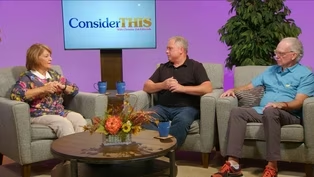
NewHow Ukraine Honors Its Fallen Soldiers
Video has Closed Captions
Clip: S7 Ep8 | 51s | Sasha Volyanyk describes the moving ways Ukrainians honor their fallen soldiers. (51s)
 New
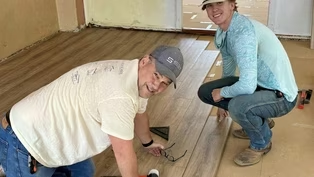
NewOpening 23 Shelters for Ukrainian Refugees
Video has Closed Captions
Clip: S7 Ep8 | 1m 28s | Sasha Volyanyk recalls opening 23 refugee shelters as war reached Ukraine. (1m 28s)
 New
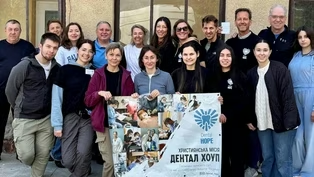
NewA Peoria Connection Helping Ukraine
Video has Closed Captions
Clip: S7 Ep8 | 44s | Mark Rein shares how an unexpected connection led to helping people in Ukraine. (44s)
 New
NewPreview: Sasha Volyanyk and Mark Rein
Preview: S7 Ep8 | 29s | Preview: Sasha Volyanyk and Mark Rein (29s)
Providing Support for PBS.org
Learn Moreabout PBS online sponsorship New Episode
- News and Public Affairs

Top journalists deliver compelling original analysis of the hour's headlines.
 New Episode
- News and Public Affairs

FRONTLINE is investigative journalism that questions, explains and changes our world.
 New Episode
 New Episode
 New Episode
 New Episode
 New Episode
 New Episode


 New Episode
 New Episode
Support for PBS provided by:
Consider This with Christine Zak Edmonds is a local public television program presented by WTVP