State of Affairs with Steve Adubato
Saving Local Journalism In New Jersey
Clip: Season 8 Episode 7 | 10m 1sVideo has Closed Captions
Saving Local Journalism In New Jersey
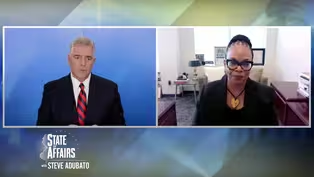
Linda Stamato, Ph.D., a policy fellow at the Bloustein School of Planning and Public Policy at Rutgers University, sits down with Steve Adubato to discuss her personal crusade to save local journalism.
Problems playing video? | Closed Captioning Feedback
Problems playing video? | Closed Captioning Feedback
State of Affairs with Steve Adubato is a local public television program presented by NJ PBS
State of Affairs with Steve Adubato
Saving Local Journalism In New Jersey
Clip: Season 8 Episode 7 | 10m 1sVideo has Closed Captions
Linda Stamato, Ph.D., a policy fellow at the Bloustein School of Planning and Public Policy at Rutgers University, sits down with Steve Adubato to discuss her personal crusade to save local journalism.
Problems playing video? | Closed Captioning Feedback
How to Watch State of Affairs with Steve Adubato
State of Affairs with Steve Adubato is available to stream on pbs.org and the free PBS App, available on iPhone, Apple TV, Android TV, Android smartphones, Amazon Fire TV, Amazon Fire Tablet, Roku, Samsung Smart TV, and Vizio.
Providing Support for PBS.org
Learn Moreabout PBS online sponsorship[INSPRATIONAL MUSIC STING] - We're now joined by Dr. Linda Stamato, Policy Fellow at the Edward J. Bloustein School of Planning and Public Policy, at my alma mater, Rutgers University.
Good to see you, Linda.
- Nice to see you too, Steve.
Been a while.
(chuckles) - It has been, but this is an incredibly important conversation.
Now, Linda and her colleagues are involved in an initiative that, let me just read this direct quote, because it goes right to it.
"You're on an unrelenting crusade to save local journalism."
A., why?
B., what does it have to do with saving our democracy?
- Well, you know, when you think about it, the public, the creation by our founding fathers, to whom a lot of people like to turn back to, when they created the Public Post Office Act in 1792, one of the reasons for that, and the reason why newspapers got lower rates for their delivery is because they believed we needed this ecosystem, although I doubt they used that term, so that all the people got information that they needed so they could be part in the way they would be of their government.
So, I think it was Jefferson who said if he had a choice between government or newspapers, he would choose newspapers.
So, I think we've gotten to a point now where what was supposed to be a unifying thing has now become a dividing thing.
And in the last couple of decades, we lost one-third of our local papers, and we need to reverse that.
And there are some good signs, which I'll talk about if you like.
- Absolutely.
In this initiative called Press Forward, formed by 22 foundations and individuals to put $500 million into the effort to save local media.
- Right.
- Foundations and individuals committed to putting money behind the effort to save local journalism.
Is that because the economics of "local media," which is exactly what we're involved in as a not-for-profit organization.
- That's right.
Yeah, you know, and most - - So, are you saying we're gonna help them?
- We are.
You know, it took a while, because we'd been declining for so long, and all of a sudden it's like people woke up, "We don't have a paper anymore, we don't know what's going on."
And so even the New York Times is in the act of pushing for local news, obviously they need it.
How else would we have known about Flint Michigan's water problem if it hadn't been for a local newspaper?
So I think what we're seeing here is that philanthropists realized they have to move into the scene, take the place of some of the equity companies that are looking to squeeze out every last bit of revenue from the ones they acquire, and include a whole range of other people, individuals, and certainly some small organizations.
In fact, I think it was the Medill School of Journalism at Northwestern, has come up with 17 models that are now in play, and we're likely to see more.
That 500 million you mentioned from the press board, New Jersey's own Civic Information Consortium is now one of its, let's call it kind of an affiliated group, because it is trying, and I guess, getting, some of the money, as well as what it gets from the state, to help create something called documenters.
And that's to have citizens in each community trained to go to local meetings to help replace what has been lost by local journalists, so that they can report what's going on at the Zoning Board, and the Planning Board, and the Town Council.
So, there are ways in which we're trying to replace some of the people who have been lost, and also to create new forms of journalism.
So, while we may have lost several thousand, there are now 641 new digital newspapers, so that's a good sign.
Nonetheless, that's not keeping us even, we've gotta do a lot more.
- And along those lines, I mean, the Caucus Educational Corporation, particularly with our partners in public broadcasting, I mean, today, we were taping all day, Linda, and I'm not gonna toot our horn because it's not appropriate, but we engaged with several members of the state legislature, members of the United States Congress, local elected officials and others, about a whole range of issues that matter to peoples' lives.
Now, here's the thing, someone might say, "Well, yeah, what difference does that make, whether we in the media do that or not?"
And it's not to be political, but to put it out there, there are many people who believe that President Trump, when he called the media the enemy of the people, that we, in the media, are their enemy.
So why should they, the people, we the people, want to help us, if we're the enemy?
I didn't make that up.
(Linda chuckling) That's what President Trump said.
We're the enemy of people.
- I know.
I think it's pretty (laughs) astonishing when you think about it.
I guess you'll recall in the column I wrote, I said, "Why is it that the first time autocrats show up, the first thing they do is get rid of the free press?"
And that's because, obviously, if you're free and you're independent, you're gonna report what you're seeing and you're hearing, and the people who wanna be autocrats, or as one has said, "I'll be a dictator even for a day," that gives them the opportunity, let's call it, to eliminate any kind of threat to the view they want to propose, and follow their policies with respect to it.
So I think, you know, it's really two things, in a sense, Steve, and you're, you're really quite right.
And I'm so pleased that PBS and Judy Woodruff, who's been going around the country, talking to people about what it means, (Steve clapping) you know, to have lost your newspaper, and people realize that they have lost it.
But it's not just the news, on a grander scale, or on a regional, or a state, or a global basis, the local news also brings communities together.
We see our kids, and we know what's going on in the local theater, we know how the schools are performing, and what you get there is a way in which the local community can still stay relatively tied together, even if they may be divided politically, you know, on national or global issues.
And I think that's one of the probably underappreciated aspects of local journalism.
And I think nonprofits are going to make it a lot easier for some of that to happen.
- Wait, nonprofit what?
Organizations?
- Yeah, well, not nonprofit newspapers, I mean, I think they're getting, for example - - Hold on, Linda, I'm sorry for interrupting.
- Sure.
- I wanna be clear, when Linda, when Dr. Stamato uses the term nonprofit, we're a nonprofit, but I assure you, I spend well more than half of my time - - Raising money.
- Spending time raising money, trying to secure sponsors, underwriters, and keep them.
- That's right.
- So, I wanna be clear, nonprofit does not mean there's not an entrepreneurial spirit and the bottom line doesn't matter.
I'm off my soap box, go ahead, doctor.
- That's right.
I'm on the board of something called the Corporation for New Jersey Local Media, and it just purchased 14 newspapers from something called the New Jersey Hills Media.
That was profit making, but it wasn't making a profit.
(chuckles softly) - That's right.
- And in any event we are going to turn that into a nonprofit, it will allow us, obviously, to seek some grants, but it also means that you can serve other purposes, you don't have to worry about the advertising, although you certainly want sponsorship.
But I think it is probably the one form that's going to start thriving in the next several decades.
I think out of the recent group of 56, I suppose it was, that formed, almost all of them are locally owned.
And I think that's very important, because that's the local perspective, and those people know what's going on, and they know the people in the council meetings they're covering, and so forth.
So, I have a lot of hope for it.
And for example, the AP is - - A few seconds left.
Go ahead.
One of the things in local media, or any media, is we can't create more time.
So, final comments, go ahead, doctor.
- Yes, I think what's important now, Steve, is we see greater coordination and cooperation between the news media.
- That's right.
- Because we can't do it individually on our own, it's no longer a competitive business.
- We don't have that luxury.
That's why we partner with public broadcasting and other entities, because no one can do this alone.
- That's right.
- Dr. Linda Stamato, a PhD Policy Fellow at the Edward J. Bloustein School of Planning and Public Policy at Rutgers University.
Linda, I cannot thank you enough.
It's been too long.
I'm Steve Adubato, that's Dr. Stamato.
Local media matters.
We'll see you next time.
- [Narrator] State of Affairs with Steve Adubato is a production of the Caucus Educational Corporation.
Celebrating 30 years in public broadcasting.
Funding has been provided by The New Jersey Economic Development Authority.
The Healthcare Foundation of New Jersey.
PNC Foundation.
Horizon Blue Cross Blue Shield of New Jersey.
PSEG Foundation.
Robert Wood Johnson Foundation.
NJM Insurance Group.
New Jersey Sharing Network.
And by Englewood Health.
Promotional support provided by The New Jersey Business & Industry Association.
And by Insider NJ.
(bright music) - Life is unpredictable.
Health insurance shouldn't be.
For over 90 years, Horizon Blue Cross Blue Shield of New Jersey has provided quality, affordable health plans to New Jersey residents.
We have served generations of New Jersey families and businesses and are committed to driving innovations that put you at the heart of everything we do.
Our members are our neighbors, our friends, and our families.
We're here when you need us most.
Horizon, proud to be New Jersey.
How Anchor Institutions Are Improving The Economy In Camden
Video has Closed Captions
Clip: S8 Ep7 | 8m 46s | How Anchor Institutions Are Improving The Economy In Camden (8m 46s)

The Shortage of Primary Care Providers in New Jersey
Video has Closed Captions
Clip: S8 Ep7 | 9m 3s | The Shortage of Primary Care Providers in New Jersey (9m 3s)
Providing Support for PBS.org
Learn Moreabout PBS online sponsorship
- News and Public Affairs

Top journalists deliver compelling original analysis of the hour's headlines.

- News and Public Affairs

FRONTLINE is investigative journalism that questions, explains and changes our world.












Support for PBS provided by:
State of Affairs with Steve Adubato is a local public television program presented by NJ PBS