Saving North Carolina’s Family Farms | Carolina Impact
Clip: Season 14 Episode 1403 | 6m 39sVideo has Closed Captions
North Carolina farmers fight to preserve family farms as development claims more farmland.
North Carolina farmers are watching farmland disappear as development expands. At Hoffner Organic Farms in Rowan County, a fourth-generation family works to protect its land and keep the farm alive for future generations. A UNC Charlotte Urban Institute study found the Charlotte region lost 760 farms between 2017 and 2022, while North Carolina could lose 1.2 million acres to development by 2040.
Problems playing video? | Closed Captioning Feedback
Problems playing video? | Closed Captioning Feedback
Carolina Impact is a local public television program presented by PBS Charlotte
Saving North Carolina’s Family Farms | Carolina Impact
Clip: Season 14 Episode 1403 | 6m 39sVideo has Closed Captions
North Carolina farmers are watching farmland disappear as development expands. At Hoffner Organic Farms in Rowan County, a fourth-generation family works to protect its land and keep the farm alive for future generations. A UNC Charlotte Urban Institute study found the Charlotte region lost 760 farms between 2017 and 2022, while North Carolina could lose 1.2 million acres to development by 2040.
Problems playing video? | Closed Captioning Feedback
Where to Watch Carolina Impact
Carolina Impact is available to stream on pbs.org and the PBS app.

Introducing PBS Charlotte Passport
Now you can stream more of your favorite PBS shows including Masterpiece, NOVA, Nature, Great British Baking Show and many more — online and in the PBS Video app.Providing Support for PBS.org
Learn Moreabout PBS online sponsorshipNew development continues to reshape our region while farmland disappears.
A new study from UNC Charlotte's Urban Institute puts hard numbers behind that trend and reveals a significant loss of small family farms.
Carolina Impact's Heather Burgiss and videographer Doug Stacker join us from Rowan County.
Heather, those wide open fields behind you sure look peaceful.
- That's right, Amy.
It's quiet on the farm here in Mount Ulla, the kind of quiet that's becoming harder to find in North Carolina.
For the Hoffner family, four generations have taken care of this land and they're facing the same questions of how to keep this way of life preserved as the world is growing in.
And their story is part of a much bigger one.
(gentle music) Here at Hoffner Organic Farms, the only grass-fed certified organic dairy left in the state, the cows aren't just a herd.
Chris Hoffner knows them by name.
- Come here, Mayberrys.
Where's Rachel?
- [Heather] He walks the fields calling to them, checks the barns, and tends to the milking equipment that keeps the operation moving.
Caring for these cows, the work here is constant and deeply personal.
- What I love about farming, like I said, it's hard to say.
It's kind of like it's just in us genetically as people, and especially being a Hoffner, Hoffner in German as farmer.
So it's just kind of hardwired in our system.
You still need to get that dirt on your hands and there's something to that.
It's just part of it.
- [Heather] His grandfather bought the original 110 acres in 1956 for about 19,000.
The family still has a check from part of that purchase.
Through the years, they've added tracts of land and looked for ways to protect their farm.
- Everything that we have here is in a conservation easement.
We work with Three Rivers Land Trust, meaning that this land will never be developed ever and ever, ever.
It will be the same a hundred years from now as it is right now.
- [Heather] That decision ensures what happens inside the farm's property lines is protected.
Outside them, the future can change quickly and without much warning.
- There's a track of land that we've been trying to purchase for a long time.
It is next to us.
We've been really trying to purchase it.
We're working with the conservation fund and some other stuff to try to figure out how to acquire that land.
And then we found out that it was under contract with a house development.
It really hits hard and it is literally our property line with the farm and our property line with my house.
- And so if you sink all that money into land cost- - [Heather] It's a situation Eva Caison encounters through her work with the Carolina Farms Fund.
- Farmers are incredibly observant.
They're always observing what's happening on their properties and also seeing what's happening next door.
And when there's adjoining parcels that are in farmland right now, but they're out of that farmer's ownership, they're aware that things could change.
(gentle music) - [Heather] A new UNC Charlotte Urban Institute study puts numbers to that change.
Between 2017 and 2022, the 14 county Charlotte region lost 760 farms.
Here in Rowan County, 124 farms disappeared.
Losing 760 farms equals about 7.8% of farms across the region.
- I think it's very important that community members in this region be aware of the statistics in that report because it impacts our daily lives, where our food comes from, how our land is utilized, and what it feels like to move through our communities as working lands transition into developed space.
- Agriculture in this country is progressively going down.
- [Heather] For Chris and his family, watching area farms and the land vanish is living history.
- It doesn't surprise me at all.
Before grandpa passed, he would talk about all the farms that used to be here and everybody was small.
They could make a living off of milking 30 cows, farming 100 acres.
And now it's just, they're just, everybody's disappeared.
There's only I think seven dairies left in Rowan County.
There's less than 100 now in North Carolina.
So it's just disappearing.
- [Heather] And that reality could accelerate.
The report cites research projecting North Carolina could lose 1.2 million acres of farmland to development by 2040, more than every state except Texas.
Between 2001 and 2016, more than 732,000 acres of North Carolina farmland disappeared, converted to housing, roads, and other development.
- We take a look at farmland that's at risk of development surrounding metropolitan areas.
We acquire that farmland, protect it forever with a conservation easement, and then we sell that land to a farmer, a next generation farmer.
(gentle music) - And back on the farm, that next chapter is still being written with Chris's children.
There's no pressure, but the interest is there.
- I would rather our legacy be one of the only farms left in North Carolina.
I would be, I think, fourth generation farmer, and so it's easier for everybody else to, we hear all of everybody else vanishing.
It's just making us all the more likely to vanish.
Since everybody else is going away, that just, I don't know, it just makes us feel like we're going to go away if it doesn't work out.
- So just trying to figure out ways to keep it alive.
Owen's sister, Ansley, is active in future farmers of America and plans to major in agriculture at NC State.
She thinks about how her family's farm can continue to survive and make a difference.
- We need to supply more food for our country and our population.
And so I feel like it's really important as our job as farmers to continue to work and to build up our farm to be able to supply the rest of the country and the population.
- [Heather] For Chris, preserving the farm is less about holding onto the past than leaving something for whoever comes next.
- I love the opportunity to pass it on to somebody else, and I love the opportunity that it is available for my kids, grandkids, or even other kids that ain't even my kids, you know, to do something, to do what they loved.
(gentle music) Grandpa worked it, dad worked it, I'm working it, they'll work it.
You know, that is one way to look at it, but it's bigger than that.
It's bigger than just me.
It's bigger than just my family.
It's the whole community.
(gentle music) - And this story isn't just about the Hoffner family.
It's about farmers across North Carolina who are looking for a way to preserve their way of life before it vanishes.
For Carolina Impact, I'm Heather Burgiss.

Big Enough to Ride | Carolina Impact
Video has Closed Captions
Clip: S14 Ep1403 | 5m 1s | Inside a live steam railroad club where model trains are big enough to ride. (5m 1s)
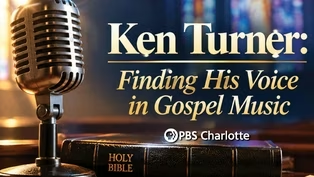
Ken Turner: Finding His Voice in Gospel Music | Carolina Impact
Video has Closed Captions
Clip: S14 Ep1403 | 7m 40s | The story and career of Christian Gospel Bass singer Ken Turner and his deep, deep voice. (7m 40s)
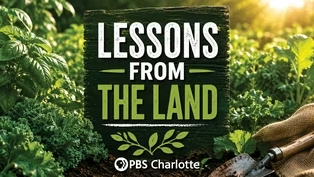
Lessons From the Land | Carolina Impact
Video has Closed Captions
Clip: S14 Ep1403 | 5m 51s | Keisha Hensley grows food, teaches sustainability and proves dreams can still blossom. (5m 51s)
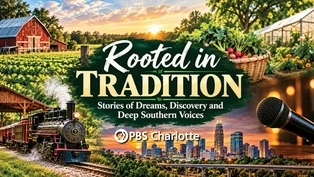
September 22nd Preview | Carolina Impact
Preview: S14 Ep1403 | 30s | Saving NC’s Family Farms, Lessons From the Land, Big Enough to Ride, & Grammy Winner Ken Turner. (30s)
Providing Support for PBS.org
Learn Moreabout PBS online sponsorship New Episode
- News and Public Affairs

Top journalists deliver compelling original analysis of the hour's headlines.

- News and Public Affairs

Today's top journalists discuss Washington's current political events and public affairs.

 New Episode

 New Episode


 New Episode


Support for PBS provided by:
Carolina Impact is a local public television program presented by PBS Charlotte